We are heading towards the peak of AI startups and development (though far from close to the peak). We are many months removed from Earnings Call proclamations executives made to stake their claim in the AI game, and to let shareholders know that they (at the very least) know about Generative AI and those executives making the ask ‘please help improve our stock price because we not proved to you we know about AI.’
Perhaps I missed it, but I’ve yet to see Earnings Call proclamations touting the mass efficiencies gained, or how profits have been generated directly, from these AI initiatives (excluding, of course, the biggest tech companies who are selling these services/tools to other big companies at profit).
Anyways, given all of that together there’s a few things which are readily provable:
- Enterprises and businesses all around the globe are scared of being left behind in the AI adoption race and are looking to build and buy AI tools to keep them in the ‘game’.
- People across the globe are doing amazing, terrifying, and wonderful things with AI. Some are doing it openly, others are quietly working several junior level jobs by wielding their prompting power.
- There is an outright boom in AI based products for consumers and business alike. It feels like the early days of the App Store: there’s literally an AI app for anything you could want. Whether it’s good is another issue all together.
In other words: there’s a lot of money to be made, and a lot of money to be lost.
When the market conditions look like this, there’s a tough decision to be made: do you build your own tools; or do you buy something and deploy it?
This is a particularly hard decision with AI tools for a few reasons:
- The LLM portion of the AI technology is still so very new, that the core models are rapidly evolving, and ‘we’ still don’t know all the edges of this stuff.
- The products around these tools are dropping releases at breakneck speed, making it even harder to evaluate fully what is commercially available.
- The pace of all of the things related to generative AI is evolving and improving on a time scale we have likely not seen before — break neck.
So what’s a company, or a person, to do? Pay for everything? Pay for nothing? Build your own? Build some?
Every decision tree which has been used in the past for the build versus buy software decisions is out of date when it comes to AI.
There’s two different decision matrixes which need to be formulated: one for enterprise level decisions (i.e. Big Companies) and one for individual level, or small businesses. Here’s how I’d advise each right now.
The Enterprise Decision Litmus
The enterprise level decision litmus test for build versus buy is in the most fraught state that it has been in. Most of these companies do not move that fast, and even the ones who do move that fast historically, seem to be struggling to move as fast as the market. The core reason for this: AI products can be rapidly developed by very small teams, which is the antithesis of what big companies are generally good at.
Which is why my current advice to big companies is very simple: if you can build and deploy your AI products in a month, then you very much should build your own AI products. However, if you cannot do that in a month, then you are likely better off buying most of the AI products right now.
The caveat being “until the market stabilizes more” which might be a few years from now, at best. The risk of this thinking is clear: most of the AI products are being slapped together fast, so due diligence before adoption is going to be key.
The reason I peg this at one month to both build and deploy, is because the amount of changes within a month which are occurring, mean that it’s more likely whatever you started building is already commercially available four weeks later, or what you started building is no longer relevant.
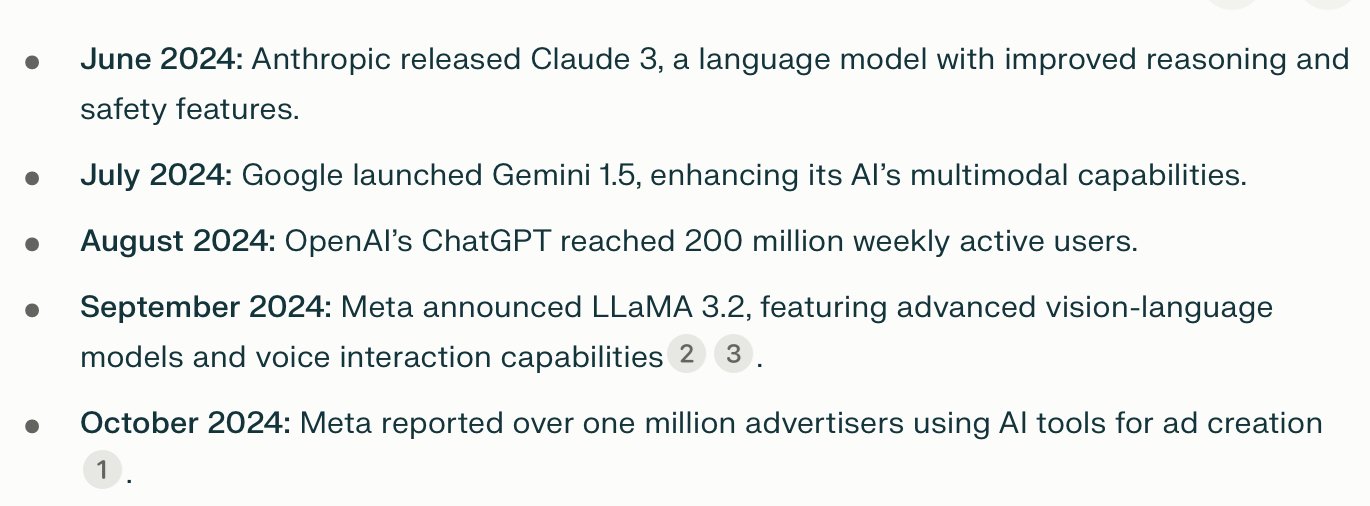
If you don’t believe me, look at this LLM release timeline. That’s just the core LLM model releases. Just look at June 2024 to now:
- June 2024: Claude 3.5 Sonnet
- July 2024: Llama 3.1 405B
- August 2024: Grok-2
- September 2024: o1 (OpenAI)
- October 2024: Claude with Computer Use
That’s a fundamental shift, every damned month, since June. Yes, that’s only LLMs, but what mattered in August fundamentally shifted with o1 in September, which again fundamentally shifted in October with Claude running agents and using a computer itself. So yes, if you cannot build something and deploy it to your enterprise within a month, then you are far better off spending less money evaluating and deploying commercial tools while working on much larger paradigm shifts at a scale in the tens or hundreds of millions of dollars budget level.
This is an exciting, but un-enviable position to be in.
The Individual and Small Business Decision Litmus
On the small business, or individual level though — things have never been rosier. These AI products are effectively leveling the tech playing field when you want to compete against the biggest companies out there. For very little money (and next to no implementation cash costs), you can compete. The litmus test here looks dramatically different, and how you think about AI products must be as well.
First, the litmus test for this scale: if you can build and deploy something in less than a week, then you should do that; if you cannot, then you are better off buying.
For almost every company or person, buying is better than building. Luckily, the vast majority of the tools are very cost effective, and nearly instantaneous to deploy. There are not a lot of good reasons for a smaller company or an individual to build AI tooling, as it is readily available, and the switching cost is really low at this scale.
Second, any individual, and every small company, should be diving head first into using AI wherever it can, as they stand to be able to reap the most immediate benefits. Things which often get tossed aside as there not being enough time for that nice-to-have can likely be done now in minutes. And the setup time is exceedingly low, probably with the largest part being finding which tool to try/adopt — and the actually implementation being measured in under an hour.
Small businesses and individuals stand to gain the most right now, as they can tackle things they would not have been able to tackle before, either because of costs, or because of time constraints. That they can feasibly do that now, and often for under $20/mo — is extraordinary. Get on it.
Final Thoughts For Now
You don’t need to believe that AI is going to be some super intelligence to be adopting it now. Even with all the flaws it has, it offers incredible value, and it’s improving nearly every week.
For every person: you are likely better off buying tooling than building tooling. The tech is too unstable, too iterative, and moving too fast to try and build most of the stuff in house — at least for another year. Perhaps longer.
However, for Enterprises, investing heavily on ‘sea-change’ level R&D is a wise decision right now. If only to bolster your internal talent and understanding of the tooling, knowing that it is going to drastically improve before you move any R&D work to production. Whereas for smaller companies, and even individuals, this is a chance to be very competitive with bigger and deeper pocketed firms who are fundamentally struggling to adopt the same type of tooling, as they are stuck evaluating or building.
It’s quite a fun time, but only if you can shift your thinking to match a new reality.