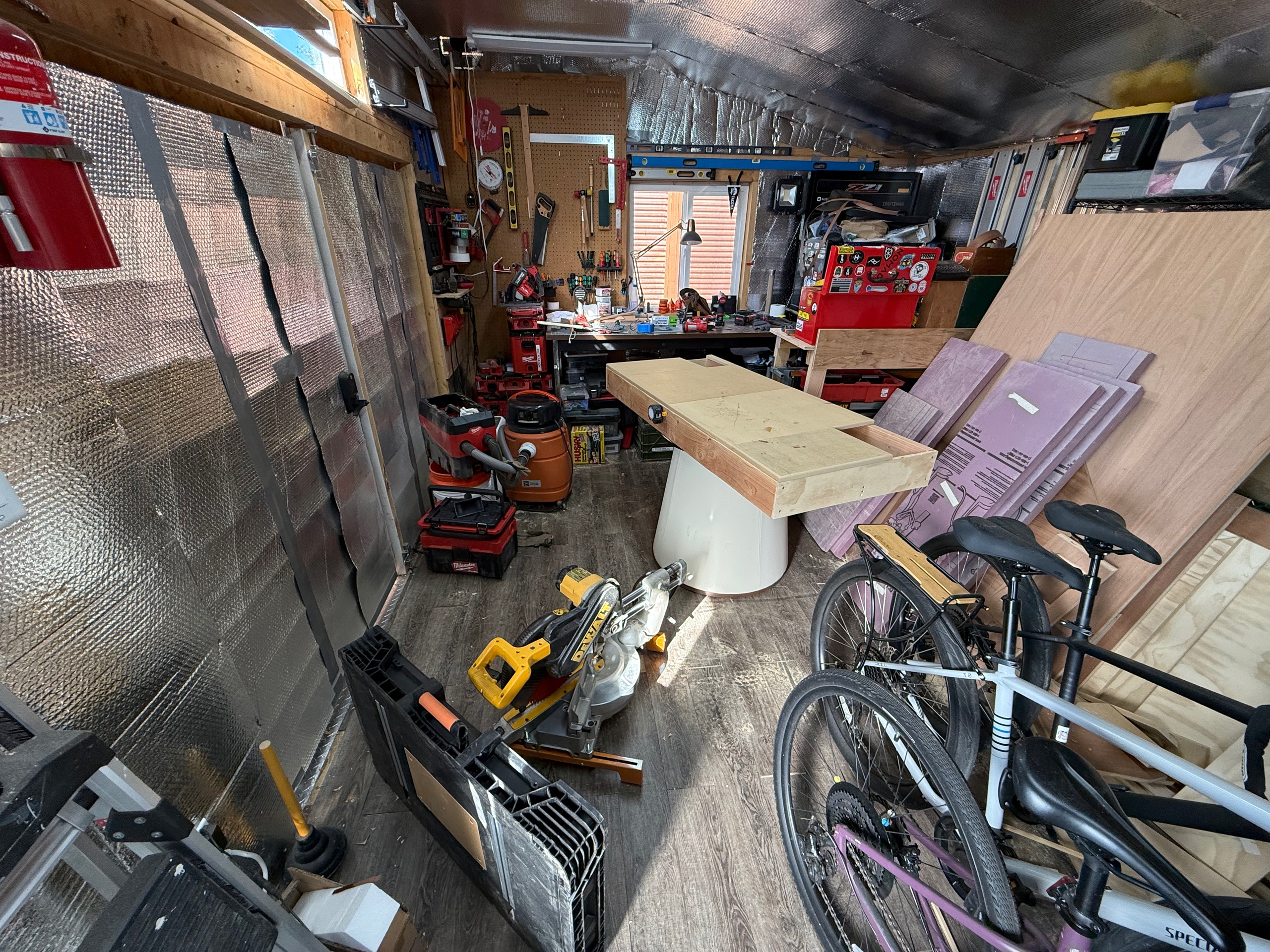
Members have been wading through a lot of my chatter about tools, and tool buying. We recently bought a home and moved, and as part of that process, we’ve been doing a bunch of projects on our house to make it our own. This isn’t new to me in many ways — it’s what we have done in nearly every house we’ve bought over the years, though this might be the most we have done all at once (instead of spreading the work over years).
Which means, well, I needed some tools.
Most of my power tools were over a decade old, and many non-power tools decades older than that. It might not seem like it on the surface of this blog, but I have spent a lot of time in my life working with tools, building, and repairing things.
So I am going to be writing about a lot of the tools I bought, and while it might not be directly applicable to you, I wanted to write this post to go over a few things before we kick that all off.
First, I do know what I am talking about. I grew up in a family where my father and grandfather had their own construction company (general contractors). My grandfather had started it as a custom home-building company, and when my dad took it over, he pivoted to commercial construction. I believe I started wearing tool bags around the second grade. It was in either the second or third grade that I spent multiple weekends with my dad building a new fence for the property we lived on — I managed four nails before he finished the rest of the panel. I worked in the field for his company through and out of college, so by the time I left for the greener pastures of tech, I had been in construction for a very long time.
Second, a big reason I want to write this all up is because most of the tool reviews appear to be YouTube videos, and it’s rather hard to ascertain what is and is not sponsored in some way. It’s also hard for me to trust a lot of that when the tools being shown as “I used this, here are my thoughts” are tools they’ve owned for a few days and still look brand new. As you know, that’s not my thing. I love affiliate revenue — it’s great — but all the tool affiliates have declined my applications, so it’s just me making no money and talking about tools (for now — who knows the future). That’s fine — at least you know it’s no bullshit and my tools have been used for months on end first.
Third, it’s becoming very clear to me that we are finding ourselves in a time in history where it’s nearly unaffordable to hire people to do things for us, or even to buy quality goods like furniture. Spelunk Reddit construction subreddits for any length of time, and you will quickly see an impressive level of shoddy fucking work from “professionals.” You will also see an impressive amount of high-quality work from hobbyists.
Thus, I am writing about tools because I know how to use them, I’ve had to buy a bunch recently, I am dismayed at the current availability of independent information, and I think we are all going to find ourselves wanting to take on projects ourselves because it’s cost prohibitive not to.
A Caveat
I can’t test every tool brand out there, as I might with other gear. So the brand I test is essentially fixed. I’ll write why I chose what I chose, but that’s about as good as I can do for you.
What I will say is that it seems most of the standard tool brands are very similar in ability and overall “what they do,” so while the reviews might not be 1:1 for your tool brand of choice, it’s unlikely anything would be worth the cost of switching brands or having multiple battery platforms.
But wait, there’s one other aspect. It’s one I have a little insight into, but am very much a beginner in: woodworking. I mentioned my background was construction — that’s very different than woodworking. My grandfather was a woodworker, and while I’d seen him do some of it and helped him with it, I had never really done it with him to any degree.
But, as I mentioned above, the quality of the stuff you can buy, even when willing to pay very hefty sums, is questionable at best. Almost everything is thinly veneered particle board, MDF if you are lucky. It’s put together with not-great methods. You set too hot a mug on it, and you get blistering. Bang into the corner, you might go through the veneer.
The notion you can buy something good which will last decades now feels like a folly. The idea that you can buy something good enough to last a few years also feels like a folly. This didn’t use to be the case, but the post-COVID reality seems to have accelerated the decline. Basically, you have two choices: spend as little as possible on something crappy and hope it lasts 1–2 years, or spend Rolex-level cash on something that uses solid wood but may or may not last more than 5 years. Wayfair, or Arhaus.
So I started doing some woodworking. It didn’t seem that hard, and for the basics, it’s not. Maybe the hardest part is getting good-quality wood to use.
I think this type of woodworking is an area which is going to be gaining in popularity, again, because you can spend far less and get something far better. And the skills are not overly complex unless you want them to be.
That’s one reason I was drawn towards it, but I am sticking around for a few reasons which might interest some of you:
- It’s building something tangible. It’s visual and visceral. I see the progress and progression directly all the time. And when I am done, it’s something I can physically touch and use constantly.
- In a lot of ways, it is the same reason I love building software. It’s solving a problem and using the solution.
- I love how, with woodworking, the outcome is set nearly with the first cut, and revising can be hard once it’s done. Which is flipped from software, where often you can push quickly to get something that works and refine from there.
Thus, we are going to talk about tools for a bit. As with all topics on this site, it’s a reflection of where my head is, and who knows — if we get enough snow this winter, we might get to talk about snowshoeing for a while.
You might consider giving some of this DIY/woodworking/repair a try yourself, as you may find the progression of it is both simple and rewarding. It goes from a “maybe I can do this” to an “oh shit, that actually worked.”
One last note: I am still me. I buy more than I need because I like to justify those purchases with a better overall end product. I like to buy better things because (often with tools) it means there’s less time tinkering and messing around, and more of a foolproof outcome from the start.
Alright, enough explaining.