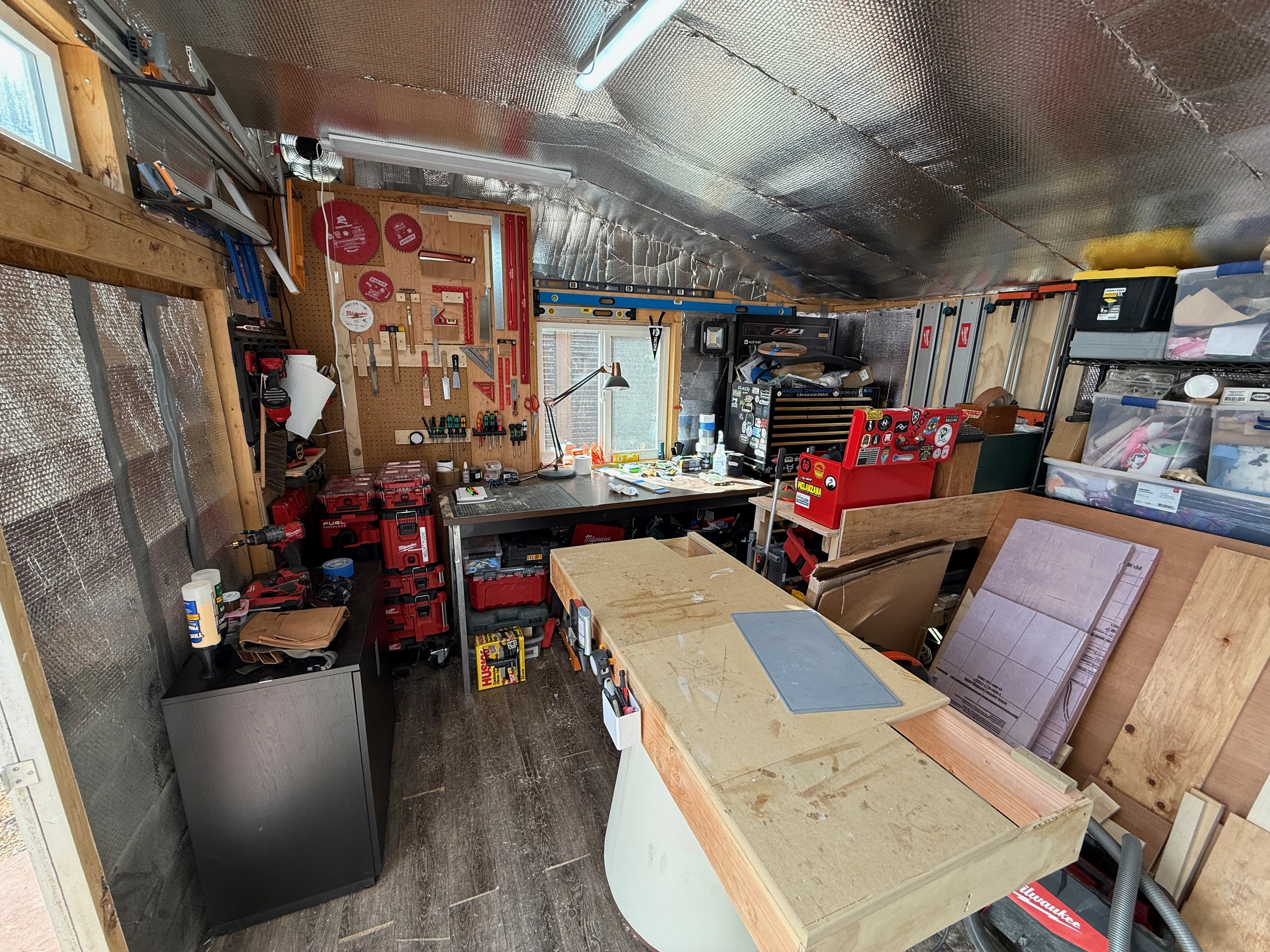
I guess before I start publishing more tool reviews, I should talk a little about why I chose what I chose. And I chose Milwaukee, mostly because it’s red. No, I am joking — I have reasons.
There’s a litany of practical ways you can choose tools. But how you start is one of two paths. Oh shit, wait, I forgot one more important thing: basically all the solid brands do the same thing and have all the general tools you could want, and the differences are so minute that it doesn’t matter a whole lot in the end what you pick.
Anyways, back to my clever two-practical-path thing. Path one: you already own batteries on a platform. If that is the case for you, then the best advice is to stay on that platform. Batteries are expensive — don’t go replacing them. That’s just silly. So if you have a couple batteries from any major brand, then that’s your brand — congrats.
On the flip side, path two is when you have no major battery setup already and are essentially starting from scratch.
This is nearly where I found myself. I had a Makita 18v LXT setup, but the batteries were so old that only one was solid enough to still hold a charge. I also had a couple batteries on the Milwaukee M12 platform on hand. I had a couple more on the DeWalt platform for some yard equipment, but those were on their last legs too.
So I was kind of starting from scratch. But, because I am who I am, I decided the best path was to determine what brand I would go with if I had nothing and then go from there.
Some Research
Now, I’ve been out of the power tool world for a while, so I had no idea what was good or not. Luckily for me, Worse on Purpose released an article on power tools right before I needed to buy some. Now, I’ll warn you: if you like what you have — and I am not about to list it — then you might not want to read that. Because, as I said at the top, most tools do the tool thing they need to do, so they are all effective tools.
We are talking about the tiny shit here — that’s what I get paid for on this blog. And the thing is, the list of good brands in that article is fucking small. So let’s talk about the real options for power tools — the ones you can feel good about buying, according to that list and me:
- Milwaukee*
- Makita
- Bosch
- Festool
That’s the list, but notice that asterisk by Milwaukee. If you’ve worked in the trades a while, you might be like, “How did the Sawzall company grow to be the every-F-150 company?” That’s a great question — here’s what Worse on Purpose wrote on that point:
TTI bought Milwaukee and basically let it run itself. Kept the R&D operation in Brookfield, WI. Kept the engineering team intact. Dumped $206 million into R&D in a single year. More than 4.4% of total sales going straight back into product development, every year.
And also:
Milwaukee’s Brookfield campus went from 190,000 square feet to over 500,000. They opened a $100 million campus in Menomonee Falls. A manufacturing plant in West Bend. Facilities in Greenwood and Grenada, MS. In the last five years alone, Milwaukee has invested $368 million in domestic expansion.
So yeah, it was bought out, but they kind of nailed it — well, at the start, because there’s also this point:
Multiple tradespeople and repair technicians report that newer Milwaukee tools have switched to bottom-of-the-barrel bearings. The kind you’d expect to find in a store-brand budget tool. Spare parts for repair are badly priced, frequently unavailable, or only sold in assemblies that include a bunch of components you don’t need.
Now, I don’t know how accurate that is, because the reality here is that it’s often simply cheaper to buy a new tool than it is to repair the current one, no matter what. When a drill is like $150 new — sometimes with another new battery — why would you even bother with repair? And also, I am not sure repair technicians’ incentives are aligned with the thinking of quality brands. I mean, you don’t like the stuff you never repair, right?
Anyways, the Reddit threads are all over the place on Milwaukee quality, and the basic rhetoric is: it used to be better. But, like, TTI bought them in 2005 and developed most of the great stuff for Milwaukee in the last decade, so “used to be” is really not that long ago, and I am not sure what to make of it.
So, again, the brands my research pointed me to got whittled down by me to only two: Makita or Milwaukee.
So when DeWalt fans want to know why DeWalt was not in the running, it’s because of that article, which means “not my fault.”
The Eliminated Few
A quick note on why I dropped Bosch and Festool from the thought train. Let’s start with Bosch: the pricing is great, the quality is there, but the breadth is limited.
Remember the first path: buy the tools for the battery you own. Which means if you start from scratch, then the platform you choose better have the tools you need, or you suddenly have different battery platforms. And in the US, the Bosch lineup is smaller, and the new stuff arrives here with a solid lag. Both of which killed it for me.
Festool is a different story. The breadth is there — it aligns best with having the tools I want and need for what I do. But, on average, you can expect to pay 15–45% more per tool, and Festool is not often on sale (and the sales are usually a weak-ass 10–15% off). Still, top-tier quality, but you pay for it.
So I basically eliminated two high-quality tool brands simply on a cost/availability basis. There’s nothing at all bad about either — they are great brands.
Makita vs. Milwaukee
I had my Makita tools for years, and they had been — and in some ways still were — fantastic tools for me.
So I went into it with three feelings which ultimately steered me towards Milwaukee:
- I’ve had an M12 impact driver from Milwaukee for the last several years, and I am a huge fan of it. It’s a great tool and has never had an issue. So whatever sentiment I had toward the longevity of Makita, I felt nearly the same about Milwaukee.
- Handling them in the store, I found the Milwaukee tools felt ever so slightly better in hand than their Makita counterparts. This will vary for everyone, which is why handling this stuff in person is important.
- Makita split their lineup between the 18v LXT and the newer 40v XGT. So for tools where you might want more power, you move to XGT. Milwaukee just stays at 18v for the most part with higher output battiers (Makita has also doubled the 18v batteriess — and still does? I don’t know), but you stay on the same battery platform with M18 for the most part. Meanwhile, Milwaukee drops down to 12v in the M12 lineup when you might want a smaller tool or less weight (to compete, Makita offers “subcompact” variants in the 18v lineup).
If your head is spinning, so was mine. I stared at the screen. But I needed to make a call. My drill was smoking under load, and the circular saw couldn’t rip a sheet of anything.
I needed tools.
Which is when the part that gets most people into Milwaukee hits: promotional sales with bundles. I was able to step right into Milwaukee M18 for a really low cost, because I got the driver bundled with two of the excellent XC6.0 High Output batteries. The savings pushed me over the edge, since I’d need batteries anyway and the Makita deals weren’t there when I was buying.
(Makita simply has fewer big sales, and when they are on sale, the price drops are not that great. Take that to mean whatever you want — they are great tools, and I would not say overpriced in any way. But, I would say, you can get deals on the red goods.)
I went with Milwaukee as I was already leaning that direction, but the draw of excellent bundle deals is what tipped me over. It’s that simple.
Any Regrets?
I think it is fair to ask what regrets I might have, but most of them are about which tool I bought when, or which variants I bought — there are not many regrets about the brand choice itself.
I feel confident that I would have been equally happy with Makita. And learning that they have plum-colored tools if you get the Japanese variants does slightly make me regret that I would have to get another battery platform if I wanted one of those (and I do). But, outside of that, every Milwaukee tool I have had has been great, and I have yet to look around and think, “Man, I bet the Makita would be substantially better.”
It’s likely some Makita tools are better than their Milwaukee counterparts, and the other way around too. That’s just how it goes.
But, I don’t have a true regret about choosing Milwaukee at all.