“Gold rush or not, nobody wants to get sued.”
Top Posts
The Hype: Yoshida & Co’s Porter BagsAugust 26, 2025
G-SHOCK DW-H5600 After 7 MonthsJuly 31, 2025
Casio Duro MDV-106 Re-ReviewDecember 15, 2022
Recent Articles
-
Sarah Lacy on Twitter Ads
Sarah Lacy asks the question, that Walt Mossberg should be embarrassed for not asking: >So if it’s so great, why only 600 advertisers? For the record, Mossberg decided to respond to the 600 advertiser number from Twitter CEO Dick Costolo with the following: >Echoed Walt Mossberg, it’s “the perfect wet dream of every marketer.” *Walt…
Sarah Lacy asks the question, that Walt Mossberg should be embarrassed for not asking:
>So if it’s so great, why only 600 advertisers?
For the record, Mossberg decided to respond to the 600 advertiser number from Twitter CEO Dick Costolo with the following:
>Echoed Walt Mossberg, it’s “the perfect wet dream of every marketer.”
*Walt Mossberg: asking the tough questions… wait.*
-
Twitter CEO Says 80 percent of Advertisers Renew
Sarah McBride and Alexei Oreskovic: >Costolo said the company counts roughly 600 advertisers, up from 150 advertisers at the end of 2010. and: >The company is expected to bring in about $150 million in ad revenue this year […] Do take note that in December they *raised* 200 million dollars in VC money, yet they…
Sarah McBride and Alexei Oreskovic:
>Costolo said the company counts roughly 600 advertisers, up from 150 advertisers at the end of 2010.
and:
>The company is expected to bring in about $150 million in ad revenue this year […]
Do take note that in December they *raised* 200 million dollars in VC money, yet they are set to make *only* 150 million of that back this year. Add to that the fact that they had 450 less advertisers last year and it makes this last statement even more comical:
>Costolo declined to answer a question about whether Twitter was profitable.
-
Five Things Eric Schmidt Said and What He Really Means
God that guy creeps me out.
God that guy creeps me out.
-
Twitter Photos
Jack Dorsey on the Twitter Blog: >Over the next several weeks, we’ll be releasing a feature to upload a photo and attach it to your Tweet right from Twitter.com. And of course, you’ll soon be able to easily do this from all of our official mobile apps. A special thanks to our partner Photobucket for…
Jack Dorsey on the Twitter Blog:
>Over the next several weeks, we’ll be releasing a feature to upload a photo and attach it to your Tweet right from Twitter.com. And of course, you’ll soon be able to easily do this from all of our official mobile apps. A special thanks to our partner Photobucket for hosting these photos behind the scenes.Good move, I like that they don’t have to bear the cost and scaling of photo hosting. ((No doubt there are some back room deals that benefit both parties, so when I say “cost” I really mean all of the cost.)) I also like that Twitter is grabbing hold of this segment of the service — this needs to be controlled by Twitter, for the sake of Twitter.
-
iAWriterService
Moritz Zimmer: >This adds a simple system wide action and/or shortcut to your Mac OS X installation to copy the current selected text of any application to iA Writer. With the notable shortcoming of not being able to move the text back into the original app. Sounds like support for tools like QuickCursor is coming…
Moritz Zimmer:
>This adds a simple system wide action and/or shortcut to your Mac OS X installation to copy the current selected text of any application to iA Writer.With the notable shortcoming of not being able to move the text back into the original app. Sounds like support for tools like QuickCursor is coming to Writer. Nice workaround though.
-
On Software Patents
[Fred Wilson says](http://www.avc.com/a_vc/2011/06/enough-is-enough.html) what we are all thinking about software patents right now. Though I agree largely with what he is saying, I don’t think abolishing software patents is the solution. Wilson’s first point is: >First of all, the idea of a transaction in an application isn’t novel. I fully agree that it *currently* is…
[Fred Wilson says](http://www.avc.com/a_vc/2011/06/enough-is-enough.html) what we are all thinking about software patents right now. Though I agree largely with what he is saying, I don’t think abolishing software patents is the solution. Wilson’s first point is:
>First of all, the idea of a transaction in an application isn’t novel.
I fully agree that it *currently* is not novel, but when this patent was granted that *was* not the case. As a result a patent was granted, that’s not a broken system — it is a short sighted one.
The solution to such a problem is not abolishing the system, rather refining it — perhaps just by shortening the period of time that software patents are upheld.
>Second, Lodsys didn’t even “invent” the idea. They purchased the patent and are now using it like a cluster bomb on the entire mobile app developer community.
This is what irks most people, but it will hurt just as bad if the original inventor comes after developers. Don’t confuse the fact that quite often the “real” inventors are the ones that go after people, it just so happens that this is not the case with Lodsys.
The fact isn’t that patent trolls shouldn’t exist — it’s that the patent system is so egregious that in order to protect patents inventors must rely on patent trolls. It’s that, as a society, we are not rewarding inventors for these inventions and instead are forcing them to do what ever they can to make money (selling patents to patent trolls).
This is the whole “pay teachers more money” argument, but in this case replace teachers with inventors. If we embrace this and seek to reward these individual instead of cribbing their work — that’s when things change.
>Third Apple and Google, the developers of the iOS and Android app ecosystems (and in app transaction systems), did license the Lodsys patents but that is not good enough for Lodsys.
Plain and simple: I don’t think that is a fair or accurate statement to make. We don’t know the terms the license that Apple or others paid to Lodsys and the understanding that went with that. Is it shady? Yes, absolutely. Is it wrong? That’s for a judge to decide.
The patent system is very much broken, but abolishing it is not the solution. You don’t abolish traffic by ridding the world of roads and highways. This is no different, it’s time to make a change — but that change is not abolishing software patents, that change is modifying the rules surrounding them.
-
Twitter’s Photo Service Rushed for iOS 5?
MG Siegler has some interesting news on the new Twitter picture offering, including thoughts on iOS 5 integration.
MG Siegler has some interesting news on the new Twitter picture offering, including thoughts on iOS 5 integration.
-
Lodsys’ Response
Lodsys: > While it is true that Apple and Lodsys have an obvious dispute about the scope of Apple’s license to the Lodsys Patents, we are willing to put our money where our mouth is and pay you something if we are wrong. Therefore, Lodsys offers to pay $1,000 to each entity to whom we…
Lodsys:
> While it is true that Apple and Lodsys have an obvious dispute about the scope of Apple’s license to the Lodsys Patents, we are willing to put our money where our mouth is and pay you something if we are wrong. Therefore, Lodsys offers to pay $1,000 to each entity to whom we have sent an infringement notice for infringement on the iOS platform, or that we send a notice to in the future, if it turns out that the scope of Apple’s existing license rights apply to fully license you with respect to our claim relating to your App on Apple iOS.Well that is certainly a strong response, this is going to get ugly.
-
The Second Best Mac To-Do App
The Hit List just launched version 1.0 and announced over-the-air syncing for $20/year ((Why would you pay monthly?)) . Thus it is immediately better than Things, yet still can’t touch OmniFocus. Though as [Shawn Blanc level-headedly points out](http://shawnblanc.net/2011/05/the-hit-list/): >In fact, for those that love the simplicity of Things but wish for the syncing of OmniFocus,…
The Hit List just launched version 1.0 and announced over-the-air syncing for $20/year ((Why would you pay monthly?)) . Thus it is immediately better than Things, yet still can’t touch OmniFocus. Though as [Shawn Blanc level-headedly points out](http://shawnblanc.net/2011/05/the-hit-list/):
>In fact, for those that love the simplicity of Things but wish for the syncing of OmniFocus, then The Hit List might be right up your alley.
Time to forget about Things ((Things.app that is, not ‘things’ in general.)) .
-
This Guy Has My MacBook
Joshua Kaufman had his MacBook stolen and knows where it is and photos of who has it, thanks to Hidden ((Recommended.)) . Since the cops seem ambivalent towards helping him ((Read his description on the site.)), he started a Tumblr — awesomeness ensues.
Joshua Kaufman had his MacBook stolen and knows where it is and photos of who has it, thanks to Hidden ((Recommended.)) . Since the cops seem ambivalent towards helping him ((Read his description on the site.)), he started a Tumblr — awesomeness ensues.
-
Lukas Mathis on Windows Phone 7
Lukas Mathis >Now that I’ve used a WP7 phone for a few weeks, I’m asking myself the same question: should I go back to my iPhone? After looking at the clean, ascetic visual language of WP7 for such a long time, iOS suddenly seems garish, overdone, and kind of ugly. Looking at iOS 4 feels…
Lukas Mathis
>Now that I’ve used a WP7 phone for a few weeks, I’m asking myself the same question: should I go back to my iPhone? After looking at the clean, ascetic visual language of WP7 for such a long time, iOS suddenly seems garish, overdone, and kind of ugly. Looking at iOS 4 feels like looking at a screenshot of a pinstriped Mac OS X Cheetah from 2001.2 So I really don’t particularly want to go back to that.This is an incredibly well written and in-depth take on Windows Phone 7 — to the point that I want to switch to Windows Phone 7 to try it out for a while…
-
Apple Launches iWork Office Suite for iPhone and iPod Touch
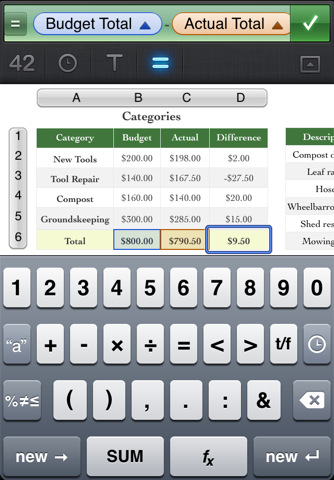
Can we all just agree that there are some things that just “don’t work”: [Inspiration from Sean Sperte]
Can we all just agree that there are some things that just “don’t work”:
-
Review: iA Writer for Mac
The latest app from Information Architects, [iA Writer for Mac](http://www.iawriter.com/), has been highly anticipated since iA launched their incredibly popular iA Writer app on the iPad. Writer is in every way, shape and form, an exercise in minimalism and focus. I have long been a fan of their iPad version and was really excited to…
The latest app from Information Architects, [iA Writer for Mac](http://www.iawriter.com/), has been highly anticipated since iA launched their incredibly popular iA Writer app on the iPad. Writer is in every way, shape and form, an exercise in minimalism and focus.
I have long been a fan of their iPad version and was really excited to see what they could do with the Mac version. This app is so very basic and simple, yet so very interesting that I find myself both struggling to describe what makes the app good and having to hold back praise of the app at the same time.
To give you a very short synopsis, iA Writer may once again make me rethink the way I write and that’s a good thing.
### Currently
Currently I write everything in TextMate on my Mac, this was a conscious decision I made to standardize my writing environment. When I open TextMate I know it is time to write. Since OmniOutliner came out I began outlining posts on my iPad, tossing that outline into TextMate and writing and editing in TextMate. I did this all with the occasional post written in Notesy or iA Writer on my iPad when my Mac wasn’t convenient to use.
That’s what I did before iA Writer came out and before we get into what I am doing now (and what I think I will continue doing) let’s take a look at iA Writer for the Mac.
### First Words
I am constantly testing different text editors on all sorts of platforms and because of this I have a standard way of testing these apps. Typically I open up a new document and just start writing stream of conscious thoughts about the app, once I am done those thoughts sometimes become reworked and interweaved into whatever I may write about the app. More often it is another text file that lies in a wasteland of old text snippets in Dropbox.
Here’s my first (unedited) stream of conscious thoughts on iA Writer for Mac:
>This is a test to see how much, or how little I hate iA Writer for the Mac. It is a $17.99 Mac app, available in the Mac App Store — setting the bar high for the “focused-writing-app” category.
>This falls in the category of apps that is made by people who actually use the product — in this case — writers.
Lofty words for having just played with the app for a few moments of time. Usually I cannot post those stream of conscious thoughts because they are laden with curse words and typos — that to me was most telling about Writer. (Not the lack of typos, just caught me in one of my better moods.)
When I immediately have a connection with an app I know there is far more than meets the eye — this is very much the case with Writer.
### It’s All Been Done Before
Of course many of you will note that apps like [Ommwriter](http://www.ommwriter.com/), [WriteRoom](http://www.hogbaysoftware.com/products/writeroom) (long time favorite of mine), [Byword](http://bywordapp.com/) and many more have offered the “focused-by-way-of-fullscreen-mode” long before Writer came out. In this respect Writer is nothing new, rather just a new take on a classic app category.
What *is* different is the focus mode, which as far as I can tell is only available in ByWord and Writer for the iPad. It is a mode that fades out all other text except for the current sentence you are working on. I am going to touch more on this mode later, but for now let’s just say that focus mode, plus fullscreen makes for a very, well, focused writing environment.
#### Difference
The difference between Writer and Byword is very, very significant. Writer has zero preferences and while Byword has limited preferences it has far too many options. Allowing you to pick what you see in “focus mode” is nice on a bullet point feature list, but in practice it is far too much choice. On and Off is all you really need. Not to mention Byword doesn’t “lock” into focus mode nearly as well as Writer.
#### Writer
[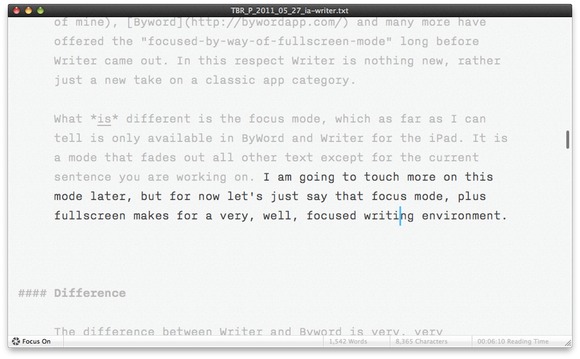 ](https://f3a98a5aca88d28ed629-2f664c0697d743fb9a738111ab4002bd.ssl.cf1.rackcdn.com/writer-ss.jpg)
#### Byword
[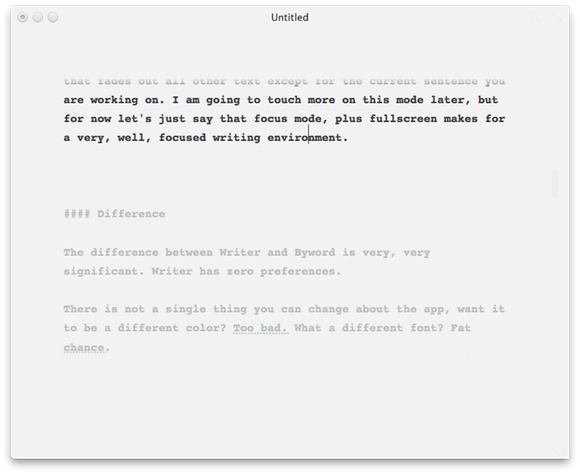 ](https://f3a98a5aca88d28ed629-2f664c0697d743fb9a738111ab4002bd.ssl.cf1.rackcdn.com/byword-ss.jpg)
There is not a single thing you can change about Writer. Want it to be a different color? Too bad. What a different font? Fat chance.
The difference is full featured versus focus. It’s something that Hog Bay got right the first time with Writeroom — don’t bother with features, make the main feature the lack of features. Writer takes that thought process to the next plateau and does a really good job of doing so.
I paid $17.99 for an app that has no preferences, forces one font and one color on me and doesn’t even show me spelling errors while I type! Yet, I am perfectly happy with my purchase.
Byword is for people that know they want to do all their writing in one app. Writer is for people that just want to open something and write. CMD+D versus CMD+1, or CMD+OPT+1, or CMD+2, or… you get the point.
I often joke about how much time I waste in Keyboard Maestro crafting funky things, or how much time I spend in OmniFocus tweaking the look and layout of the app. The problem is that the more powerful something is — the more features you give the user — the more dangerous it is to tinkerers, and I am very much a tinkerer. Writer keeps me from doing any of those non-writing activities.
### Design
[Chuck Skoda](http://chuckskoda.com/entry/callout/) will love this, but UI design is not a feature until it *is* a feature. In iA Writer for Mac, design is very much the prominent feature of the app. ((Don’t bother asking how I am differentiating this statement from what [I said about Tweetbot](https://brooksreview.net/2011/04/appsuration/) — because I fully intend on ignoring such statements. Suffice to say that Tweetbot is more like a theme applied to an app, rather than a radical rethinking of a category of apps — which is what I believe Writer has done.))
There is an amazing amount of attention that has been paid to the entire app — from the background and its subtle horizontal lines and slight grey-white appearance. To the not quite black appearance of the text, to the overly large and cyan-ish colored cursor.
There is not a single facet of this application that was not thought about in great detail. And as a user you not only see that, but you *feel* it.
### Design’s Effect on Writing
I say that the design is a prominent feature of the app because it is so damned effective on keeping me writing. How often have you been working on a document, stepped away or switched out of the app, only to come back and not be sure where you were? Well the grayed out text will get you right back on track and the big blue cursor will make itself readily apparent — why don’t all apps do it like this?
I can’t speak eloquently enough about the idea of why this app feels so right, so let’s have another random designer do it for me:
>It feels almost like, ‘well, of course it’s that way. Why would it be any other way?’
That’s [Jonathan Ive speaking about how he designs](http://www.youtube.com/watch?v=t0fe800C2CU&feature=youtube_gdata) in the film *Objectified*, but I think it perfectly encompasses what iA has done with Writer for the Mac.
### Markdown
Writer supports Markdown recognition and does so with title tags by pushing the formatting into the left margin. The side effect of this method is that you can quickly move through the document and see where your sections start — that’s much easier than a hard margin.
The rest of the Markdown support has been implemented very subtly allowing you the writer, to once again focus on your craft.
### Writing Process Now
I teased above that I think Writer will change how I write for the better. The biggest problem that I face when I write is poor editing and structure. I solved a lot of structure problems by going back to outlining posts, editing though continues to be my problem.
I tend to gloss over goofy mistakes because I edit for flow and red squiggly lines. This means I read my posts very quickly and miss a lot of small things — much to the annoyance of all of you. Writer’s focus mode forces me to read sentence by sentence, meaning that I am far more likely to actually read the sentence instead of just flying by it.
The result has meant a slight revamping of my writing:
1. Outline in OmniOutliner (both Mac and iPad)
2. Copy outline into Writer (both Mac or iPad)
3. Write in Writer
4. Edit for non-spelling mistakes in Writer’s focus mode. Make use of estimated reading time too (this is a far better metric than word counts and gives me a good idea of how many people will actually read a post).
5. Paste into TextMate for spelling, final editing, image insertion, link adding, and posting to blog.The neat thing is that all the formats are compatible and easy to use with one another. At first this seemed like overkill and using too many apps to me when I got by with just two before. However I have been sitting in this Starbucks now for 2 hours doing nothing but writing in Writer and have yet to get the normal urges I had to ‘go do something else’ — that’s what matters to me, not how many apps it takes me to get there, but the end result.
### The Caveats
To navigate between sentences in the app you use the command key plus the left or right arrow keys. This is very nice and easy to do, but it means that you can no longer use CMD+Right Arrow to move to the end of the line. This is not completely a deal breaker, but it does trip me up at times.
When focus mode is on and you are in fullscreen mode I tend to page through sentences and the text does not scroll fast enough. I would very much like Writer to always keep a few lines of text below the current “focused” sentence so that the text doesn’t get paged off the screen. This actually is the biggest annoyance I have right now.
### Check it out
Go check out Writer on the [fantastic site for it](http://www.iawriter.com/). Forget about the price and instead ask yourself if you think it would make you want to write more — if so, that alone is worth far more than $20.
-
iCloud, Lion and iOS 5
It’s official now, Apple will “unveil” Lion, iOS 5 and iCloud on Monday. Interesting that they announced this in a press release so early, meaning that there is potential for a “one more thing” that will be great. Not sure what to make of this move — other than to say that even if we…
It’s official now, Apple will “unveil” Lion, iOS 5 and iCloud on Monday. Interesting that they announced this in a press release so early, meaning that there is potential for a “one more thing” that will be great.
Not sure what to make of this move — other than to say that even if we know what is going to be announced, we still don’t know the impact of what will be announced.
[via Matt Burns] -
Review: Worthwhile for iPad
Shortly after I posted about [Tweed](https://brooksreview.net/2011/05/tweed/), I was contacted by the developer of [Worthwhile](http://itunes.apple.com/us/app/worthwhile/id439998021?mt=8), an app in a similar vein of Tweed — but one that the developer of the product felt I might actually like. I was put on the developer beta list and took a look at Worthwhile and I think it *is*…
Shortly after I posted about [Tweed](https://brooksreview.net/2011/05/tweed/), I was contacted by the developer of [Worthwhile](http://itunes.apple.com/us/app/worthwhile/id439998021?mt=8), an app in a similar vein of Tweed — but one that the developer of the product felt I might actually like.
I was put on the developer beta list and took a look at Worthwhile and I think it *is* worthwhile for you to check out. ((Couldn’t resist that.))
### Aesthetics
Let me start right away by saying that it is not nearly as visually stunning as Tweed. The app is very utilitarian feeling and likely won’t see anyone downloading it because it looks visually interesting. Like most good apps though, Worthwhile doesn’t need those visualizations to make the app useful for you.
### What It Does
Worthwhile turns your Twitter feeds, or your Twitter lists, into a large list of shared links. Tapping on a link will show the linked page to the right and provide you options to send the link to Instapaper. This is all very similar to Tweed, however unlike Tweed you can hit a button on the list itself, for each tweet, that will send that link straight to Instapaper — no need to open the whole page.
This is something that I really like and that makes the app really great for reading through links on Twitter lists. (I don’t actually have any Twitter lists that I made, but I ‘followed’ the ones that [Shawn Blanc made](http://shawnblanc.net/2011/05/managing-twitter-via-lists/) — why do the work when he did it for me.)
When you first launch the app you sign in to Twitter and Instapaper. After which your feed starts to populate. You will notice that there is a button to hide the item, or to read it later along with the URL under the tweeted text. Luckily you can turn off some of this clutter in the settings preference. I turned off the hide button and the URL preview to maximize space for the tweet text itself.
Tapping read later will immediately send it to Instapaper and hide the tweet from the list. A very nice touch. You only see Tweets with links that were made in the last 24 hours, however by enabling ‘weekend mode’ the time span is extended on Mondays to include all of the links from the past weekend. This is a great example of a feature that was made because people actually used the app before they launched it — I love that little touch.
### Usefulness
As I mentioned above the reason I was sent this app to try out is because the developer thought that I may actually find the app useful. With Tweed I never got into the app — it always seemed more cumbersome that using Twitter on my Mac or iPhone (I rarely, if ever, use Twitter on my iPad). I was pretty skeptical about Worthwhile when I saw it — but the ability to add links with one tap intrigued me enough to make we want to try out the app.
For my main timeline I think Worthwhile is useless — it’s just as easy to use Twitter on my iPhone to add things from my main feed to Instapaper — with the added benefit of seeing *all* tweets.
Where Worthwhile really excels for me is in the use of lists.
I never look at Twitter lists and never make them, but some of the lists that I follow, made by other users, are really great for using with this app. This allows me to comb through tweets that I would otherwise not see and potentially grab some interesting reads from them.
For that alone I have found myself popping Worthwhile open once a day to comb through some Twitter lists.
### Read Later
Worthwhile is in the App Store now for $3.99. Typically I don’t care about price once it is below $5 on the iPad and Worthwhile is no exception — a good buy. It’s not the prettiest, but it is highly useful and quick.
Worthwhile will truly turn your Twitter feeds into an RSS like tool that is not curated by you, but curated by people that you choose to curate it for you — this is an interesting concept. I rather like that idea.
-
Quote of the Day: Marco Arment
“Microsoft loves losing money with online services, so this should stay free forever… unless they get a new CEO who isn’t crazy about pouring billions into a hole.” — Marco Arment
“Microsoft loves losing money with online services, so this should stay free forever… unless they get a new CEO who isn’t crazy about pouring billions into a hole.” -
Twitter Is Launching Its Own Photosharing Service
From the department of: what the hell took you so long. Also, bye bye Twitpic, Yfrog and others. ((I’m assuming they will be “encouraging” people to stay away from such services.))
From the department of: what the hell took you so long.
Also, bye bye Twitpic, Yfrog and others. ((I’m assuming they will be “encouraging” people to stay away from such services.))
-
How Many Cores Does the Human Brain Have?
Biophilia: >On the other hand, the brain has about 1e15 synapses, making it analogous to five million contemporary 200 million transistor chip "cores". Amazing.
Biophilia:
>On the other hand, the brain has about 1e15 synapses, making it analogous to five million contemporary 200 million transistor chip "cores".Amazing.