Month: September 2011

  • The Dosh 6-Card ‘Luxe’ Wallet

    Anything that I have to carry with me on a daily basis is something that is worth being picky over — very picky. Four days a week I lug a computer around with me, so I purchased the fastest, lightest, computer I could. Everywhere I go, I lug a phone with me, so again, I got the best I could.

    I buy shoes based on comfort and style — I am always willing to sacrifice a touch of style to keep my feet comfy. The two things that I can’t ever get by without having with me are: keys (in some form) and my wallet.

    I can’t remember the precise year, but at some point in high school I decided that the traditional folding wallets just weren’t for me. I went with the card-wallet plus money clip approach — I always felt cool having a money clip.

    Thinking back there is truly only one wallet I have had that I actually liked, a Tumi leather card wallet. My last wallet was just OK and served me well for a quite sometime, but I never liked the size or the look of it.

    I am always open to trying a new wallet, mostly because they are easy to try out and I have yet to find that perfect wallet. So I went and purchased a pricy [Dosh wallet](https://www.dosh.com.au/). Here’s what I think of it: it sucks.

    [](https://f3a98a5aca88d28ed629-2f664c0697d743fb9a738111ab4002bd.ssl.cf1.rackcdn.com/20110919-IMG_6590-full.jpg)
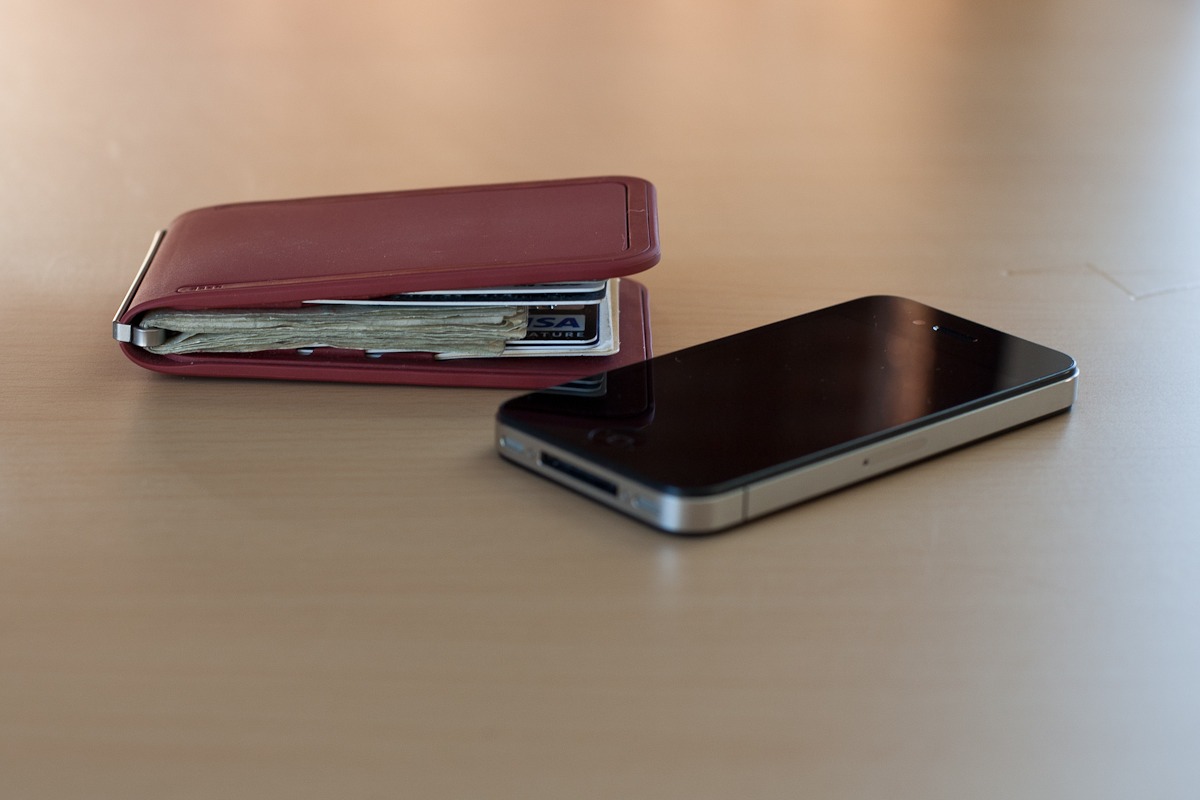
    ### The Feel

    One of the main reasons that I wanted a Dosh wallet is because it is made out of a material I have never used in a wallet before: “water-resistant polymer material”. What the hell is that?

    The short answer is that it is a rubbery plastic that feels like a grippy velvet to the touch. It actually feels quite nice to the touch and really solid, not cheap at all. Likewise the money clip is really nice, super high-quality.

    That’s where the niceness stops. The inside of the wallet is made out of a more “normal” feeling plastic and, well, feels like crap — I mean plastic. The inside is very rigid and truly ruins the overall feeling of the wallet.

    It’s a mixed bag, if you never open the wallet it is great, once you open it the experience is completely ruined.

    ### Looks

    I purchased the “Luxe Vintage 6-card” wallet and it looks good. I really like the look of the wallet from the closed perspective. When you open it you see the cheaper plastic and I hate the plastic used in the interior.

    Part of the assembly of this wallet is that some of that interior plastic shows through to the outside. The color match is excellent between the two materials, but while the rest of the exterior shows little wear, the harder plastic shows wear — I hate the unevenness of this. Even wear is fine on a wallet, but only wearing in certain areas, very small areas, drives me nuts.

    ### Functionality

    When Dosh says “6-Card” they mean it. I was hoping to sneak in an extra card or two, but that simply doesn’t work. There is only room for six cards, and business cards don’t fit well in the credit card slots.

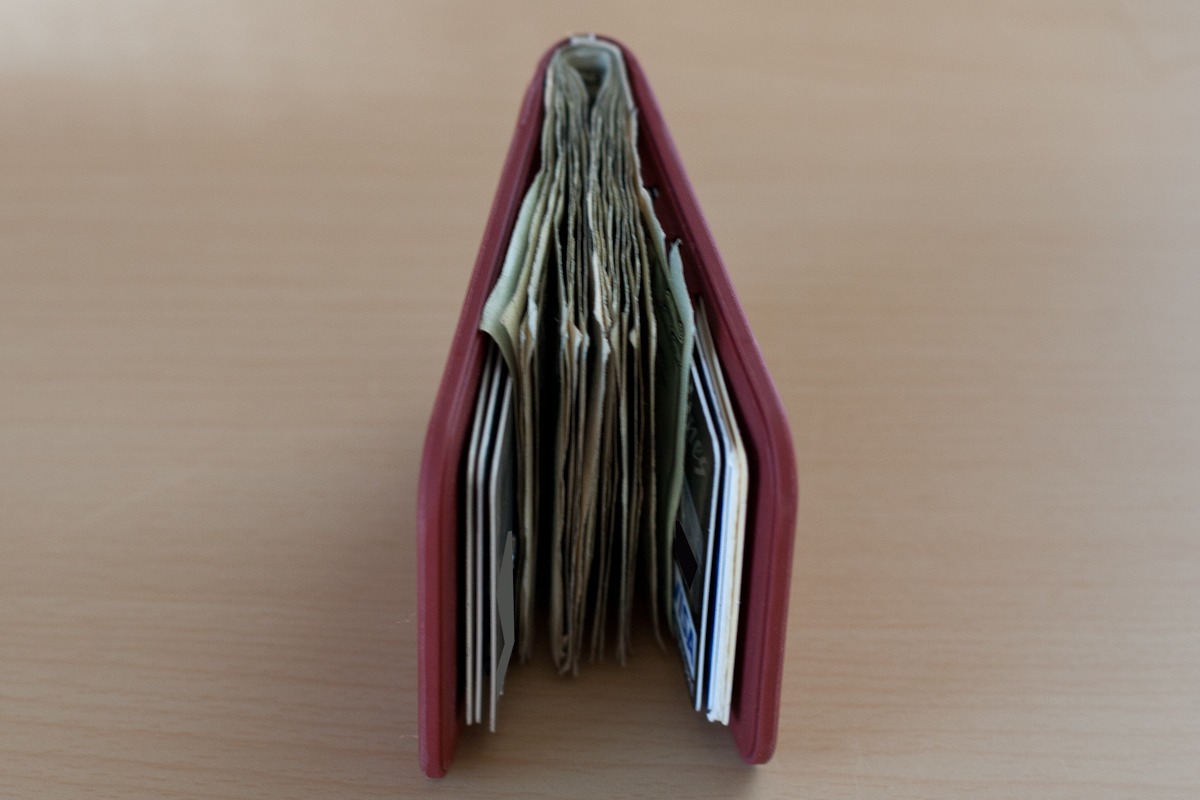
    For the money clip I’d say that 10-bills is your comfortable max for this wallet — anything more than that and it will look like a [Costanza wallet](https://f3a98a5aca88d28ed629-2f664c0697d743fb9a738111ab4002bd.ssl.cf1.rackcdn.com/george-wallet.png).

    [](https://f3a98a5aca88d28ed629-2f664c0697d743fb9a738111ab4002bd.ssl.cf1.rackcdn.com/20110919-IMG_6591-full.jpg)

    The best thing I can say about this wallet’s functionality is that nothing falls out. I have held it by the edges and shook hard to see if the cards (that are only held in by friction) escape and they never do. I am actually quite impressed by this feat.

    There are three major functionality issues with this wallet (in order of annoyance):

    The soft feeling of the outside of the wallet turns the wallet into the most difficult thing to get out of your pocket. Wearing jeans while sitting and need to get your wallet? Fat chance. It literally will pull my pocket out when I try to remove the wallet. This is one of those things where you never realize how much you take your wallet in and out of your pocket until you have a wallet that clings to the inside of your pocket for dear life. Even after a week plus of use it is still just as hard to take out of and put back in your pocket.

    Each flap of the wallet has three slots, one card per slot. Logically you would think that since the slots are staggered your cards would all be visible. Thus you would see the top edge of each card with a bit to grasp each card with your finger tips. Apparently that logic, well, isn’t that obvious.

    [](https://f3a98a5aca88d28ed629-2f664c0697d743fb9a738111ab4002bd.ssl.cf1.rackcdn.com/20110919-IMG_6593-Edit-full.jpg)
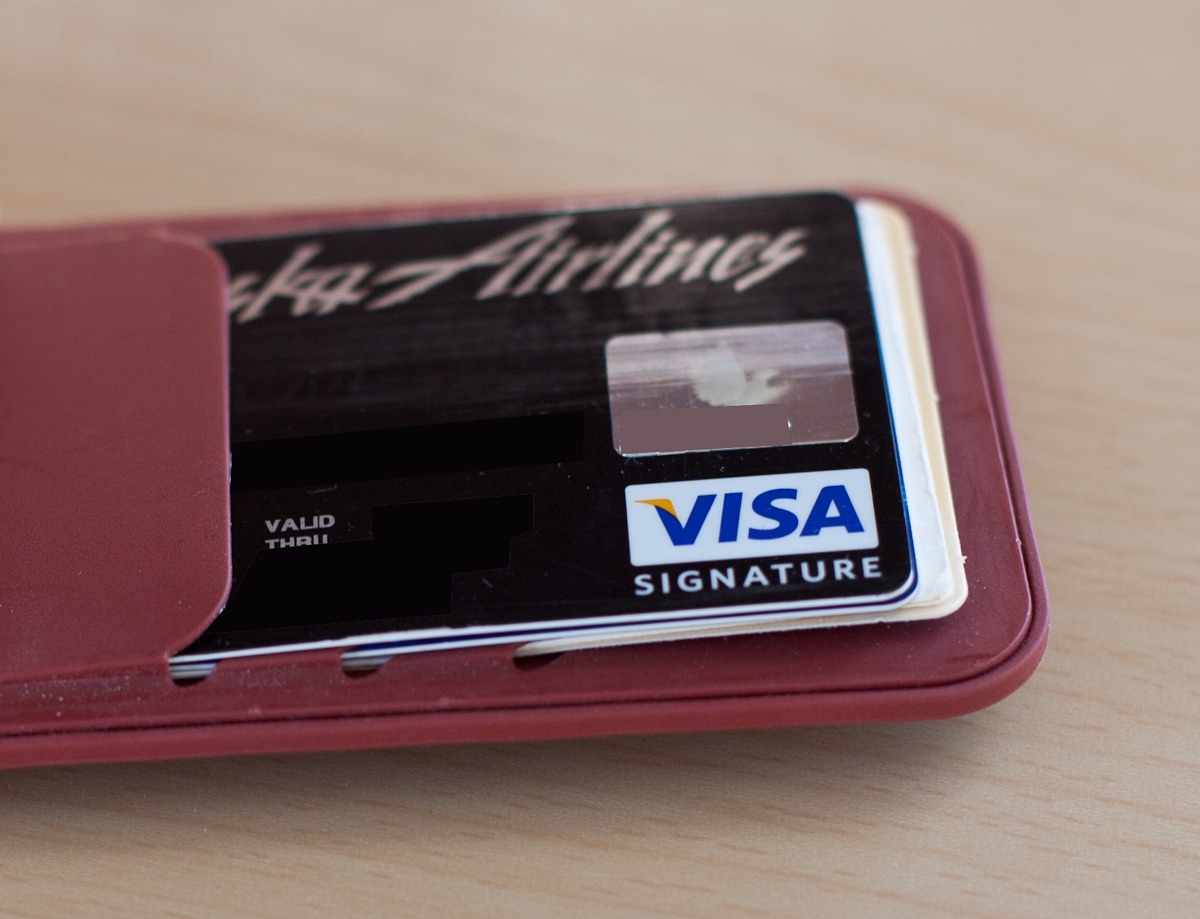
    All the cards sit at the same level in the slots so that it looks like a perfect stack of three cards. Now try to not only find the card you want, but fetch out the middle card on either side. It’s not fun.

    [](https://f3a98a5aca88d28ed629-2f664c0697d743fb9a738111ab4002bd.ssl.cf1.rackcdn.com/20110919-IMG_6592-Edit-full.jpg)
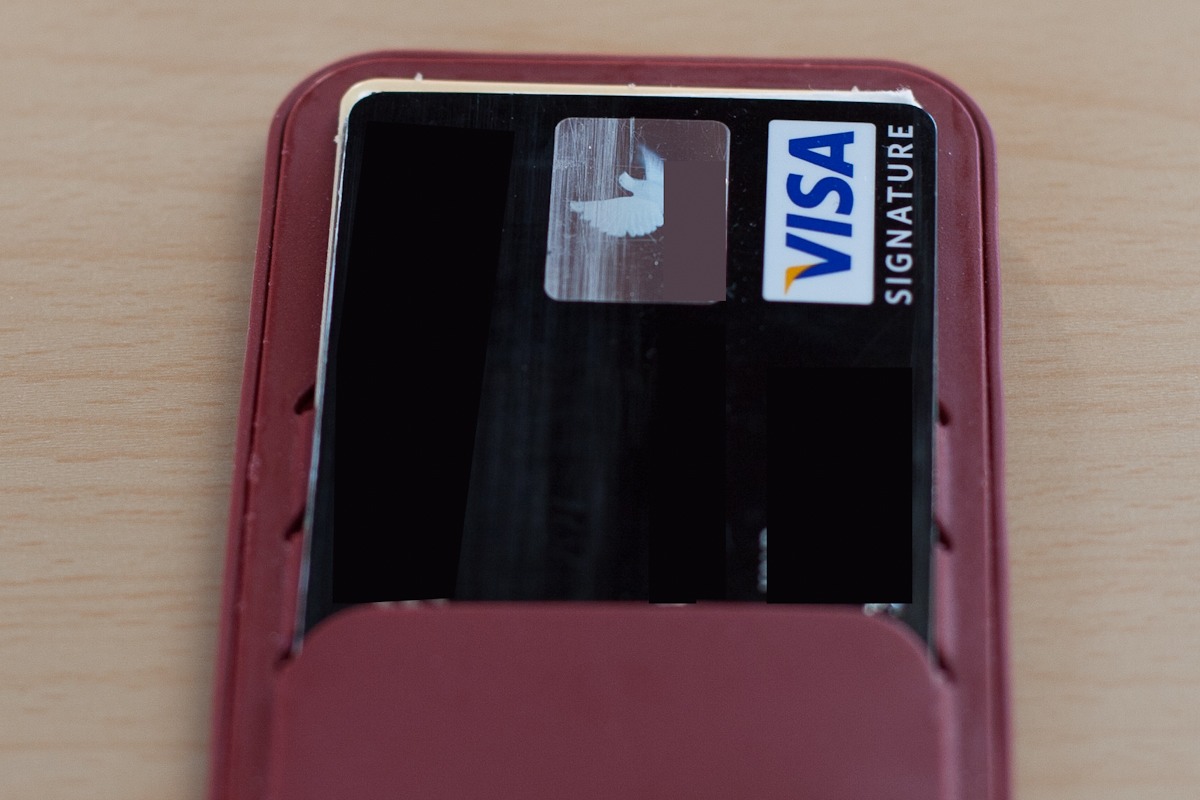
    The money clip in the middle is really great, provided you aren’t low on cash. Try slipping in an wrinkled up old bill by itself and well you are likely to end up with two pieces of a wrinkled old bill — this happens with two bills sometimes too. I found a workaround whereby you can fold the wallet all the way open and slide in the bills, but that’s pretty stupid looking in practice (like “resetting” the compass on your iPad stupid).

    Honestly as a functioning wallet, this isn’t that great.

    ### Size

    My biggest concern about the Dosh wallet was the overall size: they are very thick when empty. Turns out my concerns were spot on, once you put your six credit cards and some cash in the wallet it turns into a very thick beast.

    So thick that it is in fact not comfortable to place the wallet and iPhone 4 in the same front jean pocket as I have been doing for years. Right there, that’s pretty much the deal breaker for me.

    ### Conclusion

    I should have known better when I saw that the entire website was Flash only… I think I have that old [Tumi](http://www.amazon.com/gp/product/B002BWP1GI/ref=as_li_qf_sp_asin_tl?ie=UTF8&tag=brooksreview-20&linkCode=as2&camp=217145&creative=399373&creativeASIN=B002BWP1GI) wallet somewhere.

    [](https://f3a98a5aca88d28ed629-2f664c0697d743fb9a738111ab4002bd.ssl.cf1.rackcdn.com/20110919-IMG_6594-Edit-full.jpg)
    #### Bonus

    The packaging is excellent and one of the few wallets that actually comes in a very nice case — a case which I now use for storing collar stays.

  • Qwikster Cometh

    Jonathan Poritsky:

    >Netflix doesn’t want consumers to associate its name with plastic discs anymore.

    I think given all the Netflix stuff coming out, the above statement is just about all we know for certain right now. Poritsky is spot on. It would have been vastly easier for Netflix to position the streaming side (from day one) as a separate business — they never did.

    Netflix seems to have had the fear all along of someone/something coming along and doing to them what they did to Blockbuster and other video stores. Not only are they aware of this, but they have proven that they are fighting against it — preemptively.

    I am not sure that some of the assumptions Poritsky makes about the Netflix services of the future will hold true — especially his fears about just how separate the services will be.

    Personally I think this is step one for Netflix’s exit from the shipping plastic media business.

    What Hastings can now do and say is:

    – Look at the financials for Qwikster now that it is separate from Netflix, Qwikster loses money every day.
    – Given that we can’t afford to keep it open.
    – We aren’t closing Netflix, just this Qwikster thing.

    Basically, right at the point when the consumer recognizes the distinction between the two services (12 months?) they shut Qwikster down. Thus, they are not removing a feature, just killing a struggling business — who can blame them for that?

  • Americans and Text Messaging

    Aaron Smith for Pew Internet and American Life Project:

    >Young adults are the most avid texters by a wide margin. Cell owners between the ages of 18 and 24 exchange an average of 109.5 messages on a normal day—that works out to more than 3,200 texts per month—and the typical or median cell owner in this age group sends or receives 50 messages per day (or 1500 messages per month).

    I find that crazy. I know people love texting, but I have never been a fan. In other news, or non-news:

    >Heavy text users are much more likely to prefer texting to talking.

    So there’s that.

  • Fusion and Carbon Ads Bundle

    Worth it for just two of the apps, let alone all 10…

  • Only Enterprise and Developers Can Bypass Windows Store for Metro Apps

    Jon Brodkin:

    >Metro apps, on the other hand, will be “Distributed through the Windows Store. Apps must pass certification so that users download and try apps with confidence in their safety and privacy. Side-loading is available for enterprises and developers.”

    The more information that comes out about Metro, the less I believe Microsoft is the company behind it.

  • Cracking OS X Lion Passwords

    Basically there is an exploit that allows any user with physical access to your machine to change a user password without needing to know the old password. A couple things to note:

    1. It is my understanding that you need to be able to get your hands on Terminal. Thus a locked computer would not be vulnerable. ((Now, whether you could do this from a recovery partition and the danger to FileVault 2 users, that I don’t know.))
    2. Far more scary is that typing in your password to grant privileges to applications could result in a malicious application executing this command. Mac App Store to the rescue?

    Very interesting and one commenter pointed out this is likely related to the LDAP security issue that was making the rounds a bit ago.

  • [SPONSOR] Screens from Edovia

    Screens, the acclaimed VNC client on iOS is now available for Mac.

    Screens – It just works.

  • Qwikster

    Reed Hastings, Co-Founder and CEO of Netflix:

    >So we realized that streaming and DVD by mail are becoming two quite different businesses, with very different cost structures, different benefits that need to be marketed differently, and we need to let each grow and operate independently. It’s hard for me to write this after over 10 years of mailing DVDs with pride, but we think it is necessary and best: In a few weeks, we will rename our DVD by mail service to “Qwikster”.

    A nice post by Hastings to clarify what is going on, but Qwikster is a horrible name. But this cheered me up:

    >The additional streaming content we have coming in the next few months is substantial, and we are always working to improve our service further.

    With Starz leaving Netflix in 2012 it looked as though the streaming catalog is set to dwindle. Perhaps given this statement Netflix has found another (more direct?) way of obtaining content — let’s hope so.

  • Customer Culture

    Marco Arment wondering about the same hurdle that I foresee Microsoft having with Windows 8 and Metro:
    >The question isn’t whether Metro will be good: it probably will be. And that’s a huge accomplishment for Microsoft that they should be commended for.

    >But how will their customers react?

    The fear I have is that Microsoft will have created this great thing that is shunned by their core user base, thus allowing the “I told you so” crowd to take back over at the company. The fact that Metro got past that crowd already is nothing short of a miracle.

  • The B&B Podcast – Episode 27: Makers and Managers

    This go around Shawn and I focus on scheduling your time and responding to emails. We also follow up on popping popcorn and trying to pop coffee beans (not really).

  • Automatic Time Tracking for Your Mac

    I want to thank Timing App for sponsoring the RSS feed this week. It’s a killer app for figuring out just how much time you wasted creating that spreadsheet that no one else bothered to look at. While I don’t need to track my time — I love to track my time so that I get a sense of just what I spend my life doing.

    Let’s just say that Safari is winning for holding down the top spot of biggest time usage right now…

    It is a really great app and at least worth your time to check out. It’s in the Mac App Store where it is 50% off for a limited time only.

  • Sitting and Standing

    A Cornell University study:

    >So the key is to build movement variety into the normal workday.

    Very interesting to read, the key thing that the report says is that you need to move around. While I love standing at work, I also move frequently while at work and sit for long periods to and from work (and after work hours). Ideally I would like an adjustable desk, but I think not having an adjustable desk actually makes me move quite a bit more.

  • Thoughts on Metro

    Windows 8 with Metro UI was [unveiled](http://channel9.msdn.com/events/BUILD/BUILD2011/BPS-1004) this week and you have likely seen most of the UI and little tricks Microsoft is using to “re-imagine” Windows — and apparently Microsoft itself.

    If I am perfectly honest Windows 8 excites me a bit. Metro UI is anything but boring.

    I am not excited about Ribbon UIs and other UI monstrosities that Microsoft has jammed into their aging OS — I am very interested in everything that has to do with the Metro UI paradigm. It is something very original that is coming out of a company better known for “copying”.

    Metro UI is a risk for Microsoft, and that’s something that you can’t say about most of its products. The last risk was Windows Vista and that was a risk done by necessity so that the OS could keep up with OS X’s speed. Before that they gambled on Zune and Xbox. Both introduced well after the markets for each device was established.

    Metro is Microsoft acknowledging that Apple has something with iOS, but instead of Microsoft copying iOS (as they typically would have done) they decided to let their imaginations run wild.

    There is quite a bit about Metro that I think is darn clever and quite a bit that I hate. By and in large Metro is not an iOS clone, from what I have gleaned from playing with Windows Phone 7, erm, phones — Metro is a refreshing change. ((This would be in contrast to Android, which just feels like the Microsoft clone of iOS in my opinion. Ergo Metro is more like the difference between WebOS and iOS.))

    There’s a few things that I think are worth pointing out about Metro at this point, so let’s go through them.

    ### Copied from iOS

    There are two really interesting “concepts” that Microsoft took out of the iOS playbook: multi-tasking and Flash. There will be no “true” multi-tasking, instead Metro will kill off apps after a bit — much in the same way that iOS 4+ does multi-tasking. This was obviously done for battery-life and performance reasons, but I still find it very interesting that this approach was taken by Microsoft.

    The second thing is the [lack of Flash in IE 10](https://blogs.msdn.com/b/b8/archive/2011/09/14/metro-style-browsing-and-plug-in-free-html5.aspx). In fact just like in mobile Safari there will be no plugins that the user can install — again for battery life and performance reasons. I wonder if Adobe is still feeling pretty smug?

    Note that I don’t have any intention in calling Microsoft a copy-cat for taking these features, I just want to point out that these are very interesting (and often controversial) features to bring to Metro. It would have been far less controversial to let users install Flash is they pleased and to run down their own batteries by keeping a ton of apps open.

    Microsoft was faced with a choice of trying to please every one and trying to do what would be best for the user experience — they chose the latter, that’s interesting.

    ### Grid App Templates

    One of my favorite parts about iOS is the creativity that an App UI design can put forth. From the textures of Reeder, the crazy cards of Twitter (iPad), the awesome MLB At-Bat and more — they can all look very different. Certainly the apps can be made to look like first-party apps by utilizing many of the features built into iOS (button controls and bars), but even Apple goes outside the box on apps like iBooks. It’s fantastic.

    That’s why I was a bit worried while watching the Microsoft Build presentation about how any developer can make their apps beautiful by “dropping” them into the “Grid” template that Microsoft includes in Metro. There’s a joke to be made here about Windows developers and their eye for design, so in that light perhaps such a template is a good thing?

    I think it is potentially very bad. It is selling Windows developers short. I am sure you don’t have to build with that Grid template to get in the Microsoft store, but — and this is a big but — what will the Metro user think of non-grid apps?

    If 90% off all apps are built off the Grid template (which I think is a safe assumption given Windows apps I have seen) then wouldn’t a user be off put by an app not using this template?

    On iOS users tend to reward innovative and unique UIs, but will they on Metro when Microsoft is so heavily pushing and promoting that things all look uniform — right down to the baseline grid that the text sits on?

    What Metro apps end up looking like should be an interesting thing to watch and my guess is that (sadly) they will all look the same. I hope this isn’t the case.

    ### Landscape First

    I’m certainly not the [first to mention](http://getwired.com/2011/09/15/the-landscape-tablet-landscape/) this, but when it comes to tablets Windows 8 (and Metro) certainly look like they were first and foremost designed as a landscape UI. Certainly they rotate, but they are 16:9 widescreen and made with the “home” button on the bottom when you hold your device in landscape.

    I find that odd especially given [this post](https://brooksreview.net/2011/09/tablet-power/) that I wrote about tablets giving some power back to users through not forcing users or developers to pick an screen orientation.

    The only explanation that I can come up for this is that Microsoft really thinks of Windows 8 tablets, not as “tablets” but as laptops minus the keyboard bit.

    That is, I don’t think Microsoft sees users really using Windows 8 tablets as anything more than a slightly more portable laptop — that’s an interesting take for such a forward thinking Metro UI, it almost seems counter-intuitive to a Metro UI.

    ### Timing

    The unfortunate bit of all this Windows 8 talk is that the OS is at least another year away. By then iOS 5 will be out and we will certainly be awaiting the arrival of iOS 6 and perhaps even a new Mac OS X version as well.

    So why is that bad? Well, for starters, while Metro looks great now, in 2011, will it still look that good in late 2012?

    Perhaps you think that is the fanboy in me talking, but let me ask you this: does iOS 3 still look good to you?

  • The Four Themes

    Paul Thurrott on CEO Steve Ballmer’s thoughts at the BUILD conference:
    >The four themes for Microsoft are new hardware form factors, which include slates and convertible tablets, of course, but also the new Ultrabook PC; cloud services; and new application scenarios that provide new opportunities for developers. “Each and every one of these things is shifting our direction, what we’re doing, what we’re trying to accomplish,” Ballmer said, “and each and every one of them, I think, has incredible opportunities not just for us, but for every developer in the world.”

    So in other words Microsoft is “shifting” to build: iPads; what used to be called Tablets, but are just those funky jobbers with rotating screens that weigh ten pounds; “of course” MacBook Airs; iCloud/Google/Amazon; App Store.

    *Innovative.*

    That’s not to say this isn’t a good strategy for Microsoft, but honestly it is the *only* strategy for them — so why put these things into such silly categories?

    This bit from Thurrott cracked me up, if for no other reason than the passive jealousy the statement holds:

    >And of course, PCs are just kicking the bejesus out of tablets, despite reports to the contrary: Apple might sell 35 million iPads this year, and it gets a lot of press for that. But there will be over 10 times as many PCs sold in the same time period, and while growth is comparatively slow—as it would be for such a mature product—it’s still a growing market.

  • Flight Card

    This app makes me want to fly somewhere — man is it beautiful looking.

  • Groupon Getaways Aren’t the Deal They Seem to Be

    Rocky Agrawal has a great post about Groupon Getaways that ties nicely in with [what I wrote yesterday](https://brooksreview.net/2011/09/death-spiral/). According to Agrawal:
    >The reason that regular Groupons are so generous is that merchants are sold on the line that they can do the first deal at a loss and you will become a repeat customer. Hotels don’t buy that. To a hotel revenue manager, you’re a head in a bed. Not only must your head be profitable for a given night, it must be maximally profitable. If there’s a big convention in town and rooms are selling for $500 a night, you won’t be able to use that Groupon voucher that you bought for $100 a night.

  • Release Day Economics

    Uniform Motion details what they get to keep from various different methods of distributing their music:
    >That being said, it costs us 35 EUR/year to keep an album on iTunes, Spotify, and Amazon (105 EUR per year for all 3 of our albums!) so we don’t make any money until 24 people have bought a digital copy of the album on iTunes, or 150 single songs, or if we get tens of thousands of listens on Spotify! In most cases, it’s actually more economically viable not to sell the music at all.

    It’s a pretty amazing break down.

  • Instapaper’s (Anti-)Social Network

    Marco Arment took the time to comment on [this post](https://brooksreview.net/2011/09/ego-less/) of mine:

    > In addition to removing the emotional rollercoaster of follower counts and unfollows, this may actually increase following activity: if people realize that others won’t know when they follow or unfollow, they may feel more comfortable doing so.

    You should read the entire post about why he chose to make Instapaper’s features the way he did, it’s fantastic.

  • Windows 8 BSOD Now Includes a Sad Face

    Look at the screenshot, tell me that will not piss you off even more when your Windows machine crashes.

    On a positive note it should be much more comical when electronic billboards crash…

  • The Masked Social Network

    There’s something incredibly unnerving the first time you start “following” the liked items of other users on Instapaper. Instapaper makes no suggestions to you of popular users and offers no list of current users — this is quite unexpected.

    You get the option of looking up people via other social networks, or just by email address, this is of course in stark contrast to just about any other social offering you will encounter — as they much prefer shoving as many users in your face as possible.

    It’s a purposeful mask that has been pulled over the “social” offerings of the inherently non-social activity of reading.

    Even if you use Instapaper you can still “hide” yourself from other users, if you so desire. Perhaps most jarring is that you get no indication *if* anybody is actually following you.

    There are no follower counts.

    No following counts.

    No popularity contests.

    No cliques.

    No ego stroking.

    There’s just a list of articles that people you chose to follow decided that they liked. All without knowing who, or if, anybody will ever see that they liked that article.

    It’s a fascinatingly private social system.

    I want more of it.

    Effectively Instapaper has found a way to keep its users engaged with the site’s main purpose, reading, while offering users ways of keeping tabs other readers. It’s like getting a peek at someone else’s bookcase, without them knowing that you peeked.

    Imagine what would happen if Twitter operated this way: you have no inkling of who is following you and others have no clue if you are following them. You just have an account that you post to, occasionally a person responds to you. The only way you know if a person is following you is when you go to Direct Message them.

    Imagine that, because what would really change?

    Some numbers go away, sure, some egos are deflated — that’s a bonus. But what is the worth of a follower? To businesses it is bragging rights, and job security for “social media experts” — but for you the individual, does it matter?

    I would argue not only does it not matter, but knowing these counts makes the service worse.

    The service is made worse because people behave differently given the setting they are in. Would you say the same things if you have ten followers as you would if you had ten million followers?

    I know I wouldn’t.

    Actually I know exactly what Twitter would feel like: blogging.

    If you have a site with no analytics on it at all, then you have an exact sense of what such a Twitter-without-counts would feel like.

    I know roughly how many people read this site (blogging equivalent of followers), but I don’t know who most people are — it’s a blind count. I know who some of you are because we have conversed via email and Twitter, but the overwhelming majority of you are, well, anonymous.

    I like it that way, I am guessing most of you like it that way too. Maybe Kim Jong-il ((I cite him because, well, it amuses me — feel free to substitute any name.)) reads this site, maybe he doesn’t — but if he did and I knew that? Well, my message would certainly change.

    Follower and friend counts play to the human ego and our curiosity, but sometimes I think it would be better to let us be curious. The knowledge of not only that you are being “watched”, but of who is watching you makes social networks far less interesting. ((I like to look at this in the context of dancing — something I hate doing with a passion. I am far less likely to dance around people that I know. Slightly more likely to do it when intoxicated around people I know. Even more likely to dance around people I don’t know. And most likely to dance in front of people that I don’t know while intoxicated.))