Month: April 2012

  • ‘Still Patented’

    Marco Arment responding to Twitter’s “Innovator’s Patent Agreement”:
    >A patented “invention”, even when patented under these terms, *is still patented*. It’s not free for anyone to use, and willfully infringing upon it is still dangerous and unwise.

    Yep. And in case you were curious, here’s Marco’s stance on software patents:

    >I fundamentally disagree that software patents (and many other types of patents) are a net gain for society, and I can’t participate in that system in good conscience.

  • Jamie Moyer

    Thomas Harding for MLB.com on Jamie Moyer’s win last night:
    >At 49 years and 150 days, Moyer surpassed the previous record held by the Brooklyn Dodgers’ Jack Quinn, who beat the St. Louis Cardinals at Ebbets Field on Sept. 13, 1932, when he was 49 years and 70 days old. Moyer also tied Hall of Famer Jim Palmer for 35th place on the all-time wins list with 268.

    I’ve always been a huge fan of Jamie Moyer and it seems that when you start off your career throwing 82 MPH fastballs, it’s not that hard to sustain that for, oh, 26 years.

  • ‘Verizon Wireless 4G LTE Network Will Be Available to More Than 2/3 of U.S. Population Starting April 19’

    Verizon press release:
    >By the end of 2012, the Verizon Wireless 4G LTE network will be available in more than 400 markets, and will be available to more than 260 million people in the United States.

    Excuse me while I pat myself on the back for getting a Verizon iPad.

  • I Am Condemning Free on Principle, So Should You

    [Federico Viticci venting on his personal blog about writers that condemn services because they are free](http://ticci.org/condemning-free-on-principle):
    >There is a shared sentiment among independent writers and developers that “free” is inarguably bad as a business model.

    It is bad. In fact it’s the worst business model in the world, short of paying someone to use your product/service. There is nothing good about a free business model, nothing.

    Viticci, though (and perhaps other writers that he is referring too), seem to assume that a free business model includes what Google or Facebook is doing. And that assumption is dead wrong.

    Facebook, Google, and *this* site do **not** operate within the “free” business model. We have an advertising supported model, and such a model is very much a viable and sometimes successful business model.

    Free, however, is not viable.

    When I wrote “[Fragility of Free](https://brooksreview.net/2011/03/fragility-free/)” I stated:

    >The fragility of free is a catchy term that describes what happens when the free money runs out. Or — perhaps more accurately — when the investors/founders/venture capitalists run out of cash, or patience, or both. Because at some point Twitter and all other companies have to make the move from ‘charity’ to ‘business’ — or, put another way, they have to make the move from spending tons of money to making slightly more money than they spend.

    Twitter is making the shift, and so too will every other “free” service.

    So I don’t think it is wrong for any writer to question the viability of any product or service when the company behind it has the business model of “free”. What is wrong, what is short-sighted, is to *not* question a service when they are running on the free, VC funded, model (I’ll come back to this).

    The most popular argument for using “free” is stated by Viticci himself and it’s a poor one:

    >Some people often make witty remarks about “growing the userbase, then we’ll figure it out” types of announcements. While I appreciate their entertainment efforts, they’re actually trying to make fun of a universal truth: normal people are reluctant to pay for things they don’t know.

    That’s simply not accurate. In business one of the first things that you are taught is this graph. It’s a simple little thing that shows how consumers (generally) adopt products. But the argument above assumes that the first two consumers don’t exist.

    But that’s wrong, because we know that innovators and early adopters exist. In actuality “free” to “get” “massive” “users” is an impatient shortcut devised to skip over the first two classes and get right to “early majority”. Why? Because it takes too long and VCs/Investors need growth to show a return, and yadda yadda yadda.

    The way to get people to adopt your product or service is simple: make it compelling. Get the innovators and compel them to pass the word on down the curve. That’s how you grow, and guess what: if you charge from the beginning you can afford to wait (and you can eat more than Top Ramen).

    Free is not only a bad business model, but it is short-sighted and short-lived. No service can remain free indefinitely and that’s why it is negligent not to question a new free service when it comes out, because “figure it out later” can often end up being something that *you*, the user, aren’t going to be OK with and that is relevant.

    *(As for the free with ads business model, I think there’s going to be a massive shift in that arena too, but for now it is better than no business model — which is exactly what free is.)*
  • The New Square Icon

    Even if it wasn’t blue, it’d still be hideous.

  • ‘Introducing the Innovator’s Patent Agreement’

    Adam Messinger, VP of Engineering at Twitter:
    >The IPA is a new way to do patent assignment that keeps control in the hands of engineers and designers. It is a commitment from Twitter to our employees that patents can only be used for defensive purposes. We will not use the patents from employees’ inventions in offensive litigation without their permission.

    Interesting.

  • Canon 5D Mark II vs. Mark III vs. Nikon D800 High-ISO Video

    The Nikon appears to be much more sensitive to light and have much more noise. Amazing how well the Mark III handles noise at really high ISO. I want that camera, badly.

  • ‘The Challenge of Syncing OmniOutliner’

    The Omni Group just pulled a ‘Cultured Code’ and instead of shipping sync they have decided to explain it. This makes me sad.

  • MacStories Interview with Nate Weiner of Pocket

    Nate Weiner:
    >Absolutely yes — our hope is that Pocket will take ‘save-for-later’ to the mainstream.

    Thinking about this a bit more, I don’t think Pocket will ever be that useful for me. But I do think that it would be for my wife, and mom, and my father. I don’t save all this other crap that most people do, I don’t have a need to watch a ton of web videos — the place where I save all my web videos for later watching? Devour.com — I don’t even need to go anywhere else, everything good is usually there.

    For me I just want to read and that’s Instapaper. But I bet my wife would love Pocket — it would ‘fit’ her better.

  • Amazon Item of the Week: Lighting Science Definity – A19 Omni V2 LED Bulb

    [Marco Arment recently went through his options for LED light bulbs](http://www.marco.org/2012/04/09/led-light-bulbs-reviewed), but I wasn’t happy with his conclusions. I found this bulb and bought a couple for our living room that is illuminated just by two tall lamps with these bulbs. I have to say, I love these bulbs — even my wife noticed the difference when compared to the nasty CFLs that were in there.

    I can’t say how they stack up to all the bulbs Marco tested, but I am buying more of them.

  • Read It Later Reborn as Pocket

    Federico Viticci has a detailed take on the transformation (?) and states:
    >Unlike Weiner’s previous attempt at solving the “save for later” puzzle, Pocket is immediately visual, making it extremely clear that it wants to be a place where you save “stuff”, not just articles.

    I think thats a good description. Pocket feels more like Yojimbo in the cloud to me, than it does a good read-later service. Yojimbo may even be a poor comparison, Flipboard Pro may be a better analogy.

  • Patents and iA Writer

    Oliver Reichenstein in an interview with Dylan Love for Business Insider makes an interesting statement about patents:
    >While feel that Reading Time should be a common standard for everybody (other text editors and Websites started using it now as an indicator of text volume), we have a patent pending for Focus Mode. Some people criticized us for that. But we don’t make the rules of the industry. We follow them. Dealing with copycats is not all sunshine and rainbows. And if even bigger companies start copying us (the latest version MS Word now suddenly has a blue focus optimized cursor, just like Writer), we better have something to prove that this was our idea and not Microsoft’s or Apple’s.

    I had no clue Word adopted the blue cursor, that’s pretty lame.

  • iTunes’ Windows Problem

    Jean-Louis Gassée:
    >Today, the toxic waste of success cripples iTunes. There are times when I feel that iTunes has reached Windows Vista bloatware proportions: Increasingly non-sensical complexity, inconsistencies, layers of patches over layers of patches ending up in a structure so labyrinthine no individual can internalize it any longer. (Just like the Tax Code.)

    I’ve been thinking about this a lot lately, and by far iTunes is the one app on my Mac that I do two things with:

    1. Dread using.
    2. Actively block websites from opening.

    Something needs to change.

  • Quote of the Day: Shawn Blanc

    “My MacBook Air is now my ‘desktop’ and my iPad is now my ‘laptop’.”
  • Inside Nathan Myhrvold’s Office

    Geekwire has some photos behind the scenes of a patent troll’s office. I gotta say, the offices are fitting.

  • Augmented Paper

    Matt Gemmell:
    >For me, software experiences that feel like Augmented Paper are those that second-guess our (developers’) natural tendency to put functionality first, or to think of our apps as software. Apps are only *incidentally* software; software is an implementation detail. Instead, apps are *experiences*.

    You must read this entire post, it’s the best thing I have read in a while.

  • iCloud Numbers vs. Dropbox

    Matthew Panzarino on the iCloud versus Dropbox debate:
    >None of this matters because of this one fact: almost 70% of the 350M+ users of iDevices have access to iCloud, with some 100M+ using it already. Those are numbers Dropbox just can’t match.

    Add to that the fact that one of those two services is something Apple has a heavily vested interest in…

  • The 4-Inch iPhone

    Dan Provost on the 4-inch iPhone debate:
    >If Apple begins asking developers to make their apps have a “flexible” UI (to be compatible with 3:2 and 16:9 iPhones), when a notification banner appears the top navigation bar could simply nudge itself down. This would greatly improve the unobtrusive quality the banners strive for.

    That’d actually be great, if the 16:9 screen is really only 16:9 when viewing a video, the remainder of the time it affords for widgets to sit above or below the normal app content. I could get behind that.

    Dan also does a great job of mocking up some potential iPhone screen changes.

  • ‘Why Airport Security Is Broken—and How to Fix It’

    [Over the weekend a lot of readers sent this in to me](http://online.wsj.com/article/SB10001424052702303815404577335783535660546.html?mod=WSJ_hps_editorsPicks_1), a lot — it’s an article about the TSA and its faults. I saw it, thank you. The problem is, that while former TSA administrator Kip Hawley denounces some of the tactics used, he still has concluded that the TSA *is* a necessary evil.

    I disagree.

    The problem with the TSA is twofold:

    1. The policies that they follow, both on what is and isn’t allowed and how they screen. This is addressed very well by Hawley and it is a major problem.
    2. The people, the job.

    The second problem is what isn’t addressed, and it’s the bigger issue. Because even if we succeed in getting rid of porno scanners and allowing liquid through, we still face the issue of TSA “officers” over stepping their bounds.

    Since the inception of the TSA I have thought that airport screening should be handled not by a new agency under the directive of a dubious agency tasked with “homeland security”, but rather by the FBI.

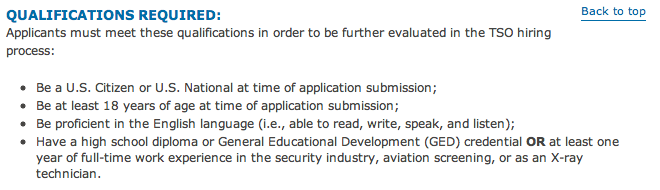
    I say this because here is the requirement for being a TSA screener:

    Those aren’t stringent requirements, and yet they are (as the TSA would have you believe) the people on the front lines protecting this country from terrorism. Yeah.

    [By comparison here’s what it takes to be a Special Agent with the FBI](https://www.fbijobs.gov/1111.asp). [And then here’s the application process.](https://www.fbijobs.gov/112.asp)

    You may not like the FBI, but not just anyone can be *in* the FBI. And that’s the difference. The TSA was built out in a couple of months and staffed as quickly as possible with the most readily available people — and that’s why the TSA is as bad as it is.

  • TSA: Keeping Us Safe from Terrorists and Our Own iPads

    The “Fair & Balanced” Fox News:
    >A Transportation Security Administration (TSA) official has been charged after being accused of stealing eight iPads from luggage at Dallas/Fort Worth International airport, KXAS-TV reported.