Year: 2012

  • ‘Five Tablets That Go Where the New iPad Doesn’t’

    After listing four pieces of crap, Eric Franklin says the iPad 2 is where it is at because:
    >That’s right. The best alternative to the new iPad is the old iPad, or as it prefers to be called, the iPad 2. It’s thinner and lighter than the new iPad and has the smoothest and most responsive touch interface of any tablet on this list.

    Forget about the fact that it doesn’t have:

    – LTE
    – Retina display
    – Twice the RAM (smoothness, responsiveness?)
    – More advanced and smooth graphics processing

    Nah, forget about that stuff because Eric Franklin says it doesn’t matter — instead just go buy an iPad 2, or maybe the Toshiba Thrive — surely you won’t regret that.

  • Google’s Innovation

    James Whittaker sharing thoughts on why he left Google:
    >Even worse was that innovation had to be social. Ideas that failed to put Google+ at the center of the universe were a distraction.

    This post is a very interesting read, beyond what is quoted here, or on *Daring Fireball*. Whittaker actually paints a pretty bleak picture for the future of Google.

    [via DF]
  • Quote of the Day: Ryan Block

    “When the software provides the metaphor for the device, every tablet lives and dies by the display and what’s on that display.”
  • Blogging About Blogging

    Earlier today [I linked to the Curator’s Code](http://www.curatorscode.org/) crap — actually I linked [to *The Loop’s* take on it because I agree with Dalrymple](http://www.loopinsight.com/2012/03/12/code-of-conduct-proposed-for-content-aggregators/):

    >How about just stop stealing other people’s shit.

    I have never been excited that someone gave me a `via` link. Often people ask if I want one when I share something with them via DM or iChat — I usually say “I don’t care.”

    Because I don’t care.

    I think the curator’s code deal is pretty stupid and inconsequential, [but Marco Arment brings up an interesting point](http://www.marco.org/2012/03/12/not-a-curator):

    >The real problem is that these posts replace the need for the source link.

    >Sites that do this can call this practice whatever they want. Often, it’s called aggregation, or simply reporting. There’s a continuum between 100% original reporting and zero value being added to the source content, but I don’t think I’m being unnecessarily inflammatory by labeling the posts on the far end of the continuum as rewriting.

    I absolutely hate the way *The Verge* cites posts — so much so I can’t read the site. Rewriting is the true problem — not adding in more `via` attribution. The problem I face is when I write a post like this that is somewhere between a linked list post and an article post — on these types of posts I try to make source links really long, more than a few words. That seems decent enough to me.

    I tend to find the people who whine about `via` attribution to fall under two categories (in general, as always, there are exceptions):

    1. News breakers. These are the guys that break news and are truly *the* source of the news.
    2. Small sites that linked to something and believe that a larger site *got* that link from them.

    I totally agree with the first and the second — well I have been there, but let me share a secret: `via` attribution links don’t give you very much traffic and certainly not lasting readership.

    I try to stay away from these debates, because blogging about blogging isn’t really interesting to anyone but bloggers. But I decided to write about this to state why/when I use such attribution.

    I use `via` attribution when it feels right.

    There’s no set rule and often I don’t remember where I found the link to begin with so I can’t put attribution on links that I sometimes wish to. Oh well: do what feels right.

  • Be More Productive With LaunchBar

    I thought I knew LaunchBar, but I don’t know it as well as Dan Frakes does.

  • Twitter Buys Posterous, Well the Posterous Team

    From the Twitter blog:
    >Posterous Spaces will remain up and running without disruption. We’ll give users ample notice if we make any changes to the service. For users who would like to back up their content or move to another service, we’ll share clear instructions for doing so in the coming weeks.

    Translation: this *is* your notice.

  • Quote of the Day: Jonathan Ive

    “A product has to be genuinely better. This requires real discipline, and that’s what drives us — a sincere, genuine appetite to do something that is better.”
  • AT&T 4G LTE Coming Soon to Twelve New Markets

    In case you got [duped into buying an AT&T iPad](https://brooksreview.net/2012/03/marketing-bullshit/) because you thought they had ‘real’ 4G in your area, you may get LTE yet.

  • TextExpander [Sponsor]

    Do you type the same things again and again? TextExpander will save you time and keystrokes.

    Just assign short abbreviations to your frequently-used snippets of text and TextExpander does the work for you. You can also use one of the included snippet libraries for HTML, CSS, autocorrection, accented words and URL shorteners.

    Try it out – there’s a free demo at [Smile Software](http://click.syndicateads.net/2012/03/TextExpander/brooksreview.html). And you can get 20% off TextExpander through March 31. 2012. Use the coupon code SYN0312 in the [Smile store](http://sites.fastspring.com/smile/product/te?coupon=SYN0312).

  • Gowalla Shuts Down

    Can’t say I am surprised to hear that.

  • You Can Sign-up, But You Can Never Leave

    [On March 6th I wrote](https://brooksreview.net/2012/03/explanations/):

    >Right now — I don’t want anything to do with Readability. I am, however, going to let things cool down before making a final decision.

    [Later that same day John Gruber linked to that post and said](http://daringfireball.net/linked/2012/03/06/brooks-readability):

    >Like Brooks, I’ve never been comfortable with the way they collect money on behalf of publishers. And their app is nowhere near as good as Instapaper.

    Once Gruber posted that I started to get a flood of comments from friends. The common theme was: “I agree with you.”

    I didn’t want to make a decision that day, but as I read more and more about Readability it made me sick.

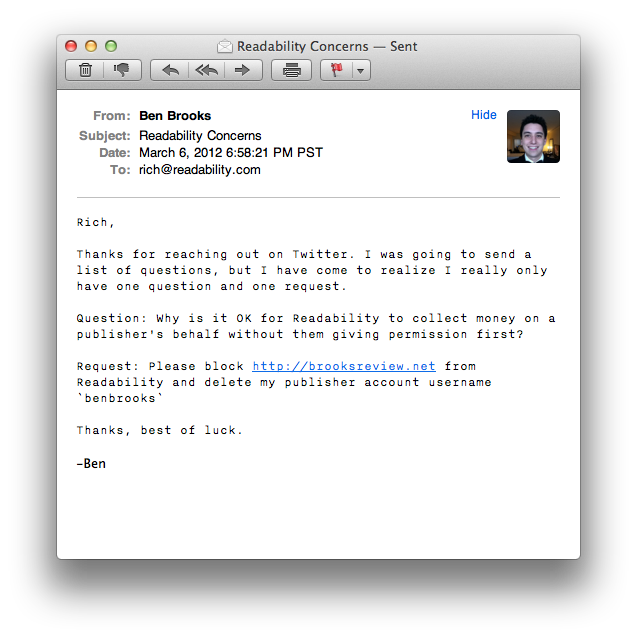
    Rich Ziade of Readability reached out on Twitter asking me to ask him any questions. I took him up on it and sent this email to him:

    As of this writing I still haven’t heard back, but I also used the contact link in the help section to request that https://brooksreview.net be blocked from Readability and that my publisher account be deleted — you see unlike a user account there is no `cancel account` link.

    Again, as of this writing, I still have not heard back and https://brooksreview.net is still not blocked, my publisher account is also still active.

    [Readability states](http://help.readability.com/customer/portal/articles/267462-how-can-i-opt-out-of-readability-view-):

    >If you don’t want your website content to be available in Readability view, you can exclude your content from being processed by contacting us directly. We’re always happy to help.

    Except I asked them to do this five days ago and not only has it not happened, but they seem to just be ignoring the request.

    That seems awfully shady.

    Update: Chris Dary of Arc90 responded to me on Twitter and got me opted-out. Thanks to him for that.

  • ‘Read It Later vs. Instapaper vs. Readability’

    Christine Chan does a nice job breaking down all three read-it-later services. What I don’t quite get is this tidbit from her article about Instapaper:

    >While it does the basics fine, I will admit, the typography and overall design of the app currently does not have the “polish” that everyone sees in Readability.

    There’s actually a lot of “polish” in Instapaper. Instapaper just doesn’t have custom fonts, but that doesn’t mean the fonts that it has are bad — they just aren’t new and shiny. Personally I think Readability did a really nice job designing their app, but it’s got a long way to go to match the usability of Instapaper.

  • The B&B Podcast #51: That’s How I Know It’s a Telemarketer

    This week Shawn and I talk about iPad stuff, retina Macs, battery life, the design tweaks I made to this site and all the confusion with AT&T 4G.

    Side note: We are now on 5by5, having joined the ranks of some very impressive nerds. I want to thank Dan for all the work he did moving the podcast over so that it doesn’t hinder any of the listeners.

  • New iPad’s Most Revolutionary Feature Is Its Battery

    Adrian Kingsley-Hughes:
    >Between the release of the iPad 2 last year and the announcement of the new iPad yesterday, Apple has nearly doubled the capacity of the battery, taking it from 25Wh to a massive 42Wh. Measured in milliamps this boosts the battery from 6944 mAh to a monstrous 11,666 mAh.

    I can’t wait for those efficiency gains to spill over in laptops and the iPhone — that should be great.

  • iPad vs. MacBook Air and iMac

    Horace Dediu:
    >The only value that a desktop of 2008 has over a new iPad is the size of the screen and a larger hard drive.

    That is pretty amazing.

  • iA Writer for iPhone

    iA Writer is now out for the iPhone (universal app) and it looks fantastic. I do most all my long form writing in Writer — love it.

  • Instapaper Placebo

    Classic and well done.

  • ‘Forget LTE — the Real iPad Wireless Story Is Bluetooth’

    Kevin C. Tofel points out that the iPad will now sport Bluetooth 4.0, which is a very nice upgrade. He lists out the reasons why it is great, including extra battery management. Here’s hoping that Apple adds this to all its devices, especially the keyboard and mouse — because man do they churn through batteries.