Category: Articles

  • App Silos

    My [recent post on Dropbox versus iCloud](https://brooksreview.net/2012/12/linchpin/) sparked a [little debate on App.net](http://treeview.simon.geek.nz/home/thread/2187381#a2187381) (click the link below the last comment to show all comments) and in my inbox. The common thread that I have seen from naysayers — those who believe Dropbox will always be better than iCloud — is simply that access to the file system is still needed. People believe that file system access is not only wanted, but necessary for *any* advanced computer user. I find this line of thinking short-sighted: Looking more at “the now” than “the future”.

    Dropbox is the best of the best right *now*, however, Dropbox is not likely the best for the future. Future technology is going to look more like iCloud than it does Dropbox — we know this already because tablets and smartphones are far more popular than computers and when is the last time you popped open Finder on your iPhone? This, understandably, worries many geeks.

    People don’t want to be tied to one app for a certain file type, stuck in these app silos where the data only exists within one app. This feels like a dictator telling us how we can use *our* devices and it understandably rubs advanced users the wrong way. Moreover the huge fear is that if we go the way of obscuring the file system, like it is in iOS, advanced users will be stuck in a world where we lack control over our own creations.

    You can see this pain right now by saving a PDF to iCloud in Preview on your Mac and then trying to retrieve that PDF on your iPad. You can’t retrieve it on your iPad because there is no Preview for iPad that can access that file. And even if you have PDFPen installed on your iPad, you still can’t access that PDF file. This is a legitimate problem.

    More frustrating still is that many users see this as restrictive and unnecessarily constraining a user to one single app. What if you want to write in ByWord on your iPad, Simplenote on your iPhone, and iA Writer on your Mac? The only way to “share” one file between the lot is with Dropbox, not iCloud.

    And while it’s up to Apple to solve the stupidity that is iCloud in TextEdit and Preview, the larger problem of obscuring the file system seems easily cured by Apple.

    The only thing that iCloud really needs is an iOS style “open in” dialog for transporting files around. Add that dialog to all iCloud enabled apps and I can’t see any need for Dropbox if you stay within Apple’s “world”. ((Meaning you use iOS and OS X only.))

    Users don’t need to see the file system as much as they just need to be able to open their files in any app that they wish. You could argue that you like folders, which mix file types, but I think it’s becoming clear that this is just not as necessary as many people *think*.

    Enter: [Plain Cloud](http://cookingrobot.de/plaincloud/).

    Plain Cloud is a little app that lists all iCloud apps with how many files each app is storing in iCloud. Click on an app and Plain Cloud opens the folder containing those files in Finder. Very simple.

    This doesn’t solve all problems geeks have with iCloud, but for users in between novice and geek, a tool like Plain Cloud actually makes iCloud *easier* to grasp and use than Dropbox. (Easier to understand too.)

    Here’s the iCloud workflow for typical users:

    1. Enable iCloud
    2. Open files from a dialog that pops up listing all the files you have made in that app.
    3. Saving is automatic.
    4. If you ever need access to a specific file outside of iCloud, open Plain Cloud.

    That’s an order of magnitude easier than the same workflow with Dropbox. Dropbox requires you to authenticate, select where you want the file saved, find that same location when you want to open the file, and choose the app to open the file with.

    Basically: Dropbox requires using Finder, and [Finder sucks](https://alpha.app.net/rands/post/2260591).

    iCloud requires that you use Finder via an “open” dialog, but that dialog is friendlier looking and better designed than Finder itself.

    The biggest shortcoming I see with iCloud is simply that it’s Apple only and yet I’m not sure how much that shortcoming matters. iCloud is a huge selling point for Apple if, and *only* if, it’s widely liked, which bodes well for users hoping things get better.

    I think the easiest way for Apple to appease those less than impressed with iCloud is to add the “Open in…” dialog to all iCloud apps and finally allow users to “share” iCloud documents between apps.

    This is not to say that Apple will change anything fundamental about iCloud. I don’t think we will see a move towards Dropbox-like ubiquity, but I do think Apple will make a few smaller tweaks that effect how apps interact with iCloud, which will greatly improve the service.
  • But These Ads are Pretty Ads

    John Gruber [makes a bold claim, while commenting on Sullivan’s post](http://daringfireball.net/linked/2013/01/02/the-dish):

    >DF, among [other](http://decknetwork.net/) notable examples, is living proof that advertising can be quick-loading, noticeable but un-distracting, and unrelated to the corrupting influence of pageviews.

    I hold Gruber’s site in very high regard, but his assertion that ads from The Deck are living proof of an ad that is “noticeable but un-distracting” is pure hyperbole.

    I reloaded that *Daring Fireball* article at least 50 times and grabbed screenshots of the page with every new ad shown — 14 in total. Of those 14 new ads, I tested each by looking at them one after another and I found that 7 pulled my eye immediately from the content to the ad. That’s not what I would call “un-distracting”. Fifty percent of the ads *were* distracting (albeit in a highly subjective test) — I think a better term for ads from The Deck would be: *less* distracting than any other ad on the web.

    The problem that publishers face is that ads *must* be distracting to be effective. That’s why I hope Sullivan succeeds: he’s going paywall without ads. I wish more people had the balls to do that.

    This is also where Gruber is getting tripped up with ads from The Deck: They are indeed great ads, mostly (there was one American Apparel ad that featured a nude woman only covered by a red bag — not offensive to me — but I’d be pissed if that was on my site) but no matter how great an ad looks, it’s still an ad. Ads are made to distract — even if just a little — it’s still a distraction.

    So here’s hoping 2013 is the year that content becomes king and advertising is shown the backseat, or better yet, the door.

  • Don’t Call it a Paywall

    [Andrew Sullivan’s ‘The Dish’ is leaving *The Daily Beast* to strike out on their own, with no ads and a paywall (which works much the same as *The New York Times’* paywall).](http://andrewsullivan.thedailybeast.com/2013/01/a-declaration-of-independence.html) Nothing new, but (and it’s hard not to do this) Sullivan, of course, thinks this is a “new” idea.

    I love Sullivan’s paywall misdirection too:

    >There is no paywall. Just a freemium-based meter.

    Yep and I don’t have to pay for my gas either. Instead I just pay to use the pump.

    Let’s make this really simple for all publishers: if a reader has to pay to access any portion of your content, then you have a “paywall” in place. Plain and simple: *The Dish* is getting a paywall. [Shawn Blanc has a podcast that has a paywall around it](http://shawnblanc.net/members/).

    Now, I for one, don’t think there’s a damned thing wrong with this — but “paywall” is one of those words that marketing types spend months coming up with clever name-arounds for, so they never have to say what they really have: A paywall.

    I’m not a Dish reader ((Nor do I subscribe to Dish TV.)), but I do wish them the best and by all accounts it’s off to a great start. At $19.99 a year this seems like a steal for the amount of work they do.

    I had a quick chat over email with David Holmes, writing for *Pando Daily*, about this and I think he sums up [his article](http://pandodaily.com/2013/01/02/andrew-sullivans-blog-is-adding-a-pay-meter-does-that-mean-you-should-too/) perfectly:

    >I’m not saying aggregation, when done right, doesn’t have value, [a]nd Sullivan and his crew are among the best at what they do. But oxygen has value too, and no one pays for that. We only pay for what we can’t get for free.

    The struggle with any paywall is convincing people to pay while keeping some free content. This is the same problem I have: Subscriber growth was all but flat last month, while I’ve been working harder and harder to produce better content (and spending money doing so). That’s not a complaint, it’s a cold hard fact about paywalls.

    Paywalls are just harder than advertising. But if you *can* make them work they *will* eventually pay better and better with each new reader. The same can’t be said for advertising.

    The trick is convincing people to pay for what they previously got — or can get — for free. I do that by [charging for timely access to articles](https://brooksreview.net/members/), whereas *The Dish* will limit the amount you can read each month. Both approaches *can* work but are harder to *make* work than an all-out Paywall like *The Financial Times*.

    An all-out paywall is something I have seriously considered. I decided against it for one simple reason: I’d rather have my work read by more people than make more money.

  • One Computer

    *Note: This article first appeared in [The Magazine, Issue 4](http://the-magazine.org/4).*

    Recently I [mentioned](https://brooksreview.net/2012/06/yojimbo-sync/) in passing how I had moved from a one-computer setup to a two-computer setup: keeping one machine at work and one at home. I further differentiated the machines by only having work-related items on the work machine (so Mail.app only had my work email account on it and so forth). My work machine was my MacBook Air, while the machine at home, a retina MacBook Pro, had both work and personal stuff on it.

    This seemed like an ideal split. I never sent email from the wrong account. I felt more efficient at work. And I only had to carry my iPad from home to work and back. But it was only a few weeks before the drawbacks set in and I reverted back to a single machine that I always bring with me.

    The speed differences between the two computers and the lack of a Retina display on the MacBook Air I had predicted would bug me *before* I divided my life into two computers. In fact, I didn’t notice these hardware factors most of the time. The real reason I went back to just one machine is that it remains too hard to switch seamlessly between two machines without missing a beat.

    Yes, I can synchronize files using Dropbox and keep documents and other settings up to date with iCloud. Those two services get you close, but they fall short of the seamlessness that I want while working. Every switch is jarring, reducing my efficiency and causing me to duplicate efforts.

    For instance, I use Keyboard Maestro to handle macros, and the program doesn’t yet have synchronization built in, nor allow a straightforward way to keep sequences up to date across multiple computers. The [support wiki notes](http://wiki.keyboardmaestro.com/Syncing_Macros_Between_Macs), “So to sync the macros file you must ensure the Keyboard Maestro editor is not running on the target Mac, and you must explicitly ask the target engine to reload the macros after the sync.” This is exactly the sort of thing I didn’t want to have to manage.

    If a Keyboard Maestro macro was only made on one machine, not the other, I couldn’t use that macro without remaking it. More often, I edited the macro on one machine and not the other, which is actually *more* annoying because I don’t remember the small edit and/or which one was edited — meaning I just had things not working consistently across two machines.

    I ran into a number of other problems that didn’t seem at first to be as significant. I’d find I had installed an app on one machine, but not the one I was using. I would forget to log out of Messages. I disliked having to take the time to install updates on two different machines when, in my working style, I wanted both to be identical—as if they were the same computer.

    But what put me over the line was not being able to keep the “state” of both machines identical. Even though I use Coda 2 on both Macs, if I was working on a code change on one Mac right before I had to leave, I would have to:

    – Save all changes.
    – Head home or to work.
    – Open Coda 2 on second machine.
    – Connect to site with files.
    – Open every file I had open.
    – Remember where which file I was editing, and which line.

    That’s not horrible, but it was a huge pain. With two machines you simply cannot step from one machine to the next and pick up work where you left off. (You might argue Coda 2 could make this easier, but then you need to argue that every piece of software should preserve state across multiple computers.)

    From my working perspective, the two-computer setup was like having a malfunctioning magic desk. All the papers would be transported from one desk to another, no matter where it was, with no effort. Except when I arrived at the new desk, all of my papers were mystically mixed up. Sure, the papers were all there and ready to use, but they weren’t where I left them.

    I returned to lugging around a retina MacBook Pro wherever I go rather than having to deal with the constant “setting up this desktop to match the other desktop” routine. Until a point at which the precise working environment of a computer seamlessly shifts from place to place, one computer just works better.

  • Follow-Up On Black iPhone 5 Nicking

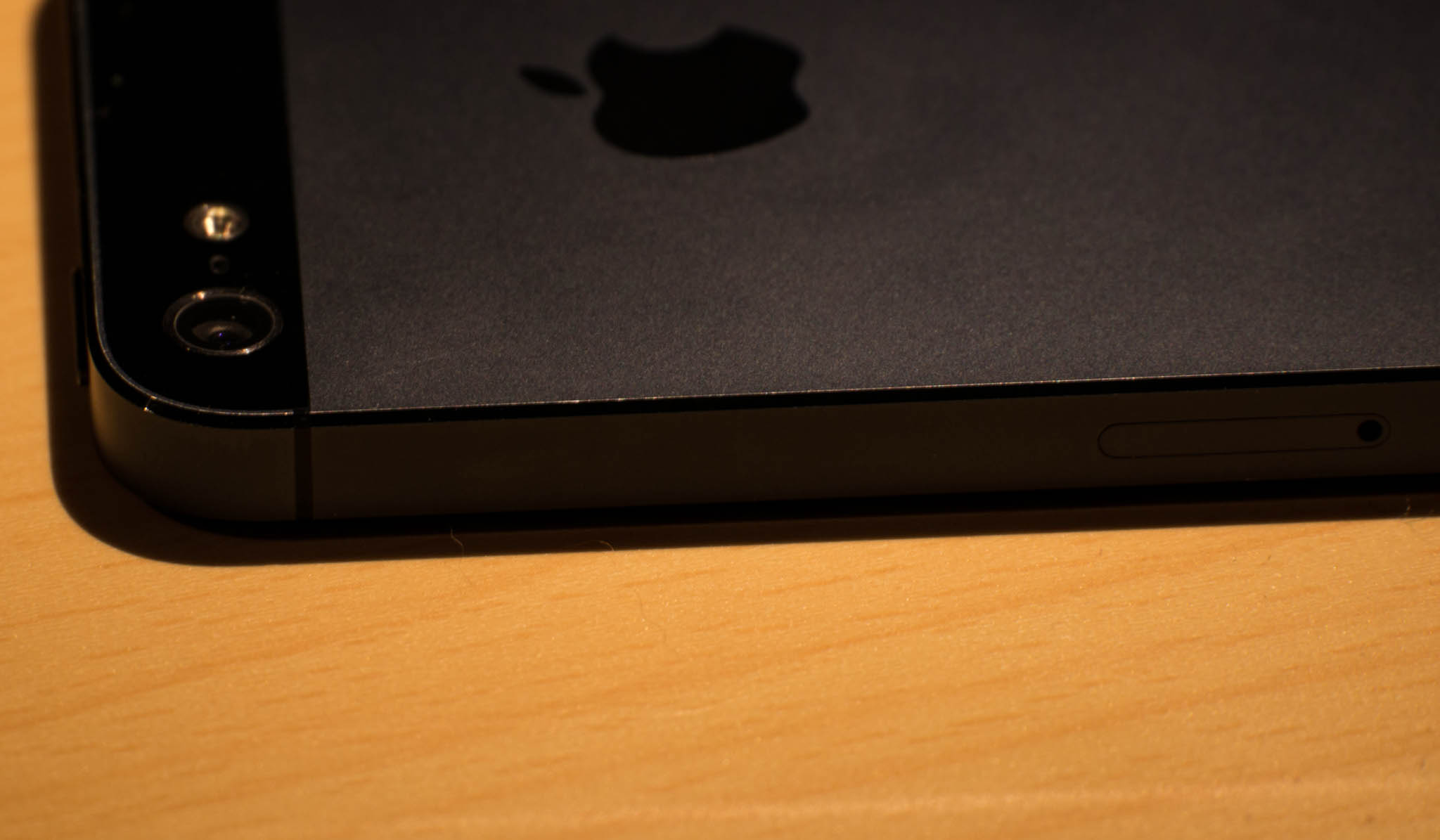
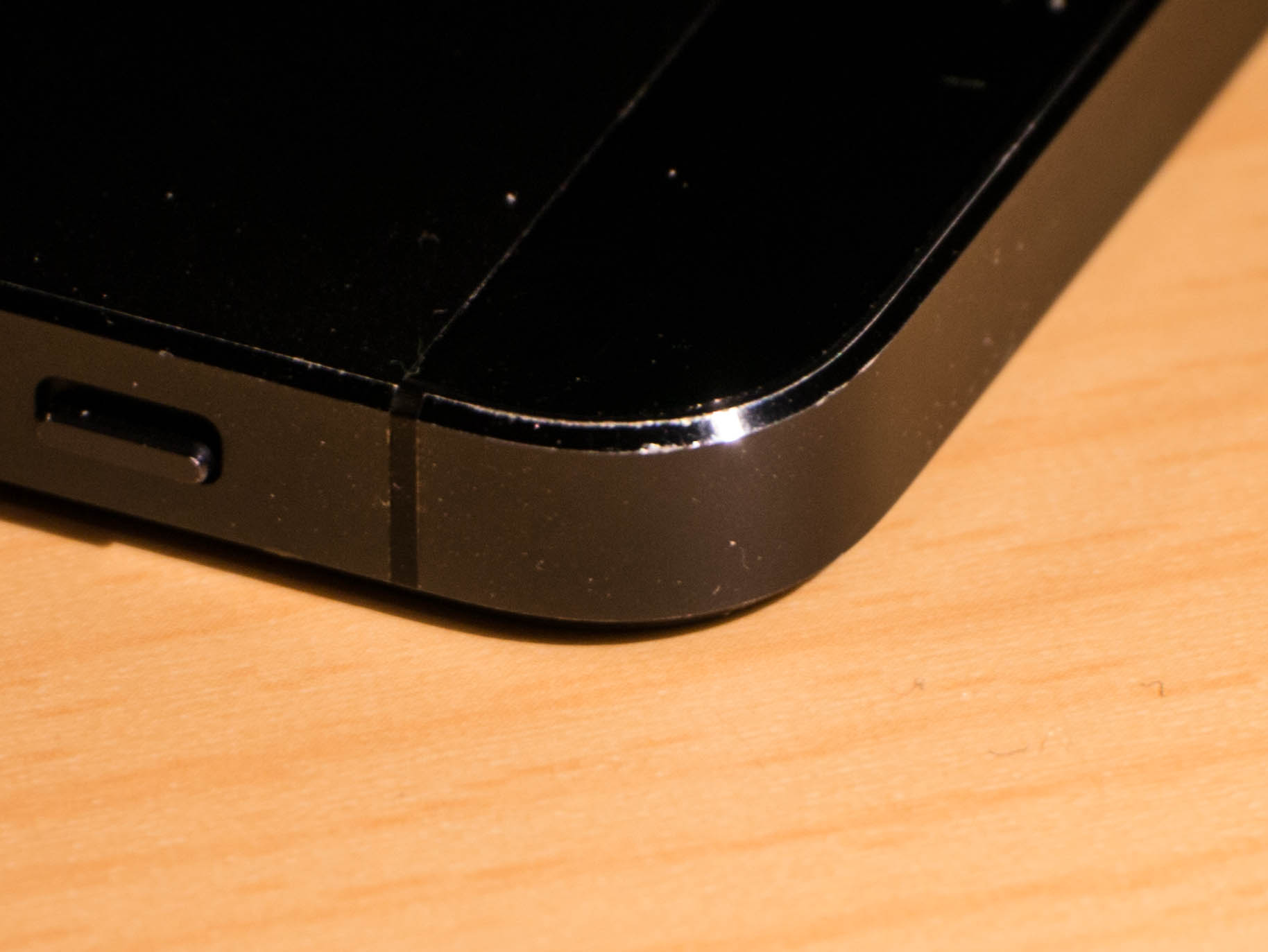
    [I posted, when I received my iPhone 5, that the black model appears to have a nicking issue along the edge band where the metal is actually painted](https://brooksreview.net/2012/09/nicked-black/). This problem has not subsided for me and I know a few people that have taken back their iPhones multiple times over this issue.

    I use my iPhone 5 everyday, keep it in a pocket alone, and never use it with a case, I also don’t baby it when it is out of my pocket. I, of course, take care not to intentionally damage my iPhone, but wouldn’t hesitate to set it down on a rough surface.

    Basically I use the phone, but I don’t abuse it.

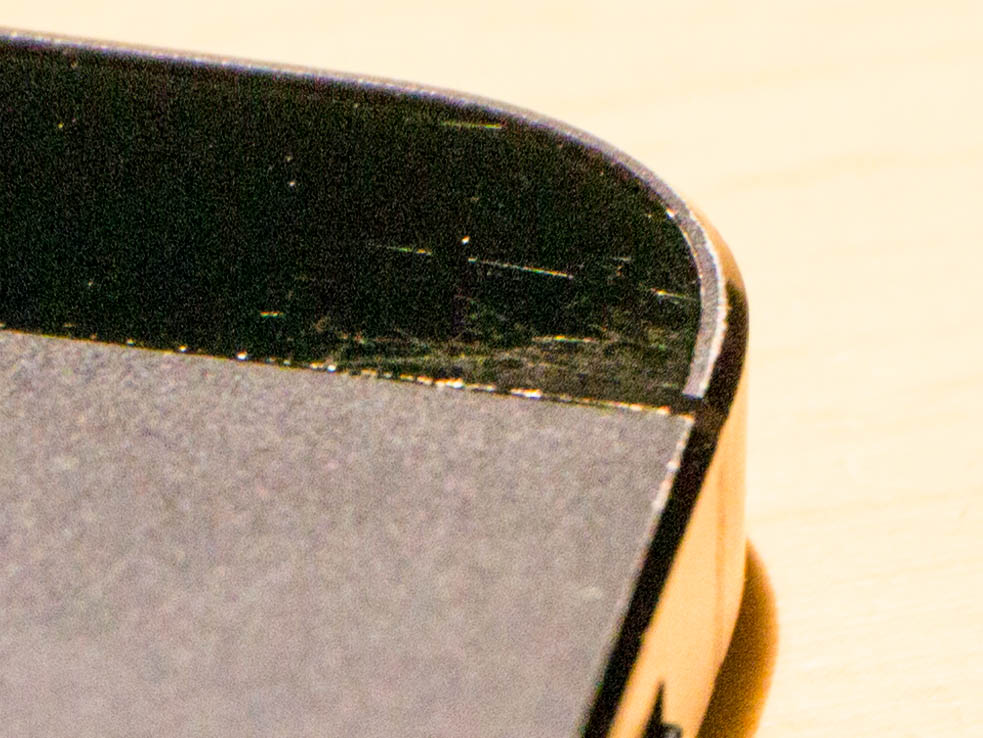
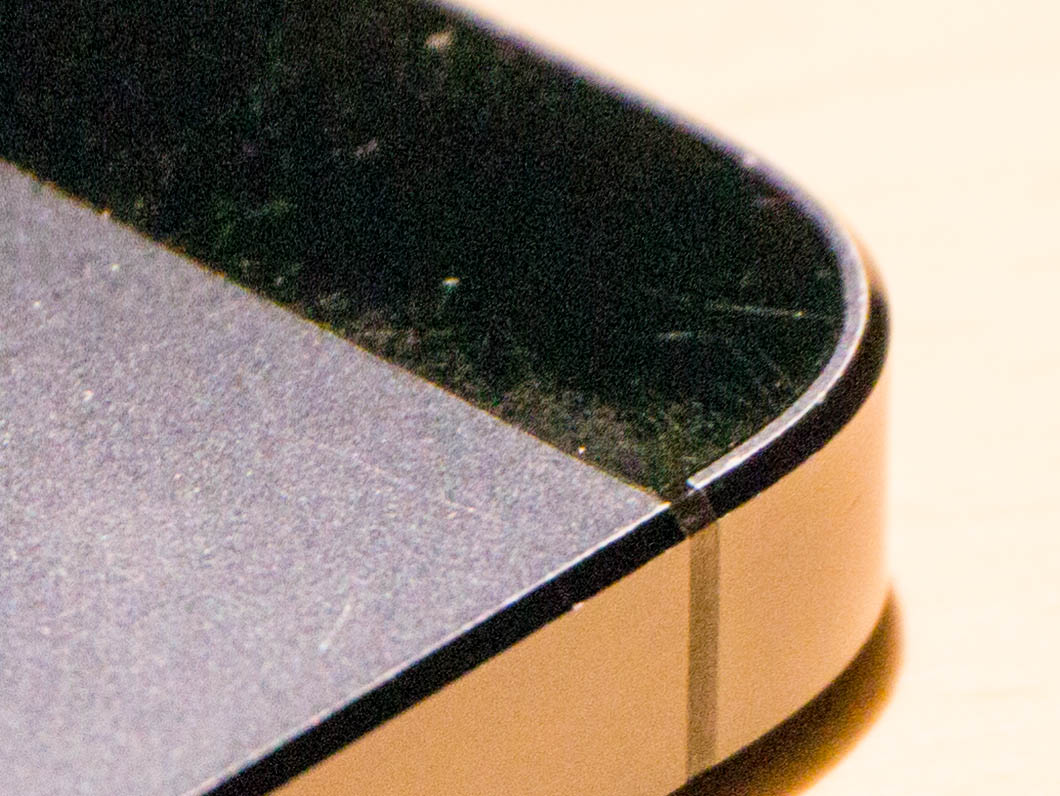
    Since September my black iPhone 5 has two cosmetic problems that are unlike those that I saw in the iPhone 4/4S.

    ## Scratching

    Scratches in top right corner.
    Scratches in bottom left corner.

    The two rear glass panels on my iPhone 5 have significant scratching in two corners — both corners opposite each other. You can feel that the glass is raised in both of these corners, and flush with the metal on the other two corners (where no scratches exist — this is not something that I caused).

    The pictures you see have been enhanced to better show these scratches, but I assure you that you can see the scratches with your eye under normal light (you just can’t photograph them that well under normal light).

    These scratches don’t bug me that much, but it’s an odd manufacturing misalignment that has led to them.

    ## Nicks


    Well the nicking problem never went away. As you can see from the photos (again enhanced in Lightroom to better show the scratches), the edge continues to wear down specifically in the corners of the bevels. However it is only the very edge of the bevel that gets scratched, which makes it a bit harder to see.

    Overall this is the same issue that any woodworker would tell you is a result of not easing the edges enough. It’s very hard to get paint or stain to adhere properly to a sharp edge.

    ## Verdict

    Get the white iPhone 5 if this sort of thing bothers you. It bugs me, but I knew this may happen when I chose black and I am thus OK with how things have turned out.

    I do hope that with the next iteration of the iPhone these issues are resolved because the black model looks far better than the white.

  • Quote of the Day: Terence Eden

    I did have a quote from Terence Eden, then I found out what a [douchebag he is](https://posts.app.net/2269200).

  • ‘Why I’m Quitting Instagram’

    [A very smart post from Ryan Block surrounding his departure from Facebook and Instagram](http://bits.blogs.nytimes.com/2012/12/31/126113/):

    >In my search for technology products and services that somehow enrich or add value to my life, Facebook and Instagram have been a net negative not only in their usefulness, but also in other, subtle ways most people don’t often consider.

    At the end of his post, Block turns the most often asked question back on people in a very smart way:

    >People wondering what there is to gain by thinning their online accounts sometimes ask: “Why quit?” Instead, I think every once in a while we should all ask ourselves: “Why stay?”

    [I’ve seen, and heard of, many conflicts](https://brooksreview.net/2010/11/facebooo/) that have started because of a stupid Facebook comment, “like”, or “tag”. It’s so dumb to me that at times I have a hard time stopping my eyes from rolling. ((It’s to the point where my wife knows better than to bring up that a fight started on Facebook to me, lest I go off on a 40-60 minute rant about how stupid that is.))

    These [small slights that people perceive](https://brooksreview.net/2011/05/follow/) with online social networking drive me further and further away from services where people are no longer rational.

    I think that is why I like App.net so very much. The paid nature of the service means that users of the service respect what is going on *more* than they do on free services. I’ve had plenty of negative comments on App.net, but rarely are they stupid negative comments like the ones I am used to in my inbox and on Twitter.

  • ‘Keyboard Maestro Macro: Append to Evernote Note’

    [Isko Salminen has written a post about appending your quotes to an Evernote note with Keyboard Maestro](http://iskosalminen.com/2012/12/19/keyboard-maestro-macro-append-to-evernote-note) instead of appending them to a text file, [as I do](https://brooksreview.net/2012/12/km-append-quote/).

    This is a particularly clever solution because it uses the Keyboard Maestro `Open URL` action to grab the same Evernote note each time. I’m not an Evernote user, but the URL scheme seems like a great feature of Evernote.

  • Delay Standby

    [Erv Walter has a great tip for delaying the standby mode](http://www.ewal.net/2012/09/09/slow-wake-for-macbook-pro-retina/), which kicks in on new retina MacBook Pros and Airs after an hour, to a more reasonable user configurable time.

    Walter chose 24 hours in his example, personally I went with four hours (14,400 seconds).

    Standby mode is very annoying when you expect to be able to quickly use your Mac, only to find yourself waiting for the RAM to have the data written back to it.

    Which brings me to another thought: why does anyone care about laptop standby times? I doubt there are many people who don’t use their Macs for 30 days and therefore rejoice that the battery will last that long. I get wanting standby time for a weekend, or even 10-14 days for people that go on a long vacation, but 30 days? Seems a bit excessive to me.

  • Updated Items for the week ending December 28, 2012

    Things updated substantially (always posted at the bottom):

    – [The Rectilinear Top Load Backpack](https://brooksreview.net/2012/12/gr1/)

  • Thirty

    When I turned twenty-five, five years ago, my wife can attest to the minor life crisis I suffered leading up to the event. I felt old, I wasn’t where I wanted to be, and *everything* mattered.

    Today I am thirty. ((December 28, 2012))

    I am closer to where I want to be, have managed to keep my emotions about turning thirty to a minimum, and realize that only a few things in life matter.

    And so, as bloggers do, here are thirty things that I *think* I know:

    1. The government is not infallible, and often egregious in the decisions they make, take note and speak up when they are wrong.
    2. Some asshole will always drive slow in the fast lane. Said asshole will justify it with the rationale that there is no such thing as a fast lane. You can refute with the tried and true passing lane logic: “Technically it is the passing lane, and by definition then you *must* be passing someone to be in it. Therefore you *must* be traveling faster than those in the right lane(s) to be in the left lane.” At the end of the day, this won’t work. Neither will riding their ass, honking, or using *Top Gun’s* “international greeting”. However, all of these things *will* make you feel better.
    3. Ignore people that constantly ask for your opinion, only to then refute your opinion. They don’t care to actually listen to your opinion, so you shouldn’t care to waste your breath.
    4. People will never stop blaming their incompetence on the day of the week. “It’s Monday so I am just dragging today.” “No one works on Friday, that includes me.” It is best to avoid these people, they are the ones going no where fast and have yet to realize the day of the week doesn’t matter much any more.
    5. Early morning meetings have the potential to screw over the rest of your day. Avoid early morning meetings at all costs — always get a couple of hours of work in before your first meeting.
    6. No one wants to work on Friday (see number 4), so it’s a great time to catch up. Also a great time to schedule a meeting, late in the afternoon, to ensure that it will be a short meeting, or a cancelled meeting. (Additionally, choosing to work over “bank holidays” is another great way to get a lot done.)
    7. The Electoral College is bullshit.
    8. Well tailored clothes make you look 50% better — no matter how cheap the clothes that are well tailored were when you purchased them.
    9. Facebook is changing our culture in a way that I hate.
    10. A lot of paranoid people are crazy, however most people are simply not paranoid enough — which is also crazy.
    11. If you simply nod and say “I understand” when you first meet people, you will learn far more about them than they learn about you (they will just assume that you agree with them). Don’t fall into the trap of assuming people agree with you based on the fact that they did not refute you — that’s a suckers game.
    12. You should never be surprised when an idiot does something idiotic. We know this, but it is also important to just realize that idiots will be idiots and that is just how it is. Anger about this fact will get you no where.
    13. Likewise, someone who is constantly doing idiotic things is likely also an idiot — you just may not be willing to label them as such.
    14. Telling someone that you were right is far less satisfying then letting them learn you are right on their own.
    15. It’s only a secret if you don’t tell anyone, and it doesn’t matter how many times people tell you this, because it’s one of those things you just have to learn the hard way.
    16. Features, specs, and checklists are irrelevant. The best thing you can get is specific to you and so you should take any review not written by you with a grain of salt.
    17. Whenever you check out at a store and the little credit card reader asks if you want to donate to XYZ charity — just donate a dollar. It takes no extra time, you probably won’t notice the missing dollar, and you will be doing something good while you buy your Cheetos.
    18. Coke drinkers always tell themselves that Coke is better than Pepsi in the same way that Android users convince themselves that Android is better than iOS.
    19. Saying things like the above, number 18, will fill your inbox every time.
    20. Don’t give a shit about what people think of your honest opinion. If you think Android is better than iOS, Windows better than Mac, and Nikon better than Canon — so be it. You’d be wrong, but at least you’re standing for what you believe in, and that’s more important.
    21. Life is a lot easier if you set two standard drinks: one non-alcoholic and another alcoholic. Keep both simple, the more complex your order, the bigger an asshole you look like. (Doubly so with coffee orders.) Make sure both are common enough that even a dive bar will have them. (I went with Pepsi/Coke and Makers Mark on the rocks.)
    22. Respect matters to people (well most people) more than money or gifts. If you want to retain an employee/tenant/anyone just treat them with respect — whatever respect means for the relationship you have with them — it will go further than any gift or money will (mostly).
    23. Expect the worse of the weather and be prepared. If forecasters say no snow, but it’s going to be low 30s and raining — expect snow. Forecasters use models, you should use common sense.
    24. You have no right to complain for something that was free, so pay for your stuff and you won’t look like a fool when you complain about it.
    25. Own your weaknesses. I know I’m not good at sports or grammar and a ton of other things. It is because I know this that I am willing to seek help and take advice on these matters. I was only able to do that when I admitted that I sucked at these things.
    26. The little things matter.
    27. Except when they don’t.
    28. When you feel like shit, smile. Smiling goes a long way and if you can get someone else to smile because you smiled, your fake smile might become a real one. And, if even just for a moment, you might feel better.
    29. There’s nothing better in life than making a baby giggle.
    30. Lists like this are often full of bad advice.

  • Keyboard Maestro Macro / AppleScript: Mail This Selected Item

    *(This post is a part of a series on Keyboard Maestro, [see more here](https://brooksreview.net/tag/KM-SERIES/).)*

    As part of my job I compile a monthly PDF report which I send out to the owners of properties I manage. I do this for quite a few properties every month.

    When I started I used a bunch of TextExpander shortcuts to build the email, but this soon became too cumbersome. Not one to rest, I eventually built a Keyboard Maestro macro based off of Automator to send these files. Using Automator allowed me to pre-fill all the info in the email, with custom dates and `To` fields, but Automator has a significant downside.

    Anyone who triggers Automator via Keyboard Maestro knows that Automator is a really slow tool to use. I would be waiting for my computer to think and work before I could do anything else and this drove me nuts.

    I immediately started to work with AppleScript to try and replace Automator — I figured out how to do everything except automatically attach the selected file from Finder. The more I searched, the less I came up with a solution. Until [Eelco Lempsink](http://tupil.com) got in touch, responding to my plea for help on App.net, Lempsink sent over an awesome AppleScript that builds a new email with the selected Finder item attached.

    So with Lempsink’s permission, [here’s the AppleScript he built](https://f3a98a5aca88d28ed629-2f664c0697d743fb9a738111ab4002bd.ssl.cf1.rackcdn.com/mail-attach-fixed-again.zip):

    tell application "Finder"
     -- Make a list to gather the names of the selected files
     set fileAliases to {}
     -- Get the selection of the frontmost Finder window
     set fileSelection to the selection
     -- Iterate of the selection
     repeat with fileItem in fileSelection
     copy the fileItem as alias to the end of fileAliases
     end repeat
     -- Check if the selection is not empty
     if the number of items of fileAliases is 0 then
     -- Audible feedback, so the script always does something.
     beep
     else
     -- Now talk to mail to create the message
     tell application "Mail"
     set newMessage to make new outgoing message at beginning with properties {visible:true}
     -- Attach all the selected files
     repeat with fileAlias in fileAliases
     make new attachment with properties {file name:fileAlias} at after the last paragraph of newMessage
     end repeat
     -- Put Mail in the foreground
     activate
     end tell
     end if
     end tell

    When executed this AppleScript grabs the selected Finder item(s) and attaches them to the email. For my purposes I needed to add a bit more to it so that I didn’t have to touch a single thing in the email before I sent it.

    [Here’s my modifications](https://f3a98a5aca88d28ed629-2f664c0697d743fb9a738111ab4002bd.ssl.cf1.rackcdn.com/Maill-attach-Ben-Mod.zip):

    -- Variables
     set theSubject to "PROPERTY NAME Owner's Report"
     set theContent to "Let me know if you have any questions. -Ben"
     set recipientAddress to {}
     tell application "Contacts"
     if group "CONTACT GROUP" exists then
     set recipientAddress to "CONTACT GROUP"
     end if
     end tell
     tell application "Finder"
     -- Make a list to gather the names of the selected files
     set fileAliases to {}
     -- Get the selection of the frontmost Finder window
     set fileSelection to the selection
     -- Iterate of the selection
     repeat with fileItem in fileSelection
     copy the fileItem as alias to the end of fileAliases
     end repeat
     -- Check if the selection is not empty
     if the number of items of fileAliases is 0 then
     -- Audible feedback, so the script always does something.
     beep
     else
     -- Now talk to mail to create the message
     tell application "Mail"
     set newMessage to make new outgoing message at beginning with properties {subject:theSubject, content:theContent, visible:true}
     -- Set a recipient
     tell newMessage
     make new to recipient at end with properties {address:recipientAddress}
     make new bcc recipient at end of bcc recipients with properties {address:"HIGHRISE BCC ADDRESS"}
     end tell
     -- Attach all the selected files
     repeat with fileAlias in fileAliases
     make new attachment with properties {file name:fileAlias} at after the last paragraph of newMessage
     end repeat
     -- Put Mail in the foreground
     activate
     end tell
     end if
     end tell

    I’ve added a few things:

    – A variable block, so that I can define items one time. Here I define the report subject, the content, and the contacts to send the email to. I added this because I had to create one Applescript for each property I manage. I decided to use a contact group instead of individual contact emails in the script because it allows for easier information change down the line: I just update the Contacts application.
    – The other changes are just adding in the spots for the variables.
    – Additionally I added in a BCC field where I stick my [Highrise](http://highrisehq.com) BCC address for logging my email correspondence.

    That’s the AppleScript, and it rocks.

    ## Keyboard Maestro

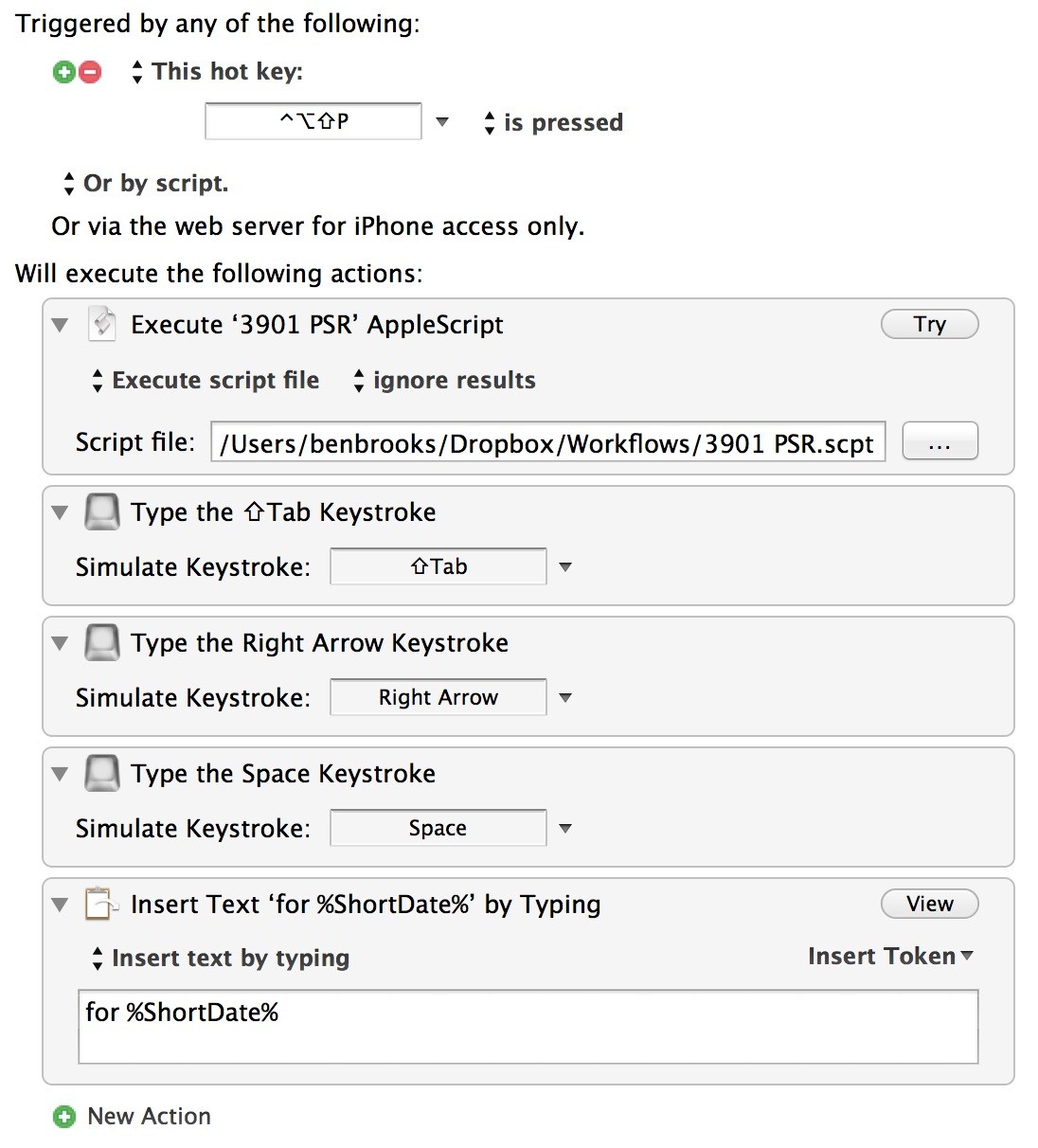
    I, of course, trigger this with Keyboard Maestro. You could use FastScripts, but I use Keyboard Maestro so that I can add one more thing: today’s date. I know you can get this in AppleScript, but for the life of me I can’t figure out how to format the date the way I want it. ((I truly suck at Applescript.))

    The Keyboard Maestro Macro.

    Depending on what fields you have Mail showing in the compose window you may need to edit the tabbing and arrows on the macro — essentially I just use keyboard shortcuts to navigate to the subject line and append today’s date.

    The entire macro only takes a few seconds to run and that makes it much faster than Automator.

    I stack every property under one hot key trigger so I can just click the one I want to use. This is saving me a ton of work each month.

  • The Goruck GR1

    Ah, the GORUCK GR1. Right before I purchased the Tom Bihn Smart Alec, I stopped and considered a purchase of the GORUCK GR1 — coveted by many. It’s a fantastic backpack that is made in the USA by a company that thinks all of their products need to stand up in war — and no I’m not joking.

    My buddies took early versions of our rucks to combat and to cities the world over, and critiqued every last detail. Green Berets became judge and jury of quality.

    (more…)

  • Updated Items for the week of December 21, 2012

    Things updated substantially (always posted at the bottom):

    – [TSA’s Christmas Non-Miracle](https://brooksreview.net/2012/12/tsa-christmas/), updated December 17, 2012.

    – [The Dropbox v. iCloud debate](https://brooksreview.net/2012/12/linchpin/), updated December 18, 2012.

    – [Instagram promises revisions](https://brooksreview.net/2012/12/insta-ad-2/), updated December 18, 2012.

  • Keyboard Maestro Macro: All Caps to Title Case

    *(This post is a part of a series on Keyboard Maestro, [see more here](https://brooksreview.net/tag/KM-SERIES/).)*

    I really hate websites that capitalize every letter of an authors name in their byline because it makes it hard to link to that post — mostly because I like to copy and paste names so that I make sure I don’t make a typo.

    Luckily with names, for the most part, a simple Title Case will fix the problem. This is an action that can be done very simply in Keyboard Maestro.

    The result of this macro is to take the highlighted text and convert it from all caps to Title Case, so that I can post a link citing the author without worrying about misspelling a name.

    ## The Macro

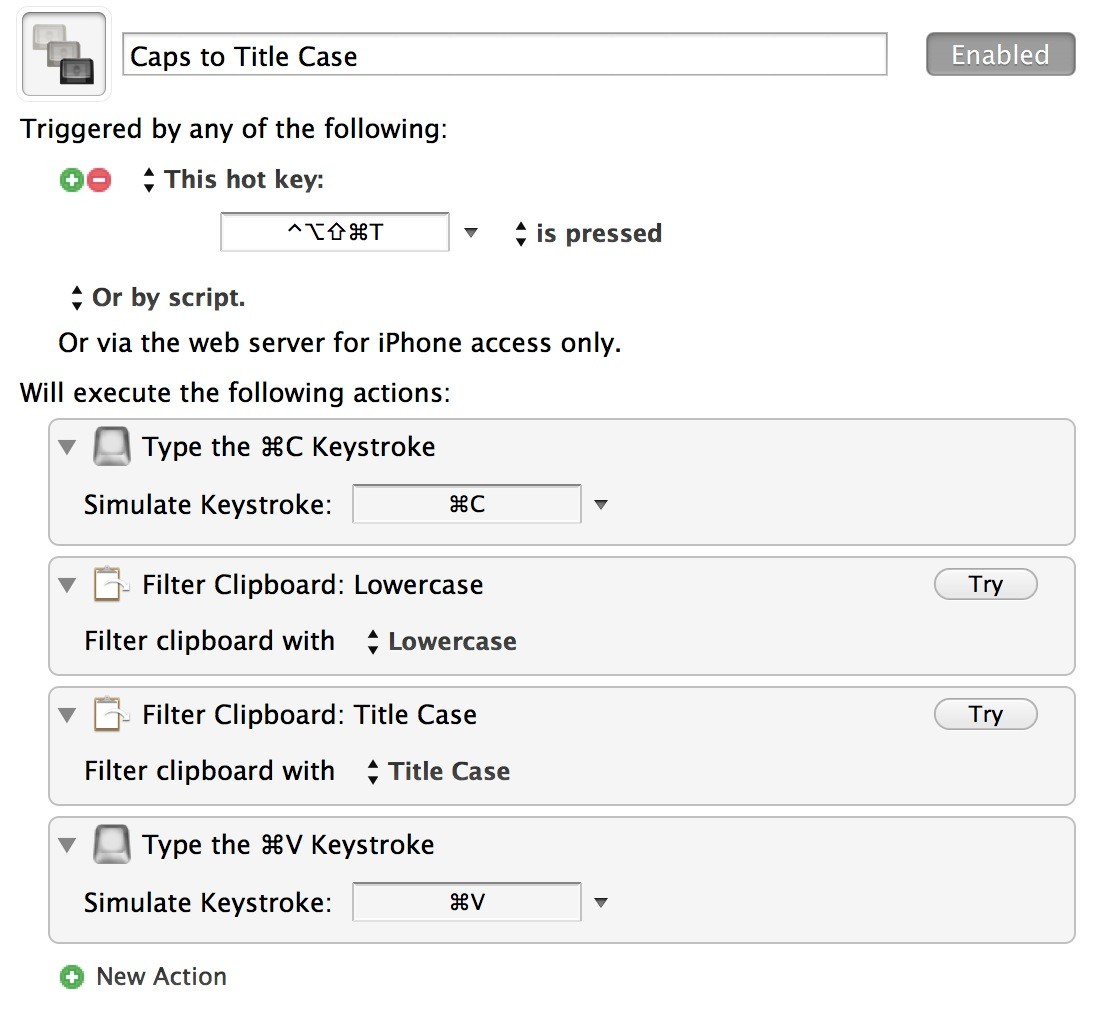
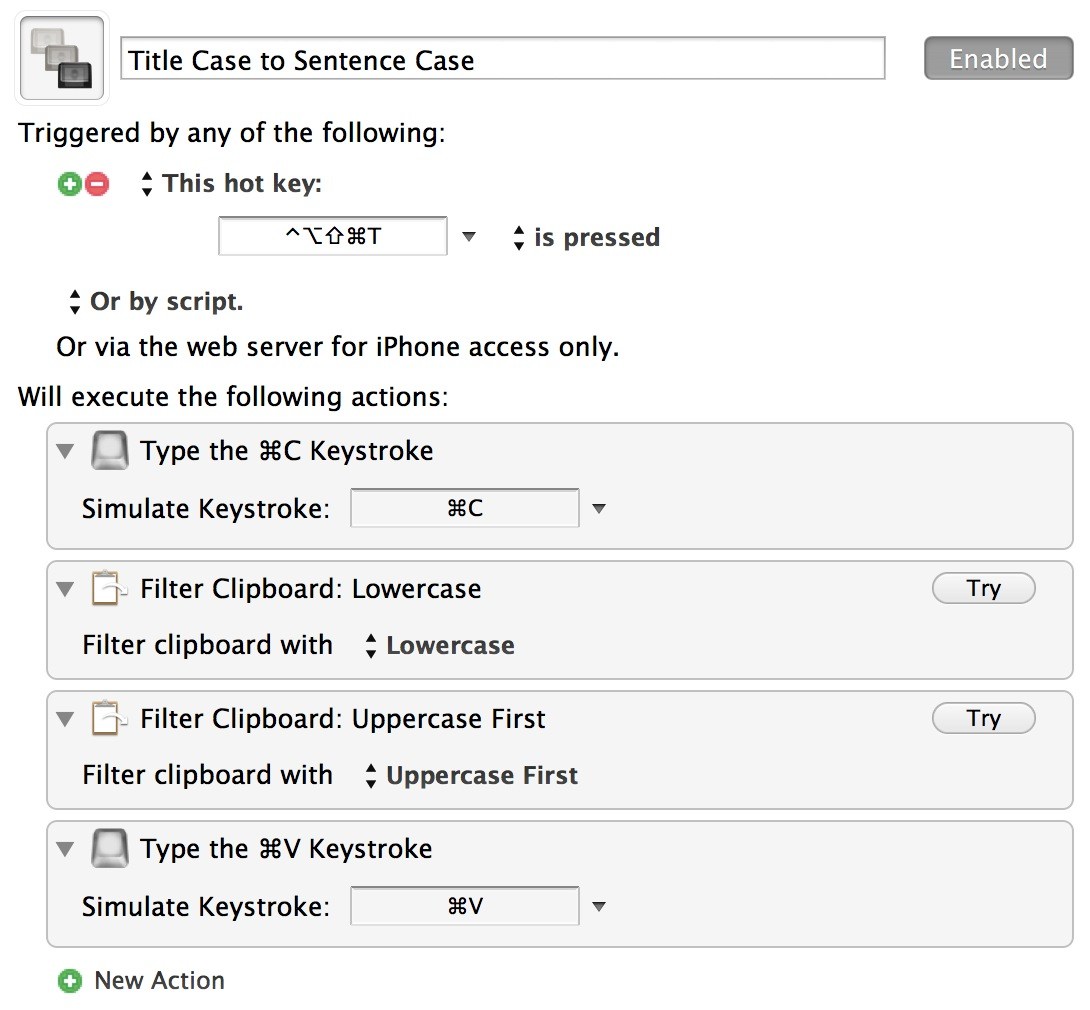
    I start by triggering the macro with a hot key, specifically the hot key: `Control + OPT + Shift + CMD + T`. (Easy to remember as every modifier except `FN` is pressed, then `T` for Title Case.)

    The macro assumes that you have the editable text selected, so you will need to have already copied and pasted your text where you want it. (I made it this way so that I could use it universally, as many leases I work on also suffer this problem.)

    The finished macro.

    Next Keyboard Maestro performs four actions:

    1. The selected text is copied to the clipboard using the action: `Type the CMD+C keystroke `.
    2. Next Keyboard Maestro filters the clipboard to all lowercase (this is done because the Title case action won’t change the case of all capitalized words). To get this action, just add the `Filter Clipboard` action and select lowercase.
    3. Add the same action again, but this time filter to Title Case.
    4. Like the copy action above, we change it to paste by sending the keystroke `CMD+V`.

    All done.

    If everything works your all caps text should now be properly cased. This also works for titles of blog posts, as it will remove your poor casing and re-case the words as they should be (just be sure to edit for proper names and such).

    ## Bonus

    One change makes it useful for legal documents.

    I mentioned that I often use this in leases at my day job, another thing that comes up is people liking to type in all caps for emphasis. I find it ridiculous, and impossible to read, so I have another macro to re-case those stupid sentences to Sentence Case.

    The steps are the exact same, just choose `Sentence Case` instead of `Title Case` in the third step.

  • ‘The Answer Is Just a Click Away’

    [Dave Pell has a great post about the technology overload that many of us feel](http://tweetagewasteland.com/2012/12/technologys-placebo-effect/):

    >The idea that we need a technological solution for too much technology is, at best, the Internet era’s great placebo effect. We feel like we’re getting a little better, but that’s just part of the same addiction. We’ll always be just one more piece of technology away from the solution.

    The solution, as we all know, is just to turn our devices off. It’s good advice that is hard to follow. This seems like the perfect thing to keep in mind as (here in the U.S.) we head into the holiday season where work slows, people aren’t in a hurry to have you respond to emails, or calls.

    It’s easier to ignore your iPhone when Grandma chastises you every time you check your iPhone. ((Not *my* Grandma, mind you, she flipping loves her iPad and my terrible Vimeo videos of my daughter.))

  • Moving Out of the Big City

    [Riccardo Mori has a great post talking about App.net and the differences between App.net and Twitter. Mori has this really great statement](http://morrick.me/archives/6056):

    >So, when someone starts interacting with you out of the blue, you don’t tend to think *Who the hell are you?* (as it may happen on Twitter). Instead, you feel like you just moved out of the big city, to a smaller town, and you’re surrounded by friendly neighbours who have come here for the same reasons: to escape the urban alienation, so to speak.

    I like the analogy between big city and small town. It fits for me because while people are still strangers, strangers in a small town are more aligned with your beliefs and your life than the typical stranger in a big city.

    Mori’s post is a great look at why App.net is not the same as Twitter.

  • Lifting the Limitations

    [Thomas Brand has some thoughts on Dropbox and iCloud, culminating in this great point](http://eggfreckles.net/notes/linchpin/):

    >People use Dropbox on their iOS devices because they want to share information between Apps. And they use Dropbox on their Macs and PCs because they want to share information between people and computers. Why not make iCloud better at both, and lift the superimposed limitations on sharing information between apps that gives Dropbox a linchpin in iOS?

    It’s a really good sounding idea, but I think it would break the simplicity of iCloud if done improperly. There is one way I think that could add such a feature without over complicating things: allow iCloud apps to all have “Send to…” buttons in them.

    If I am working in Numbers and have another app, on either my Mac or iOS, that has registered to be able to open the file type I am working on a user can open a share sheet that shows apps and sends a copy of the file to that app’s iCloud bucket. This would be simple, non-destructive, and easy to explain to all users.

    Of course this opens the can of worms that is the “Open with…” dialog currently on Macs, where all too often the sheer amount of apps listed is overwhelming. That is one aspect I don’t know how to overcome, because a preference to limit shown apps would defeat the entire purpose of ‘ease of use’.

  • ‘What Instagram’s New Terms of Service Mean for You’

    [Jenna Wortham and Nick Bilton reporting on the ToS changes at Instagram](http://bits.blogs.nytimes.com/2012/12/17/what-instagrams-new-terms-of-service-mean-for-you/):

    >This means that photographs uploaded to Instagram could end up in an advertisement on the service or on Facebook. In addition, someone who doesn’t use Instagram could end up in an advertisement if they have their photograph snapped and shared on the service by a friend.

    That’s the same sketchy crap that Facebook pulls (and no wonder since Instagram is owned by Facebook). You may be perfectly fine with your privacy being invaded — perhaps not even seeing it as an invasion — but will you be fine if a picture of your kid holding a Coke can becomes the next Coke ad plastered all over Instagram and Facebook?

    The problem with this rule is that you, and those you photograph, become implied endorsers and spokespeople for these “brands” ((I am now only capable of saying the word “brands” with the [Marco Arment](http://www.marco.org) emphasis.)) and that’s bullshit.

    If you want an alternative [Flickr looks to be the place to go right now](http://shawnblanc.net/2012/12/the-new-flickr/). Their new mobile app is solid and people have been joining, or re-finding, Flickr in droves lately. Best of all, you can pay a measly `$29` for a year long Pro account that will remove the need for Flickr to create bullshit terms of service.

    If you want a more stuck up version, [500px is fantastic](https://brooksreview.net/2012/04/500px-2/).

    **Updated (December 18, 2012):** [Instagram has responded to the negative reactions with a statement that talks down to users a lot](http://blogs.wsj.com/digits/2012/12/18/instagram-no-we-arent-going-to-sell-your-photos/). However this is one great clear part in the response:

    >The language we proposed also raised question about whether your photos can be part of an advertisement. We do not have plans for anything like this and because of that we’re going to remove the language that raised the question.

    Good. Now if only the rest of the statement had less bullshit I could actually make heads or tails of what they really are saying — which to me sounds like: “calm down, dude.”

    One bit I did chuckle at:

    >From the start, Instagram was created to become a business.

    Ways I read that:

    – We always wanted Instagram to be a business, never knew how.
    – Yippee! We are *becoming* a business.
    – Our business was to get a lot of users and sell for a crap-ton of money. We succeeded.

    Anyways — good on Instagram for pledging to remove that sections, now we just need to make sure they don’t forget.

  • A Few Thoughts on Dropbox, Apple, and Linchpins

    [John Gruber is on a bit of an “Dropbox is an essential feature” kick](http://daringfireball.net/linked/2012/12/17/dropbox-linchpin):

    >The scary part though, is that one recurrent theme I see in nearly every single “how I write on the iPad” story is Dropbox. It’s the linchpin in the workflow.

    [And in a follow-up post](http://daringfireball.net/linked/2012/12/17/apple-dropbox):

    >Jobs may well have been right that Dropbox is a feature, not a product, but it’s a hell of a good feature, and one that iCloud does not provide.

    As you can probably guess, I *slightly* disagree with this mindset. I think that a year ago Gruber would have been dead on, but I think iCloud is actually changing the importance of Dropbox for many users.

    Right now it’s hard to write on an iPad and not use Dropbox, but it’s been getting easier every day. I actually don’t store a single draft or even archive in Dropbox any longer. Everything is in the iA Writer iCloud storage — where the hell that lives I have no clue, but it also doesn’t matter either.

    Dropbox is a power user tool/service/feature — a damned good one — just not something the average user is going to leverage in the way that others do. iCloud is a consumer level feature. It’s good enough for power users if they are willing to relinquish control and trust Apple, but mostly it’s a drop-dead simple solution for *everyone*.

    It may be simple to show someone how to use Dropbox, but it’s even *easier* to show someone how to use iCloud. That’s the killer feature of iCloud: integration.

    (The argument in my mind is that Dropbox requires you save to a folder, and recall from a folder. Whether all files just live in the master Dropbox folder, or subfolders, is irrelevant — the user still has to think about a non-default folder. Doubly hard on iOS when the user must pick *which* of their Dropbox folders to use with the app. Compare that to iCloud where you can just tell someone: save it to iCloud. Both iOS apps and Mac OS X just show iCloud as iCloud [and it is quite cumbersome to actually create folders within iCloud].)

    When it comes down to it, iCloud and Dropbox perform the same actions, just interfacing with the user in a very different way. iCloud hides the file system and ties documents to applications, whereas Dropbox is *just* a syncing file system not tied to any app. The difference is subtle, but important.

    In that light I truly believe that Dropbox is the past and not the future of cloud based file storage. Managing files is just not something that a user should need to do any longer. ((I suspect too that iCloud is more of the model Microsoft *will* take with SkyDrive, with the added feature being that it will work like Dropbox on non-Windows systems.))

    With that said, iCloud scales very poorly. This is the core problem with iCloud right now — just try and find one Writer file amongst hundreds, or thousands even — you’ll likely end with your heading banging on the desk.

    Here’s the thing though: iCloud’s problem is a UX/UI issue (i.e., easily fixed). Dropbox could easily shift into iCloud, but that’s not the service that they sell and they won’t get that kind of OS level integration from Apple or Microsoft — both have competing services — and therefore a technically easy shift becomes nearly impossible because of the competitive landscape.

    It should be interesting to see how this unfolds in the next few years.

    **Updates (December 18, 2012)**: [Chris Gonzales adds his thoughts on this matter and makes a fantastic point](http://unretrofied.com/blog/2012/12/17/on-dropbox-and-icloud):

    >iA Writer, an example used by Ben as a fully self-contained solution, could go out of business someday. What happens to that data? Does Apple allow you to export it for use in other apps?

    I do wonder what, if anything, will happen to my data if one of these apps does go under.