Top Posts

Leica Sofort 2June 13, 2024
Grand Seiko SBGX261February 23, 2023

Recent Articles

  • Ex-NSA Guys’ Startup To Protect You From NSA

    Mike Arrington on Virtru (an encryption startup): Which is great except that the founders are ex-NSA guys who used to be paid to do things like collect emails and phone call information from hundreds of millions of terrorist suspects Americans. That’s a really tough problem we are going to be facing. The people who are…

    Mike Arrington on Virtru (an encryption startup):

    Which is great except that the founders are ex-NSA guys who used to be paid to do things like collect emails and phone call information from hundreds of millions of terrorist suspects Americans.

    That’s a really tough problem we are going to be facing. The people who are likely best qualified to build secure and robust encryption systems, are also the people who work at, or have worked at, places like the NSA, CIA, DOD, etc. That’s not to say these agencies are the only source of the talent, but they are certainly the largest talent pool of people.

    On the one hand, Virtru can be seen as shady because there are ex-NSA people involved. On the other, every person would jump all over a Snowden backed startup — and the same argument about his former employer can be made as can be made of Virtru.

    Which is why independent security audits are going to become a larger part of these narratives. We are basically at a point where we now know, and act, as though we cannot take people at their word. So now we need to start hiring people and asking them to please find where someone has fucked up the encryption.

  • The Wrong Camera

    Mike Johnston: There’s nothing worse than seeing a fantastic picture when you don’t have a camera with you. But seeing a fantastic picture when you have the wrong camera with you is almost as bad. Them be some fighting words.

    Mike Johnston:

    There’s nothing worse than seeing a fantastic picture when you don’t have a camera with you. But seeing a fantastic picture when you have the wrong camera with you is almost as bad.

    Them be some fighting words.

  • How Nest Is Already Using All That Data From Its Army of Smoke Alarms

    Kelsey Campbell-Dollaghan writing about Nest: We’re a long way off from a future where Google can access any of that data—and in fact, it may never. So fret not, if you’re concerned about privacy. Both companies would have to make major changes to their privacy policies before anything even remotely like this will come to…

    Kelsey Campbell-Dollaghan writing about Nest:

    We’re a long way off from a future where Google can access any of that data—and in fact, it may never. So fret not, if you’re concerned about privacy. Both companies would have to make major changes to their privacy policies before anything even remotely like this will come to pass.

    Thank GOD privacy policies are hard to change. What’s that? They aren’t hard to change? Oh, they change all the time? Well that sucks.

  • Uber Isn’t Worth $17 Billion

    Aswath Damodaran on FiveThirtyEight: For all these companies, the key selling point is “disruption,” one of the tech industry’s worst buzzwords. The companies argue that they’re upending existing ways of doing business — hailing a taxi, with Uber, or finding lodging, with Airbnb — and given the sizes of the businesses they’re supposedly disrupting, the…

    Aswath Damodaran on FiveThirtyEight:

    For all these companies, the key selling point is “disruption,” one of the tech industry’s worst buzzwords. The companies argue that they’re upending existing ways of doing business — hailing a taxi, with Uber, or finding lodging, with Airbnb — and given the sizes of the businesses they’re supposedly disrupting, the sky’s the limit when it comes their value. But is Uber, which was founded five years ago, really worth $17 billion? My answer, as I hope to detail below, is only if we make some big assumptions about the taxi market and Uber’s place in it.

    I know this has been a hotly debated topic for the past two(?) weeks, but this analysis is pretty hard to argue about. Investment in a company like Uber isn’t about current revenue, or even future expected revenue — it’s about future potential revenue. Hence the ridiculous use of “disruption” in investing.

    I like Uber, but I think you are kidding yourself if you think it is worth $17 billion. But, that doesn’t mean it’s a bad investment at a $17 billion valuation.

    Why? Easy: all you need to do is persuade someone else to come buy it for enough money that you get rich. And if Snapchat is any indication, that shouldn’t take long.

  • Clipping from Mail using the OmniFocus Clip-o-Tron

    Nice. Beats those AppleScripts I have been hacking away at. [via Shawn Blanc]

    Nice. Beats those AppleScripts I have been hacking away at.

  • How to Make Pancakes with your Japanese Rice Cooker

    Awesome. Excuse me while I try this out. Update: I made these. They rock.

    Awesome. Excuse me while I try this out.

    Update: I made these. They rock.

  • Dan Kois on His Month Without Sitting

    Dan Kois: 2:41 Definitely having trouble getting work done. The idea of opening up a new document to edit feels crushing, as though each task I take on carries with it the additional burden of standing the whole time. But hey, it’s the first day! I’ll get used to this. His experiences, and pain, yes…

    Dan Kois:

    2:41 Definitely having trouble getting work done. The idea of opening up a new document to edit feels crushing, as though each task I take on carries with it the additional burden of standing the whole time. But hey, it’s the first day! I’ll get used to this.

    His experiences, and pain, yes that all happens when you convert to standing. But dear lord, do not stand all day — that’s bonkers.

  • On Interruptions

    UPDATED (on Jul 14, 2014): Richard Koopmann has significantly reworked his data, and while it doesn’t change the outcome, it is worth looking at if you are a data nerd. I’ve preserved this post as original and the new data can be found here. I had this theory, while reading something completely unrelated, and the…

    UPDATED (on Jul 14, 2014): Richard Koopmann has significantly reworked his data, and while it doesn’t change the outcome, it is worth looking at if you are a data nerd. I’ve preserved this post as original and the new data can be found here.
    I had this theory, while reading something completely unrelated, and the theory goes like this: I wonder if people tend to leave people alone more if they deem the device (or thing) they are using (or doing) to be of a “work” related type of task. That is, are we more or less inclined to bug people if we think they are doing something more than just screwing off? Common sense answers this: of course we are less inclined to bug people we perceive to be busy with something of importance.

    The unanswered question that nagged at me: if I am writing a novel on an iPhone, am I more or less likely to get interrupted, than I would be if I was writing the same novel, same place, but by hand with a pen on paper? I’m doing the same task, just using a different device — how would that matter to the perception others had of me?

    I thought the answer would be: never bug someone physically writing — they are clearly busy. I admit, that’s a rather stupid way to think as there are plenty of ways to waste time with a pen and paper, but I still had to know if I thought the same way as others.

    So imagine you walked into an open office, and you can see what each person is doing the device(s) they are using and as you walk in you know you want to kill some time talking to someone — anyone. You know all the people in the room, and have no preference who you talk to, you just don’t want to write that TPS report so you want to shoot the shit.

    Someone is on an iPhone, another on an iPad, another on their laptop, another still on a desktop, and then someone writing on actual paper with an actual pen — which of those people are you most likely to interrupt?

    Naturally, I took a poll to help get to the bottom of this.

    I asked two questions, while both are essentially asking the same thing, I rephrased the question to try and get a more accurate set of data.

    The Results

    I’m not a statistician and it’s been almost a decade since I had a class on it (I aced the course though). Because of that I decided to ask for some help and Letterpress ace @rkoopmann got in touch. He, apparently is a wiz with poll data.

    So he worked up this report for me and I want to present it to you in its entirety.


    Here we go, thanks rkoopmann:

    Methodology

    The poll was presented as a post with an embedded iframe on The Brooks Review website. The post was titled Interruption Survey and contained the following introduction and note:

    I’d appreciate you taking a moment to fill this out (note this is an iframe, you need to scroll the frame to get to the “finish” button):

    Note: I’m assuming you want to interrupt someone and they are using the device.

    Instrument

    The poll consisted of two questions:

    1. I am more likely to interrupt someone using:
      • a pad of paper to write.
      • an iPad.
      • a Desktop.
      • a Laptop.
      • an iPhone.
    2. I am least likely to interrupt someone using:
      • a pad of paper to write.
      • an iPhone.
      • a Desktop.
      • an iPad.
      • a Laptop.

    Each of these items was required and only one choice was allowed per item.

    Results

    Respondents

    There were 499 submissions received between 2014-06-11 18:44:51 and 2014-06-14 14:34:49 (GMT?).

    Note that some percentages may not sum to 100% due to rounding.

    Geography

    The majority of respondents (58%) were from the United States; the next-largest group of respondents (9%) was from Great Britain. The remaining 33% of respondents came from 49 other countries with each country contributing less than 5% of respondents.

    Operating System

    The overwhelming majority of respondents (82%) were running an iOS (49%) or OS X (33%) device. Windows (4%) and Linux (2%) were the remaining identified operating systems; the tool was unable to identify platform for the remaining 12% of respondents.

    iOS 7.1 (46%) and Mac OS X 10.9 Mavericks (29%) were the largest group of respondents; 9 respondents (2%) were bleeding-edge dev-types running iOS 8; 14 respondents were old-school OS X 10.1 Puma (released Sep 2001).

    Q1. I am more likely to interrupt someone using

    • a pad of paper to write. 12%
    • an iPad. 16%
    • a Desktop. 15%
    • a Laptop. 6%
    • an iPhone. 51%

    We can see that an iPhone was selected at a significantly higher rate and a Laptop was selected at a significantly lower rate (chisq = 317.7635; df = 4; p \< 0.001) than expected (if we assume all options would be selected at the same rate of 20%).

    There was no significant differences with how frequently a pad of paper to write, a Desktop, and an iPad were selected.

    By Operating System
    • iOS users (49% of respondents) responded with an iPhone at a significantly (chisq = 184.9796; df = 4; p \< 0.001) higher rate than expected.
      • iPhone users (34% of respondents) responded with an iPhone at a significantly higher rate and a Laptop and a pad of paper to write at a significantly lower rate (chisq = 151.5882; df = 4; p \< 0.001) than expected.
      • iPad users (15% of respondents) responded with an iPhone at a significantly higher rate and a Laptop at a significantly lower rate (chisq = 36.5205; df = 4; p \< 0.001) than expected.
    • OS X users (33% of respondents) responded with an iPhone at a significantly (chisq = 82.9102; df = 4; p \< 0.001) higher rate than expected.

    Q2. I am least likely to interrupt someone using

    • a pad of paper to write. 45%
    • an iPhone. 21%
    • a Desktop. 22%
    • an iPad. 2%
    • a Laptop. 9%

    We can see that a pad of paper to write was selected at a significantly higher rate and that a Laptop and an iPad were selected at significantly lower rate (chisq = 264.4569; df = 4; p \< 0.001) than expected.

    There was no significant differences with how frequently an iPhone or a Desktop were selected.

    By Operating System
    • iOS users (49% of respondents) responded with a pad of paper to write at a significantly higher rate and a Laptop and an iPad at a significantly lower rate (chisq = 151.7143; df = 4; p \< 0.001) than expected.
      • iPhone users (34% of respondents) responded with a pad of paper to write at a significantly higher rate and an iPad and a Laptop at a significantly lower rate (chisq = 105.5882; df = 4; p \< 0.001) than expected.
      • iPad users (15% of respondents) responded with a pad of paper to write at a significantly higher rate and an iPad and a Laptop at a significantly lower rate (chisq = 46.3836; df = 4; p \< 0.001) than expected.
    • OS X users (33% of respondents) responded with a pad of paper to write at a significantly higher rate and an iPad and a Laptop at a significantly lower rate (chisq = 78.4790; df = 4; p \< 0.001) than expected.

    Holy cow, that’s so close to legitimate journalism that it makes bloggers everywhere shudder.

    What Does This Mean?

    What it means is that if you want to get work done, uninterrupted, you better not be doing it on an iPhone.

    And if you really want to be left alone, write on paper.

    But there are bigger implications to all of this than just the above. The audience that completed this survey is pretty tech centric. Therefore the respondents (one would assume) inherently know that you can likely do more work on your iPhone than a pad of paper these days. ((Exception to crazies like Mr. Rhone and Mr. Marks.)) And yet, the perception of someone likely to be dicking off on an iPhone, and therefore interruptible, is still there.

    Look at the data, it suggests that the hierarchy of what is seen as a “real” tool goes from: is essentially paper in a league of its own. The iPhone is seen as something you are clearly not using concentration for, given the willingness to bug people using them.

    That’s crazy.


    A few people wondered why I didn’t just use generics for iPad and iPhone — like tablet and smartphone — my reasoning was twofold:

    1. I don’t care about the other devices.
    2. I suspect that people would answer differently between iPhone and BlackBerry, but not between HP and Apple for laptops. So I reasoned that the best way to keep that consistent was to name some devices.

    The data can’t explain why we perceive paper as being more serious — more uninterruptible — but it does let us know that there is a different perception when you are using paper. And as an employer that’s a perception which I think employees should be aware of.

    Maybe you love responding to emails from your iPhone, but perhaps, if you want your boss to think you are working, responding on a piece of paper is a better strategy.

    Did I really just recommend that?

    Either way my curiosity is only more peaked now.

    UPDATED (on Jul 14, 2014): Richard Koopmann has significantly reworked his data, and while it doesn’t change the outcome, it is worth looking at if you are a data nerd. I’ve preserved this post as original and the new data can be found here.

  • Quote of the Day: Patrick Rhone

    “Just because you give a fuck does not mean I should give a fuck.” — Patrick Rhone

    “Just because you give a fuck does not mean I should give a fuck.”
  • Testing Your Internet Speed with Keyboard Maestro

    A long time ago I saw this post on Justin Blanton’s site. In it he found a command line tool to use Speedtest.net to test his internet speed. Sounded great, I couldn’t get it to work. Here’s what I did, I followed these instructions, but downloaded the file manually. Ok, that’s neat, it works in…

    A long time ago I saw this post on Justin Blanton’s site. In it he found a command line tool to use Speedtest.net to test his internet speed. Sounded great, I couldn’t get it to work.

    Here’s what I did, I followed these instructions, but downloaded the file manually.

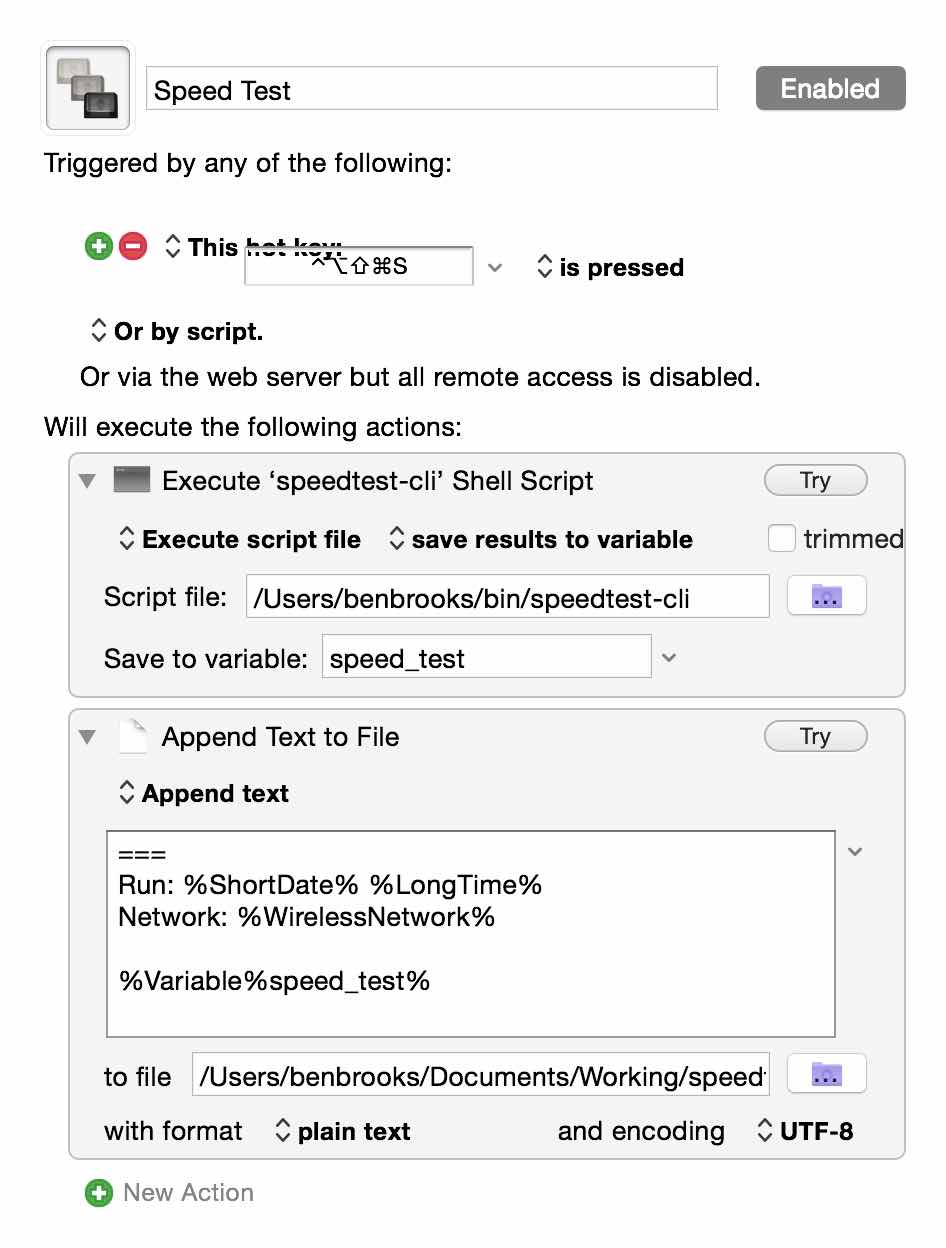
    Ok, that’s neat, it works in the command line. But, I’m not typing that crap out. So I flipped over to Keyboard Maestro where I can execute that command line script and write out the results to a text file for logging.

    Here’s what that looks like:

    All I do is run the script, write the output to a variable and then append that variable to a text file.

    In the text I append to the variable I also add in a separator, the time and date, and the network name I am on. Seems like over a long enough period I should be able to collect some interesting data.

    Oh, and remember, as all those links say: don’t abuse this tool. It’s not for testing your bandwidth every 5 minutes.

  • LaunchBar and Pinboard

    This is epic: A suite of custom actions for LaunchBar 6 that provide access to Pinboard bookmarks. [via Shawn Blanc]

    This is epic:

    A suite of custom actions for LaunchBar 6 that provide access to Pinboard bookmarks.

  • Amazon, The New Bully

    There’s been a lot in the news about Amazon not selling products from companies or publishers that it is having a spat with. It’s childish, but I am sure makes sense to someone at Amazon. The latest, as I’ve linked to with this post, is that it seems Amazon is restricting some books purchased from…

    There’s been a lot in the news about Amazon not selling products from companies or publishers that it is having a spat with. It’s childish, but I am sure makes sense to someone at Amazon.

    The latest, as I’ve linked to with this post, is that it seems Amazon is restricting some books purchased from being read on the Kindle iOS app.

    I’ve long switched to purchasing from the iBooks store since it is easier, but this kind of shit is going to keep happening unless the DOJ takes Amazon to task for it. ((Unlikely, as it seems Amazon has paid off the DOJ. Not really, but probably. No, no, not really. But likely.))

  • Breaking News iOS App

    I’m sure most reading this either have the Breaking News app on your iPhone, or follow the account on Twitter/App.net. Breaking News provides a very real, but only sometimes, very important service. In my opinion there is no doubt that it is the best at what it does. Over the past year I’ve noticed the…

    I’m sure most reading this either have the Breaking News app on your iPhone, or follow the account on Twitter/App.net. Breaking News provides a very real, but only sometimes, very important service. In my opinion there is no doubt that it is the best at what it does.

    Over the past year I’ve noticed the Breaking News push notifications get less annoying, and more accurate with their urgency.

    But today they have launched a feature on the iOS app that I think takes the service to the next level — it does something that seems futuristic:

    A first for a news app: proximity alerts for big breaking stories near you

    Allow the app access to your location and you get notifications for important things happening near you. Very cool. I (thankfully) have not seen this in action, but I love knowing it is there.


    One other thing: how is something like this not a built-in part of iOS/Android/Windows/Macs? Seems like this could be better done at the OS level. Like the Amber Alerts already built in.

  • How Slack Is Changing How Newsrooms Talk Amongst Themselves

    Joseph Lichterman on Slack: The Times of London built a bot that pulls in people’s schedules — so you can ask the bot if someone is busy before you bother them directly. Vox Media’s product team gets alerted through if there’s an issue with any of their sites — and they’ll also get an alert…

    Joseph Lichterman on Slack:

    The Times of London built a bot that pulls in people’s schedules — so you can ask the bot if someone is busy before you bother them directly. Vox Media’s product team gets alerted through if there’s an issue with any of their sites — and they’ll also get an alert that notifies who was assigned to fix the problem. At BuzzFeed, one developer loves to eat at a certain Mexican food cart, so they built a Calexico Bot (named, appropriately, after the food cart) that asks if someone wants to go to the cart every time someone types his name.

    Slack is such great tool. I absolutely love it, and the stuff listed above is so clever.

    If you sign up for Slack with this link and you get a $100 credit and I get a $100 credit (if you upgrade or something).

  • Apple’s Silent Email Filtering Is just Plain Wrong

    Kirk McElhearn: There’s a serious problem when your emails may not be delivered and you are not notified. That’s messed up, I’m glad I switched from using iCloud as my primary email last year.

    Kirk McElhearn:

    There’s a serious problem when your emails may not be delivered and you are not notified.

    That’s messed up, I’m glad I switched from using iCloud as my primary email last year.

  • This Map Shows Every School Shooting Since Sandy Hook

    Made the rounds yesterday: It was the 74th school shooting since Adam Lanza’s infamous assault on Sandy Hook Elementary School in Newtown, Connecticut — and, as this map shows, they’ve happened all over the country. Ridiculous…

    Made the rounds yesterday:

    It was the 74th school shooting since Adam Lanza’s infamous assault on Sandy Hook Elementary School in Newtown, Connecticut — and, as this map shows, they’ve happened all over the country.

    Ridiculous…

  • A History of Application Launchers

    Epic post about launchers, and the power of LaunchBar 6 from Shawn Blanc

    Epic post about launchers, and the power of LaunchBar 6 from Shawn Blanc

  • Possibilities

    Watts Martin: While Android has had a lot of these capabilities for years, I haven’t found anything like Launch Center Pro or Editorial in terms of automation and scriptability, and those apps manage to do what they do on today’s iOS. Imagine what we’ll see when these arbitrary restrictions get lifted. The thing is: I…

    Watts Martin:

    While Android has had a lot of these capabilities for years, I haven’t found anything like Launch Center Pro or Editorial in terms of automation and scriptability, and those apps manage to do what they do on today’s iOS. Imagine what we’ll see when these arbitrary restrictions get lifted.

    The thing is: I can’t imagine, and that excites the hell out of me.

  • Time Versus Inspiration

    John Carey: Some of us live in the past, others are perpetually stuck in the future, lest not we forget the present for it is what dreams are made of. That is, if you’re doing it right.

    John Carey:

    Some of us live in the past, others are perpetually stuck in the future, lest not we forget the present for it is what dreams are made of. That is, if you’re doing it right.

  • Interruption Survey

    I’d appreciate you taking a moment to fill this out (note this is an iframe, you need to scroll the frame to get to the “finish” button): Note: I’m assuming you want to interrupt someone and they are using the device. View Survey

    I’d appreciate you taking a moment to fill this out (note this is an iframe, you need to scroll the frame to get to the “finish” button):

    Note: I’m assuming you want to interrupt someone and they are using the device.