“And Communist Russia was so bad because they followed their people, they snooped on them, they arrested them, they put them in secret prisons, they disappeared them.”
Top Posts
Leica Sofort 2June 13, 2024
Grand Seiko SBGX261February 23, 2023
Casio Duro MDV-106 Re-ReviewDecember 15, 2022
Recent Articles
-
Quote of the Day: Steve Wozniak
“And Communist Russia was so bad because they followed their people, they snooped on them, they arrested them, they put them in secret prisons, they disappeared them.” — Steve Wozniak
-
‘Scanadu Scout, the First Medical Tricorder’
Since I’m done with KickStarter, I felt the need to show you guys something awesome on Indiegogo — a Tricorder should suffice, [backed][1]. [1]: http://www.indiegogo.com/projects/scanadu-scout-the-first-medical-tricorder/x/1629035
Since I’m done with KickStarter, I felt the need to show you guys something awesome on Indiegogo — a Tricorder should suffice, [backed][1].
[1]: http://www.indiegogo.com/projects/scanadu-scout-the-first-medical-tricorder/x/1629035
-
Quote of the Day: Bruce Schneier
“Liberty requires security without intrusion, security plus privacy.” — Bruce Schneier, in 2006
“Liberty requires security without intrusion, security plus privacy.”— Bruce Schneier, in 2006 -
‘Has U.S. Started an Internet War?’
[Bruce Schneier for CNN][1]: > That’s the key question: How much of what the United States is currently doing is an act of war by international definitions? Already we’re accusing China of penetrating our systems in order to map “military capabilities that could be exploited during a crisis.” What PPD-20 and Snowden describe is much…
[Bruce Schneier for CNN][1]:
> That’s the key question: How much of what the United States is currently doing is an act of war by international definitions? Already we’re accusing China of penetrating our systems in order to map “military capabilities that could be exploited during a crisis.” What PPD-20 and Snowden describe is much worse, and certainly China, and other countries, are doing the same.
I see a new Cold War approaching on the horizon.
[1]: http://edition.cnn.com/2013/06/18/opinion/schneier-cyberwar-policy/index.html
-
‘Kickstarter Allowed Funding for a Sexual Assault Manual’
[Harry Marks on the under-reported scandal][1]: > I’m pissed. This was not about “freedom of speech” or “First Amendment rights” or “just not reading it if you don’t like it”. This is a permission slip for rape. Plain and simple. I’m with Marks, I refuse to fund anything else that is on Kickstarter. It’s one…
[Harry Marks on the under-reported scandal][1]:
> I’m pissed. This was not about “freedom of speech” or “First Amendment rights” or “just not reading it if you don’t like it”. This is a permission slip for rape. Plain and simple.
I’m with Marks, I refuse to fund anything else that is on Kickstarter. It’s one thing to defend the project on the basis that you don’t see the harm, but to admit that you see the harm, that you disagree with it — and still do nothing — that’s just fucking spineless.
[1]: http://curiousrat.com/kickstarter-allowed-funding-for-a-sexual-assault-manual
-
If You Think PRISM Doesn’t Matter Because You’ve Nothing to Hide, Read This Now
[Daniel J. Solove debating the “nothing to hide argument”][1]: > Privacy is rarely lost in one fell swoop. It is usually eroded over time, little bits dissolving almost imperceptibly until we finally begin to notice how much is gone. When the government starts monitoring the phone numbers people call, many may shrug their shoulders and…
[Daniel J. Solove debating the “nothing to hide argument”][1]:
> Privacy is rarely lost in one fell swoop. It is usually eroded over time, little bits dissolving almost imperceptibly until we finally begin to notice how much is gone. When the government starts monitoring the phone numbers people call, many may shrug their shoulders and say, “Ah, it’s just numbers, that’s all.” Then the government might start monitoring some phone calls. “It’s just a few phone calls, nothing more.” The government might install more video cameras in public places. “So what? Some more cameras watching in a few more places. No big deal.” The increase in cameras might lead to a more elaborate network of video surveillance. Satellite surveillance might be added to help track people’s movements. The government might start analyzing people’s bank records. “It’s just my deposits and some of the bills I pay—no problem.” The government may then start combing through credit-card records, then expand to Internet-service providers’ records, health records, employment records, and more. Each step may seem incremental, but after a while, the government will be watching and knowing everything about us.
[1]: https://chronicle.com/article/Why-Privacy-Matters-Even-if/127461/
-
‘Remembering James Gandolfini and Tony Soprano’
[Alan Sepinwall][1]: > Tony Soprano was a monster, but an oddly relatable one. He struggled with his family, whether enduring the caustic disapproval of his mother or the misbehavior of his kids, and went to therapy to deal with panic attacks and a wide-ranging feeling of depression. But he also had no compunction about strangling…
[Alan Sepinwall][1]:
> Tony Soprano was a monster, but an oddly relatable one. He struggled with his family, whether enduring the caustic disapproval of his mother or the misbehavior of his kids, and went to therapy to deal with panic attacks and a wide-ranging feeling of depression. But he also had no compunction about strangling a man to death while taking daughter Meadow on a college tour. He was vulnerable. He was charming. He was cruel and vindictive and angry and practically drowning in self-pity.
Tony Soprano is one of the greatest TV Characters ever concocted and ever acted. Soprano makes Draper look like amateur hour. I always hoped to see Gandolfini appear in more roles, and every time I did see him it made me smile. He never was Tony Soprano again, and that was OK, but he also never made you think the character he was playing at the time was anything but that character.
Gandolfini probably could have made a career playing mobster roles, like Cruise playing super-cop roles, but instead he had roles where he was a gay hit man. Rest in peace, James Gandolfini.
[1]: http://www.hitfix.com/whats-alan-watching/remembering-james-gandolfini-and-tony-soprano
-
Privacy, Secrecy, the Web, and Ads
I’ve always been a private person. The guy in the room that didn’t care to speak much about anything that mattered, the guy in the room that heard everything, but disclosed very little. The quiet guy. I wasn’t trying to hide bad things, nor was I trying to hide good things — I just preferred…
I’ve always been a private person. The guy in the room that didn’t care to speak much about anything that mattered, the guy in the room that heard everything, but disclosed very little. The quiet guy. I wasn’t trying to hide bad things, nor was I trying to hide good things — I just preferred not to talk about *me* to other people. I am private.
At some point in college though, the allure of all of these social services proved too strong and I joined my peers. I became less private and less comfortable. Then, as I began to settle into a new stage of my life in 2010, I noticed that I had given up a lot of my privacy. It was unsettling.
I began a personal campaign to take back some of my privacy and as part of that used only services that treated me as though I was the customer, not the product. Generally speaking only the paid services.
In an [excellent essay for The New Yorker][1], Jill Lepore talks about the difference between privacy and secrecy, making this over arching point:
> The opening of Mazzini’s mail, like the revelations that the N.S.A. has been monitoring telephone, e-mail, and Internet use, illustrates the intricacy of the relationship between secrecy and privacy. Secrecy is what is known, but not to everyone. Privacy is what allows us to keep what we know to ourselves. Mazzini considered his correspondence private; the British government kept its reading of his mail secret.
I urge you to read the entire essay.
I place great value on privacy and also place great value on publicly sharing my thoughts on a website, accessible to anyone. This is not a contradiction.
As a society we hate privacy, but as individuals we cherish it. We hate it when friends keep things from us, or limit what they share online, but we in turn hate sharing everything with our friends. We block someone, while criticizing them for blocking us.
The larger issue is that there are some things that we naturally assume to be private, which turn out not to be. No one thought their emails *were* being read, but likely assumed they *could* be read — unless they were super criminals why else would anyone care about their email? Yet, our emails *are* being read in the sense that they are being cataloged. Not because we are super criminals right now, but because *we just may* become super criminals later on.
In effect, with programs like PRISM, we are being monitored *now* so that we may be stopped *later* if, presumably, we’re among the very small fraction of people that need to be stopped later.
We can argue the legality of this invasion of privacy, force the blame on whomever we wish, but I place the blame squarely at our own feet. For years we have been proving to companies like Google and Facebook that their usage of our data, our secrets, is of little concern to us. Just don’t charge us money to use your stuff.
These companies already share our data with Pfizer to target us for their blue pill ads. What hint have we given them that it’s not OK to share our data with the U.S. Government?
What stance have we taken as a society that the Government should have picked up on where we say: place value *here*. Our actions to date have said one thing: *make it free*, take what you want from us, so long as it’s not **cash**.
And if this is the standard by which so many web companies have been operating, who’s to blame when those companies make the rather logical and rational decision to allow the Government access in the name of *Freedom*?
Of course the problem doesn’t stop with free services, it extends to paid services like Office365, Dropbox, iCloud, etc. What stance have we taken to stop using these services until they respect our privacy? When someone as privacy concerned as me refuses to read most terms of service, and privacy policies, it becomes resoundingly clear that there’s a lack of caring on the part of consumers.
Just make it free and easy, and we’ll use it.
The debate about data privacy is now more complicated than just what is free and what is paid — neither has proven to be trustworthy. The debate now centers around which companies are more worried about protecting their users than they are with protecting ambiguous *bad guys*.
Hollywood has been conditioning us for years to believe that any person with a Mac (logo covered of course) and a few dozen terminal windows can break into any computing device anywhere. Is anybody really shocked that Hollywood wasn’t that far off? The bigger shock is that we’re all potential bad guys in the eyes of the government.
As much as I’d like to place the blame squarely at the feet of the Government, I see little logic in that argument. Let’s step back and look at the U.S. at a macro level: The country we see does not seem concerned about privacy in the least. We blindly turn over troves of marketing data about ourselves, without even reading what will be done with that data, in the name of, well, getting our desired username on the latest and greatest service.
We religiously carry little bits of plastic for each store we shop in so that we may save a few dollars, all the while providing troves of market research and targeting mechanisms to companies. We carry these loyalty cards with so much loyalty, that we often turn around and go back home if we find ourselves at the store without our card. God forbid we miss out on those points.
Given that our society demonstrably does not care about its online privacy, I wonder two things:
1. Wouldn’t it have been out of touch for the U.S. Government to assume we *do* care and check with us before storing all our communication in a big fat database?
2. Even if the government had disclosed the existence of such technology, and the subsequent use of it, would we have even bothered to read the privacy policy?In that sense, PRISM truly seems to have been made in the image of American internet users.
[1]: http://www.newyorker.com/reporting/2013/06/24/130624fa_fact_lepore?currentPage=all&mobify=0
-
Sky Guide
I’ve never been a person that has been overly interested in the night sky. I can certainly appreciate the beauty of it, but I never cared much beyond that. There’s been a lot of apps out there for iOS that try to teach and show people like me what’s above us. I’ve never paid any…
I’ve never been a person that has been overly interested in the night sky. I can certainly appreciate the beauty of it, but I never cared much beyond that. There’s been a lot of apps out there for iOS that try to teach and show people like me what’s above us. I’ve never paid any attention to them.
And then, in Seattle, the guys behind Fifth Star Labs showed me their latest creation: [Sky Guide][1]. I’ll admit I was prepared to suffer through hearing about just another app about stars. So I asked what set their app apart, and I was told: photography.
Now I am interested.
Sky Guide’s imagery is made up out of 37,000 photographs taken by one of the guys behind the app over the course of a year. And holy crap is it beautiful.
It’s one thing to show those images, but my absolute favorite feature of the app is that you can slide your fingers to dim or brighten the stars — I love that. The entire app is butter smooth and well done.
I’ll tell you what, I may not use this app very much, but I sure appreciate how well done it is.
[The app is Universal and $1.99 on the App Store][2].
Since I know you guys are probably just as curious as I am, [here’s how those photos were shot][3].
[1]: http://www.fifthstarlabs.com/
[2]: https://itunes.apple.com/us/app/sky-guide-view-stars-night/id576588894?ls=1&mt=8
[3]: http://skysurvey.org/survey/ -
Choice Quotes from More PRISM and NSA Articles
[USA Today has a great interview with three former top NSA officials, who were also Whistleblowers][1] (it’s worth reading the whole thing): > **Binney: **What it is really saying is the NSA becomes a processing service for the FBI to use to interrogate information directly. … The implications are that everybody’s privacy is violated, and it…
[USA Today has a great interview with three former top NSA officials, who were also Whistleblowers][1] (it’s worth reading the whole thing):
> **Binney: **What it is really saying is the NSA becomes a processing service for the FBI to use to interrogate information directly. … The implications are that everybody’s privacy is violated, and it can retroactively analyze the activity of anybody in the country back almost 12 years.
[Daniel J. Solove, for The Washington Post][2] (I no sooner criticize this paper for crappy content, then they start churning out great stuff):
> When privacy is compromised, though, the problems can go far beyond the exposure of illegal activity or embarrassing information. It can provide the government with a tremendous amount of power over its people. It can undermine trust and chill free speech and association. It can make people vulnerable to abuse of their information and further intrusions into their lives.
[Bruce Schneier on why and how][3], he now believes it plausible/possible that the NSA is actually keeping the content of all calls:
> I believe that, to the extent that the NSA is analyzing and storing conversations, they’re doing speech-to-text as close to the source as possible and working with that. Even if you have to store the audio for conversations in foreign languages, or for snippets of conversations the conversion software is unsure of, it’s a lot fewer bits to move around and deal with.
That’s smart, just store the text of the call — any transcribed conversation with less than 80% certainty (just throwing out a number) you save the audio too. That reduces the data store dramatically — fascinating idea.
And, of course, despite seemingly overwhelming evidence to the contrary, and a metric ton of smoke billowing out of the NSA, [President Obama still insists][4]:
> What I can say unequivocally is that if you are a U.S. person,** the NSA cannot listen to your telephone calls, and the NSA cannot target your emails … and have not.**
Who’s he lying to, the U.S. Citizens that elected him, or himself? At this point I am not sure he even knows. What’d be great is for personal emails and call content from Obama to a friend to leak out, man that would be epic. ((And I don’t typically ever use the word ‘epic’.))
For one moment, [let’s go back to that interview with former NSA employees][5]:
> **Q: Do you think President Obama fully knows and understands what the NSA is doing?**
> **Binney: **No. I mean, it’s obvious. I mean, the Congress doesn’t either. I mean, they are all being told what I call techno-babble … and they (lawmakers) don’t really don’t understand what the NSA does and how it operates. Even when they get briefings, they still don’t understand.
> **Radack:** Even for people in the know, I feel like Congress is being misled.
> **Binney:** Bamboozled.
> **Radack: **I call it perjury.[1]: http://www.usatoday.com/story/news/politics/2013/06/16/snowden-whistleblower-nsa-officials-roundtable/2428809/
[2]: http://www.washingtonpost.com/opinions/five-myths-about-privacy/2013/06/13/098a5b5c-d370-11e2-b05f-3ea3f0e7bb5a_print.html
[3]: http://www.schneier.com/blog/archives/2013/06/evidence_that_t.html
[4]: http://thenextweb.com/insider/2013/06/17/pres-obama-if-you-are-a-us-citizen-the-nsa-cannot-listen-to-your-telephone-calls-and-the-nsa-cannot-target-your-emails/?utm_medium=Spreadus&utm_campaign=social%20media&awesm=tnw.to_c0ZGR&utm_source=Twitter
[5]: http://www.usatoday.com/story/news/politics/2013/06/16/snowden-whistleblower-nsa-officials-roundtable/2428809/ -
The Battery Life Race
[Ben Bajarin on the battery life race][1]: > One thing I will be watching very closely with the fall lineup is the battery life claims from all the new notebooks. I am convinced this is the feature-of-all-features for the PC industry this year. For me the more interesting thing is going to be seeing what…
[Ben Bajarin on the battery life race][1]:
> One thing I will be watching very closely with the fall lineup is the battery life claims from all the new notebooks. I am convinced this is the feature-of-all-features for the PC industry this year.
For me the more interesting thing is going to be seeing what mobile battery life does this fall with expected new iPads and iPhones. If the MacBook Air can have better battery life than my current iPad — what the hell does the next generation iPad get for battery life?
And why can’t my iPhone ever make it through the day? ((iOS beta’s notwithstanding.))
[1]: http://techpinions.com/i-need-a-pc-and-i-know-it/18704
-
‘A Week With iOS Seven’
[Chuck Skoda is back with the latest yearly installment of ‘A Week with iOS’, and it’s a must read][1]. Chuck is one of the more level headed people that has a blog, so I always appreciate his thoughts. While his post is longish, it’s the last paragraph that is an absolute must read for everyone.…
[Chuck Skoda is back with the latest yearly installment of ‘A Week with iOS’, and it’s a must read][1]. Chuck is one of the more level headed people that has a blog, so I always appreciate his thoughts. While his post is longish, it’s the last paragraph that is an absolute must read for everyone.
Take that last paragraph to heart.
[1]: http://chuckskoda.com/entry/a-week-with-ios-seven/
-
Quote of the Day: Marco Arment
“Nobody — not Google, not the manufacturers, and certainly not the carriers — gives a shit if you hate your Android phone or put that cheap tablet in a drawer after a month.” — Marco Arment
“Nobody — not Google, not the manufacturers, and certainly not the carriers — gives a shit if you hate your Android phone or put that cheap tablet in a drawer after a month.” -
Chatology
I think, among Mac users, there’s an almost universal hatred for Messages on Mac OS X. Don’t get me wrong, iChat needed an update, and it’s great to have iMessage integration on the Mac, but Messages is not a stable app. It’s an overly annoying app to use 90% of the time. While Messages works,…
I think, among Mac users, there’s an almost universal hatred for Messages on Mac OS X. Don’t get me wrong, iChat needed an update, and it’s great to have iMessage integration on the Mac, but Messages is not a stable app. It’s an overly annoying app to use 90% of the time.
While Messages works, it should work a hell of a lot better than it does, so when Flexibits told me they made a companion app to Messages called [Chatology][1] I was pretty excited to see it.
Chatology does not replace Messages, and you don’t send things from Chatology to people. What Chatology does do is give you incredibly fast and stable search results of conversations from iChat and Messages.
That alone is pretty cool, but unlike Messages search you get drilled down right to the specific message — the best part about Chatology is that you can filter to just show links or photos too. That’s what I really love about Chatology.
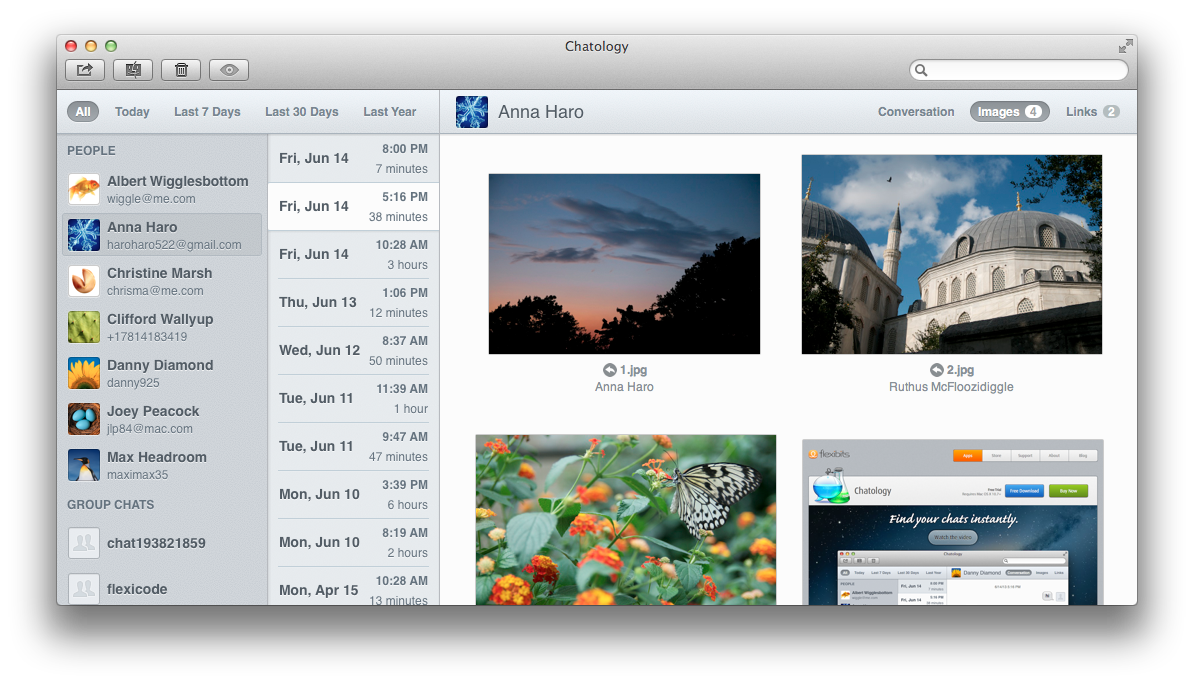
Filtering by photos. I have a friend, we’ll call him SB for short, and we often send back and forth design comps to get feedback and when I want to pull one up to look at again Messages has a seizure. ((Ok, that’s an understatement.)) So something like Chatology really makes Messages a much more reliable tool when you want the content of your chats to be searchable later on. The bonus to that is that if most of the messages you send on your iPhone are through iMessage, then they also become searchable (easily so) on the Mac — I love that.
This is not an app for everybody, but those that could use an app like this, are really going to love it.
[It’s $19.99 and it’s *not* on the App Store][2].
[1]: http://flexibits.com/chatology
[2]: http://flexibits.com/chatology -
‘Apple’s Commitment to Customer Privacy’
[Interesting open letter from Apple regarding PRISM][1]: > We do not provide any government agency with direct access to our servers, and any government agency requesting customer content must get a court order. I say this is interesting because it has less beating around the bush than the other press releases we have seen, but I…
[Interesting open letter from Apple regarding PRISM][1]:
> We do not provide any government agency with direct access to our servers, and any government agency requesting customer content must get a court order.
I say this is interesting because it has less beating around the bush than the other press releases we have seen, but I still don’t like the wording of “direct access”. Either the Government has access to Apple servers are they don’t. It’s one thing for Apple to scrape their own servers and package up data that they have been compelled to turn over via Court Order, and quite another to allow direct, or indirect, access to Apple servers upon receipt of court orders.
I want these questions answered: At any point does the U.S. Government, or contractors working on their behalf, have any access to Apple servers in any way? When compelled by court order, does Apple, or the agency compelling Apple, access the data that has been legally compelled to be turned over?
Answer those.
I love the digs at the end though:
> For example, conversations which take place over iMessage and FaceTime are protected by end-to-end encryption so no one but the sender and receiver can see or read them. Apple cannot decrypt that data. Similarly, we do not store data related to customers’ location, Map searches or Siri requests in any identifiable form.
That seems like a dig at Google to me, I love it. I am curious though about the FaceTime and iMessage encryption. Bottom line: can those two services be intercepted and read by the NSA right now? I doubt I’ll ever get that answer, but I am dying to know.
[1]: http://www.apple.com/apples-commitment-to-customer-privacy/
-
‘Real’
[Matt Drance, talking about iOS 7][1]: > The parallax effect conveys an entire living world under that glass, not just abstract pictures and icons. This is reinforced by the launch and quit animations: your eye never loses sight of where you’re going, or where you came from. You are moving through this world. There is…
[Matt Drance, talking about iOS 7][1]:
> The parallax effect conveys an entire living world under that glass, not just abstract pictures and icons. This is reinforced by the launch and quit animations: your eye never loses sight of where you’re going, or where you came from. You are moving through this world. There is almost no change in context, ever.
The idea of spacial awareness and moving about inside of the machine that is your iPhone is very present in iOS 7 — and it’s a good way to describe every other change Apple has made. I keep coming back to that psychological theory that you really do lose your train of thought when you pass through a doorway.
The sudden jolt of shit flying back in when you hit the home button in iOS 6 (and under) devices was sometimes enough for me to momentarily lose my train of thought, but in iOS 7 it feels like I am just shifting, swiveling, ((There use to be a similar transition in Keynote {seems to be missing now} that zoomed out and panned up or down, then zoomed back in when you switched slides. iOS 7 transitions are similar to that.)) from one section to the next. While the new animation feels like it takes longer, it also feels less jarring, I never lose my place and I think that’s far more important than speed (says he only a week into it).
It’s very early on to be making these assumptions, but this seems like a larger theme Apple is using as the underlying basis for iOS 7. I like it.
[1]: http://www.appleoutsider.com/2013/06/17/real/
-
Quote of the Day: Brice Schneier
“We can’t fight for Internet freedom around the world, then turn around and destroy it back home. Even if we don’t see the contradiction, the rest of the world does.” — Bruce Schneier
“We can’t fight for Internet freedom around the world, then turn around and destroy it back home. Even if we don’t see the contradiction, the rest of the world does.” -
‘NSA Admits Listening to U.S. Phone Calls Without Warrants’
[Declan McCullagh reporting on comments from Rep. Jerrold Nadler][1]: > Rep. Jerrold Nadler, a New York Democrat, disclosed this week that during a secret briefing to members of Congress, he was told that the contents of a phone call could be accessed “simply based on an analyst deciding that.” > If the NSA wants “to…
[Declan McCullagh reporting on comments from Rep. Jerrold Nadler][1]:
> Rep. Jerrold Nadler, a New York Democrat, disclosed this week that during a secret briefing to members of Congress, he was told that the contents of a phone call could be accessed “simply based on an analyst deciding that.”
> If the NSA wants “to listen to the phone,” an analyst’s decision is sufficient, without any other legal authorization required, Nadler said he learned. “I was rather startled,” said Nadler, an attorney and congressman who serves on the House Judiciary committee.[President Obama, not a week earlier][2] (as transcribed by The Wall Street Journal):
> They are not looking at people’s names, and they’re not looking at content. But by sifting through this so-called metadata, they may identify potential leads with respect to folks who might engage in terrorism. If these folks — if the intelligence community then actually wants to listen to a phone call, they’ve got to go back to a federal judge, just like they would in a criminal investigation. So I want to be very clear. Some of the hype that we’ve been hearing over the last day or so — nobody’s listening to the content of people’s phone calls.
The argument here is that Obama was specifically addressing PRISM, and not the overall capabilities of the NSA. I call bullshit. Either Obama was being intentionally deceitful by word-smithing around the truth, or he was *also* being lied to by the NSA and thus ignorant about the rampant abuse of power coming from the NSA. I highly doubt the NSA would be able to do this without the President knowing. So…
**UPDATE**: Looks like CNET’s sources/government is backtracking. Instead of CNET clearly updating the story, they went through and just changed a bunch of shit like hacks do, which completely changed the story, so they re-wrote the headline. Hacks. Anyways…
[1]: http://news.cnet.com/8301-13578_3-57589495-38/nsa-admits-listening-to-u.s-phone-calls-without-warrants/
[2]: http://blogs.wsj.com/washwire/2013/06/07/transcript-what-obama-said-on-nsa-controversy/ -
Clear Organizer Pouches from Tom Bihn Make Great iPad Mini Stashes
I was packing up the diaper bag for the day today, and realized that I should bring a battery backup charger for my iPhone, which meant a cable too. And since I was at it why not grab the iPad mini in case an opportunity to use it provides itself. Normally this crap would have…
I was packing up the diaper bag for the day today, and realized that I should bring a battery backup charger for my iPhone, which meant a cable too. And since I was at it why not grab the iPad mini in case an opportunity to use it provides itself. Normally this crap would have just been floating around in the the diaper bag, but then I had a thought. Why not use a [Tom Bihn clear organizer pouch][1] to store everything in. Bingo.
[Works pretty damned well][2]. There’s no padding, but everything fits pretty nicely.
[1]: http://www.tombihn.com/accessories/TB0319.html
[2]: http://www.flickr.com/photos/showngo/9051811280/ -
‘Stockman Requests Subpoena of NSA’s White House, IRS Phone Logs’
[ Congressman Steve Stockman ][1]: > As you know, recent revelations show the National Security Agency has been keeping an “ongoing, daily” log of every domestic phone call in the United States. > > I respectfully request your Committee subpoena the records of every phone call made from all public and private telephones of all IRS…
[ Congressman Steve Stockman ][1]:
> As you know, recent revelations show the National Security Agency has been keeping an “ongoing, daily” log of every domestic phone call in the United States.
>
> I respectfully request your Committee subpoena the records of every phone call made from all public and private telephones of all IRS personnel to all public and private telephones of all White House personnel.
>
> If President Obama is collecting such information, he certainly would want us to use it. If he has nothing to hide he has nothing to be afraid of.Maybe Stockman isn’t any better than any other congressman, but you gotta love this letter he sent to the House Committee on Government Reform & Oversight requesting PRISM data to investigate the recent IRS targeting of political groups.
[1]: http://stockman.house.gov/media-center/press-releases/stockman-requests-subpoena-of-nsa-s-white-house-irs-phone-logs