Top Posts

Leica Sofort 2June 13, 2024
Grand Seiko SBGX261February 23, 2023

Recent Articles

  • The B&B Podcast #88: Legacy Twitter Relationships

    >For the final show of 2012, Shawn and Ben record a show in their old style of casual conversation. Topics include teething, Amazon Prime, OmniFocus, scaling back on Twitter followers, Time Magazine’s top 10 gadgets of the year, and more. I had fun this week, a bit longer to make up for no more shows…

    >For the final show of 2012, Shawn and Ben record a show in their old style of casual conversation. Topics include teething, Amazon Prime, OmniFocus, scaling back on Twitter followers, Time Magazine’s top 10 gadgets of the year, and more.

    I had fun this week, a bit longer to make up for no more shows this year. We will be back in January and if you want to sponsor a 2013 show — get in touch now.

  • ‘I’m Sticking With Apple Maps’

    [Jim Dalrymple tried out Google Maps and is deciding to stick with Apple Maps](http://www.loopinsight.com/2012/12/13/im-sticking-with-apple-maps/): >On the way, I ignored some directions to see how it would handle being re-routed. >It did okay, but there was a long lag as it figured out where to take me next and instead of finding the best route from…

    [Jim Dalrymple tried out Google Maps and is deciding to stick with Apple Maps](http://www.loopinsight.com/2012/12/13/im-sticking-with-apple-maps/):

    >On the way, I ignored some directions to see how it would handle being re-routed.

    >It did okay, but there was a long lag as it figured out where to take me next and instead of finding the best route from where I was, it kept trying to take me back to the original route.

    That’s the best part about Apple Maps, in my use — both in the U.S. and Canada — Apple Maps almost instantly rerouted me, whereas most turn-by-turn mapping systems have a notable lag that can be the difference between a two minute or fifteen minute mistake.

    Apple maps.
    Google Maps. Note the curious lack of the lake that Apple shows.

    I’m also (unsurprisingly) sticking with Apple Maps, but for different reasons:

    1. The Google icon is hideous. It’d be great if it weren’t for the huge cutoff `G` and you know that cartoonish looking maps background.
    2. The maps look like cartoons. Look at Apple Maps and then Google, the difference to me is striking. Apple maps look like professional maps, whereas Google’s look like un-styled computer generations. I-5 in Washington is an eight lane freeway, which Google shows as one yellow stripe and Apple shows as two roads split directionally.
    3. The Google UI is not an iOS UI — that’s crappy because this is an app to be used on iOS, Google should have stuck with iOS standards.

    Having street view back is nice, I guess, but I never really missed it. Instead this is what matters to me: how the app looks. As you can see from the screenshots at the side, the Apple Maps just look better. That matters to me, moreover the non-standard iOS UI isn’t something I want to deal with when I use an app that I will likely be using when I need to get things done quickly (at a stop light perhaps).

  • Trade Unions of America

    Growing up I had a lot of the thoughts that young budding entrepreneurial types have: – Why isn’t everything just free? Oh, communism doesn’t work? Ok. – Why is “made in China” bad? Oh, now it isn’t? – Why do we have unions? …Well? Unions did an amazing thing for workers across the world —…

    Growing up I had a lot of the thoughts that young budding entrepreneurial types have:

    – Why isn’t everything just free? Oh, communism doesn’t work? Ok.
    – Why is “made in China” bad? Oh, now it isn’t?
    – Why do we have unions? …Well?

    Unions did an amazing thing for workers across the world — they made common courtesy a standard in factories and business around the world.

    Unions have done a lot of fucking good.

    But the unions that exist in the United States today, aren’t doing much fucking good.

    Hostess went out of business *because* of unions playing chicken (and losing). The United States Postal Service is hamstrung by union contracts of old that they were forced into for fear of the mail just, well, stopping.

    Here’s a (generalized) primer on what unions do:

    – Protect worker rights from backlash, retaliation, poor working conditions, low wages, and so on.
    – Charge workers a fee for this service. Of course this sometimes benefits the worker, but not when the union causes them to be on mandatory strike and the backup funds run out, or when the union forces the company to just close down. Doubly sucks when you aren’t a member of the union, but are still forced to pay.

    In a nut shell, that’s what unions do. They practice democracy (forced democracy?) in business by getting all the workers of one type together and saying: not a single one of us will work for you unless XY & Z are met.

    I am of a couple opinions on unions:

    1. They are a relic of a system that no longer needs them. The Government is now successfully regulating worker safety and protections.
    2. Unions are making Americans uncompetitive in the global economy by back loading contracts with pensions that aren’t sustainable or viable. It’s not the up front labor costs that are killing companies — it’s the retirement that is.

    [So when I read this report from Monica Davey, my heart was warmed a bit](http://www.nytimes.com/2012/12/12/us/protesters-rally-over-michigan-union-limits-plan.html?pagewanted=2&_r=1&adxnnl=1&adxnnlx=1355328392-oh2WfpTn0oNsppwTuP6ziA&pagewanted=all&):

    >The legislation here, which will go into effect next year, bans any requirement that most public and private sector employees at unionized workplaces be made to pay dues or other fees to unions. In the past, those who opted not to be union members were often required to pay fees to unions that bargained contracts for all employees at their workplace.

    How this isn’t standard is beyond my comprehension of stupidity.

    I’m not saying we abolish unions, but I think as a country we need to give thought to what a union, today, really means for workers. Unions as they currently exist are a relic and are hurting the U.S. economy — that doesn’t mean we do away with unions, but revamping them is needed.

  • Making Money on the Web: Ads versus Paywall

    As most readers know, I [made the switch from an advertising supported site in July 2012 to a paywalled](https://brooksreview.net/2012/07/new-tbr/) site. I have plenty of reasons for the switch, but more interesting to most of you is: “how’s it going?” Well. Kinda. I’ve thought quite a bit on how to approach this and I think all…

    As most readers know, I [made the switch from an advertising supported site in July 2012 to a paywalled](https://brooksreview.net/2012/07/new-tbr/) site. I have plenty of reasons for the switch, but more interesting to most of you is: “how’s it going?”

    Well. Kinda.

    I’ve thought quite a bit on how to approach this and I think all of you (members or not) deserve the entire set of facts in order to actually understand what “how’s it going” means. So here goes.

    ## Ads

    Before the paywall, there were ads, and I had four revenue streams for the site:

    – Fusion ad
    – RSS sponsors
    – Donations
    – Amazon Affiliate links

    Initially, when the site was young, Fusion paid me $450 a month to run ads on the site. I don’t know if that was a good deal, or a shit deal — I still don’t because bloggers hold this data near and dear, I’m tired of that bullshit — so there you go, that’s what I was paid at the start.

    Near the end, when the site was getting roughly 50,000 unique visits a month, I had upped the Fusion payments to $600 a month. And honestly I still have no clue if that was a fair rate or not — I always felt $1000 a month was the true value of an ad slot on this site. If I were to sell the ad myself I’d charge $1,500 a month to one advertiser and I bet I would be booked solid.

    With the RSS sponsors things were trickier. I can say filling those slots myself sucked and was disheartening all the time. The Syndicate helped a lot, but the money wasn’t as good.

    Near the end I was charging almost $500 per week for the 8,200 RSS subscribers I had. I think the true value and sustainable rate for this size was closer to $450 a week. If I were to start back up again today I would charge $500 a week and risk not filling every week.

    In total I only ever received $200 in donations. (Thank you to those that donated.)

    Amazon affiliates are actually a good deal, netting me between $150-600 a month. That’s why I kept those around, because they are mostly transparent for readers and items I would still recommend even if I didn’t get a kickback. Either way, it is silly not to do Amazon affiliate links — that’s coming from someone who hates ads.

    That’s where I was with ads. I made on average $2,100 a month. My stats were 50,000 uniques and 150,000 page views a month with 8,200 subscribers. Maybe that’s good, maybe it’s bad, I have no clue because no one ever shares this info.

    Now you have one data point to go off. So before you look to blogging as a career, take a look at those numbers again because they are gross and not the net profit.

    ## The Paywall

    So how many members do I have? Roughly 255 right now. Again, I don’t know if that is good or horrible. It amounts to a little less than $1,000 a month after fees and such. So less than half of what I was making before.

    What I’ve learned is that the member base is very stable. That I barely gain new members each month, and likely if I want to up the membership I will need to talk about the membership more.

    That, in a nutshell, is where things stand right now. The membership is great because it’s no extra work, but it is growing really slowly — yet very stable. I’d recommend it to anyone out there, but temper your expectations. ((A better idea is to submit an article to The Magazine as the payments are top notch and any one with a good article can get paid a great rate.)) I had hoped to have closer to 500 members by now — oops.

    ## Now

    A lot of people want to know where this leads now. Which is a clever way (or not so clever actually) of asking: will you keep the paywall?

    Yes.

    Since putting up the paywall I’ve been able to stop caring about stats and money. All I focus on is writing and that’s way better.

    Yes there is a little bit of support, but far less than the work it took to fill RSS slots, or mentally think about keeping up page views to try and get better ad rates.

    ## Full Time

    Since I am answering questions that I am often asked, the question of whether I am going full time or not should be addressed. It’s one of the top five questions I get asked.

    The short answer to whether I am going full time: nope.

    The longer answer is that I would like to eventually, but the site revenue just wouldn’t come close to supporting me. If and when the site can support me full time, that’s great, if it never does I am fine with that too.


  • ‘Pageview Journalism’

    [Tom Foremski writing for ZDNet about ‘pageview journalism’](http://www.zdnet.com/the-changing-role-of-pr-in-the-era-of-pageview-journalism-7000008473/): >The result is what we have today: a bland me-too media landscape which publishes huge numbers of the same stories. We’ve all seen that now haven’t we. Hell, you’ve seen it here too. A new hot iOS app comes out and there are fifty sites publishing a…

    [Tom Foremski writing for ZDNet about ‘pageview journalism’](http://www.zdnet.com/the-changing-role-of-pr-in-the-era-of-pageview-journalism-7000008473/):

    >The result is what we have today: a bland me-too media landscape which publishes huge numbers of the same stories.

    We’ve all seen that now haven’t we. Hell, you’ve seen it here too. A new hot iOS app comes out and there are fifty sites publishing a review of the app, because “I was given early access to X.” Yay, me!

    Again, I’ve done it here. It’s hard not to, because the reality is that you get contacted by a lot of people and offered a lot of free shit if you have even a modicum of popularity on your website.

    Worse still is that if this is a physical good, once these companies have your mailing address they will *keep* sending you shit hoping that you write about it — happens to me. Even worse still is that most writers won’t tell you that. Want to know what’s even worse? These companies typically say that these items are “review items” suggesting that you write about them in exchange for being sent them, but also suggesting you don’t get to keep the item — yet most bloggers simply won’t return the item until someone asks for it back (hint: companies never ask for these things back).

    Again, I’ve been caught in this. With the Tom Bihn Smart Alec I accepted the updated model with an agreement that I would write about it ((To be clear, Tom Bihn asked if I was interested in checking out a new backpack and in no way do I feel that they deal in a shady way. Every interaction with them has been the best of any company I have worked with. I use them as an example because I really have nothing bad to say about them.)) , and the backpack would be a review item. However, after I reviewed it I emailed my contact and *purchased* the backpack from Tom Bihn because I liked it so much. ([Here’s the proof](http://cl.ly/image/3m24393b043g), they did refund me the shipping since I already had the backpack — hindsight I should have paid for that too.)

    I personally go out of my way now to get these items back, make it clear when I receive a free item, and so on and so forth.

    Most writers don’t.

    That’s why you end up with a circle-jerk of reviews all around the same item, all at the same time. It’s starting to really piss me off. Instead of participating I am trying to go out of my way to *buy* things and review those that people aren’t talking about — that, I think, is far more interesting for readers.

    So next time people start writing about the same thing at the same time — well now you know why.

    **Afterthought Update:** In thinking about this a bit more, this could be construed as a damnation of all other bloggers. Please don’t read it that way, this is a generalization of the standard “blog process” — there are many good bloggers that do it the right way. There are many times I fuck up despite concerted efforts not to. I do feel that if we don’t call people out on this, then we won’t really know where the motivations lie and that is what ultimately bugs me.

  • Quote of the Day: The Oatmeal

    “When I ‘declined’ an interview, what actually happened was you emailed my MOTHER and she had no idea what Buzzfeed was, so she said no.” — The Oatmeal

    “When I ‘declined’ an interview, what actually happened was you emailed my MOTHER and she had no idea what Buzzfeed was, so she said no.”
  • The Most Interesting Section of the Fortune Interview of Larry Page

    [Miguel Helft, in an interview with Google’s CEO Larry Page, has one of the most humorous back and forths I have read in a while](http://tech.fortune.cnn.com/2012/12/11/larry-page/): >**So in light of that, Apple’s still a partner. It’s a competitor. You and Steve Jobs were friendly.** At times. **At times. You said that whole thing about Android and…

    [Miguel Helft, in an interview with Google’s CEO Larry Page, has one of the most humorous back and forths I have read in a while](http://tech.fortune.cnn.com/2012/12/11/larry-page/):

    >**So in light of that, Apple’s still a partner. It’s a competitor. You and Steve Jobs were friendly.**
    At times.
    **At times. You said that whole thing about Android and them being angry about it, that it was for show.**
    I didn’t say that entirely. I said partly.
    **[Apple did it] partly for show, to get the troops to rally**
    By the way, that’s something I try not to do. I don’t like to rally my company in that way because I think that if you’re looking at somebody else, you’re looking at what they do now, and that’s not how again you stay two or three steps ahead.
    **So Apple obviously is a huge distribution partner for some of your services. How is the relationship?**
    What I was trying to say was I think it would be nice if everybody would get along better and the users didn’t suffer as a result of other people’s activities. I try to model that. We try pretty hard to make our products be available as widely as we can. That’s our philosophy. I think sometimes we’re allowed to do that. Sometimes we’re not.

    There’s a couple really fantastic things being brought to light here that I want to point out:

    1. Page [wisely] won’t directly answer the questions about Google’s relationship with Apple. Yet it is clear from his answers that the relationship is strained and he sounds frustrated by that. “I said partly.” Is the phrase I would point to to back this up — what a passive aggressive answer by Page. This is the one thing that drives me crazy about most CEOs: they refuse to talk straight. Page doesn’t have to answer, but if you’re not going to answer, why not just say that instead of dancing around words with bullshit phrases.
    2. I love this statement by Page: “We try pretty hard to make our products be available as widely as we can.” I love that statement because it is a direct contradiction of reports that Google demanded a large share in order to get Turn by Turn navigation in the iOS maps application. Yes, Google should make money, but Page waxes on in this entire interview about “greater good” bullshit, sharing, and when it comes down to it money still matters.

    Want proof that money matters a lot to Google? Here, from Page:

    >I think there’s no company you would choose that would be better positioned to transition and innovate in mobile advertising and monetization. We’ve got all the pieces we need to do that going forward.

    I’d agree, and in that light this statement from Page should scare the crap out of users of Google:

    >The fact that a phone has a location is really helpful for monetization.

    I bet.

  • More on Retina Displays and How Disruptive They Are

    [Kyle Baxter takes exception to my stance that retina displays are *disruptive*, stating in a response on his site](http://tightwind.net/2012/12/brooks-retina/): >I would prefer a retina iPad Mini obviously, but between a retina display and a small, lightweight form, I choose the smaller, lighter form. It contributes more to the device’s usability than does a brilliantly clear…

    [Kyle Baxter takes exception to my stance that retina displays are *disruptive*, stating in a response on his site](http://tightwind.net/2012/12/brooks-retina/):

    >I would prefer a retina iPad Mini obviously, but between a retina display and a small, lightweight form, I choose the smaller, lighter form. It contributes more to the device’s usability than does a brilliantly clear and beautiful screen.

    This is missing the point.

    [Shawn’s statement](http://shawnblanc.net/2012/11/levine-ipad-mini/), [which I represent as I quoted it last](https://brooksreview.net/2012/12/haters-gonna-hate/), was:

    >As awesome as Retina displays are, they don’t fundamentally change the usability or use-case scenarios of the iPad.

    The argument isn’t: which is more useful iPad with retina display, or iPad mini. The argument is that retina displays, by themselves, are not a disruptive technology — a notion which I firmly call bullshit on.

    [The original post from Dana Levine which started it all culminates as follows](http://thetechblock.com/why-everyone-loves-ipad-mini/):

    >There isn’t actually any new use case that a retina display enables, other than being prettier.

    Levine, to be fair to Blanc and Baxter, has his entire article wrapped in the context of the iPad mini. The statement from Levine that I am arguing though, is the one quoted above.

    I have no doubt that the iPad Mini is fantastic to read and hold — no doubt that in many ways it is better — but I very much doubt that retina displays are **not** a disruptive technology. It is my opinion that such a thought is short-sighted.

    The argument is not that smaller is greater than sharper — the argument is that retina displays on their own *are* a disruptive technology. [I think retina displays are disruptive](https://brooksreview.net/2012/12/haters-gonna-hate/), Levine (for one) thinks that they are *not* disruptive.

  • Keyboard Maestro Macro: Append to Quote File

    *(This post is a part of a series on Keyboard Maestro, [see more here](https://brooksreview.net/tag/KM-SERIES/).)* One of the things that I have always loved doing is saving quotes. The problem for me has aways been where to save those quotes. As it turns out, I don’t often go back and read the quotes — they are…

    *(This post is a part of a series on Keyboard Maestro, [see more here](https://brooksreview.net/tag/KM-SERIES/).)*

    One of the things that I have always loved doing is saving quotes. The problem for me has aways been where to save those quotes. As it turns out, I don’t often go back and read the quotes — they are more like things that I use as future references. I have some quotes in dedicated apps — never to be seen again — others in Yojimbo and Pinboard and none of these solutions work well for me.

    All I want is a bunch of quotes strung together, so I decided to craft a way to save quotes with Keyboard Maestro and a hot key trigger.

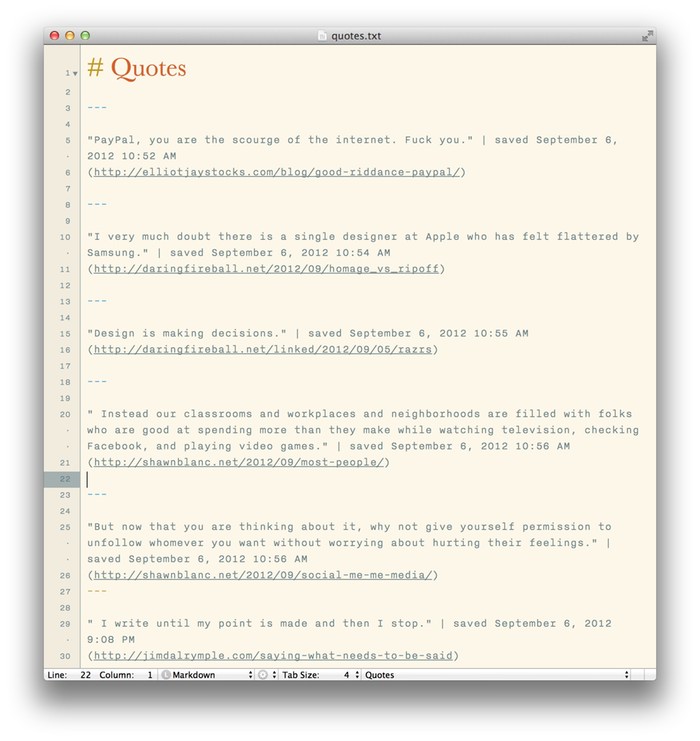
    Doing this is actually pretty simple: all the quotes end up in the same text file and the end result looks pretty decent for viewing.

    The finished product.

    Here’s what my macro grabs:

    – The quoted text.
    – The current date.
    – The URL of the quoted text.

    All of that info is dumped into one file as an append action. The process is actually very simple.

    ## The Macro

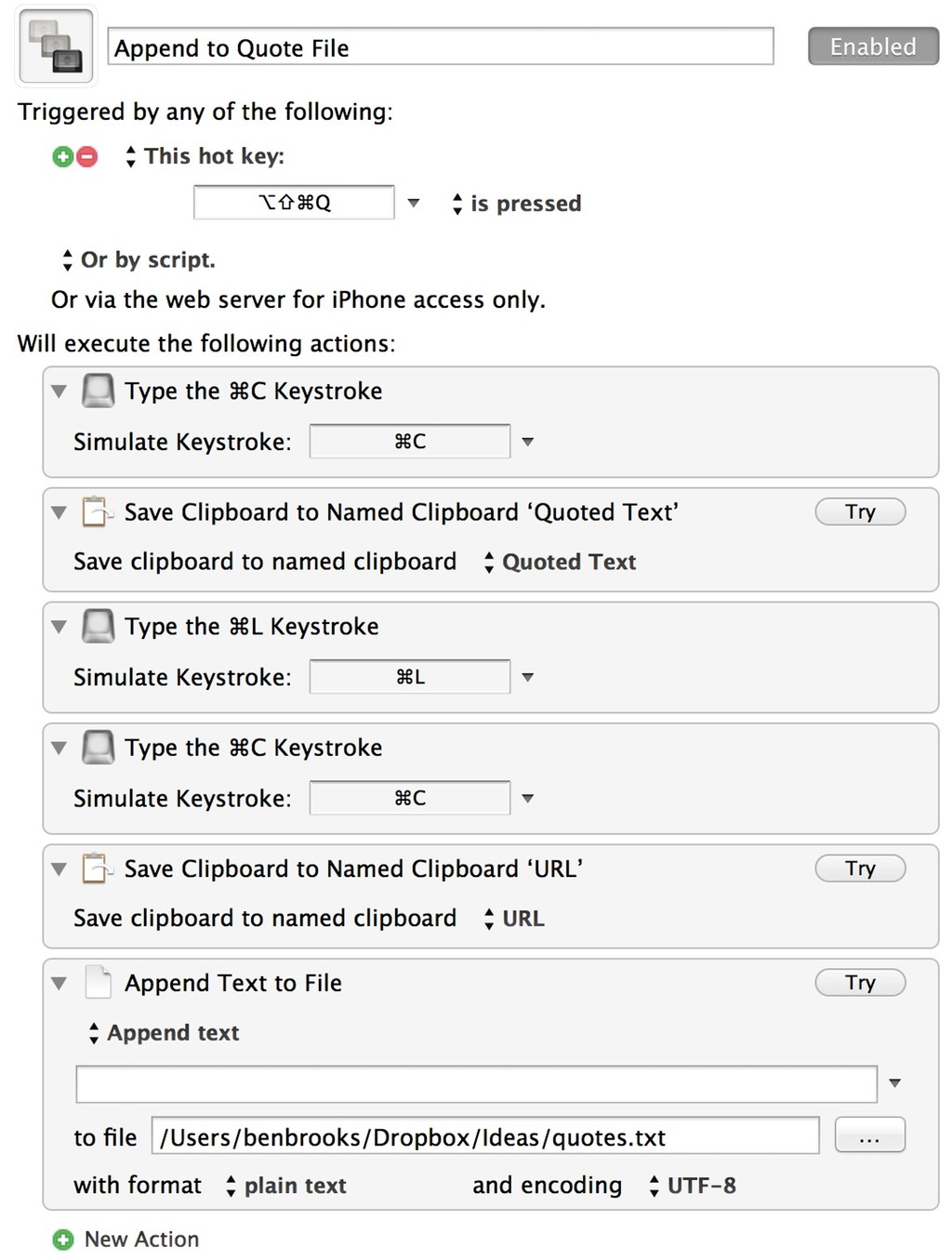
    The full macro.

    As you can see this macro is exceedingly simple, but it assumes you have already selected the text you want to quote.

    1. The first thing the macro does is copy the selected text using `CMD+C`.
    2. Next the macro saves that copied text to a named clipboard called `Quoted Text`. (Hint: to create named clipboards just select the `Save Clipboard to Named Clipboard` action and in the chooser for the named clipboard, select `New`. You can also edit these in the preferences for Keyboard Maestro.)
    3. I then simulate the keystroke `CMD+L`, which highlights the current URL in Safari and Chrome.
    4. Again, just copying that URL and setting it to another named clipboard — this time called `URL`.
    5. The last part is to append this text to our file. So I have set the following to append to the file:

    {OPT+Return}
    ---
    {OPT+Return}
    "%NamedClipboard%Quoted Text%" | saved %ShortDate% %ShortTime%
    {OPT+Return}(%NamedClipboard%URL%)

    I couldn’t get the command `%Return%` play nice in TextMate 2, so I added carriage returns by using `OPT+RETURN` when entering the text.

    That’s it, now every time you invoke the command your text, URL, and dated added is appended to one text file. I personally find this much more useable than a dedicated app because I store it in Dropbox and can get to it from anywhere.

  • Skydrive and Verbs

    [Quentin Hardy writing of his experience with Windows 8 on the Lenovo IdeaPad Yoga](http://bits.blogs.nytimes.com/2012/12/10/windows-8s-clarity-problem/): > That evening I was at dinner with Satya Nadella, the head of Microsoft’s server and tools business. “You should have just used our online service through Skydrive,” he said, referring to Microsoft’s online storage service. > I pointed out that…

    [Quentin Hardy writing of his experience with Windows 8 on the Lenovo IdeaPad Yoga](http://bits.blogs.nytimes.com/2012/12/10/windows-8s-clarity-problem/):

    > That evening I was at dinner with Satya Nadella, the head of Microsoft’s server and tools business. “You should have just used our online service through Skydrive,” he said, referring to Microsoft’s online storage service.

    > I pointed out that this was not intuitively clear from the Windows 8 look: Instead of saying “write” or “store,” the icon says “Skydrive.” Instead of offering activities, Microsoft is assuming that buyers are up on all of its products, and clear on how to begin using them.

    Hardy makes a fantastic point. Whenever I set up an iPad or iPhone for a new user, they figure out where email, phone, contacts, calendars and so forth are, but the web? That one confuses most people, because “Safari” isn’t something they are used to calling the Internet.

    I very much like the idea of giving users a better understanding of what things do by using verbs instead of brand names — I think it is a natural extension of this post-pc hoopla people are caught up in.

    One last thing to note: I setup a Skydrive account a couple of months ago and while I barely use it, I have to say it is a really solid service. I personally wish more iOS developers integrated it into apps so that Dropbox wasn’t the defacto method of getting at synchronized files.

    I’m not saying Skydrive is or isn’t better than Dropbox, I haven’t used it long enough to say, but in my testing Skydrive has been surprisingly very good.

  • Quote of the Day: MG Siegler

    “Again, there will be winners in this space. And the only thing I’m certain of is that those winners won’t look or act anything like The Daily.” — MG Siegler

    “Again, there will be winners in this space. And the only thing I’m certain of is that those winners won’t look or act anything like The Daily.”
  • ‘Why I’m writing on the iPad’

    [Jason Snell writing about, well, writing (on his iPad)](http://www.macworld.com/article/2018600/why-im-writing-on-the-ipad.html): >Using the iPad slowed me down and got me to think about what I was writing in a way that using my trusty MacBook Air never would. That perfectly encapsulates a feeling that I have been getting from my iPad too. I use iA Writer on…

    [Jason Snell writing about, well, writing (on his iPad)](http://www.macworld.com/article/2018600/why-im-writing-on-the-ipad.html):

    >Using the iPad slowed me down and got me to think about what I was writing in a way that using my trusty MacBook Air never would.

    That perfectly encapsulates a feeling that I have been getting from my iPad too. I use iA Writer on both my Mac and iPad. Both are full screen — both then show the same amount of distractions (none). Yet I much prefer working on the iPad with the on screen keyboard.

    I never knew why until Snell wrote his article today.

    While the iPad is slower, and can be frustrating to edit with, I find that my words are more considered on the iPad. Yes, it’s all psychological, but that doesn’t make such a sentiment any less true.

    I’m with Snell on this one: I think that I *need* to write on my iPad when I want to take a more considered approach to things.

  • ‘T-Mobile USA Plans to Ditch Phone Subsidies’

    [Sinead Carew reporting for Reuters on changes coming for T-Mobile](http://www.reuters.com/article/2012/12/07/us-tmobileusa-iphone-idUSBRE8B604A20121207): >Under the unsubsidized model, Legere said customers will be able to upgrade their phones when they want to by trading in the device. T-Mobile USA’s bigger rivals have been restricting upgrades to keep their subsidy costs under control. This is going to be fascinating to…

    [Sinead Carew reporting for Reuters on changes coming for T-Mobile](http://www.reuters.com/article/2012/12/07/us-tmobileusa-iphone-idUSBRE8B604A20121207):

    >Under the unsubsidized model, Legere said customers will be able to upgrade their phones when they want to by trading in the device. T-Mobile USA’s bigger rivals have been restricting upgrades to keep their subsidy costs under control.

    This is going to be fascinating to see how it works. For one, will customers truly be willing to pay more upfront in order to have lower monthly bills and no commitment contracts? I personally don’t think they will be willing to pay more upfront.

    For most people it simply doesn’t make sense to pay more upfront because most users won’t be upgrading yearly. Most users want a really nice device, really cheaply, and they are willing to wait in order to get that.

    A 16GB iPhone 5 on contract with any of the three largest carriers in the U.S. will set you back: `$199`. For that you probably will pay `$80-100` a month and be stuck paying that for two years. If you want to upgrade you will have to pay a different price, which is typically calculated based off of a pro-rated system. So if the subsidy is `$450` over two years, to upgrade in one year you will likely have to pay `$225` *more* than the subsidized price of the phone. Makes sense.

    Most users then just wait two years. Apple knows this, and that’s why they use the same trick BMW (and others) does: not changing the visible look of the device substantially every year. (BMWs typically look the same for 5-8 years, with only enthusiasts being able to tell the subtle changes. Thus you can remain *happier* with your BMW for longer because you still feel like you have “the current model” — which is what Apple is doing too. Your phone and car don’t instantly look old the *next* year.)

    Now, the unsubsidized price of the iPhone 5 16GB? `$649`. Yikes.

    In order for buying a new unsubsidized iPhone to make financial sense, you would want your monthly bill to decrease by `$20/mo`. That makes it a wash from a pricing standpoint.

    T-Mobile has cheaper plans, and it sounds like they will reduce the monthly bill further for those without a subsidy on their device. Also T-Mobile will be buying back old devices. So theoretically you could probably get a new iPhone for the upgrade price of `$199` *if* you account for the lower monthly bill and the buy-back. You’d still pay the higher price, but aggregated overtime it would not be more expensive.

    HOWEVER, that’s not how the consumer mind works — consumers don’t use that logic. The general consumer is illogical — they have a *want* ((Not a need.)) and they fill that want without using a spreadsheet to determine what the best value is over time. So in the consumers mind they walk in and choose the device based on sticker price: AT&T sells it for `$199`, T-Mobile for `$649`.

    T-Mobile loses every time.

    I apply this logic all the time with renting apartments. Renters don’t look too much at the monthly cost, they look directly at the *initial* cost. So if my deposit is cheaper and I give them the first month free — they’ll typically pay `$100/mo` *more* than a competing rental unit.

    Why is this? Most consumers don’t have the cash to pay a lot upfront. So for them, often, the only way to get the things they want is to find it for as cheap as they can initially and not worry about long-term costs.

    It’s hard to explain to a consumer that they save money long term, when most consumers are just focused on the immediate: “If I buy the best long-term deal, I can’t order pizza for dinner tonight, *or* tomorrow.” And thus, they buy the cheaper one because they can get *two* things they want right *now*: pizza and a new phone.

    So T-Mobile might find a winning solution with savvy and smart consumers, but that’s a much smaller group than the general consumer base. Overall: this isn’t a great idea for T-Mobile — then again they don’t have much to lose either.

  • Quote of the Day: Jim Dalrymple

    “It’s a lot of fun to play loosey goosey with numbers isn’t it Amazon?” — Jim Dalrymple

    “It’s a lot of fun to play loosey goosey with numbers isn’t it Amazon?”
  • The B&B Podcast #87: Listener Q&A

    >Shawn and Ben answer questions submitted by you guys, the listeners. Ranging from App.net, Twitter clients, website memberships and Ben’s paywall, what podcasts we listen to, and more. This wasn’t live, but a really good show — not that I am biased or anything.

    >Shawn and Ben answer questions submitted by you guys, the listeners. Ranging from App.net, Twitter clients, website memberships and Ben’s paywall, what podcasts we listen to, and more.

    This wasn’t live, but a really good show — not that I am biased or anything.

  • ‘Apple and Twitter’

    [Patrick B. Gibson is the latest to posit that Apple should buy Twitter — Gibson argues that Apple needs Twitter in order to make successful web services](http://patrickbgibson.tumblr.com/post/36041799210/apple-and-twitter). On the surface this is a pretty solid argument, with this being the most quoted line of the article: >My friend and co-worker Tom has a thesis about…

    [Patrick B. Gibson is the latest to posit that Apple should buy Twitter — Gibson argues that Apple needs Twitter in order to make successful web services](http://patrickbgibson.tumblr.com/post/36041799210/apple-and-twitter). On the surface this is a pretty solid argument, with this being the most quoted line of the article:

    >My friend and co-worker Tom has a thesis about Apple’s biggest problem: Google is getting better at design faster than Apple is getting better at web services.

    That’s a gross oversimplification of the competition to Apple that Google poses and truly isn’t much of a problem. I think the problems need to be broken down by each company to see what is really happening.

    Apple’s current problems:

    – Under-age and poor working conditions in overseas factories.
    – Web services that have yet to be proven reliable.
    – Intellectual property theft, resulting in shockingly similar competing products.
    – Inability to keep up with demand.
    – No social networking presence.
    – Mapping problems.
    – Voice search.

    Google’s current problems:

    – Design that is lacking.
    – A social networking presence that is as robust as Microsoft’s.
    – Lack of profitability from Android.
    – Motorola’s, umm, “issues”.
    – Infringement on other’s intellectual property (see: Motorola).
    – No control over hardware, must partner with other companies.
    – No presence in the living room.

    The problem isn’t as simple as Google getting good at design faster than Apple is at web services — just as it wouldn’t be a problem for Google if Apple was suddenly amazing at web services.

    The real thing that should be concerning people is how shockingly well Apple has all of their problems under control:

    – Factory conditions are being solved by starting to open factories in the U.S., independent audits, and threatening to cease business with factories that don’t meet Apple standards.
    – To say that Apple is horrible at web services, is becoming a statement like the old adage: “Macs are too expensive.” It used to be true, but with each passing day Apple’s web services are getting shockingly good and reliable. I use iCloud everyday and have yet to have a problem with syncing, backups, or document storage. It’s not that people don’t have problems, but it’s more that the problems truly are less and less everyday.
    – As for IP theft, enter licensing and lawsuits — which Apple has proven they are pretty damned good at.
    – The inability to keep up with demand is not only a good problem to have, but an easy one to fix with more factories (which is what Apple is doing).
    – I have yet to see a valid reason why Apple needs a social network. If Apple just chooses to partner instead they don’t ever have to worry about their offering being relevant, only that they partner with the relevant social networks. As they have with Facebook and Twitter — why would we need an Apple social network when we have two massive ones already?
    – The mapping issues are very real, but also very new. They are also not the type of problem that will sink Apple — Apple would swallow its pride and go back to Google Maps before they let mapping sink the company. Give it a year, this problem will be gone.
    – Voice search is an interesting one. Siri is very good when it works, but it’s not consistent, or as fast as Google. This is one problem Apple really needs to focus on as they have questionable control over it right now.

    So, out of all the issues I think you could make a good case that Apple has two large problems with Maps and Voice Search — neither are huge problems with web services, but with fine tuning the current offerings (the hard part is already done).

    Now look at Google’s problems:

    – Design is still an issue, and while they are improving, Android still looks like crap compared to iOS or Windows Phone.
    – They have a social network, but it’s not popular. It’s not only then a money pit, but a talent pit.
    – Not making money from your mobile OS is a real problem. Luckily I don’t think that is the case, but it’s hard to argue that they are making anywhere close to the money Apple is (from either iOS or soon Android).
    – Motorola is going to become a huge red number on their income statements soon — and will/is causing trust issues with Android “partners”.
    – While Google hasn’t directly been sued, every Android “partner” is, including Motorola. Not just by Apple either, Microsoft too. Bottom line, whether directly or indirectly Google is going to pay for the IP problems in Android.
    – The lack of hardware control is always going to be problematic as we see now that Google is starting to see the issues with always relying on another company with conflicting motivations. Most Android users say they have a Samsung, or HTC, or just Android — you’ll never here the Google name in there. Further what if HTC and Samsung jump to another platform — what then of Android? That’s why they bought Motorola, but they were also only able to buy Motorola because Motorola isn’t a popular device maker right now.
    – And lastly Google TV, Q, whatever. The Apple TV may just be a hobby, but it’s a damned great one for Apple devotees. No one can say that about Google — so if Apple comes out tomorrow with a dominant media offering for the living room, they are already set to move on it for millions of users. Google would find itself with its pants down.

    Apple is in control of most of its problems, Google is focusing on the wrong problems.

    Even my small list here is a gross oversimplification of the problems, but far more accurate than Gibson’s oversimplification.

    Oh, and on the idea that Apple should buy Twitter: why? The top talent is already leaving the company — it’d be easier and cheaper just to offer them a million each to come to Apple for a couple years — you can’t buy Twitter for $100 million, but I bet you could buy 80-90 of their best engineering talents for that sum.

    [via DF]
  • The Surface Solution

    [Jim Dalrymple, commenting on the Microsoft Surface, notes that he sees the fundamental flaw of the Surface being that it does not actually solve any need or problem](http://www.loopinsight.com/2012/12/05/microsoft-forgot-to-solve-a-problem/): > Which brings me back to the Surface. What did it solve? Microsoft loaded the Surface with a 16GB operating system that isn’t optimized for a tablet,…

    [Jim Dalrymple, commenting on the Microsoft Surface, notes that he sees the fundamental flaw of the Surface being that it does not actually solve any need or problem](http://www.loopinsight.com/2012/12/05/microsoft-forgot-to-solve-a-problem/):

    > Which brings me back to the Surface. What did it solve? Microsoft loaded the Surface with a 16GB operating system that isn’t optimized for a tablet, but rather is a hybrid desktop/tablet OS that tries to do both.

    At first read I was nodding along and right there with Dalrymple on this, but then I got to thinking about it just a bit more and I think Dalrymple is actually wrong on this one.

    If we take iOS and Android devices, I think it is safe to lump them into the focused device category. They are purpose made to not doing everything, but to do many of the things one would want to do. The reward is ease of use and high portability with great battery life. The downside is that you likely will still need another device at times to accomplish all that cannot be accomplished on these diminutive devices.

    Now take Mac and Windows — both are full blown desktop operating systems. Both can do just about everything one could want to do with a computer and do it exceedingly well. There’s not much (if anything) that iOS or Android can do that Windows or Mac OS X cannot do. However there are tons of things that only can be done on these larger OS devices — almost everything is faster on the larger OSes too. Of course the trade off with a full-blown OS is that the devices required to run them are not nearly as portable as iOS and Android — more importantly they are power hungry devices with relatively short battery life.

    Of course certain devices turn these generalizations on their heads (the MacBook Airs for example), but overall a user chooses between highly portable and less capable, or highly capable and less portable.

    This is where I think the Surface comes in. I think it is a device that fits between these two categories. Not quite as easy to use, portable, and battery efficient as the iOS and Android counterparts, but it is *more* capable (at least on paper). And unlike full-blown OSes it is not as bloated, more portable, and more energy efficient. It’s a hybrid of the two as Dalrymple noted. The Surface does nothing better than either category, but does (hopefully) all the good of each category. (That goes for both the Surface RT and the Surface Pro.)

    So back to Dalrymple’s question of what the Surface solves, which I would answer with: it solves the same problem that car manufacturers solved (or tried to solve) with SUVs. Some people want both a car and a truck, but can’t afford both. That doesn’t necessarily mean that the Surface solves the problem well, but it solves the perceived problem of needing a hybrid device. It’s essentially the same thing original tablets tried to solve, just in a different form factor this time around.

    The problem is really a manufactured problem — because you can’t really have a truck that drives like a car. Just as you can’t have a full-blown OS that drives like a mobile OS. You can however create a new class of devices that are good enough at some of the things that the other two categories excel at and you will find a very willing and large user base.

    Essentially the Surface is for the “soccer mom” of mobile devices — who the “soccer mom” of this category is has yet to be identified, but I’d wager there are millions of them out there.

    The analogy isn’t a perfect fit, but the idea is. The Surface is trying to be the best of both Windows and Mobile/Touch Windows, yet as of right now it doesn’t do either very well, but it may also not have to do both well as long as it does both well *enough*. The idea of the Surface is a very good one, but the execution of the Surface is, so far, very poor.

    That’s why the introduction of the Surface excited many iOS lovers, while the actual product has disappointed almost all that held hope for it.

  • ‘iOS Keyboard Has Room for Improvement’

    [Chris Bowler brings up a great point about the iOS basic keyboard](http://chrisbowler.com/journal/ios-keyboard-has-room-for-improvement): >Using Mail’s keyboard is a significant reduction of efficiency compared with writing in iA Writer. Here’s hoping Apple recognizes the better design and embraces the approach. The keyboard in Writer really is better, but it’s not the best. [As Shawn Blanc notes in…

    [Chris Bowler brings up a great point about the iOS basic keyboard](http://chrisbowler.com/journal/ios-keyboard-has-room-for-improvement):

    >Using Mail’s keyboard is a significant reduction of efficiency compared with writing in iA Writer. Here’s hoping Apple recognizes the better design and embraces the approach.

    The keyboard in Writer really is better, but it’s not the best. [As Shawn Blanc notes in his link to Bowler](http://shawnblanc.net/2012/12/ios-keyboard/):

    >Speaking of which, in Writing Kit the left and right margins of the app are tap targets to move the cursor to the left or right, respectively. This is a feature that first appeared in the app, Writings.

    Shawn goes on to liken that feature to Pull to Refresh — as in it is something that should become iOS standard.

    The iOS keyboard has a lot of room to grow, but it needs to grow wisely — adding keys at the top of the keyboard is handy, but it also cuts a line or two from the viewable content. This is likely why Apple hasn’t added such a row.

    Likewise adding gestures that are hidden over the top of the existing interface is a clever solution, but far too clever to be discoverable or teachable to the masses embracing the iPad.

    Neither of these solutions are good solutions — they are all hacks that exist because the base OS keyboard is lacking.

    My solution is a bit less clever, but I think overall a bit *more* useable. Just add the fifth row, of what I will call action keys, to the keyboard whenever the user switches to the numerical keyboard. So you still have a full-ish view of your text, but then by tapping just one key you get a row of action keys that allow for broader selection. A hybrid approach if you will.

    If Apple wanted to be even more clever it could have a default set of keys and then three slots that add your most used keys. So for a guy like me, brackets, and asterisks would bubble up into a couple of those slots.

    I don’t like the idea of adding this row of action keys as a user selectable row — it needs to be set in stone. However, the idea of one to three keys changing based on how someone actually uses the device would be a clever compromise that would go a long way towards efficiency.

    Now the question becomes: is Apple motivated to make changes to the keyboard? If you think Apple sees the iPad as a creation device, then Apple certainly must be motivated — and I don’t think there are many left that think Apple sees the iPad as just a media tablet.

  • The Periodical Co

    [Yesterday I posted about Laker Compendium](https://brooksreview.net/2012/12/laker-ipad/), an HTML 5 based iOS app framework for publishing magazines yourself. It looks very nice, but it still requires a lot of work and tweaking around in Xcode. [Today I found out about The Periodical Co, a new shop that has set out to](http://theperiodical.co) create a platform for building…

    [Yesterday I posted about Laker Compendium](https://brooksreview.net/2012/12/laker-ipad/), an HTML 5 based iOS app framework for publishing magazines yourself. It looks very nice, but it still requires a lot of work and tweaking around in Xcode.

    [Today I found out about The Periodical Co, a new shop that has set out to](http://theperiodical.co) create a platform for building your own Newsstand iOS app — all without needing to know code. The best part is that the price is only a cut of your subscriptions — sounds like a win-win to me. What will be interesting is to see how this is accomplished, but I for one am keeping a close eye on this. I very much hope that it is done in a way that utilizes simple Markdown or HTML formatted text files that are uploaded somewhere to create a new issue — after the publisher sets the overall design. That’s what I am looking for:

    – Allow me to create a look.
    – Allow me to push content into the app at will, you can call them issues if you want — I don’t care.

    I have a feeling this is just the tip of the iceberg and can’t wait to see what the future holds with this micropublishing movement.

  • StickNFind

    [A while back I posted about the nRF8002 from Nordic Semiconductor and had this to say/wish](https://brooksreview.net/2012/06/bluetooth-proximity/): >I’ve long speculated that a better way to use geofencing is to make use of bluetooth chip to tell your phone where you actually are. Turns out, someone else makes the hardware already. The chip is a way to…

    [A while back I posted about the nRF8002 from Nordic Semiconductor and had this to say/wish](https://brooksreview.net/2012/06/bluetooth-proximity/):

    >I’ve long speculated that a better way to use geofencing is to make use of bluetooth chip to tell your phone where you actually are. Turns out, someone else makes the hardware already.

    The chip is a way to interact with your phone based on proximity — not needing to always look for and connect to bluetooth or use highly inaccurate GPS coordinates. My wish has always been for my phone to be able to “know” it is in the car and thus the volume needs to be turned all the way up (and on).

    [Today we get step one in the form of an already funded Indiegogo campaign for this very chip. A chip that you stick to things you want to later be able to find.](http://www.indiegogo.com/sticknfind?c=home). Is it gimmicky? Hell yeah. Is it useful? Not *really* useful because you can’t tell direction, only proximity.

    But, BUT, it is the first step in using these chips for proximity based control. Who’s to say that some clever iOS dev won’t reverse engineer these little chips and make a sensor that knows when you are at your desk, or on the “throne”. ((That’s *your* cue to start making that app for me.))

    I backed the project for six of them — if nothing else it will be better than the Elevation Dock, or Hidden Radio. Hell, they already have working prototypes.

    [via reader David E.]

    **Update:** I no sooner post about this, then I see this message in my inbox about the project:

    >By placing Stick-N-Find stickers in your Car, Home, Office, etc., the StickNFind Task Launcher has the ability to change automatically a user’s phone settings, launch applications, change ringtone music etc.

    That’s Android only, but man are we getting close to what I want.