Month: March 2011

  • A Toy

    I wanted to get a white iPad 2 because I had yet to see many people talking about how the white changes the user experience of the device, but after playing with one in the Apple store I am glad I didn’t get one.

    Shawn Blanc and I talked a bit about this on our last podcast, but I wanted to make a point to mention it here. There are two things that really turn me off about the white version of the iPad 2.

    1. The white frame, unlike the black version, looks plastic. I suspect that this is because (to my eye) the white looks like it is closer to the surface than the black, or maybe it’s the reverse. What ever it is when you get finger prints on the white it makes the white look like cheap plastic and less like a cold sheet of glass. This gives the white iPad the over look of a toy. Again, this is really hard to explain with words, but after talking to a few people about it, I don’t seem to be alone.
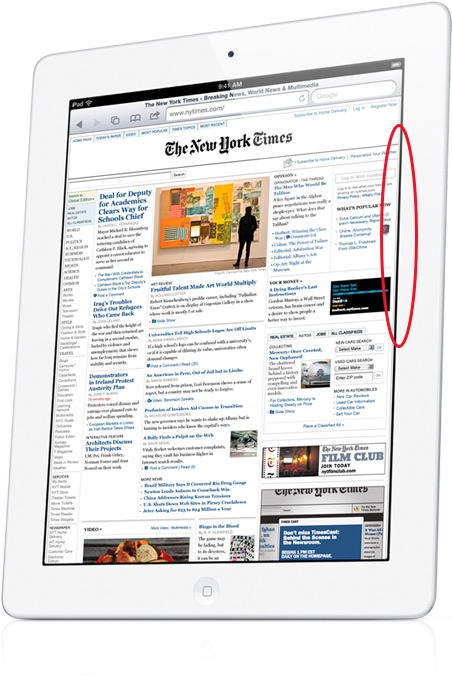
    2. The iPad’s screen does not extend from edge to edge of the bezel — there is a very slight gap between where the white iPad frame ends and the screen’s display starts. You can see this depicted in the below image, circled in red:

    [Image Source: Apple]

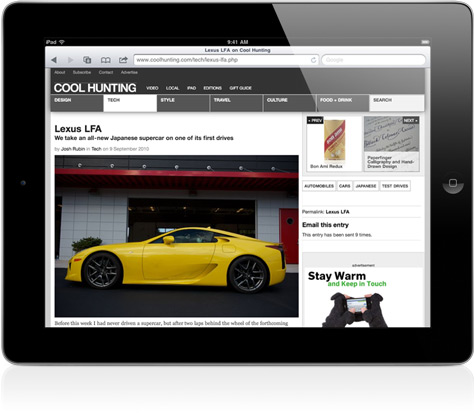
    This is not a knock against Apple’s manufacturing, but it does contribute to a major problem. That problem is the screen on the white version looks to be set farther back from the glass. You don’t notice this same edge on the black iPad 2 as you can see in the below picture — it’s there, but harder to see:

    [Image Source: Apple]

    This only further contributes to the overall toy look to the white iPads.

    What I am not trying to say is that you shouldn’t buy a white iPad 2 — rather you should see one in person first before you buy one. It’s not a bad device, it is still very good — but for me the look isn’t quite right.

  • Random Thoughts Gleaned From the SXSWi Trade Show Floor

    I took a quick hour long stroll through the trade show floor during my visit and here are some random things that popped into my head as I wandered around.

    • Blogger still exists. I don’t exactly know what it does anymore, but I did see their logo.
    • If your booth is across from Google’s booth you better get used to looking at the backs of potential customers. It really isn’t even fair.
    • SEO marketing booths look exactly how you would expect SEO marketing booths to look. By that I mean they look like crap and everybody speeds up a half tick as they walk by.
    • The trade show really is not that happening of a place.
    • WordPress geniuses were on hand and I thought that was pretty neat. I didn’t quiz any of them, but the booth was packed with people talking to them.
    • The only product I stopped to play with was the DAS keyboard. Which is a mechanical keyboard and is very loud and requires a firm keystroke. The keyboards weren’t connected to anything so I couldn’t get a good test of how typing on them is, but I am, and always have been, intrigued by them.
  • Apple’s Role in Japan during the Tohoku Earthquake

    From an email sent to Kevin Rose from a friend that works at Apple in Japan:

    7 hours and 118 aftershocks later, the store was still open.  Why? Because with the phone and train lines down, taxis stopped, and millions of people stuck in the Tokyo shopping district scared, with no access to television, hundreds of people were swarming into Apple stores to watch the news on USTREAM and contact their families via Twitter, Facebook, and email.  The young did it on their mobile devices, while the old clustered around the macs. There were even some Android users there. (There are almost no free wifi spots in Japan besides Apple stores, so even Android users often come to the stores.)

    What is even re remarkable is the caree they took for their staff. Stocking food and water, and perhaps more importantly allowing staff and staff family to sleep at the stores. Awesome work.

  • Fragility of Free

    I like to pay for things I use, even if I get no benefit out of paying — I like to pay. It wasn’t always that way for me, as most of my life was years of trying to find, and trying to use, nothing but free software. As such, one of the first Mac apps that I fell in love with was the excellent Quicksilver — a free application launcher and so much more.

    I spent untold hours learning how to wrench every last drop of power I could out of the app and thanks to sites like 43folders.com I learned to use the crap out of Quicksilver. I mean I know how to use it — like guru level.

    Then, like so many other free apps, Quicksilver died a slow death. ((It has since been reborn, but will never be the same.))

    When Quicksilver went away I paid for a version of LaunchBar and moved on with my life. ((I am omitting a passage about tears and other un-manly things here.)) It’s not cheap, at $35, but that money gives the developer a reason to stick with development — it becomes a real business instead of just an elaborate hobby.

    I paid for Tweetie and subsequently Tweetie 2 not solely because it was the best Twitter client, but also because I could pay for it and therefore support the development of it. What happened to Tweetie though may be the perfect testament for just how fragile a free app truly is.

    When Twitter bought up Tweetie and then rebranded it as Twitter for iPhone all seemed ok as Loren Brichter was staying on board as lead developer. I think the past few weeks have taught us all one lesson — it’s hard to force changes in a free app.

    Before Tweetie was free the customers were in charge because Brichter needed those customers to be paying and happy so that he could have a viable business. When it went free — well things changed.

    When Twitter introduced the Quickbar — more affectionately known as #dickbar — users revolted at the forced interjection of promoted trends and an object that ‘messed’ with the view in the user’s content stream. Had Twitter for iPhone still been Tweetie and cost the users money I can assure you that Brichter would have removed the Quickbar immediately and would have been very communicative with users about that.

    Ratings effect sales more than they affect free downloads for apps.

    Instead, Twitter quietly pushed an update that made the Quickbar slightly less annoying. ((I say slightly because it is still ugly as sin. I mean I get that it is a flip clock style — what I don’t get is why then swiping from side to side changes it. That makes no sense and is absurd. If you want to change a flipping interface the last thing you would try is swiping at it. Just silly.)) I think it was at this point that everyone saw the fragility of free as I see it.

    The fragility of free is a catchy term that describes what happens when the free money runs out. Or — perhaps more accurately — when the investors/founders/venture capitalists run out of cash, or patience, or both. Because at some point Twitter, and all other companies, have to make the move from ‘charity’ to ‘business’ — or, put another way, they have to make the move from spending tons of money to making slightly more money than they spend.

    It’s at this moment that we begin to see the fragilities of the free system. Things that never had ads, get ads — things that were free, now cost a monthly fee. We have all seen it before with hundreds of services — many of which are no longer around.

    Again, I like to pay for things and here is why:

    1

    When you pay for software/services upfront you know how much it is going to cost right away. That may seem obvious, but imagine if the developers over at the beloved Alfred App decided that the only way they can keep developing is to begin charging for it? Things wouldn’t be so pretty.

    What if tomorrow Google decided that they would start charging for Gmail? How much would you be willing to pay — don’t think for one moment that they can’t make that call, they can. You see when a developer sets out to charge from day one they set the price at an amount that will sustain them so long as they get X sales. Most users won’t even get around to using the app until well after it has surpassed X sales — safe to say then that it will be more likely the developer lowers the prices than raises it.

    With something like Alfred you have to be concerned that the developer decides that they need money so they will start charging $5 — then that’s not enough so they bump it up to $8, then $10, and so on. The problem is that they don’t want to charge money and they feel bad about it, but they need to charge money. Instead of charging $10 on day one they waited until it was too late.

    2

    Sticking with Gmail for another example, imagine if Google decided that Gmail was a money loser and that it was to be shut down. Doesn’t matter what you offer to pay, in a week it’s gone.

    This happens with free software and services, sometimes with paid services (but that is far less likely). Sometimes the funding for free just runs out — perhaps it was just someones hobby, a hobby that you depended on — doesn’t matter because it is gone now.

    3

    The above two scenarios are perhaps the best ones that a user can face, this last one though is what Twitter currently faces: the we-need-to-make-money-but-still-want-to-be-free situation.

    It’s a pain in the ass for users.

    Users don’t care whether you are profitable, they only care whether and how your profitability will affect them. With Twitter it seems users will be putting up with only using the official Twitter clients and then on top of that putting up with advertising being forced into their streams.

    This, when there are a lot of users screaming that they will pay for the service — just leave the damned thing alone. Unfortunately this is a rather vocal group that is also known as the minority.

    I say that this is the worst of the scenarios because it often means death by indecision. Everyone wanting to create something new and great when something old and useful is sitting right there. It’s trying to re-invent the wheel. Twitter’s options are simple: sell user data and information to marketers (not likely), advertise everywhere (seems where they are headed), charge customers (would make the service smaller, but the end users would be loyal and happy).

    Again, I would rather pay up front, on day one.

    Stabilizing Free

    The only free things I like and trust are free things that are trials, or labeled as beta. Everything else should be charging from day one — I don’t mean to get all 37Signals on people here, but they have a good point. What good will Twitter be next month when 20% of the average user’s stream is advertising?

    Will I even want to use it?

    Will you?

    I’d rather pay for the long term survivability and ad-free usage that a monthly fee would fetch.
  • SXSW Gear Video

    Some people wanted to know what gear I brought down to SXSW with me, I shot a quick video with the iPad 2, edited in iMovie on the iPad 2 and uploaded straight to Vimeo from the iPad 2. That may mark the easiest video I have ever created. I also recorded the voice over separately after I shot the video — good times.

  • At SXSW, Apple schools the marketing experts

    Since I have been at SXSW I have only seen three huge lines: this make-shift Apple Store, the Frog Design opening party and a session I failed to get into today.

    I have seen just as many original iPads in use as I have iPad 2s being used. I have also seen a deluge of Macs and very few Windows PCs.

    I have yet to see any Android tablets. I did see one Google phone as the user was smacking the side of the phone to try and get the screen to rotate.

    Apple has zero advertising that I have seen, yet has the overwhelming presence. Amazing.

  • Quick Takes on Five Apps (No. 4)

    I’m back with the latest installment of the Quick Takes series where I look at five apps.

    NHK World TV Live (iOS Universal)

    I didn’t even know this app existed until the tragedy in Japan. It’s a fantastic little app that streams live news from NHK in Japan, that is both fast and high quality over 3G. I really dig this app.

    AroundMe (iPhone)

    This is not a new app to me and likely not to any iPhone user. What I want to say though is that this app is never more valuable then when you are in a city that you don’t know. Sometimes you just need to know what is around you.

    Grouped{in} (iPhone)

    This app is easily the most advertised at SXSWi and if you even look at the screenshots in the App Store you will be stricken with the thought: “Oh God”. Indeed, it’s ugly. Also it’s not very good at all — move along.

    PlainText (iOS Universal)

    When this app first came out I wasn’t a huge fan — I thought it was nice enough and quickly became happy with Writer. This trip though I downloaded PlainText again and have really started to like it. I don’t think it will replace Writer just yet, but the auto syncing has proven to be killer. I love the piece of mind that the couple of words I typed before darting into another session is stowed away safely in the cloud — without the archaic pressing of a sync button.

    9 Innings 2011 Pro (iOS Universal)

    It is a ridiculous little baseball game that has terrible graphics and questionable attributes to the players. ((For instance Washburn has never in his life thrown a 98 MPH fast ball — never.)) The game play is dead simple and not revolutionary. It’s really not that good, which is why I am embarrassed to say that I happen to be a bit addicted to it at the moment. I guess none of that matters when you have fun playing the silly little thing.

  • Quote of the Day: Andy Ihnatko

    “Google has done a great service to mobile computing by offering a modern and muscular multitouch OS free to anybody who wants to build and deploy it. But it’s becoming clear that Android is a house with empty rooms, plastered walls, bare subflooring, and pipes and wires sticking out from the places where appliances and services should go.”
  • The B&B Podcast, Episode #3: Sissies

    Shawn and I talk about waiting in line for our iPad 2s and a few thoughts on our limited time with them. A huge thanks to our two sponsors Due app and Justin Blanton.

  • Twitter To Developers: Enough With The Twitter Clients

    For the first time I can think of, Twitter has made a greedy move. Without apps like Tweetie and TweetDeck I think it is safe today Twitter would not be where it is today. Now they are turning on these developers to seemingly protect thier revenue stream. Shame.

  • WordPress Guided Transfers

    Hew with WordPress:

    We’re launching a new upgrade called Guided Transfer where for a $99 one-time fee we’ll handle every detail and tech thingamajig involved in moving your content, theme, domain, and more to any one of the recommended hosts we’ve vetted. (And of course your new site will be Jetpack-powered.)

    That’s a bargain if you ask me.

  • Helping Japan

    I would like to ask all of you to help Japan recover from this natural disaster they are currently experiencing. I have family there and thus far we have not been able to reach them. Anything you donate helps.

  • What Your Email Domain Says About You

    Amanda Green:

    Yahoo! users are most likely to be overweight women ages 18-49 who have a high school diploma and are spiritual, but not religious.

    The funny thing about this report is that it seems pretty accurate based on my encounters.

  • Flare: Fun photo editing for the Mac

    Stephen M. Hackett:

    It brings the fun of iOS to the Mac, in an app that is much more lightweight than something like Photoshop or even Pixelmator. With the ability to edit filters and save presets for later, it really is pretty powerful.

    Just from the looks of it, this app isn’t for me — but I think Stephen hits the nail on the head, in that it is a great little iOS type app for most Mac users.

  • Instapaper 3.0 is here!

    Marco Arment:

    You can find friends through your linked Facebook or Twitter accounts, your email addresses in Contacts (from the app), or by entering their email addresses yourself (on the website). Since we’re starting from zero, check back often over the coming weeks to find more friends who linked their Facebook or Twitter accounts with Instapaper.

    This is a great update to one of the best apps and services I have used in the past 3+ years. This update is worth $20, but will cost you nothing — amazing.

  • Quicksilver: Mac OS X at your Fingertips

    I switched over to LaunchBar a long time ago, but it is good to see that Quicksilver has a new home and is being developed once again — adding not just bug fixes but new features as well.

  • Square’s Response

    Jack Dorsey responding to criticism from VeriFone:

    The waiter you hand your credit card to at a restaurant, for example, could easily steal your card details if he wanted to—no technology required. If you provide your credit card to someone who intends to steal from you, they already have everything they need: the information on the front of your card.

    You should read the entire letter because really it was a silly play on VeriFone’s part.

  • Readability Goes Full HTML5

    For all the whining over Readability’s App Store rejection I think the HTML5 version turned out quite nice.

  • Gruber’s iPad 2 Review

    John Gruber:

    The fact is, Apple got it right with the iPad 1 in almost every way, and the iPad 2 reflects that. If you didn’t like the original iPad, you’re not going to like the iPad 2. If you liked the original iPad, you’re going to like the iPad 2 even better.

    I suspect that is going to echo my sentiments when I get one.

  • Walt Mossberg’s iPad 2 Review

    Walter S. Mossberg:

    It never crashed in my tests, unlike every Android tablet I’ve tested.