“A few years from now, an hour with a good plumber — if you can find one — is going to cost more than an hour with a good psychiatrist. At which point we’ll all be in need of both.”
Month: May 2011
-
Indie iOS Devs Under Legal Fire For Offering In-App Purchases
John Brownlee:
>The lead developer behind the popular Mac dock replacement DragThing and the fantastic iOS scientific calculator app pCalc is about to be sued for patent infringement because his software uses Apple’s own in-app purchasing mechanism. And he’s not alone.The best thing Apple could do here is tell the developers that Apple will fight this for them. If developers have to start hiring lawyers then you can kiss iOS developers good bye.
-
Comcast Offers Help to The Pirate Bay
Ernesto at TorrentFreak.com:
>Comcast has reached out to The Pirate Bay and set aside resources in case the BitTorrent site needs it. “I can have our engineers work directly with them to assist,” Jason Livingood told TorrentFreak.
Yesterday Comcast customers were unable to reach The Pirate Bay — many assumed that Comcast was blocking the site. What is really cool is that Comcast not only reached out to The Pirate Bay after hearing about this, but they also did this:
>Comcast reached out to Serious Tubes Networks, who deliver transit to The Pirate Bay, and they were able to correct the issue.
Comcast probably doesn’t care for The Pirate Bay and all the BitTorrent traffic that it brings to Comcast pipes, but in this case they really did the right thing. Kudos to them.
-
The Ballmer Days Are Over
Disclaimer: I own Microsoft stock. Yes, this is *not* pro-Microsoft but I feel the need to be very open about this.
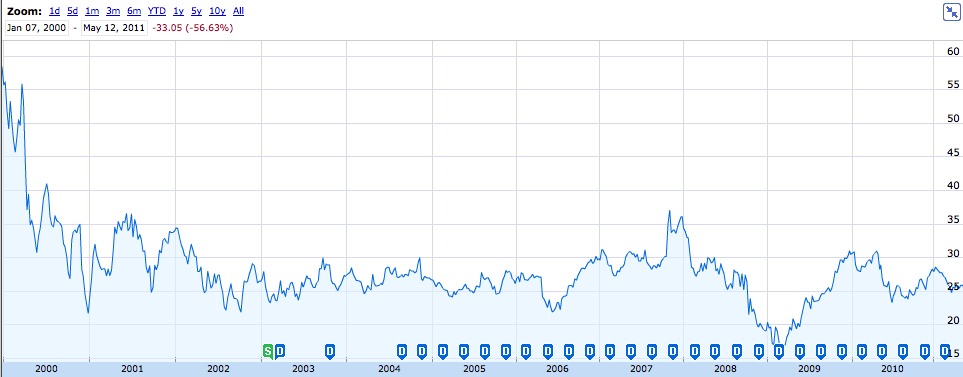
He’s employee number 30 and has been with Microsoft since mid-1980. In 2000, after nearly 20 years of service, Microsoft promoted Steve Ballmer to Chief Executive Officer. In the ten plus years that Ballmer has been at the helm of Microsoft he has done this to the company:
[
 ](https://f3a98a5aca88d28ed629-2f664c0697d743fb9a738111ab4002bd.ssl.cf1.rackcdn.com/ms-ss.jpg)
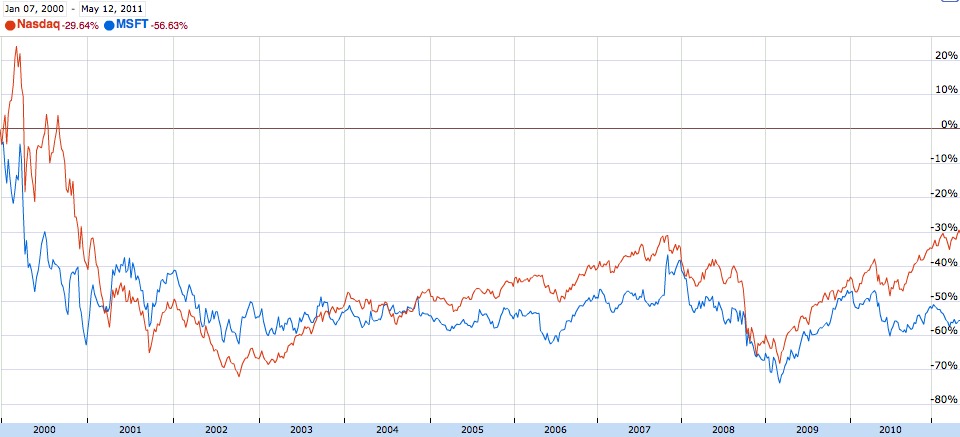
As you can see that’s not looking very pretty, but that data alone doesn’t tell the entire story. To be fair we have to look at what the stock market in general has done too. Here’s the same plot with the NASDAQ data along with MSFT’s (note I chose NASDAQ because the index best reflects the business of Microsoft):
[
 ](https://f3a98a5aca88d28ed629-2f664c0697d743fb9a738111ab4002bd.ssl.cf1.rackcdn.com/ms-nd-ss.jpg)
It’s pretty obvious from the chart that Microsoft has been moving right along with the NASDAQ, or it has been moving the NASDAQ right along with it — however you want to look at it.
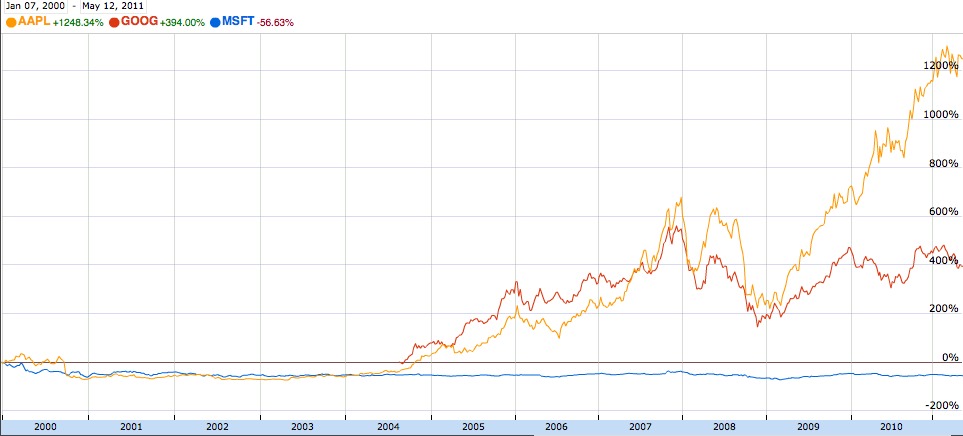
From these two charts it seems rather obvious that Microsoft is on a downward trend, but is that accurate? Let’s look at the same chart, but remove NASDAQ and add in Apple and Google:
[
 ](https://f3a98a5aca88d28ed629-2f664c0697d743fb9a738111ab4002bd.ssl.cf1.rackcdn.com/ms-gg-aa-ss.jpg)
Once you do that it seems pretty obvious that Microsoft has been slowly declining, while Google and Apple have been taking off like a rocket since 2004.
While these charts are anything but proof of bad management — in business school the first thing they teach you about CEO’s is: it is the CEO’s job to *increase* the shareholder value of the company. Since taking the position Ballmer has decreased shareholder value, as reflected by stock price, by -56.63%. That. Is. Not. Good.
### Countdown ###
I think it is appropriate at this time to start the countdown of how long Ballmer has left until he “steps down”. ((Because high profile CEOs rarely get fired, typically they choose to resign instead.)) This Skype deal should be the final nail in the coffin for the Ballmer era at Microsoft, yet I fear that employee number 30 may get a reprieve. Let’s take a stroll down Ballmer memory lane:
#### $8.5 BILLION ####
Ballmer’s acquisition of Skype for $8.5 billion dollars is not only a gross overpay, but a complete waste of money for Microsoft. Ballmer has yet to lay out a [clear reason why Microsoft wanted Skype](http://gigaom.com/2011/05/09/why-microsoft-is-buying-skype-for-8-billion/). He has only stated the obvious: integration in Microsoft products — which could have been done in a partnership instead of an acquisition. In fact, the acquisition by most accounts sounded more like a move by Ballmer to buy something that others ((Read: Google, Facebook.)) may have wanted to own — just for the sake of others not owning it.
Beyond that is the fact that Microsoft has 89,000 employees — are you telling me that the company that put a computer in every home couldn’t create a Skype clone?
Not only could Skype have been made in-house, Skype *should* have been made in-house by Microsoft.
Even if it would have cost $1 billion dollars Microsoft would have been better off creating Skype in-house. Does anybody really think Apple spent anything close to $1 billion dollars building FaceTime?
This entire acquisition feels like a desperate move, made by a desperate man. As a shareholder I hope that the regulators stop the acquisition, but I highly doubt that will happen.
#### The iPhone ####
Ballmer is now famous for [saying](http://www.usatoday.com/money/companies/management/2007-04-29-ballmer-ceo-forum-usat_N.htm):
>There’s no chance that the iPhone is going to get any significant market share. No chance. It’s a $500 subsidized item. They may make a lot of money. But if you actually take a look at the 1.3 billion phones that get sold, I’d prefer to have our software in 60% or 70% or 80% of them, than I would to have 2% or 3%, which is what Apple might get.
We can get into talking tough and all that, but Ballmer — as the face of Microsoft — should have never made such a short sighted comment about any product released by a serious competitor like Apple. What is less quoted is the comments he made immediately following the above:
>In the case of music, Apple got out early. They were the first to really recognize that you couldn’t just think about the device and all the pieces separately. Bravo. Credit that to Steve (Jobs) and Apple. They did a nice job.
>But it’s not like we’re at the end of the line of innovation that’s going to come in the way people listen to music, watch videos, etc. I’ll bet our ads will be less edgy. But my 85-year-old uncle probably will never own an iPod, and I hope we’ll get him to own a Zune.
What is so shocking about this is that Ballmer recognizes that first to market is important — yet it took until 2010 to launch Windows Phone 7, [three years after the iPhone](http://en.wikipedia.org/wiki/Windows_Phone_7).
Where is the “innovation” that Ballmer mentions in the music space — the Zune is effectively dead now and I bet his Uncle *does* have an iPod at this point. ((I’m going to go with a shuffle that a family member bought for him to listen to Otis Redding on. Because who doesn’t like “Sitting on the dock of the bay”.))
This is the epitome of short sighted behavior by Ballmer and should have made the board and shareholders incredibly un-easy at the time and especially now. Instead it bolstered his support as a man who was going to squash the evil Apple bug.
Short sighted behavior like this can and should be forgiven if the person later recognizes his errors and immediately moves to correct it, yet again though it took three years to get a serious iPhone competitor out of Microsoft. They never created a music/video player that gained traction after the Zune faded into Wikipedia archives. That cannot and should not be forgiven.
#### Windows Phone 7 ####
As I mentioned above Windows Phone 7 was seriously late to the party. Three years late means that most consumers Microsoft was targeting were on at least their second iPhone before Microsoft started to slowly ship Windows Phone 7. Add to that the basic lack of now common place smart phone features and you begin to see that Microsoft shipped a product that was competitive with the software *from three years ago*.
Windows Phone 7 may stand to be a long term success for Microsoft, but I doubt it. It is a product that in every way shows why Ballmer should not be in charge any longer. It was late and short sighted about the current market needs. In 2006 Windows Phone 7 would have blown away every technophile, this one included, in 2010 it is interesting and underwhelming.
I can assure you there are no crowds forming to get one.
It is the Zune all over again — a solid offering made far too late to make a substantial difference.
#### Windows Mobile ####
Windows Mobile 6.5 was a powerhouse of a product. Pre-2007 most U.S. buyers of smart phones chose between BlackBerry and Windows Mobile
6.55. ((6.5 came out later, likely it was 5 at this time.)) Both were small screened devices with a hardware keyboard — with exception to the few HTC devices with stylus based touch screens. Palm was struggling at the time and Windows Mobile was the dominant player in consumer minds, BlackBerry was the beast in boardrooms.In the U.S. it was a two platform market for the most part — the iPhone changed that. BlackBerry immediately started to make clones with the Storm [launching in 2008](http://en.wikipedia.org/wiki/Blackberry_storm). Microsoft could have started shipping compelling devices — instead they squandered what little market they had until it was an insignificant market share. So much for that 60% Ballmer wanted.
#### Copycats ####
In 2005 Apple held its World Wide Developer Conference with [banners hanging that read](http://www.flickr.com/photos/emeidi/43356340/): “Redmond, start your photocopiers.” Microsoft used to have a knack for taking any technology that was upcoming, copying it and launching it under their moniker(s) and squashing that small company. Apple made a joke about it, but Ballmer should have taken it as a directive. Instead it wasn’t until a year later when Microsoft released the heavily troubled and much criticized Windows Vista.
Copying your competition is not necessarily a poor business move — Microsoft itself has proven time and time again that you can be very successful by doing so. Ballmer has continued this tradition, but with a glaring difference: tardiness. Where Microsoft used to be fast to copy and shut down these companies — before traction was gained — they have now been slow — and comically bad — at copying others. What happened?
Hell, Microsoft used to innovate too, but even that seems to have disappeared (unless you count the Office Ribbon interface).
#### Danger, Danger ####
In 2008 [Microsoft paid $500 million for Danger](http://www.microsoft.com/presspass/press/2008/feb08/02-11acquisition.mspx). This was Ballmer’s response to the iPhone: an acquisition that went (almost) no where. I could say more, but Michal Lev-Ram of Fortune does a [better job](http://tech.fortune.cnn.com/2011/03/01/t-mobile-says-farewell-to-microsoft-danger/):
>Microsoft says most of the team working on Danger has already been absorbed in to the Windows Phone 7 group (Microsoft’s home-brewed mobile operating system). But the Redmond-based software giant had much bigger plans for Danger back in 2008, when it announced it was buying the small Palo Alto, Calif. company. The plan was to tap into the Sidekick-maker’s “deep understanding of consumers” and its “young and enthusiastic, internet-savvy and socially inclined” customer base (according to a company release from 2008). Obviously, that never quite happened.
#### The Infamous iPhone Funeral ####
About a month before the launch of Windows Phone 7, Microsoft held an [iPhone funeral procession](http://blogs.seattleweekly.com/dailyweekly/2010/09/microsoft_throws_windows_7_par.php) in Redmond. This is not something a confident business does, this is something an arrogant business does — regardless of what company does something like this it is both childish and stupid. Not to mention that the people in the parade look like evil servants, complete with a Darth Vader on a motorcycle.
It’s silly — and it was done in good fun to boost employee morale. None of that matters though because a good CEO would have never let that happen and that fact that Ballmer let it happen says a lot about him as CEO: arrogant to a fault.
### Next Steps ###
The above are all recaps of the things that Ballmer has had a hand in over the last ten years that should be enough to give the board a reason to remove him. The scariest thought isn’t Ballmer remaining in power — it’s who his successor may be. My guess is that it is another long time employee (calling #40), but that would be a worse decision than letting Ballmer blow money on hookers and Skype.
There are two things Microsoft needs to do now before it is really time to fret.
#### New CEO ####
Microsoft should be searching for a new CEO *right now*. The Skype acquisition damage can still be mitigated if the proper people are put in place to immediately leverage the Skype brand. A new CEO should be:
1. Passionate about technology: don’t you get the feeling that Ballmer doesn’t really care about the products that Microsoft makes, in the same way that Steve Jobs cares about how employee shuttle buses look and how and where color is applied? Any new CEO should love technology and that will begin to show at Microsoft like it did when Gates was still at the helm if the right person is hired. Ballmer seems to care more about being the biggest thing on the market instead of the products his company creates.
2. Forward thinking: Ballmer has shown his short sightedness time and time again, let’s get an executive with some vision. It is time that Microsoft starts creating new markets instead of trying to understand markets that their competitors are creating.
3. An outsider: this is going to be the hardest thing for Microsoft to realize, but they need to get some fresh eyes on the problem. At the very least it should be someone who has not spent more than the last five years with the company. Microsoft needs a fresh outside perspective. An insider will just keep following the GPS coordinates that have been set forth by Ballmer.#### Talent ####
The second thing Microsoft needs to focus on is acquiring talent and not product names. They should be making acquisitions that bring in top notch talent. Microsoft used to be the top pick for young budding tech stars, today that is hardly the case. ((With no disrespect to the many talented people that are currently working at Microsoft, or desire to work there. I know many Microsoft employees that are exceptional, they are just not being allowed to shine.))
If Microsoft wants a chance and long term survivorship they need to make themselves appealing to young stars. You can’t appeal to this young crop of talent unless you offer compelling products. More and more job selection for the elite talent is less about money and more about job satisfaction. Microsoft’s best bet here is to start acquiring fresh young companies **and** keeping the talent that comes with it.
### The End? ###
Microsoft isn’t dead yet, nor will it be soon. It is however in the early stages of death and Ballmer isn’t going to the hospital — he’s running to go party some more.
Microsoft needs a swift kick in the ass.
UPDATE: [Let’s not forget about the failed Kin](http://techcrunch.com/2010/06/30/microsoft-puts-down-the-kin/).
-
‘Stay tuned’
Paul Reynolds:
>Asked today about the possibility of Amazon launching a multipurpose tablet device, the company’s president and CEO Jeff Bezos said to “stay tuned” on the company’s plans. In an interview at Consumer Reports’ offices, Bezos also signaled that any such device, should it come, is more likely to supplement than to supplant the Kindle, which he calls Amazon’s “purpose-built e-reading device.”That sounds about right from all the rumors and speculation that I have seen. I would guess it would be a touch screen device running Android with the Amazon appstore installed. I would further guess that the full Amazon web store would be presented rather nicely on the device.
Those are pretty easy, the bigger question is price. Will it be higher or lower than the iPad and will there be an ad supported version?
-
The New Yorker iPad App
John Biggs has a really [nice write up on](http://www.crunchgear.com/2011/05/12/it-is-finished-the-new-yorker-ipad-app-is-the-beginning-of-the-end-of-print/) why he is leaving his [New Yorker](http://www.newyorker.com/) paper subscription in the dust for the iPad only version. Since as long as I can remember my house was always filled with magazines. My parents both got a ton of subscriptions and I would always get to peruse through my dad’s car magazines when he was done. As I got older and my parents divorced and I started to get my own magazine subscriptions — mostly car magazines — but I loved reading all that information.
Those magazines subscriptions had Newsweek and Businessweek added to them late on — among others. The one thing I hated about magazines was that they take up far too much room if you want to hang on to them for archives and reference. In 2004 I started using Zinio — an online magazine distributer — who for the same price as the print subscription would give you magazines in a DRM protected, Adobe laden, PDF that you could use their (not so stellar) viewer to read.
To this day I still use Zinio and while it has gotten better over the years the DRM has always been a problem for the service. To my knowledge all those archives of Zinio magazines I saved are unreadable at this point because they switched to a new viewer that uses Adobe Air — lovely. Their iPad app is ok, but really it is just an extension of the often crappy Adobe Air app that they have for the Mac. I have been pretty reluctant to wanting to switch full on to iPad only subscriptions because the pricing simply was not competitive — $4.99 an issue is just too much if you want to buy every issue.
Luckily Apple introduced subscription pricing and like all of you I have been watching closely to see how publishers are reacting to it. Our first taste was a sour one that The Daily offered. One app that I have really taken too is Bloomberg’s Businessweek+ app that allows you to subscribe to the weekly periodical for a seemingly low price of $2.99 a month, or $36 bucks a year. It’s not the best pricing, but it’s not the worst either.
The content of Businessweek has always been hit or miss for me, but it is typically news that I don’t seek out and that I like to know (even if I get to it much later than I could on the web). The fact is that I find the content valuable, you may not. What intrigues me about Businessweek is the app itself, which you can see my thoughts on [here](https://brooksreview.net/2011/04/businessweek-2/) (I like it).
Outside of Businessweek and the few Zinio magazines that I still subscribe too I haven’t been too enamored with iPad magazine apps. Then the New Yorker wrote something that I really wanted to read — really wanted to read. The end result of which is that I am now a yearly subscriber to The New Yorker in e-format only and I am quite pleased with it.
The New Yorker really raises the price at $59.99 a year — something most iPad users are going to need to think about. I have never had a subscription to The New Yorker, but I have read articles from it on occasion. As far as the content is concerned: it is top notch and that is almost not debatable.
The app itself is what intrigues me the most.
The app seems to take the idea of adding eye candy and throw it out the window. This is not an app designed for Apple freaks, or iPad users — this is an app that has been very intentionally designed for readers.
*I love that.*
The font is crisp, clear and readable. You don’t get fancy carousels that don’t work, or multimedia enriched everything — you get quality writing displayed in a quality reading manner. The navigation is straight forward and an expanded view shows you where you are in everything, lest you get lost. Everything in the app is smooth like butter, everything just works. Sure the text isn’t zoomable, or selectable, or shareable — but it is highly readable and in the end that’s what I bought it to do.
It’s safe to say that I have tried a lot of magazine apps and that, of all of them, I hope more publishers model their apps after what The New Yorker has done — they have won me over.
-
iMac Game Performance (mid 2011 models)
Interesting results from Bare Feats on the newest iMac models and how they stack up against the Mac Pro. They conclude that the iMac makes for a great “best buy” gaming Mac. I think it is more than all but the most serious gamers will need.
-
Thomas Hawk on Why He Will Likely Switch Back to an iPhone
Thomas Hawk:
>Updating the operating system on your Android phone is a huge pain in the ass. In order to update my Samsung Galaxy Vibrant from the Eclair operating system to the Froyo operating system (keep in mind that Google’s working on honeycomb now apparently, which is two operating updates ahead of what I just updated to), I had to go through hell to get it done. No OTA for Samsung. No iTunes for Samsung. No, I had to manually find the file somewhere on the web on a confusing website, download it to a Windows machine (yes Windows only), and update my phone through a long confusing process.Not to mention that Google has no naming convention that would tell you “Éclair” is older than “Froyo” — that alone would drive me nuts.
UPDATE: Thanks to everyone for pointing out that Android releases are done alphabetically, which is dumb. Why is it dumb? Industry standard is numbers because numbers make sense. What happens if you want to release an minor update, you get things like ‘Alpha Name + 2.2’ — because that is consumer friendly.
-
Something New
Khoi Vinh:
>None of these are perfect, but they’re all imaginative and incredibly creative, and what’s more, they are fearless in acknowledging that this platform is something new, that it requires an entirely different approach to software, that in order to succeed, they have to create products that truly embrace the strengths and the weaknesses of the iPad.So what is he talking about? Three new apps to interact with Photoshop. Made by Adobe. Say what you will about Adobe and its Creative Suite, they have really taken to the iPad at reasonable pricing — it all feels like the calm before the storm.
-
OmniOutliner for iPad Is Now Available
It’s $19.99 because it is a damned impressive offering. They use the Solarized themes in some of the documents and really have made a robust offering. I am still playing with it, but I can already tell it’s going to get used a bunch. Also, no export to Dropbox but if you use DropDAV then you can export to Dropbox.
-
Quote of the Day: Felix Hernandez
“I don’t try to strike out people, but sometimes they swing and miss.” -
Enough Episode 33
Patrick and Myke were kind *enough* to have me on as a guest. We talk about what I would install on a stripped down MacBook Air 11″. We also discuss throwing fish, so you should at least be interested in that.
-
After approving NBC buyout, FCC Commish becomes Comcast lobbyist
Nate Anderson:
>Four months after approving the massive transaction, Attwell Baker will take a top DC lobbying job for the new Comcast-NBC entity, according to reports.This shows a complete disregard for all Americans.
-
WikiTrust
Kevin Poulsen on the agreement WikiLeaks makes its employees sign:
>The confidentiality agreement (.pdf), revealed by the New Statesman, imposes a penalty of 12 million British pounds– nearly $20 million — on anyone responsible for a significant leak of the organization’s unpublished material. The figure is based on a “typical open-market valuation” of WikiLeaks’ collection, the agreement claims.Trust, I hear, is hard to come by among thieves. ((Don’t bother emailing me about this. Stealing private information with the hopes of profiting off of it is, right or wrong, stealing. ))
-
Top Grossest Apps
Neven Mrgan:
>Then Apple added in-app purchases, and decided to include those when calculating apps’ earnings for the Top Grossing list. The result? The list is completely dominated by fake-money compulsion engines. The very fact that these are the top grossing apps signals just good they are at vacuuming money out of pockets.This change really irks me since Top Grossing used to be where one could easily find excellent apps. Now it is just an extension of the Top 25 Free apps category.
-
Googlers and Windows Machines
MG Siegler:
>Since the end goal of Chrome OS is clearly to end Windows dominance both in the workplace and the world in general, someone asked what percentage of Google employees still use Windows machines at work?Answer (according to Sergey Brin): 20%. That’s staggeringly low.
-
Sprint’s Offensive Ad Pulled
Ina Fried:
>The ad, which ran on a number of political Web sites and in various newspapers on Tuesday, depicts a man in a dress similar to that worn by the spokeswoman for T-Mobile. The ad featured the tag line “It makes sense if you don’t think about it”–also a play on T-Mobile’s advertisements. The ads were funded by Sprint and created on behalf of a number of groups opposing the proposed $39 billion deal.Be sure to click through to take a look at the ad, great stuff.
-
Facebook Apps May Have Leaked Millions of Users’ Personal Data
Nathan Olivarez-Giles and Jessica Guynn:
>Among the information that could have been accessed is data from user profiles, pictures and Facebooks chats between users.
>”Fortunately, these third parties may not have realized their ability to access this information,” said Nishant Doshi, a Symantec spokesman in a company blog post. “We have reported this issue to Facebook, who has taken corrective action to help eliminate this issue.”Well, at least they didn’t know until they posted about it in the Los Angeles Times.
-
No iAds for Kids
Federico Viticci:
>Mike Zornek, developer of the free Dex app for iPhone and iPod touch (a Pokèmon browser application), relays an email from the iAd Network Support team in which an Apple employee explains how iAds may not be displayed anymore in apps targeted to “young children” because of the advertisers’ preference to not show ads to this particular audience.This is a good change in policy for everyone but the developers. Apple benefits because they won’t have to worry about children being targeted with advertising — something lawmakers always have problems with. Advertisers benefit for the same reasons too. Parents and children benefit from seeing less ads.
The unfortunate part is that lesser advertising systems might begin to be used in place of iAds, which could get ugly for consumers.