Year: 2011

  • The Failed Promise of ‘The Verge’

    When Engadget was purchased by `Aol.` I was concerned ((Updated at the bottom.)) — then all the best writers at Engadget jumped ship (which may or may not be related to inner workings at Engadget — either way it doesn’t matter for these purposes) and started doing their own thing over at *This is my Next*. It was a noble effort and a ballsy move — it’s everything that so many of us nerds love to see — fight the man.

    Then Topolsky and crew launched their next big thing: *The Verge*. It’s what they envisioned tech reporting to be when they left Engadget, but unfortunately for them it sucks.

    The design — though I am not a fan — is a notch above just about every other large tech site on the web. The writers for the site are good and seem smart. ((More on this in a bit.))

    The ads are present and at times over-run the site, but I have yet to be offended or sufficiently annoyed by them.

    The photography and videography puts to shame even larger sites like *The New York Times* and *The Wall Street Journal*.

    The amount of posts is astonishing. The scoops, breaking news, features, interviews, product reviews are there.

    What’s missing is compelling content.

    There’s a lack of opinion and a lack of wow. I have yet to read something on *The Verge* that left me thinking:

    – Oh wow, great point.
    – I hadn’t thought of that.
    – Woah.
    – I must quote this.
    – That’s so far off base, but person X made a great argument.

    There is just a lot of vanilla tech reporting going on — the kind that I expect to see on CNET. Which is a shame because by all accounts the writers for the site *are* smart — the type that should get it, but refuse to spell it out for readers.

    In fact the most compelling and interesting writing in *The Verge* are [the posts that its senior editors](http://www.theverge.com/2011/12/15/2638611/horseshit) post in the “forum” in response to criticism. That shouldn’t be the case, yet they are the only posts I look forward to reading on the site.

    Further proof: here are two of the latest reviews on the site that illustrate a general lack of opinion:

    ### David Pierce’s Sphero Review

    David Pierce’s [Sphero review](http://www.theverge.com/2011/12/19/2645681/sphero-review) might be the epitome of what I am talking about. He makes statements about how it’s “simple” to recalibrate the device every time you go to use it — to only later half-criticize the fact that you must recalibrate the device every time.

    >You have to calibrate the Sphero every time you turn it on. It’s a simple process […]

    Then later:

    >[…]but it means you spend a lot of time picking the ball up and shaking it back on and re-calibrating.

    So it’s a simple process, just one that you spend a lot of time doing and the you have to do often. I would guess this is a much bigger annoyance that Pierce is making it out to be — but I will never know because he barely covered it in his review.

    He gives the gadget a 5/10 rating — could you be any less opinionated than that?

    Maybe so, because here are his closing two sentences:

    >However, it needs a much broader swath of uses before I can recommend spending $129.99 on it.

    *Sounds like he doesn’t recommend it.*

    >Though honestly, can you really put a price on messing with your cat without even getting off the couch?

    *Wait so it is worth it?*

    So which is it: not worth it, or totally worth it? I’m confused.

    ### Joshua Topolsky’s Verizon Galaxy Nexus Review

    Joshua Topolsky’s [Verizon Galaxy Nexus review](http://www.theverge.com/2011/12/16/2638466/galaxy-nexus-review-verizon-lte) — a follow-up review on the device to talk about a 4G LTE version — is right with the rest of the site.

    The first mistake that Topolsky makes is with battery life. He states:

    >Even though the battery life takes a clear hit, I don’t think it’s necessarily a dealbreaker on this phone. Obviously it can’t hold a candle to non-4G devices, but a swappable battery (or extended options) and an option to switch off 4G can help ease the pain.

    That’s just stupid, I’m sorry, but it really is a stupid statement. It’s like saying: “This car is really fast, but it only gets 2MPG when in fast mode. That’s not a problem at all, but best to just turn off fast mode.” Or break it down like this, Topolsky first states: Battery life suffers. One would think that would be a black mark, but Topolsky quickly states that it is not. Then he talks about how it isn’t nearly as good in the battery life department as other non-4G device. Then offers two ways (both at a detriment to usability of the device) that a user can take to avoid this battery ‘issue’.

    Topolsky states that he is specifically reviewing the 4G LTE version of the phone and he glosses over the fact that you take a “clear hit” to battery life when using this feature — the very feature he is reviewing.

    I can’t be the only one that sees the stupidity here.

    He then goes on to tout the speed of the device over 4G — yeah the same 4G he just said you may want to turn off to mitigate battery drain.

    I fully understand what he is saying: the 4G is fast, but it drains your battery fast. So best to turn it off if/when you don’t need it, but I can’t be the only one that thinks that makes for a device that is a bit more of a pain in the ass to use than this review would lead one to believe. Yet that is never stated when it should be stated explicitly.

    Ok, let’s just get down to Topolsky’s verdict:

    >Ultimately, you have to make the decision of what you want out of a phone, and there are excellent choices on the market right now. Personally? Verizon just got themselves a new customer.

    I take that and the 8.7/10 rating as a recommendation of this device — so I have to ask why not come flat out and say that you recommend people buy this device? Why make it a gray area of interpretation: “I like it, but who knows if you will.”

    I hate that.

    Further, what are the other “excellent choices” that I should consider instead of this phone? How is this phone better than those in your opinion? Topolsky answers the who, what, when, where — just not the how and why and those are the only two I can’t read on the manufactures website.

    One last thing: there are three bullet points listed as “good” and three “bad” for this review, which is fine, but there is no weight given to them.

    Is having a “Fantastic 720p display” really of equal weight to “Camera quality can be spotty”? I would guess that most people are going to be happier with a great camera than with a “fantastic” display — a display mind you that most say is not as nice as the iPhone 4/4S. ((See update about this at the bottom of the post.)) Is battery life (also list as “bad”) really the same weight as well? I can’t believe that most consumers would think these things are equal — so why are they listed as equal?

    ### Lackluster

    As I said above I was pretty excited about *The Verge* and what the crew behind it was trying to do. I think they created a great independent site that gets excellent access to companies they cover. I think that they created a great brand and image.

    But I think the site’s content is pretty lackluster.

    Push aside the press release re-writes that contain little to no commentary — this is par for the course (unfortunately) — and you are left with tech specs.

    When the most interesting thing you write on your site — from a reader’s perspective that reads 300+ tech sites in his RSS reader — is a rebuttal to another site, well I think you have big problems.

    [MG Siegler summed up *The Verge*](http://parislemon.com/post/14286785030/horseshit) (and most tech sites for that matter) pretty well — whether he intended to or not I don’t know — when he said:

    >I don’t know about you, but when I read my favorite technology writers, I want an opinion. Is the iPhone 4S the best smartphone, or is it the Galaxy Nexus? I need to buy one, I can’t buy both. Topolsky never gives us that. Instead, he pussyfoots around it. One is great at some things, the other is great at others. Barf.

    The problem is endemic of the industry as a whole. You can say all you want about my opinions — whether I am right or wrong — what you can’t say is that I don’t have one. I will take you disagreeing with me all day long over being a bland yes man.

    This is a rather long winded way of saying exactly what MG Siegler said above: take a stance.

    ##### Bonus

    For the record, here are some hard and fast recommendations.

    – Buy the iPhone 4S and nothing else.
    – Unless you are a nerd buy a 13” MacBook Air.
    – The only tablet to get is an iPad, but you probably don’t need one.
    – Apple makes the best displays and anything else you buy will look like crap in comparison.
    – Pepsi is better than Coke.
    – Glenlivet 18yr is the best Scotch.
    – Tom Bihn makes exceptional bags.
    – Don’t bother reading *The Verge*.

    **UPDATED** (on Dec 20, 2011): I incorrectly stated that it was the Aol. buyout that spurred this, when in fact I believe it was the Huffington merger and her subsequent elevation to be in charge of Engadget that did so. I regret this error.. It appears I was still wrong, as [Joseph Caiati on Twitter](https://twitter.com/joecaiati/status/149186816103297024) pointed out it was likely the [AOL Way memo](http://www.businessinsider.com/the-aol-way) that did it. I really regret being wrong twice. Hey guess what? I am still wrong about the reason according to Nilay Patel:

    I’ve asked him to share the real reason, no response yet. I, yet again, regret this error. At this point it really doesn’t matter why they left Engadget, or even if they did. Doesn’t change my main complaints about *The Verge* itself.

    Secondly I stated that most think the iPhone 4/4S screen is better than the Galaxy Nexus. [Here is the article I should have linked that too](http://www.flatpanelshd.com/news.php?subaction=showfull&id=1319022037).

    Additionally people have told me that The Glenlivet 21yr is much better, however I cannot speak to this as I have yet to try it.
  • The Parable of RIM

    A great take on where RIM really went wrong by Horace Dediu:
    >But RIM did nothing. Almost nothing. They were the healthiest competitor. They felt no pain from iPhone’s entry.

    This is really worth the read.

  • North Korea’s Economic Backwardness in One Picture

    You have to wonder what — if anything — will change with the passing of Kim Jong-il.

  • Prince Alwaleed Invests $300M in Twitter

    Mourad Haroutunian and Jonathan Browning report:

    >[…]Halawani said in a telephone interview, adding that Alwaleed and Kingdom Holding bought the shares from founding shareholders. “I expect Twitter does not need further funding before going public.”

    and

    >In a separate interview with Al Arabiya, Halawani said Twitter will probably hold an IPO in two years.

    So we can then safely assume that Twitter loses about $150 million a year… right?

  • Apple Moves Forward With TV Plans

    Over 1200 words from *The Wall Street Journal* that doesn’t further expound upon anything you could read at any Apple related blog about Apple’s plans for TV. What you do get is plenty of “people familiar with the matter” statements that then go on to say: “Apple’s plans are vague.”

    *No shit.*

    Jessica E. Vascellaro and Sam Schechner:

    >When the company plans to start selling such a device and whether it would receive traditional broadcast or cable signals remains unclear, said these people, who say Apple may change its plans.

    What a wealth of information.

  • Undocumented Nest Incompatibility With Single-Stage Wiring

    Marco Arment commenting about the Nest thermostat:

    >The problem arises when the Nest needs to charge itself and neither the heat nor air conditioning has turned on in a while, like on a mild day. Without a C circuit to take power from, it can only charge itself from running the system.

    >So it pulses the R-W heat circuit in short bursts to get power.

    Marco doesn’t think that is good for his boiler — and he is right because that’s not good. Best way to think of it: starting up your car and turning it back off, then repeating. Battery wear down on your car aside — cycling a heating system or your car’s engine that often is not optimal.

    This isn’t likely something that will directly cause a problem, but it is putting unneeded wear and strain on your heating system — no way I would allow this.

  • The Homeland Security Snow-Cone Machine

    Kevin Underhill:
    >Still, it is something special when a homeland-security grant is used to buy a snow-cone machine. 

    You need to read this entire post because the ridiculousness of the statements to justify this are hard to believe.

  • Amazon Kindle Fire redirects all Android Market requests to Amazon App Store

    Dieter Bohn:
    >So if you want to install Android apps on the Kindle Fire that aren’t included in the Amazon App Store, you have two options: hunting down the apk file and sideloading via your computer or rooting the device entirely. If you want to browse the Android Market on the web from a stock Kindle Fire, you’re basically out of luck.

    Interesting, I wonder if this will have any anti-competitive repercussions. I see the logic in doing this — the device doesn’t support these apps so Amazon is trying to help you — but I can think of at least three better ways to implement this “feature” that wouldn’t force you to the Amazon store.

  • ‘Dear Congress, It’s No Longer OK To Not Know How The Internet Works’

    Joshua Kopstein:
    >But the chilling takeaway of this whole debacle was the irrefutable air of anti-intellectualism; that inescapable absurdity that we have members of Congress voting on a technical bill who do not posses any technical knowledge on the subject and do not find it imperative to recognize those who do.

  • The B&B Podcast – Episode 38: Skinny Jeans

    Shawn and I talk about the Galaxy Nexus and what flavor ice cream sandwich it really is.

    Thanks to our awesome sponsor: [Instacast](http://affiliate.vemedio.com/itunes/app/420368235/bbsponsor).

  • MG Siegler on Blogging

    MG Siegler in response to Josh Topolsky:
    >This is the problem I have with most technology reviews these days. Everyone seems so afraid to say how they really feel about the device. And more often than not, that’s exactly what readers want.

    I’d extend this to more than just tech reviews — it seems endemic of most of the “analysis” that I read everyday.

  • Quote of the Day: Daniel Jalkut

    “It’s a big freaking deal to us, while other people just don’t see it.”
  • The AOL of Today

    Brent Simmons on Facebook:

    >I wonder sometimes if Facebook is the America Online of today, with roughly the same future where we look back and wonder why we were all on it and we wonder what happened and then remember that it still exists, sort-of.

    Not a bad thought.

  • IE to Start Automatic Upgrades across Windows XP, Windows Vista, and Windows 7

    A nice move by Microsoft, actually a great move. Of course there is still a way around it and I would guess that if your company is still running something less than IE 8 they will use this method to block it, noted by Ryan Gavin:

    >The Internet Explorer 8 and Internet Explorer 9 Automatic Update Blocker toolkits prevent automatic upgrades of IE for Windows customers who do not want them. Of course, we firmly believe that IE9 is the most compelling browser for business customers, and we want them to make the decision to upgrade at their convenience.

  • ‘Kindle Fire Does Not Fire the Imagination’

    Khoi Vinh on the Fire:
    >Amazon has gotten a lot of praise for not flagrantly emulating the iPad with the Kindle Fire, and I concur with that a little bit. However, it should get no praise for its utter lack of imagination.

  • Macworld Buying Guide: iPad Keyboards Review

    Dan Frakes:
    >I’ve tested approximately three dozen of the iPad keyboards on the market. Here’s a quick look at the main types available, along with my recommendations for a few of the best in each category.

    What a great guide — even makes me consider getting some sort of setup like this.

  • New Breaking News iPhone App

    Comes with handy push notifications and the ability to “follow” certain topics to stay up to date. The best feature though? A quiet time mode where you can set the times you don’t want it to send you a push notification.

    Every app that sends push notifications should have this setting — better yet — iOS should allow you to set this globally.

  • Backpacks and Messenger Bags

    I need another bag like a need a hole in the head — at least according to my wife. I have (off the top of my head) over 20 different bags at my house: from huge duffle bags to an iPad man-purse. My wife, well, isn’t too happy whenever I get a new bag.

    For the most part I am an over one shoulder bag type of guy. Since my freshman year in high school I have been using a messenger style bag of some sort — that was 1998.

    I have tried just about every messenger bag out there:

    • Leather
    • Flapped
    • Zippered
    • Nylon
    • Waterproof
    • Vertical
    • Large
    • Small
    • Huge
    • No strap
    • Sling strap with odd strap that comes back around the other way.
    • Lots of pockets
    • One pocket

    Yeah I’ve been there, done that. Since ’98 there has probably only been a handful of times I can remember switching back to a backpack for everyday carrying — usually precipitated by some self-imposed need to carry more stuff — all switches were short lived.

    For me the messenger style bag is the pinnacle of style. Backpacks are for kids and hiking — neither of which fit my daily routine. The other problem is that I am six feet, three inches tall so any normal sized backpack is either going to:

    1. Not fit me.
    2. Look ridiculously small on my back.

    So I need a slightly larger bag than most and that’s not really a good thing. When Micheal Lopp recently wrote about his switch to a backpack I was immediately sold and purchased his exact setup:

    What sold me was not his get through lines fast sell, but the practicality of a backpack and the ability to remain mobile with one. The entire post just struck a chord with me.

    Could I have one bag that suddenly works for just about every situation that I am likely to encounter?

    If I can, then that is what I want. ((God knows it would make my wife happy.))

    This is part one and this is going to be a long series and most of you are not a big enough bag nerds to care — but those that are should get something out of this. ((I hope.))

    In part one we are dealing with using a backpack from day to day (home to work to home) type situations and how it stacks up against messenger bags that I have used.

    The Idea

    Before I go any further I want to talk about my reasoning for why I am ready to go back to a backpack, or why I think I am.

    1. I am married and generally don’t give a shit anymore what people think of the way I look. The only exceptions are my Wife’s opinion and my opinion (not necessarily in that order). So the idea that only kids wear backpacks is quickly fading on me.
    2. I love hiking and wouldn’t dream of carrying anything other than a backpack while hiking. They stay put and distribute weight well ((Not so of any messenger bag I have tried.)) and I think it would be nice to bring that comfort to my daily routine.
    3. I have had stuff fall out of my Ristretto while on a plane and in my car — that is starting to get really annoying.
    4. I want to get rid of most of my bags and just have one bag. ((Ideally one, realistically I know that isn’t likely to happen for me.)) The idea of not having the mental clutter of extra bags stored somewhere in my home is incredibly appealing to me.
    5. Lopp is right about never really having your body totally free when you are using a messenger bag — you are always striving for balance on the strap. I want very much to feel that freedom again.

    So there you have it.

    So why the Tom Bihn and not something awesome like the Goruck GR1? Some reasons:

    1. The Bihn is cheaper.
    2. Tom Bihn is local.
    3. I have not had a bag as well designed (ergonomically) as the Ristretto and that’s just a small vertical messenger with a handful of pockets — imagine what they can do with a backpack.
    4. I have a really good daypack for hiking — I just need a city bag and the Bihn seems more tailored for that use.
    5. The Smart Alec seems more versatile in the ways that you can arrange it — including having no laptop pouch at all.
    6. I went with the Tom Bihn because Tom Bihn has proven to me that their bags are great.

    Gearing Up

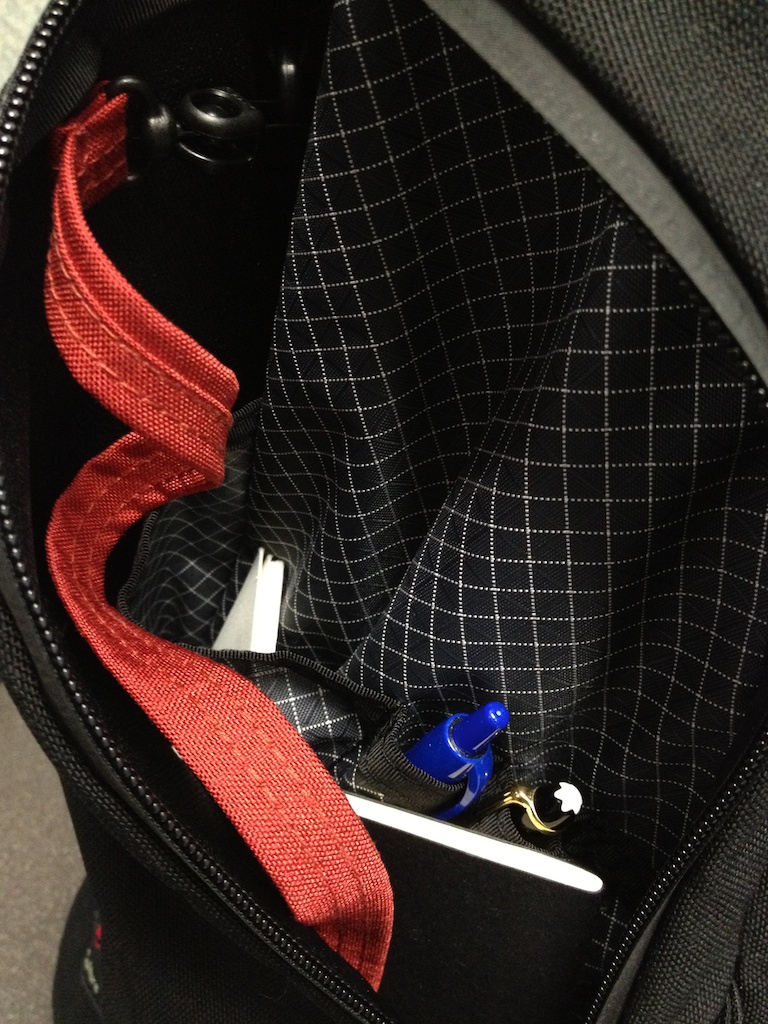
    The first thing I had to decide was the layout for the bag. This would serve as the layout for the bag across all types of uses so I spent time thinking about this. The right side pocket of the bag (my right when I am wearing the bag) contains:

    • Keys
    • Notebooks
    • Business Cards
    • Pens

    Because of my profession I have to deal with a lot of keys on a regular basis (our key cabinet at the office holds 160 keys and on any given day my already large (20+ keys) key ring needs to be supplemented with these keys, so I needed an area that I could toss loose keys in. This works perfectly. I did notice that the strap Tom Bihn provides is not long enough to reach from its location to a door if needed (this is how I stow my home and office keys). Luckily, Tom Bihn makes a double length strap that I picked up.

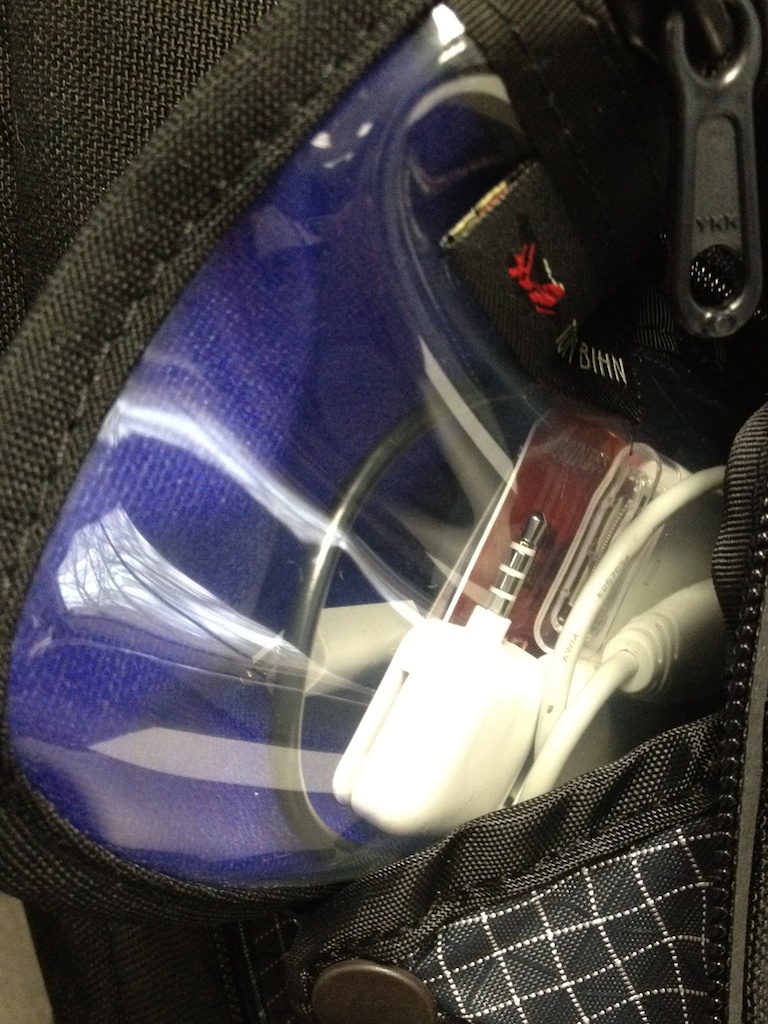
    The pocket on the opposite side carries a little accessory bag from Tom Bihn that holds my daily essentials, which include:

    • Mophie Juicepack Reserve
    • Dock connector cable
    • Mini USB cable
    • Micro USB cable
    • Camera Connection Kit
    • Square Card Reader
    • SD Card
    • Thumb Drives
    • Two Credit Cards

    The pocket also holds a pack of playing cards ((A great idea I stole from Micheal Lopp. I have a deck of the Helviticards that I keep in there.) and my current favorite hard candy. ((Lifesavers right now, I bought a mass amount from Amazon a while back and — well — I still have a few cases.))

    I like keeping all those little bits inside an internal bag because I never have to wonder if I lost a thumb drive or if it just went in another pocket. I also carry a few more things than I did with a messenger bag because:

    1. I have the room.
    2. I do not notice the weight.

    Internally there is a lower center pocket that I haven’t found a use for just yet. It’s an odd pocket in an odd location.

    In the top internal pocket I stow:

    • Headphones
    • Micro fiber cleaning cloth

    I like Lopp’s idea of leaving half of this pocket open (it’s divided) for stashing a wallet/passport/watch and things of that nature while you are traveling — especially when going through security checks.

    The Brain Cell locks (rather cleverly) into the backpack and secures shut with velcro on the top. I really don’t like the use of velcro here, but the security it offers is almost worth the tradeoff of the noise it produces. I have been thinking about this quite a bit since getting the bag and while I am getting more and more used to the velcro I am beginning to think about stitching in a button and clasp to shut the Brain Cell with — but I will give it a bit more time before making that move.

    The Brain Cell offers a mesh pocket that is rather small and flat on the front of it. In there I stash small bits of paper like receipts and permits (usually elevator permits that I always forget to change out). I particularly like this pocket because it holds paper things flat and keeps them from getting “lost”.

    Aside from what was mentioned the only items that I add before leaving the house are my MacBook Air and my iPad 2. ((Typically I do not carry a charger with me for my devices unless it is an overnight trip because I have one at my office and one at home — if you don’t have two like this I feel bad for you.))

    In the morning when I gear up to leave I only need to toss in my MacBook Air, iPad 2, and headphones. That’s not much different from the messenger bag life style. What I have noticed is that I am still not used to zipping up a bag.

    Overall there isn’t much of a difference here when I get ready to leave. My bigger fear initially was that I would end up throwing too many things in the bag that just sat in there loosely or out of place. This has actually not been as problematic as it was with the messenger bag because everything secures in its place — allowing you to immediately see what doesn’t belong.

    Car Toss

    The car toss is my morning ritual where I put my bag in the backseat of the car (fancy, I know). With all messenger bags I typically slide the bag in the footwell behind the driver’s seat. The Smart Alec doesn’t fit there (remember I am a tall guy so my seat is all the way back). Instead I toss the bag on top of the seat behind the driver’s seat.

    I really mean toss here too. The protection afforded by the Brain Cell gives me no worries about the gear inside of it (I can fit my Air and iPad in the Brain Cell).

    This is a huge difference from my messenger bag, becausee:

    1. The padding was a lot thinner in the Ristretto, so I took greater care when placing it down somewhere. I was always aware with other bags that my gear could still be damaged if not properly handled.
    2. The Ristretto was prone to having things fall out or move about the bag if not carefully rested — this is not so with the Smart Alec as everything just stays put.

    I would much prefer this bag to slide behind my seat to conceal it a bit more, but I haven’t had a problem with the Smart Alec sliding about the rear seats.

    Heading Home

    About 40% of the time I loose track of the time near the end of my work day. Because of that I will often glance up at the clock and realize it is past time to go home ((If I leave too late I am in for a traffic headache)) and I tend to rush my packing to get out of the office.

    My messenger bags were perfect for speed packing and so far the backpack has proven it is even better — much to my surprise.

    One thing that I never even realized was a problem for me was the tucking of the padded flap on the Ristretto to secure my MacBook Air. The Smart Alec with Brain Cell requires you to close a velcro flap and zip the bag and it would seem like that backpack is causing more work while adding time, but in my usage the backpack is actually much easier and faster to pack up.

    I think the reason behind this is that the motion for tucking is much more cumbersome than pressing down on a velcro flap. I also always made sure the tuck was all the way in and smoothly done.

    I also tend to have things I need to bring home from work — a chore to do when your bag is nearly full already as with the Ristretto — are easily swallowed up in the depths of the Smart Alec.

    The best part for me though: being able to check on apps while walking to my car. Before it wasn’t possible because I would be using one hand for the door and balancing the bag with the other hand/arm — yet I never noticed that I was doing this. Freeing up that arm has allowed me to sync up Twitter and the like with where they were on my MacBook Air before I left my desk.

    One day I left my office with the side pocket unzipped that had pens and notebooks in it. To my surprise everything was still in its place when I got to the car. This alone made me feel a lot more secure with the backpack than my messenger bags.

    Thoughts and Observations

    • I’ve only had the bag for about a week now and have been very self conscious about the fact that I am carrying a backpack, yet no one else seems to notice or care. I’ve asked my wife a few times if it looks too dorky — let’s just say she doesn’t think it looks any worse than any other bag I use.
    • The backpack is much larger than I am used to. Even when mostly empty I find that it doesn’t tuck away as discretely as my messenger bags have in the past.
    • I have never had a bag that I felt so confident in the security and protection of the things inside of the bag.
    • The zippers still feel a bit stiff to me. This is exaggerated by the waterproof coating on them and I tend to find that these types of coatings ease up over time. I am hoping that zipping the bag doesn’t require me to also hold the bag after a bit more use.
    • The Snake Charmer bag is much larger than expected, but should be perfect for longer trips.
    • Initially I bought a medium sized push for my daily essentials, but quickly realized that was much too large — I scaled back to the small.
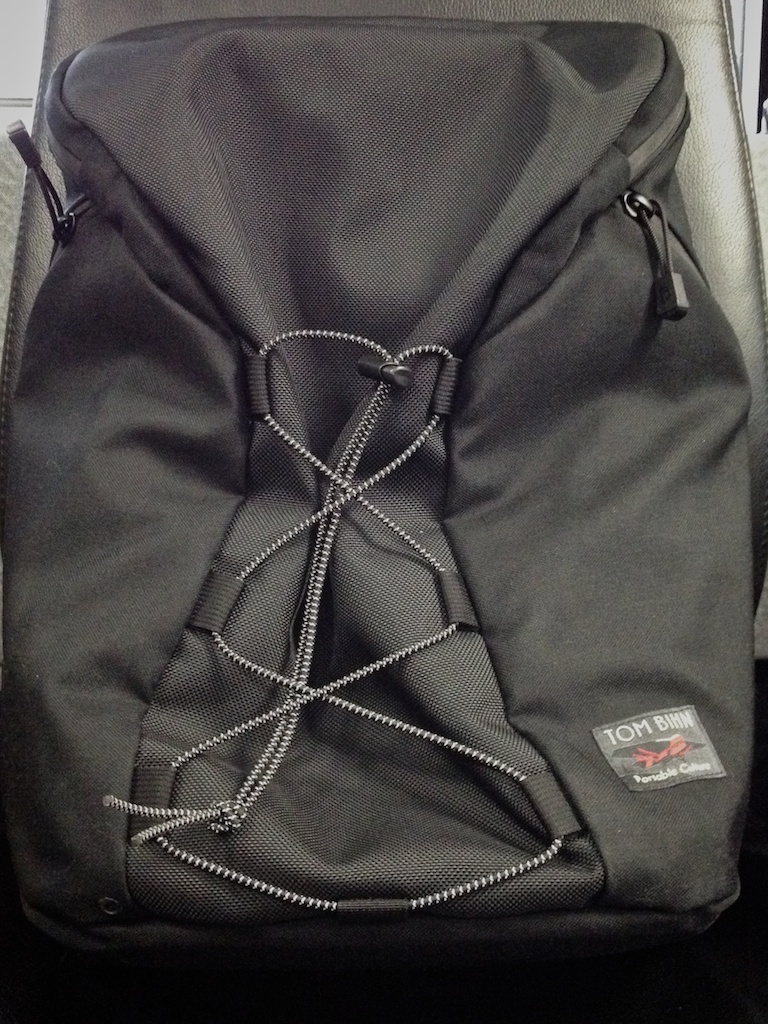
    • While the elastic cord across the front may look like a silly bit of design it is actually functional. More than just being able to strap a jacket in it ((Which works really well.)) — tightening the strap will cinch up the backpack to shrink the size a bit when it is empty. This is a great little touch.
    • When wearing a rain jacket or synthetic down jacket the straps tend to slip around much more than I would like. However when wearing a softer texture like a sweater or shirt the straps have just the right amount of friction to them — not too “grabby”. It’s an interesting trade-off that non-rain-all-the-time folks will likely not notice.
    • The backpack is much lighter than I would have guessed. Many of the highly padded backpacks that I have used are too structure and heavy to be great — not the case at all with the Smart Alec as it has a nice lightweight to it.

    Consensus on Daily Use

    This backpack is probably the largest bag that I have carried on a regular basis in my life, yet it doesn’t feel like the biggest bag I have ever carried. The second strap (as opposed to the one strap on messenger bags) adds a lot of psychological weight to the bag and a makes the bag a bit more cumbersome to put on — something that I feel is offset by the usefulness of that second strap.

    Once on this is the best bag I have ever carried on a regular basis.

    Everything about the bag seems to have been designed by someone who uses backpacks. It doesn’t look professional, yet after using it I can’t help but feel bad for those hapless businessmen lugging around briefcases and messengers at the expense of their backs and balance.

    On an average work week I bring my lunch two days. Those two days always necessitated an additional lunch bag with my Ristretto. With the Smart Alec I don’t even notice the extra items that I carry into the office. Same goes for those odd days that I need to bring more than one small thing home.

    The size of the Smart Alec is quite obviously overkill for my day to day routine — yet I don’t notice that it is.

    It’s a bag in waiting.

    Deceptively bigger than you would expect — while feeling smaller than it truly is.

    I’d feel uncomfortable carrying my Ristretto through Pike Place Market when I am showing guests around Seattle: it was too small to be helpful and far too open to ever feel secure in such a crowd. With the Smart Alec though it’s a no brainer: throw it on my back and go. What could be simpler?

    I really like this bag. So much so that I have put up for sale almost every other bag that I own — the Ristretto is next (and I love that bag).

    Thus far the Smart Alec has done the one thing that I truly hoped it would do: eliminate my need for any other bag.

    Next Up:

    In part two I will be covering using the bag for a weekend getaway and just how much you can stuff in it. Look for that some time after Christmas.