Month: July 2012

  • ‘The Real-Time Web Is Too Important to Entrust to Twitter’

    Matthew “The Panzer” Panzarino arguing the importance of real-time networks like Twitter:
    >More power to Twitter, and I hope that its business continues to grow and thrive. But for us, those of us who understand the inherent power in the real-time flow of information, we need to plan a future where Twitter isn’t the only option.

    You need to read his entire post: it’s a fantastic look at why Twitter is as important as no one knows that it is. Twitter is quite literally the fastest way to find out about anything. Not only is it pure documentation of life on a second-by-second basis, it is one of the few reliable ways to find out up-to-the-moment information in a time of crisis.

    To put it in a better perspective, with due respect to those involved, imagine how different the world would be today if we had Twitter before 9/11/01. How many lives could have been saved by giving real time information to all? Maybe none, maybe it still would have been too unexpected, but I like to think that not only is Twitter a great place for me to complain, it is also an amazing place to be informed and to engage in the world.

    There simply is no other tool as good as Twitter is for informing the world on a moment-by-moment basis, and Panzarino is right — this is far too important of a tool to be in the hands of just *one* company.

  • IAP Greed

    Craig Grannell writing about the annoying (greedy?) practice of iOS gaming developers forcing users to continue to buy things via an IAP, in order to continue enjoying the game. He writes:
    >They are designed around keeping you hooked through the time investment you’ve put into them, rather than around addictive, exciting, engaging game design. The problem is, money talks, and with top-grossing titles typically being the most exploitative money-gouging games on the App Store, why wouldn’t more developers head in that direction?

    I don’t play enough games to notice this, but it shows the bad side of the business model I advocate for: charging for your work. The tough distinction is between a service and an actual app. Instapaper is a service in my mind, and thus I would be willing to pay monthly for it (I pay for the subscription). By that I mean, I would be willing to pay just to use the basic service on the website. Numbers is just an app, not a service, so I feel you should be charged accordingly. This means, charge me enough to fund the next version of the app — how ever far away that might be.

    I am not sure where games fit in, they feel more like apps than services, but then some games are really services. Things like *Words with Friends* feels like a service, not a game. Whereas *Tetris* clearly is a game to me.

    The real question in my mind right now, is whether this is something that should be regulated by the marketplace (gamers) or by Apple? Should Apple start rejecting apps that can’t be used in a long-term and meaningful way without IAP? Or should Apple continue down the current path and leave it to the gamers to stop buying these IAPs?

    I think the latter is the best move, but I also think it is the slowest option.

  • ‘The End of Formality’

    David Heinemeier Hansson is on a roll — his latest post makes a fantastic point:
    >We’re breaking down the stranglehold of formality everywhere. No more personal secretaries, memos on official letterhead, meetings that must happen in person. There’s never been less mental mask switching between work and play. We wear the same clothes, use the same technology. It’s a liberation of the mind and it’s the new world order.

    Moreover, business cards are less important, as is the idea one needs separate work and personal cell phones. As you can probably tell from my pictures that I use of myself, I still dress rather “professionally,” but what you may not know is that I am my own boss, which means I dress however I want. I have never had a problem with someone’s dress code, and the points that DHH brings up in this article are fantastic.

    The idea does seem to correlate with technology companies well; those that are stuck in formality seem to be dying, while those that focus on the work at hand seem to be thriving. Nothing is more stark than the difference between Apple and RIM.

    I wish that more people my age dressed well, but I also recognize that *I* am the one that sticks out, not the other way around.

  • Quote of the Day: Jason Kottke

    “I love Twitter the service and I am starting to really dislike Twitter the company.”
  • ‘And Then the Music Stopped’

    David Heinemeier Hansson on stock valuations and the collapse of Zynga, Groupon, and Facebook:
    >So between just these three, some $40 billion has been extracted from the market caps that pension funds and other last-sucker-in-line investors bought into. While, in the process, soured many on the idea of the public markets and enriched investment bankers hawking the toxic stocks. Hey, at least someone got out while the going was good.

    Heinemeier Hansson and I very much agree on the stupid methods with which stocks are valued — the method appears solely based on hype. I hadn’t done the math, but I can’t believe how high these stocks were, only to come tumbling back closer to reality.

    I know that most stocks are bought by large buyers, but I also wonder how much places like Etrade have to do with this — allowing individuals to buy very small amounts of stock on a whim. I have to think that somehow, the pool of investors has shifted from people eager to look at the numbers, to a group of people that say: “hey, Facebook, yeah everyone uses Facebook.”

    I wish it wasn’t that way — hard to keep a company honest when the investors don’t really care to read about what the company is doing behind the scenes.

  • ‘Captchas Are Becoming Ridiculous’

    Andrew Munsell has a pretty funny tale of trying to enter a captcha: those squiggly word-things on signup pages. They have become more and more difficult to solve, because as Munsell notes, computers are getting better and better at being more human with regard to solving these puzzles.

    Captchas might be one of the more user-hostile things on the web, but we need them to stop SPAM and AHH, we need them!

    The thing is (at the risk of sounding like a broken record) if you just charge every user for a sign up, then you never need to worry about captchas. Because even if a SPAM bot signs up, well, you get paid, and that’s not a sustainable model for spammers.

  • The Polarizing ‘New’ Apple Ads

    As most saw over the weekend, [Apple released three new ads that focus on their ‘genius’ support team](http://www.apple.com/mac/videos/#tv-ads-laborday). The ads show helpless users of Macs, all wanting to do something, and needing help.

    There’s been a lot of debate, and over the weekend about these ads, but I never saw the ads, so I just knew about them from what I saw in Twitter and my RSS feed. The reaction was a bunch of less than happy Mac users:

    [John Gruber](http://daringfireball.net/linked/2012/07/28/genius):

    >These spots don’t appeal to me, personally. They’re not cool. But they’re not supposed to be cool, and they’re not targeted at existing Mac users.

    [Jean-Louis Gassée](https://twitter.com/gassee/statuses/229210920717541376):

    >Ouch! Cringe-inducing new Apple “Genius” ads for Mac. Put those back in the bottle. First celebrity Siri ads, now this?

    [Ken Segall](http://kensegall.com/2012/07/new-mac-ads-landing-with-a-serious-thud/):

    >In the effort to show that the Genius is the most helpful guy in the world, Apple has created customers who, shall we say, are on the dim side. In past ads, Apple has shown “ordinary people doing extraordinary things,” simply because Apple products are so easy to use. Now we have thick people who want to be better, but need a Genius to help. Not exactly flattering.

    Lastly, [Gruber’s comments](http://daringfireball.net/linked/2012/07/30/segall) on Segall’s post really made me go watch the ads:

    >The idea is these on-screen Mac users in need of help are supposed to make the viewer at home feel like, “Hey, I’m smarter than that guy.”

    Of the three ads, ‘Mayday’ is the only one I care for. I think ‘Labor Day’ is kind of funny, but doesn’t do much but show off the iPhoto products you can order. ‘Basically’ is, basically, a warning that you should go to the Apple Store to buy your Apple goods — because otherwise you don’t *actually* get a Mac.

    But I want to talk about ‘Mayday’ because I think it is a great ad — an ad that I can relate to first hand as a non-dumb-Mac user. Most of the ‘Mayday’ ad is just so-so, but it is the ending that I think is great, subtle, but great. At the end the flight attendant comes to get the Genius to help with a Keynote presentation — after the Genius just finished helping with an iMovie project — the Genius springs to action, but so does the Mac user he was just helping.

    Let that sink in for a moment.

    The guy that was so “helpless” before is filled with confidence and proclaims: “Let’s do this” — gets up with the Genius to go help *another* Mac user.

    So Apple just subtly told all would-be Mac users that:

    – If you come to the Apple store for help, we *will* help you;
    – You won’t need to come back for more help;
    – You can now help *others* with Mac problems.

    This is something I have seen time and time again, once you show a new Mac user how to do something — they find it so easy to do again, and now they tend to be more than willing to actively help *other* Mac users. It used to be a game — dodging being a Windows tech support friend — but with Macs I have found that most users are all too happy to help other users.

    To me, that *is* what this Apple ad is showing — and Apple is just giving new users an FYI that they can find Apple Geniuses in their stores.

    I don’t think the ads are bad at all, they just aren’t geared towards anyone reading this site.

    This ad tells new users that there is great help available, help that will teach you — not lecture you. That Mac users band together. Some say these ads aren’t great, but I think ‘Mayday’ is pretty great — it’s just telling a story we aren’t used to seeing Apple tell.
  • Reviewing S°lar, a Weather App

    It’s almost to the point now where I don’t expect any new weather apps to be worth even thinking about, but I am glad I gave [S°lar](http://thisissolar.com) a try after [Jon Mitchell](http://twitter.com/ablaze/status/228353678095024128) pointed it out to me on Twitter. Let’s get something clear first, it’s not an ideal weather app for me, but it is really interesting and worth talking a bit about — because it does weather a bit differently.

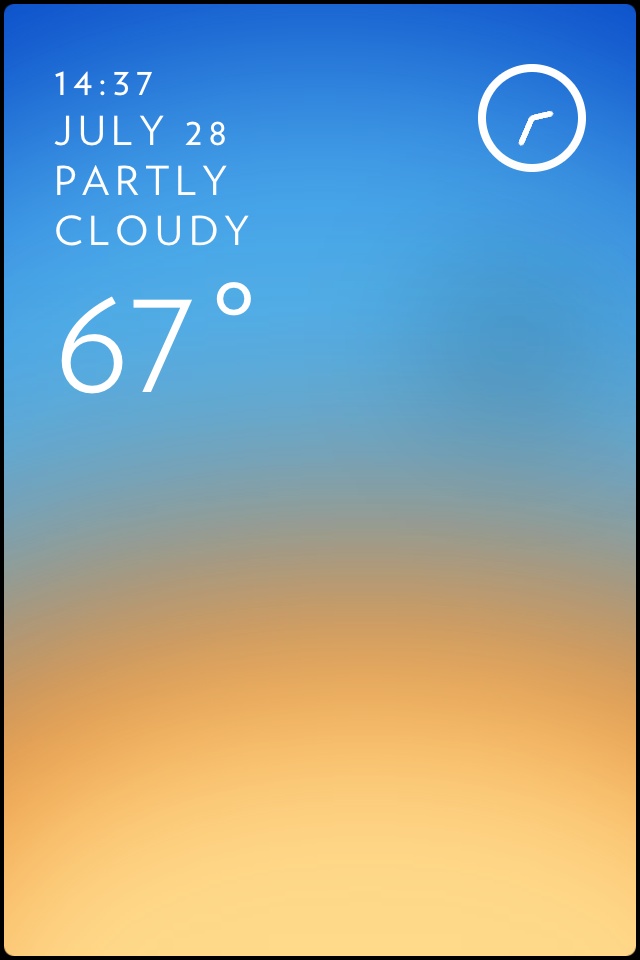
    The first thing that immediately struck me about S°lar is how much I love the way the weather data (just temp and conditions) is displayed:

    Default S°lar view.

    That’s a pretty minimal set of data, but it does two things really nicely:

    1. Shows the temp in an easy glance able manner.
    2. Shows a background that isn’t some silly image of the weather, or static thing — instead it gives your a hint of the temp and an indication of the weather (it drips from the top if raining, or shows colors to indicate clouds or blue sky — in this case it is warmish with a blue sky).

    S°lar isn’t like Dark Sky, but it’s better than most any other app for giving you an idea of the weather in a traditional manner.

    If that was all this app did, I would likely keep it around — but as it turned out this was only scratching the surface.

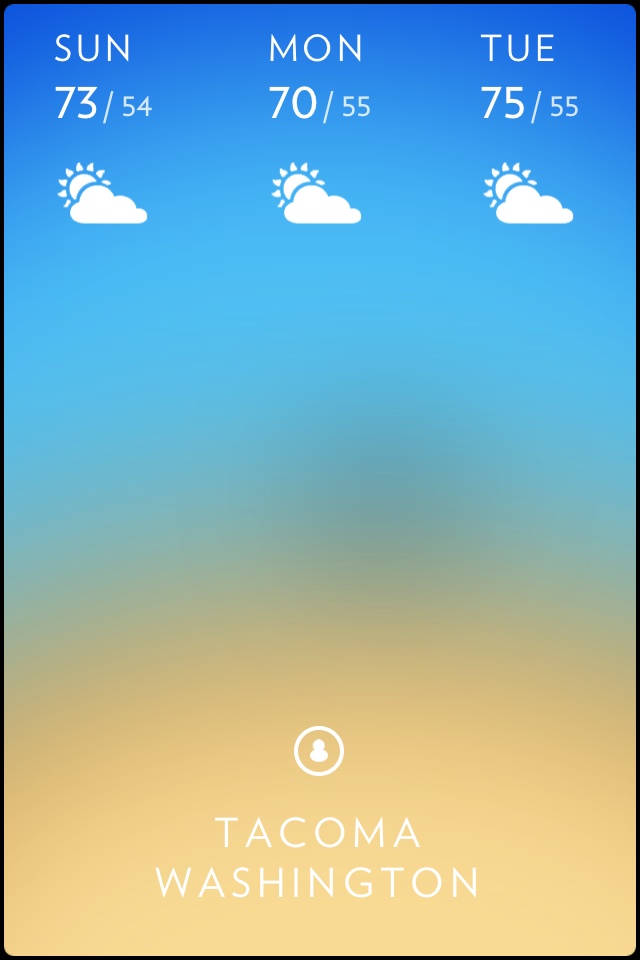
    Pull down, and you get the three day forecast:

    Drag down to get this forecast.

    Slide your finger from the bottom up, you can see the weather info change based on the hourly forecast — this is pretty neat:

    The hourly forecast, shown by sliding your finger from the bottom up.

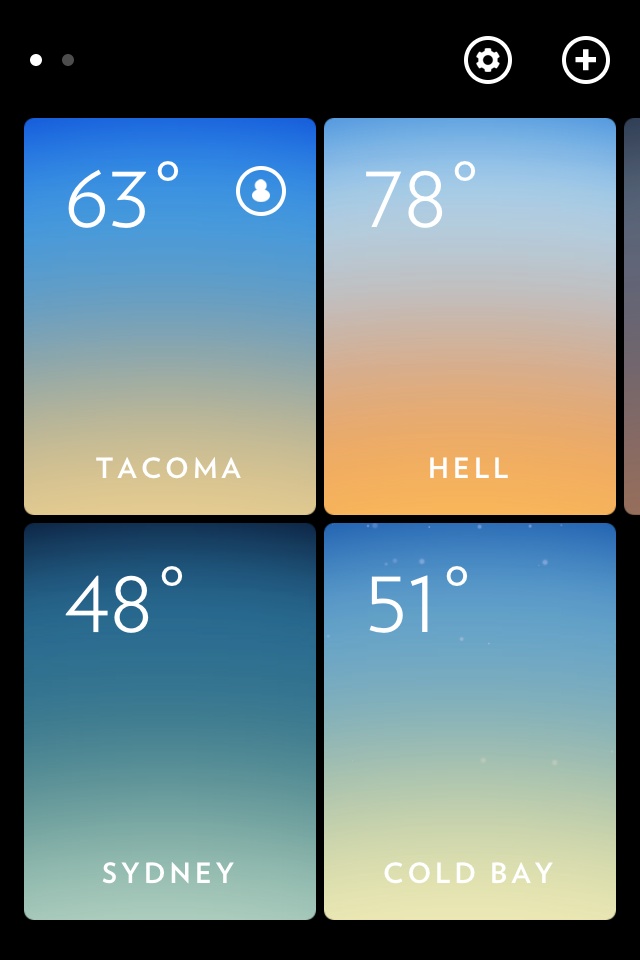
    Double tap to pull back and see all of your locations:

    All my locations.

    What I love about this is that the view is actually useful, and not just a switcher (you can swipe from side to side to change locations without pulling back to this view). Many weather apps make you select a location before they show you any data, so I love that this app gives you useful data before you even dive into a location. It just works “out of the box”.

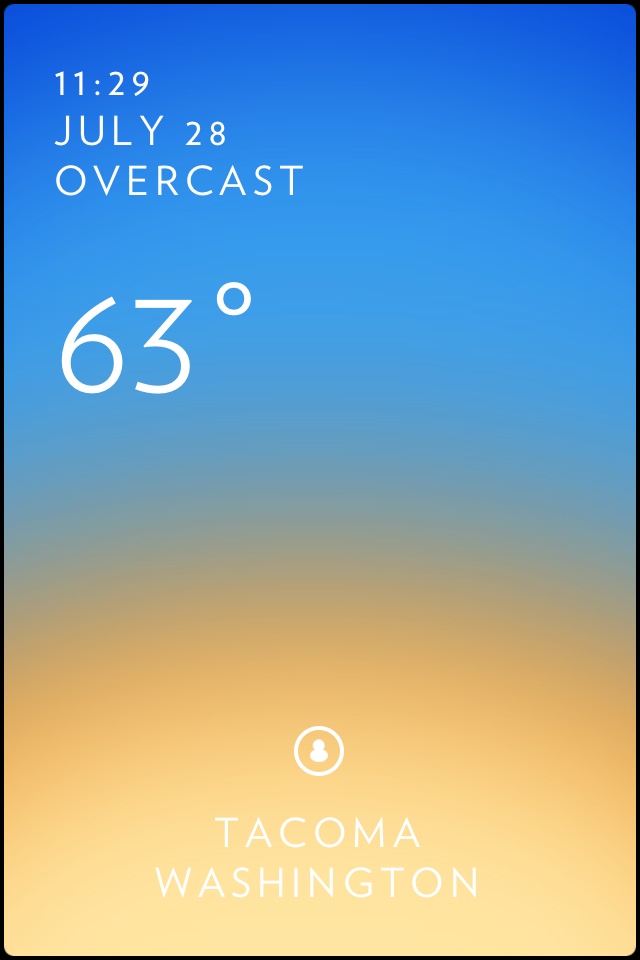
    The settings screen is equally simple and well designed:

    The settings screen.

    Ok so none of those screens are unique — because while beautiful, they certainly aren’t revolutionary.

    Here’s the reason that I like this app though: go back and look at those swipes and taps I mentioned — each one can be done with only your thumb and iPhone in one hand. That’s not something I can say for many apps.

    ### Why Ben, Why

    I really like this app, the UI and interface is really nice and really invisible — S°lar is the [Clear](http://www.realmacsoftware.com/clear/) of weather apps — and I really like Clear.

    Overall I don’t know how useful S°lar will be to me (I love Clear, but I don’t use it anymore), but I do think that S°lar is a very solid weather app, and a perfect convince-someone-they-want-an-iPhone-app.

    [Get it from the App Store for $0.99.](http://itunes.apple.com/us/app/solar-weather/id542875991?mt=8)

  • Quote of the Day: @mikeysan

    “‘Powered by Adobe’ seems more like an apology than an advertisement.”
  • The Economics of Google Fiber

    Stacey Higginbotham:
    >Granted, that profit might not be as large as the broadband profits that Comcast or AT&T currently enjoy, but it’s a profit.

    Woah, wait — Google is expecting to actually profit from Google Fiber. That *is* impressive, I had assumed that they were doing this as a break-even or small-loss business entity to drive ad viewers, but if they can actually turn a small profit from it, well that is impressive.

    Hopefully, buy making it profitable, they will roll it out in more areas. If for no other reason that to put pressure on Comcast. ((Fucking Comcast.))