Year: 2013

  • ‘The View-Master User Interface’

    [Dr. Drang on the parallax feature of the iOS 7 Home screen][1]:

    > Despite all the talk of flatness—and there’s no question, the icons and certain other parts of the UI are much flatter—this gives iOS 7 as a whole a greater illusion of depth than it ever had before. The shadows and reflections of today pale in comparison. If Apple can enforce, or at least encourage, a consistent use of this new depth, our experience using iOS devices will improve because the software will seem even more physical.

    I’m really interested to see if this bit of magic makes it to third-party apps or not. It’s a really neat effect that not only adds immense depth, but one that surprisingly makes the device feel a lot better to use — I’ve no clue why.

    [1]: http://www.leancrew.com/all-this/2013/06/the-view-master-user-interface/

  • ‘Fertile Ground’

    [Marco Arment on how Apple just re-ignited the App gold rush][1]:

    > Apple has set fire to iOS. Everything’s in flux. Those with the least to lose have the most to gain, because this fall, *hundreds of millions* of people will start demanding apps for a platform with thousands of old, stale players and not many new, nimble alternatives.

    I can attest to what Marco is saying, because right now *every* app that isn’t an Apple app looks ancient on my phone. I’m holding my money up in the air — so too will millions of iOS users this fall — who’s going to grab it?

    [1]: http://www.marco.org/2013/06/11/fertile-ground

  • The WWDC Keynote

    There’s a lot of information to parse that came out of Apple (did you know you can buy new Airport/Time Capsules already?), but I think two really important factors that can be evaluated now are summed up well by Jim Dalrymple and John Gruber.

    [Dalrymple][1]:

    > One thing that became very clear to me early on in today’s keynote is that Apple was having fun again. They were really enjoying themselves.

    The product demos were tedious as always, but the remaining parts of the keynote were very fun and most importantly engaged with the audience. This is a company that has been paying attention to what is said about them, and ignoring it because they don’t think it is true.

    [Gruber][2]:

    > The software is now of a piece with the hardware. Two sides of the same coin. Not hardware design and software design. Just design.

    The amount of overhaul is astounding and it is very clear the the direction forward is that there is no software, there is no hardware, there is just iPhone (or iPad, MacBook Pro, what have you).

    Ignore every other judgment. I have and am playing with both iOS 7 and Mavericks on my full-time devices ((I’m a sadist, clearly.)) and a lot will change from now until launch. Ignore criticisms of design until Apple has worked all of the design out. This is a beta, and not even a public one at that.

    Or as [Cap Watkins put it][3]:

    > We asked for a revolution and were delivered one which, all complexities considered, amounts to more than any one of our best first launches.

    [1]: http://www.loopinsight.com/2013/06/10/apples-confidence/
    [2]: http://daringfireball.net/2013/06/ios_7_signature
    [3]: http://blog.capwatkins.com/ios-7-unpolished-by-design

  • Quote of the Day: Daniel Ellsberg

    “This wholesale invasion of Americans’ and foreign citizens’ privacy does not contribute to our security; it puts in danger the very liberties we’re trying to protect.”
  • Quote of the Day: Timothy Lee

    “Snowden wasn’t crazy to question whether he’d be treated fairly by the American justice system.”
  • ‘Here Come the Encryption Apps’

    A great post from [Matthew Green comparing different encryption apps for iOS][1]. Someone (I can’t find the source) on App.net sent this over to me and it is a great breakdown from someone who presumably knows his stuff.

    Of the apps listed I use Wickr quite a bit. I thought it was pretty secure, but it looks like it is less secure than I thought. I just signed up for Silent Circle and will be testing that out. It’s a much more complicated system, but it looks to be far more secure of a system.

    [1]: http://blog.cryptographyengineering.com/2013/03/here-come-encryption-apps.html?m=1

  • ‘The Problem With Metadata’

    [Jane Mayer for *The New Yorker*][1]:

    > “The public doesn’t understand,” she {Susan Landau} told me, speaking about so-called metadata. “It’s much more intrusive than content.” She explained that the government can learn immense amounts of proprietary information by studying “who you call, and who they call. If you can track that, you know exactly what is happening—you don’t need the content.”

    Mayer also points out that when you are looking at just metadata the operation effectively becomes a data driven collection, whereby computers do all the heavy lifting. This means the NSA can effectively monitor every communication with minimal manpower. Yikes.

    [1]: http://www.newyorker.com/online/blogs/newsdesk/2013/06/verizon-nsa-metadata-surveillance-problem.html?mobify=0

  • Quote of the Day: Edward Snowden

    “I will be satisfied if the federation of secret law, unequal pardon and irresistible executive powers that rule the world that I love are revealed even for an instant.”
  • ‘The NSA’s Dragnet’

    [Richard Dunlop-Walters has an excellent break down of PRISM and the NSA][1], so if you don’t want to read all the details, but want to be informed — Dunlop-Walters’ summary is your best bet.

    [*The Verge* also has a good synopsis][2] of President Hypocrite, I mean, President Obama’s remarks on the matter. President Obama’s comments largely can be summarized by: “Dude, totally legal, chill out. Can’t we all just snorkel this out?”

    What an asshat.

    I’ve long assumed that calls, texts, and emails are not really private. ((Side note: This makes Justin Blanton all the wiser. He requires that you use an encrypted text client called Wickr to text with him.)) Sure they are private from the average Joe, but not for the mighty “intelligence community”. What’s actually bugging me most is the file aspect of this. Because Microsoft, Google, Apple — they all *store* files for users. These files could, and many probably are, sensitive in nature — at least sensitive enough you’d actually care that the government is/can be looking at them at will.

    Add to that reports are Dropbox is about to join up. [OwnCloud][3] and [File Transporter][4] are looking better and better each day — despite the near zero developer support for them.

    [1]: http://thebrief.io/news/the-nsas-dragnet
    [2]: *The%20Verge*
    [3]: http://owncloud.org
    [4]: http://www.filetransporter.com

  • Quote of the Day: Matt Gemmell

    “The junction between mortality and mundanity is an exquisite source of perspective.”
  • ‘U.S., British Intelligence Mining Data From Nine U.S. Internet Companies in Broad Secret Program’

    I don’t even know where to begin on this [PRISM program the NSA is running][1]. All I can say is that it is bullshit and kudos to the Washington Post for breaking the story and providing a lot of detail.

    Additional stories [here][2], [here][3], and [here][4].

    [1]: http://www.washingtonpost.com/investigations/us-intelligence-mining-data-from-nine-us-internet-companies-in-broad-secret-program/2013/06/06/3a0c0da8-cebf-11e2-8845-d970ccb04497_story.html
    [2]: http://www.washingtonpost.com/wp-srv/special/politics/prism-collection-documents/
    [3]: http://www.dni.gov/index.php/newsroom/press-releases/191-press-releases-2013/869-dni-statement-on-activities-authorized-under-section-702-of-fisa
    [4]: http://www.washingtonpost.com/blogs/worldviews/wp/2013/06/06/nsa-chief-two-weeks-ago-were-the-only-ones-not-spying-on-the-american-people/

  • Vesper Take Two

    *I originally started writing a normal Vesper review. I talked about the design, the icon that I like slightly more than I dislike it. About the features missing, about the use cases, and so on. But because I am a bit slow on this, I had the chance to read a lot of other reviews. So I deleted mine and wrote this instead.*

    I’ve met John and Dave. I don’t have their phone numbers or anything, and I don’t warrant any special consideration from either — I’ve only met them briefly at that. Oh, and Brent is from the same city as me too.

    It smells of bias in here.

    Oh, and this app they have created, this beautiful gem of design (both graphic and interactive), my god they charged $4.99 for it and [I’m all about paying for things][1].

    Bias I tell you. *Bias*.

    But I’ve been struggling all day with my next sentence here.

    It’s just that I don’t know if the app is worth $4.99 and that’s tough for me to say for a few reasons.

    $4.99 is nothing to spend on a good app. It’s a trivial amount given the clear work that was put into [Vesper][2]. Trivial.

    And yet do we buy a “thought collection” app — which by the way really is an apt description no matter how pompous it sounds — for $4.99?

    It does so little, and there’s so many options. It’s not the price, it’s just how do you recommend that, how do you sell that argument to someone looking at all the options?

    There’s two arguments that I can make about this app:

    1. That this app is not worth the price. That there are other options out there that do far more for far less money. There are probably hundreds of note taking apps out there that offer data portability, syncing, and all the other options we have come to expect from a paid note taking app — options that just simply don’t exist in Vesper.

    2. Or I could argue that this app is worth every penny of the $4.99, because just look at it. Just feel it. My god man.

    I personally think both statements are true.

    Vesper is phenomenally well designed from the graphics, animation, feel, speed, and interaction. It looks and feels great. It’s a fucking Ferrari of note, no, thought collection apps.

    And yet I wouldn’t recommend people buy it for the same reason I rarely recommend or argue that people buy a Mac in 2004, an M5 at any time, or an iPhone in 2006.

    Either the design is compelling you to use something more than you otherwise would, or you buy Windows/Kia/Android. That’s not a knock against other companies, it’s a statement of fact about human psychology. You either are compelled to use things you love because of practicality or because of the way they make you feel.

    Vesper is not a practical app for a multitude of reasons.

    Personally I’ll go out of my way to use things more if I love the way I feel, they feel, when I use them. It’s why people drive an M5 when a Toyota Corolla would do the job better 60% (ok 90%) of the time.

    I don’t know or care what the future holds for Vesper because I just enjoy the app. You’ll find better options for $5, of that I won’t argue, because I’d rather just enjoy the app I pissed $5 away on.

    [1]: https://brooksreview.net/2011/03/fragility-free/
    [2]: http://vesperapp.co
  • Keyboard Maestro, Markdown Links, and Ulysses III

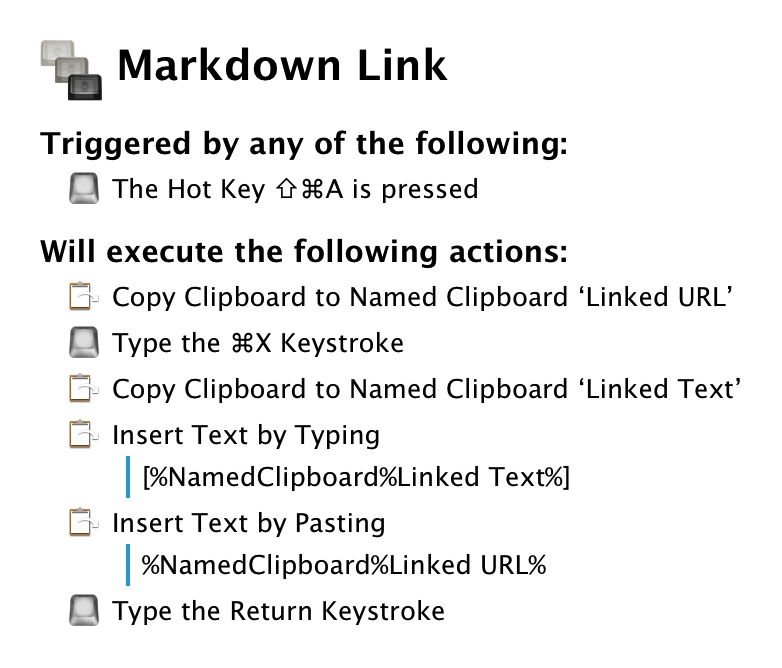
    For a very long time now I have had a [simple Keyboard Maestro macro](https://brooksreview.net/2011/03/mad-links-km/) that would take the link on my clipboard and make a Markdown link out of any editable text that I have selected. It’s been a huge help to me over the years for formatting my writing.

    With my [recent switch to Ulysses III](https://brooksreview.net/2013/04/ulysses-iii/) as my all-things-everyday-writing-app the macro no longer worked. Well, it worked about 60% of the time. Ulysses is a bit *too* helpful when you go to create a link, popping up a dialog prompting you to enter the URL once you put brackets around your text.


    So I tweaked my Keyboard Maestro macro specifically for Ulysses to solve this problem. Before I show it to you, I do want to note that it is not as instantaneous as before, so wait a beat after using it so that you don’t get things all messed up.

  • ‘TSA Drops Plan to Allow Airline Passengers to Carry Small Knives, Bats, Golf Clubs on Planes’

    [Speaking of][1] fucking bullshit, [here’s another one][2]:

    > The Transportation Security Administration is abandoning a plan to allow passengers to carry small knives, souvenir bats, golf clubs and other sports equipment onto planes in the face of fierce congressional and industry opposition, the head of the agency said Wednesday.

    The reasoning is just absurd. Here’s the reason Pistole said they were making the move:

    > He said intercepting them takes time that would be better used searching for explosives and other more serious threats. TSA screeners confiscate over 2,000 of the small folding knives a day from passengers.

    Basically the argument for loosening the rules is that these items pose no real security threat and take away time that could be better spent looking for real threats. So in his backtracking Pistole naturally said:

    > By scuttling the plan to drop the knives and sports equipment from TSA’s list of prohibited items, the agency can focus its attention on other priorities, including expanding its Pre-Check program to identify ahead of time travelers who don’t pose a security risk, TSA Administrator John Pistole told The Associated Press.

    So they *were* going to loosen the rules to better focus on security, but *now* they will not loosen the rules so that they can better focus on — wait for it — security. Huh?

    *Morons.*

    I also saw that 145 jackass congressmen/women wasted their time writing a letter in opposition of loosening the rules, instead of fixing things like the economy. [Here’s their letter][3] if you are interested in shaming any of them (two jackasses even signed in green ink, granted their last names are Green, but be original people).

    [1]: https://brooksreview.net/2013/06/nsa-collecting-phone-records-of-millions-of-verizon-customers-daily/
    [2]: http://www.washingtonpost.com/politics/government-drops-plan-to-allow-passengers-to-carry-small-knives-bats-golf-clubs-on-airplanes/2013/06/05/a494a448-ce0e-11e2-8573-3baeea6a2647_story.html
    [3]: http://noknivesonplanes.com/wp-content/uploads/2013/05/5.22.13_TSA_No-Knives-on-Planes.pdf

  • ‘NSA Collecting Phone Records of Millions of Verizon Customers Daily’

    The headline [pretty much says it all][1], but here’s Glenn Greenwald’s report:

    > The document shows for the first time that under the Obama administration the communication records of millions of US citizens are being collected indiscriminately and in bulk – regardless of whether they are suspected of any wrongdoing.

    And:

    > Under the terms of the blanket order, the numbers of both parties on a call are handed over, as is location data, call duration, unique identifiers, and the time and duration of all calls. The contents of the conversation itself are not covered.

    The New York Times covers it a bit differently, with [Charlie Savage and Edward Wyatt reporting][2]:

    > The Obama administration is secretly carrying out a domestic surveillance program under which it is collecting business communications records involving Americans under a hotly debated section of the [Patriot Act][3], according to a [highly classified court order][4] disclosed on Wednesday night.

    The key difference between the two reports is that it sounds like The New York times believes the records to be only “business” in nature — those from a specific business subsidiary of Verizon — whereas The Gaurdian report seems to be claiming that there is a “business provision” in the Patriot Act which is being used to get all-ish records Verizon. That’s my reading at least.

    Either way, it’s fucking bullshit.

    [1]: http://www.guardian.co.uk/world/2013/jun/06/nsa-phone-records-verizon-court-order
    [2]: %20http://www.nytimes.com/2013/06/06/us/us-secretly-collecting-logs-of-business-calls.html?hp
    [3]: http://topics.nytimes.com/top/reference/timestopics/subjects/u/usa_patriot_act/index.html?inline=nyt-classifier
    [4]: http://www.guardian.co.uk/world/interactive/2013/jun/06/verizon-telephone-data-court-order

  • Why Paywalls and Big Media Don’t Work as Well as a Reasonable Person Might Assume that they Should Work

    Today the Washington Post [announced][1] that they will put up a Paywall. Of course [this][2] interests me, but not as a point of vindication — because I think the Washington Post will likely fail in their paywall foray.

    The problem with paywalls and big media is that big media lacks compelling content. The majority of the content I find on the Washington Post is also content that I could find, like or, better versions of on another site for free. This is the paywall problem.

    A paywall only works if the content that exists behind the paywall, *only* exists behind the paywall.

    This is the core issue with any site that does a paywall, including this site. If all I continued to do when I put up the paywall was link to articles that every other tech blogger was linking to, adding only my own particular brand of snark — well in that scenario you have something that’s not really worth paying for. You can get those *same* links and *similar* snark from another ad-supported site — screw paying *this guy*.

    That’s the issue that faces The Washington Post.

    With the model as the Post described it, they must be outputting more than twenty compelling articles each month (first twenty articles are free) — and those articles that exist beyond the twenty must also be *worth* paying for. Because a good article is not something many are willing to pay for, your writing needs to then be so great, or so unique, that all of a sudden it *is* worth paying for.

    Essentially, news is out, and opinion is in. That means it’s not just twenty good news articles, it’s specifically *more than twenty good opinion* articles that need to be produced at the highest levels of “interestingness” before you can get people to pay. And I’m sorry, but I just don’t think the Washington Post can do it.

    That’s a huge wall to scale for the Post and a huge ask of their readership. When what you mostly write about can be found on just about any other news site people have a hard time paying for that content.

    [1]: http://www.washingtonpost.com/business/economy/washington-post-to-phase-in-a-paid-online-subscription-model/2013/06/05/d2e1bce4-cdd4-11e2-8845-d970ccb04497_story.html
    [2]: https://brooksreview.net/members/

  • Eavesdropping

    [Bruce Schneier writing about the new backdoors that the FBI wants installed][1]:

    > The FBI believes it can have it both ways: that it can open systems to its eavesdropping, but keep them secure from anyone else’s eavesdropping. That’s just not possible. It’s impossible to build a communications system that allows the FBI surreptitious access but doesn’t allow similar access by others. When it comes to security, we have two options: We can build our systems to be as secure as possible from eavesdropping, or we can deliberately weaken their security. We have to choose one or the other.

    A really good overview of the problems that surround eavesdropping via backdoors in software.

    [1]: http://www.schneier.com/blog/archives/2013/06/the_problems_wi_3.html

  • Mac mini Server

    When I saw a deal offered by Macminicolo.net on *[Daring Fireball][1]*, I was interested. Then I found out the cost of entry could be reduced even further by “renting” a Mac mini instead of buying one.

    *Sold*.

    I went into this adventure with Macminicolo.net having never used a Mac server before, and in just a night I had the following up and running:

    1. Hosting for Benbrooks.me
    2. Email for Benbrooks.me (Or so I thought. Turns out I was only half way there)
    3. A VPN to route all internet traffic through.

    Granted I found guides all over the web that were easy to find and fairly easy to follow.

    More advanced things required some guidance, which luckily was also readily available.

    At this point I decided that I wanted to try and port the hosting for Brooksreview.net over to the mini (Spoiler: that’s what is serving the site now.) and so I started following guides to get WordPress up and running. I found out that you don’t need MAMP, just MySQL installed — one less app running, but then I got a bit, well, *nervous*.

    Yes, I had an instance of WordPress up and running, but I suck at managing databases and I was worried about messing up the migration — especially losing my Mint stats… *again*.

    So I hired Rusty Ross to give me a hand getting everything else setup. And I’m glad I did because there are so many disastrous pitfalls that I would have tripped into had I not hired Rusty. [You should hire him][2].

    ## The Advantage

    There’s no practical reason I can think of to move from one of the many lower cost options to a Mac mini if all you want to do is to host some email and a website or four.

    The advantage to having the Mac mini is that I have a lot of control and a lot of flexibility.

    I can do the typical Mac server things like running Mail.app and having rules set up. Or running Torrents, or what have you. There’s a lot of things that I can do.

    What I am doing right now is:

    – [VPN][3] for use when I am not on a trusted network.
    – Running Mail.app so that my rules work all the time.
    – Synchronizing OmniFocus (which is a way faster solution).
    – Using the Transmission web interface should I need to download a Torrent.
    – Hosting all of my websites.
    – Hosting all of my email.
    – Using Scrup as my own personal Cloud.app.
    – Storing all of my Dropbox on it, while using Selective Sync on my Mac. (OwnCloud is great, but no apps support it, so there is limited iOS utility right now.)
    – Using BitTorrent sync for work files.

    I’ve only [scratched the surface][4] of what I can do. There are a lot more automated tasks that I will push to the mini in future.

    This little mini is really fantastic; fast to work with, and overall a better performing, more cost effective solution for my needs.

    [Go get one][5].

    [1]: http://daringfireball.net
    [2]: https://twitter.com/ConsultantRR
    [3]: http://macminicolo.net/mountainlionvpn
    [4]: http://www.farawaymac.com
    [5]: http://macminicolo.net

  • ‘Sent From Byword’

    [Shawn Blanc has a great write up on Byword 2][1]. I’ve actually been waiting to read his thoughts, since I know how much he loves and uses Byword.

    The ability to publish directly to your site from Byword is nothing short of a fantastic addition — I look forward to seeing how this develops.

    [1]: http://shawnblanc.net/2013/06/sent-from-byword/

  • The Banality of ‘Don’t Be Evil’

    [Julian Assange, reviewing Eric Schmidt and Jared Cohen’s new book, *The New Digital Age*][1]:

    > The section on “repressive autocracies” describes, disapprovingly, various repressive surveillance measures: legislation to insert back doors into software to enable spying on citizens, monitoring of social networks and the collection of intelligence on entire populations. All of these are already in widespread use in the United States. In fact, some of those measures — like the push to require every social-network profile to be linked to a real name — were spearheaded by Google itself.

    I almost always don’t like Assange, but the enemy of my enemy… Or something like that. In his review Assange brings up some fantastic points, like the one quoted above and this gem:

    > If you want a vision of the future, imagine Washington-backed Google Glasses strapped onto vacant human faces — forever.

    Gives me the heebie-jeebies.

    {via *[Daring Fireball][2]*}

    [1]: http://www.nytimes.com/2013/06/02/opinion/sunday/the-banality-of-googles-dont-be-evil.html?pagewanted=all&_r=1&
    [2]: http://daringfireball.net/linked/2013/06/03/assange-schmidt