“All too often, the ones who are aggressively seeking the theory of the day don’t have a lot to show for what they did yesterday.”
Top Posts
The Hype: Yoshida & Co’s Porter BagsAugust 26, 2025
G-SHOCK DW-H5600 After 7 MonthsJuly 31, 2025
Casio Duro MDV-106 Re-ReviewDecember 15, 2022
Recent Articles
-
Quote of the Day: Seth Godin
“All too often, the ones who are aggressively seeking the theory of the day don’t have a lot to show for what they did yesterday.” — Seth Godin
-
Quote of the Day: Chris Bowler
“Ev and Biz have shown they can build amazing services, but they haven’t proven to build services that are profitable.” — Chris Bowler
“Ev and Biz have shown they can build amazing services, but they haven’t proven to build services that are profitable.” -
‘As Web Search Goes Mobile, Competitors Chip at Google’s Lead’
[Claire Cain Miller][1]: > In the future, Google could answer more complicated questions, Mr. Gomes said, like “How far is it from here to the Eiffel Tower?” and “Where could I go to a concert in warm weather next year?” I wanted to link to this and simply post a screenshot of Siri providing the…
[Claire Cain Miller][1]:
> In the future, Google could answer more complicated questions, Mr. Gomes said, like “How far is it from here to the Eiffel Tower?” and “Where could I go to a concert in warm weather next year?”
I wanted to link to this and simply post a screenshot of Siri providing the answer to the first question. It didn’t work. Siri couldn’t parse that original question, instead telling me my location. The second question prompted a straight web search.
It’s clear to me that this is where search is headed, and it’s also clear that this is exactly the kind of search/task that Siri was made to do.
So the question really is: who builds a reliable product first?
Google has an obvious edge given the sheer power of their search tool and the data they have backing it up.
What I wouldn’t do is count Apple out. Because while Siri isn’t always great, Apple has no problem partnering with people like Yelp, OpenTable, Wolfram|Alpha, and so on to get the data that they need to make a better product.
Apple will build what they need, but only if they actually have to build it, whereas Google will always build what they need because they desire to own all the information.
That’s an odd role reversal for the two companies.
[1]: http://www.nytimes.com/2013/04/04/technology/as-web-search-goes-mobile-apps-chip-at-googles-lead.html
-
The Weak Gesture
President Obama [announced][1] that he would return 5% of his salary every month for 2013. He does so as a gesture of solidarity with other federal workers who are getting shafted. This is a stupid and pointless gesture. As the New York Times notes, the 5% being returned will equal $16,667 dollars over the course…
President Obama [announced][1] that he would return 5% of his salary every month for 2013. He does so as a gesture of solidarity with other federal workers who are getting shafted.
This is a stupid and pointless gesture.
As the New York Times notes, the 5% being returned will equal $16,667 dollars over the course of this year. What exactly is that supposed to accomplish?
I will give the president this: it *is* a gesture. I’m just not sure what the gesture is.
I think there are two ways to look at this:
1. That Obama is doing something noble. He is trying to stand “with the people” and show that he too is willing to “suffer” financially.
2. That it is a pointless fucking gesture.I, unsurprisingly, want to focus on point two.
## The Pointless Gesture
Before I get you all riled up, it’s best to understand exactly what the President of the United States of America gets. Here’s a [pretty good break down][2], which summarized is:
– $400,000 yearly salary.
– $50,000 expense account (annually)
– Free home to live in.
– Staff to do anything and everything (34 people).
– Chef (actually, 5)
– Transportation
– Security (Which is an understatement)
– Office
– Retirement that is in the millions ((Interestingly it is noted that Dub-ya declined his retirement.))
– A lot more.To be honest, all of this sounds perfectly reasonable to me — I am in no way saying this should be changed or disallowed. However, given all of that, now take into account how much the Obama’s have made personally (book sales mostly) [since 2000][3]: $18,563,000. Good for them, honestly, but now are you starting to realize why $16,677 is a pretty fucking pointless gesture?
It’s also worth pointing out that Clinton received $15 million in advances for his post-Presidential book. Obama is likely to receive more given his status as the first non-old-white-guy U.S. President (among many other reasons).
[@CJCHILVERS on App.net][4]:
> Let’s see, poverty is up to 1960s levels, gas has tripled since 2008, the debt is unfathomably high and no one can say exactly how many are now unemployed…Yeah, a 5% pay cut should do it.
*Pointless fucking gesture.*
But there’s more to this than just taking some money and giving it back, because to me this admits two things:
1. Giving back part of your pay, in my mind, is an admission that you failed to fully perform your duties. It’s no different than getting short-changed an appetizer at a restaurant and instead of just getting the food, you just don’t get charged for it. *You still wanted that appetizer, now you are hungry(er).*
2. Since this isn’t a one-time repayment, and instead a re-payment over the course of the year, this to me is admission that the President isn’t expecting to be able to better perform his job going forward.All of this coming from “the leader of the free world” or whatever tagline is trendy this year.
So to recap:
– Obama already has plenty of money
– Obama really has no need for money at present
– He is giving back only $16,667 of the $18+ million he has made over the last 13 years.
– The money he is giving back absolutely solves nothing — probably doesn’t even pay for the time of the person(s) that need to make all the ledger moves and account for it.
– Feels like an admission that he has failed, and will continue to fail, as the President of the United States.I don’t like it. Sends the wrong message to Americans and the world. If I’m another country, I just witnessed the President of the United States saying that he has failed to do his job fully.
Come to think of it, this gesture isn’t pointless, but actually a sign of weakness.
[1]: http://www.nytimes.com/2013/04/04/us/politics/to-highlight-pain-of-budget-cuts-obama-to-return-of-part-of-pay.html
[2]: http://everything2.com/index.pl?node_id=1478184
[3]: http://www.celebritynetworth.com/articles/celebrity/barack-obama-fortune/
[4]: https://alpha.app.net/cjchilvers/post/4441192 -
Quote of the Day: Marcus Fehn
“People will (and should) judge the shipping product and not some promises, so what you’ll get is what we shipped, and we need to be confident about it, and we are — all is good.” — Marcus Fehn
“People will (and should) judge the shipping product and not some promises, so what you’ll get is what we shipped, and we need to be confident about it, and we are — all is good.” -
Ulysses III
Sometimes, when something new comes along, I can’t help but be a little giddy about it. I see the email, the announcement, the download link, and all I can think is “Shit I am driving right now, should I pull over?” Such was the case when I got an email from Max Seelemann telling me…
Sometimes, when something new comes along, I can’t help but be a little giddy about it. I see the email, the announcement, the download link, and all I can think is “Shit I am driving right now, should I pull over?”
Such was the case when I got an email from Max Seelemann telling me that [Ulysses III][1] had been submitted to the Mac App Store and was awaiting approval **and**, that in the meantime, here was the beta preview of the app. I didn’t pull over, but I did make sure that downloading and playing with the app was the very first thing I did when I got back to my Mac.
I’ve been using Ulysses for [a long time][2], I love the app, but it fell by the wayside as I fell in [love with Writer][3]. I’ve had some sneak peaks and some beta builds of the Ulysses III text editor, but nothing that would prepare me for how excellent Ulysses III truly is.
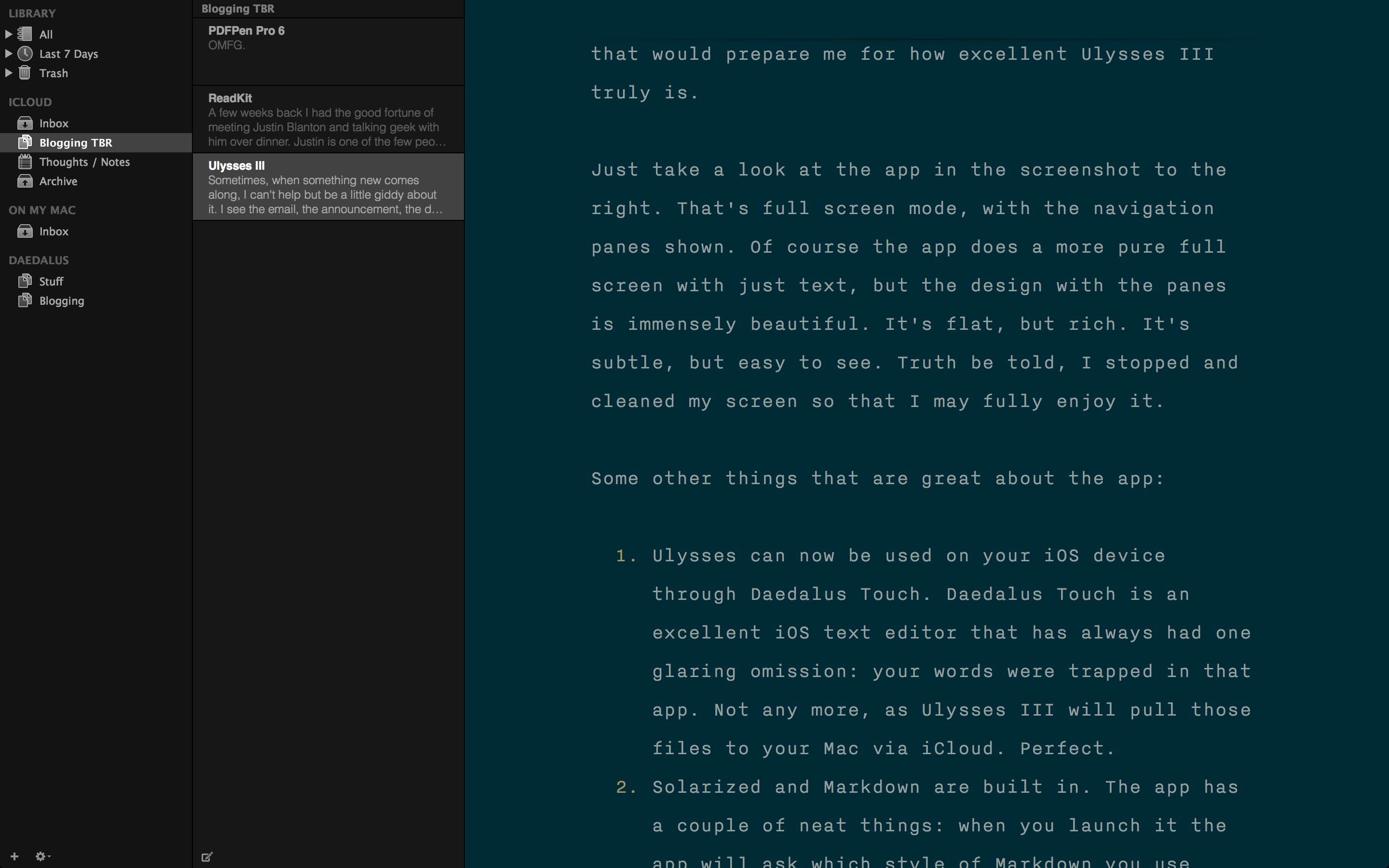
Ulysses III, fullscreen in three pane mode. Just take a look at the app in the screenshot to the right. That’s full screen mode, with the navigation panes shown. Of course the app does a more “pure” full screen with just text, but the design with the panes is immensely beautiful. It’s flat, but rich. It’s subtle, but easy to see. Truth be told, I stopped and cleaned my screen so that I may fully enjoy it.
Some other things that are great about the app:
1. Ulysses can now be used on your iOS device through [Daedalus Touch][5]. Daedalus Touch is an excellent iOS text editor that has always had one glaring omission: your words were trapped in that app. Not any more, as Ulysses III will pull those files to your Mac and show them in the sidebar as you see in the above screenshot. What’s even nicer is that not all your files are synced, allowing you to get rid of things you don’t want to see on iOS, and yet still be able to see everything on your Mac. Perfect.
2. Solarized and Markdown are built in. The app has a couple of neat things: when you launch it the app will ask which style of Markdown you use (underscores or asterisk) ((Asterisks are the original, and should always be used.)) and remember that setting. The app has a very beautiful transition between Solarized light and dark themes and automatically defaults to the dark theme when you go fullscreen — a very nice touch.
3. You can select your own font, or make your own color scheme. But truth be told all you really need to do is change the font from Menlo to Nitti Light and select Solarized.If you had previously tried Ulysses and didn’t like it, now is the time to give it another look. It’s simpler, it’s refined. Ulysses of old is like the current (non-two) version of the OmniFocus for Mac, and the new version, Ulysses III, is OmniFocus for iPad. That’s the difference level — that’s the simplicity and power this app packs.
What I like, that Writer doesn’t give me, is the navigation of my files. The iCloud file picker on Mac is broken at best and useless on most occasions — yet that is all I use. To be able to group, sort, search, link, and sync files all within a beautiful interface without having to ever manage files in the Finder, or the confusing iCloud file picker, is a breath of fresh air.
I don’t know how best to explain my preference for Ulysses III over Writer, so the best analogy I could come up with is this: Writer feels like the perfect piece of paper, with the perfect pen, while Ulysses III feels like the perfect notebook, with the perfect pen. There will always be times when one piece of paper is desirable over a notebook, but those are less often than the times when a notebook is more desirable.
This analogy also fits with the difference between file management. Where with Writer you are stuck with many sheets of paper that are easily misplaced and only loosely paper clipped together. With Ulysses everything is in one place, bound together, it can get crowded if you are not careful, but works much better than the former. (I created an Archive box for finished works in Ulysses, which cleans things up nicely.)
I’ve moved Writer out of my Home screen and replaced it with Daedalus Touch, and have and will, be only writing in Ulysses III. I can’t recommend it enough.
It’s on sale for a week at $19.99, and the final price with be $39.99. [Go buy it][6]. (Likewise [Daedalus Touch][7] is only $0.99 right now.)
(See also: [Brett Terpstra’s take on it.](http://brettterpstra.com/2013/04/03/mac-app-review-ulysses-iii/))
[1]: https://itunes.apple.com/app/ulysses-iii/id623795237?ls=1&mt=12
[2]: https://brooksreview.net/2010/11/writing-tools/
[3]: https://brooksreview.net/2012/03/writing-2/
[5]: https://itunes.apple.com/app/daedalus-touch-text-editor/id406964546
[6]: https://itunes.apple.com/app/ulysses-iii/id623795237?ls=1&mt=12
[7]: https://itunes.apple.com/app/daedalus-touch-text-editor/id406964546 -
‘My Divorce From Google – One Year Later’
[Tom Henderson on leaving Google behind][1]: > What I’ve concluded is that I’m happy, and I find that Google and SEO and tracking have soiled the web in unbelievable ways. Google has imposed a constraint on content through its ad business that I can’t get away from, because content is trying to adapt to Google…
[Tom Henderson on leaving Google behind][1]:
> What I’ve concluded is that I’m happy, and I find that Google and SEO and tracking have soiled the web in unbelievable ways. Google has imposed a constraint on content through its ad business that I can’t get away from, because content is trying to adapt to Google so it can be found, but especially because content becomes monetized in doing so– to the detriment of us all.
That’s an interesting thought, and something I hadn’t thought about. It’s sad to think about how much sites tweak their content and headlines just in hopes of a few extra clicks on Google and subsequently their Google Ads.
One thing that many of you have asked about in response to my [post last week about valuing privacy more than money][2], is why. Why is privacy so important?
Let’s let former Google CEO and current Chairman Eric ‘Uncle Creepy’ Schmidt answer that for you, as reported by [Holman W. Jenkins Jr.][3]:
> “I don’t believe society understands what happens when everything is available, knowable and recorded by everyone all the time,” he says. He predicts, apparently seriously, that every young person one day will be entitled automatically to change his or her name on reaching adulthood in order to disown youthful hijinks stored on their friends’ social media sites.
Any questions?
[1]: http://www.itworld.com/software/350485/my-divorce-google-one-year-later
[2]: https://brooksreview.net/2013/03/quit-i-dare-you/
[3]: http://online.wsj.com/article/SB10001424052748704901104575423294099527212.html -
Black Maple Hill
A good friend of mine wanted to get a really great present for another good friend of ours — he wanted to get a bottle of Pappy, or better known as Pappy Van Winkle. Now if you know anything about Bourbon, that particular whiskey is the holy grail of American whiskeys right now. *If* you…
A good friend of mine wanted to get a really great present for another good friend of ours — he wanted to get a bottle of Pappy, or better known as Pappy Van Winkle. Now if you know anything about Bourbon, that particular whiskey is the holy grail of American whiskeys right now. *If* you can even find a bottle, you’d be lucky to afford it — “empty” bottles sell on Ebay for well over twice the retail cost (usually more).
If you find it in a bar, drink it. If you find a bottle, buy it.
Since Pappy was out of the question he sought after Black Maple Hill — [a whiskey he learned about in this Wall Street Journal feature][1].
As luck would have it he snagged what appears to be the last bottle in the state, and gave it as a gift. Luckily for us, our friend opened the bottle and allowed us to partake.
Holy shit.
I’ve spoken here about my love for a fine single malt, typically not much of a bourbon fan (which Black Maple Hill is), but I am always open to trying other whiskeys.
Black Maple Hill is perhaps one of the best whiskeys I have ever had, hands down, no question. Best of luck finding it.
[1]: http://online.wsj.com/article/SB10001424127887324532004578362663959730642.html
-
‘What Does a Tablet Do to the Child’s Mind?’
[Nick Bilton writing about a recent experience he had at dinner with his sister and nieces where the kids were given iPads to placate them][1]: > So will a child who plays with crayons at dinner rather than a coloring application on an iPad be a more socialized person? > Ozlem Ayduk, an associate professor…
[Nick Bilton writing about a recent experience he had at dinner with his sister and nieces where the kids were given iPads to placate them][1]:
> So will a child who plays with crayons at dinner rather than a coloring application on an iPad be a more socialized person?
> Ozlem Ayduk, an associate professor in the Relationships and Social Cognition Lab at the University of California, Berkeley, said children sitting at the dinner table with a print book or crayons were not as engaged with the people around them, either. “There are value-based lessons for children to talk to the people during a meal,” she said. “It’s not so much about the iPad versus nonelectronics.”This is something we struggle with all the time. Our daughter isn’t much interested in the iPad any more (she used to love Garageband) unless you are Facetiming with someone. However, TV, will instantly calm her down — but she typically only watches for 45 seconds at a time before she moves on to playing, glancing back and dancing when ever a song is heard. We still feel guilty every time the TV goes on, or when we give her an iPad to distract her for 10-15 minutes.
It’s a tough call to make for a parent, when all you want to do is the “right” thing for your child, but “we” are not alone. We are dealing iPads, but every generation of parents before us has had something like this they struggled to deal with. Toys, play-pens, bouncers, walkers, and so forth — the problem is not new, but that doesn’t make it easier to solve.
[1]: http://bits.blogs.nytimes.com/2013/03/31/disruptions-what-does-a-tablet-do-to-the-childs-mind/
-
‘The Life and Times of a TV Show Piracy Release Group’
[Andy for TorrentFreak](http://torrentfreak.com/the-life-and-times-of-a-tv-show-piracy-release-group-130331/): > Today, the vast majority of Internet TV show downloaders simply fire up a general site such as The Pirate Bay or specialist outlets such as EZTV, hunt down a torrent, and then count down the minutes until it’s ready to watch. But how did that torrent begin its life and who…
[Andy for TorrentFreak](http://torrentfreak.com/the-life-and-times-of-a-tv-show-piracy-release-group-130331/):
> Today, the vast majority of Internet TV show downloaders simply fire up a general site such as The Pirate Bay or specialist outlets such as EZTV, hunt down a torrent, and then count down the minutes until it’s ready to watch. But how did that torrent begin its life and who put it there?
It’s always interested me how and why all these TV Shows are readily available on the Internet (via Torrents) in both a high quality form and in a very timely fashion — for free. Given the time, resources, security, and planning it takes to share a TV Show, it seems amazing to me that people are willing to do all that in defense of a principle and not for money.
-
‘The Pebble’
[Stephen Hackett reviewing The Pebble, a massively delayed, “smart” watch][1]: > This means turning off the iPhone, flipping it to Airplane Mode or simply leaving it on your desk when you go to lunch means your phone will forget what its supposed to do. Or leaving your watch inside when you mow the grass. Or…
[Stephen Hackett reviewing The Pebble, a massively delayed, “smart” watch][1]:
> This means turning off the iPhone, flipping it to Airplane Mode or simply leaving it on your desk when you go to lunch means your phone will forget what its supposed to do. Or leaving your watch inside when you mow the grass. Or leaving your phone in your bag when you workout. Or do anything a normal human does, really. It blows.
That sounds fantastic — who doesn’t want to mess around with pairing your watch to your phone every time the two get more than 30 feet apart?
Stephen makes the point that the Pebble is doing things no one intended with iOS, but even if you are willing to dismiss these shortcomings as a software limit due to lack of foresight, there’s still a slew of other issues:
1. The hardware isn’t great.
2. The aesthetics of wearing the Pebble are poor.
3. If Apple decides to make their own watch ((Which I am doubtful of, but there is a lot of smoke. However, one must determine if it is idiots venting the steam from their heads, or real smoke from a real fire.)) that doesn’t necessarily mean that the Pebble gains more features. Apple very likely would make *only* their watch work with iOS. So banking on that isn’t smart.## One Final Thought to Wrap This Up
Take a look at the photos Stephen posted: the watch display truly looks like crap. It’s not just the crispness, the overall design looks like crap. The only screen that looks decent is the updating screen — as even the watch face Stephen shows looks neat, but highly impractical.
There’s two reasons to wear a watch:
1. Style.
2. Utility.Most people get a little of both from a watch if they buy a nice one, and at the very least get the second without too much badness happening on the style front with a cheap watch.
The Pebble though is uglier than your standard $30 watch, costs more, and only does more *if* you are willing to fight it constantly. *Fun.*
[1]: http://512pixels.net/2013/03/pebble-review/
-
‘Why Developers Shouldn’t Use iCloud Syncing’
[Brent Simmons][1]: > How comfortable are you with outsourcing half your app to another company? The answer should be: not at all comfortable. Simmons’ argument has been linked all over the web as an astute damning of iCloud’s unreliable synchronization for developers to use in their apps. I think Simmons missed something with his statement:…
[Brent Simmons][1]:
> How comfortable are you with outsourcing half your app to another company? The answer should be: not at all comfortable.
Simmons’ argument has been linked all over the web as an astute damning of iCloud’s unreliable synchronization for developers to use in their apps.
I think Simmons missed something with his statement: user trust.
It’s true that developers should want to own every aspect of their app and the services it depends on — this way Apple can’t go all Google Reader on your ass.
However, developers should *also* be thinking about the trust they’re asking users to place in them, their company, their employees, and their ability to protect confidential data. What if Glassboard, which Simmons built and references, was made by a 15 year old kid as her first app? She owns your data. Do you trust her to keep it safe?
If you’re well known, or trusted by the geeks reviewing your app, then owning everything is probably fine. However, if you’re unknown and need to gain your user’s trust then iCloud seems like a better solution. As a user, I already trust Apple (App Store credit cards and all). If you‘re a new developer and use iCloud sync to store my data, then you don‘t need a bunch more trust.
As a user and blogger who doesn’t know you, I’m far more likely to give you a shot, than my trust.
So while there are technical and long-term strategic reasons not to use iCloud, I think there are also very good short-term strategic reasons *to* use iCloud.
[1]: http://inessential.com/2013/03/27/why_developers_shouldnt_use_icloud_sy
-
Quote of the Day: John Gruber
“This, from the company that shitcanned Google Reader because they wanted to ‘focus’.” — John Gruber
“This, from the company that shitcanned Google Reader because they wanted to ‘focus’.” -
Quote of the Day: Laird Hamilton
“To me, there’s nothing worse than waking up and realizing that the sun’s already been up for awhile.” — Laird Hamilton
“To me, there’s nothing worse than waking up and realizing that the sun’s already been up for awhile.” -
‘Email Signoffs: End Them Forever.’
[Matthew J.X. Malady fighting the good fight](http://www.slate.com/articles/life/culturebox/2013/03/email_signoffs_end_them_forever_best_yours_regards_they_re_all_terrible.single.html): >Henceforth, I do not want—nay, I will not accept—any manner of regards. Nor will I offer any. And I urge you to do the same. I can’t tell you how much I agree here. See also: “[Email Mistakes That Irritate Smart People](https://brooksreview.net/2010/07/email-mistakes-that-irratate-smart-people/)” I largely skip all formalities that…
[Matthew J.X. Malady fighting the good fight](http://www.slate.com/articles/life/culturebox/2013/03/email_signoffs_end_them_forever_best_yours_regards_they_re_all_terrible.single.html):
>Henceforth, I do not want—nay, I will not accept—any manner of regards. Nor will I offer any. And I urge you to do the same.
I can’t tell you how much I agree here. See also: “[Email Mistakes That Irritate Smart People](https://brooksreview.net/2010/07/email-mistakes-that-irratate-smart-people/)”
I largely skip all formalities that older generations applied to email. No intro, unless it is an email needing severe formality, and never any signoffs longer than `-Ben` — hell half the time I spell my own damned name `Bem` on accident so I even try to avoid writing that much. ((Clearly I could make a TextExpander snippet or something here, but for what point, I’m barely typing any characters to begin with.))
What’s clever about email is that there are always sender and receiver fields that tell people who sent the email, who received it, and even who was CC’d on the email. So what’s the point of all the other cruft?
Mostly ego, or so my ego assumes.
-
Quote of the Day: Frank Chimero
“The past wasn’t better, we just forgot about all the shitty shit.” — Frank Chimero
“The past wasn’t better, we just forgot about all the shitty shit.” -
Forecast.io
I get emails from people trying to do weather apps all the time. But the best emails I get are from Jack and Adam at Dark Sky — these guys just get it. They just publicly launched [Forecast.io](http://blog.forecast.io/post/46290267206/announcing-forecast) and it’s amazing. I’ve been using it for a bit and here’s my verdict on it: it’s…
I get emails from people trying to do weather apps all the time. But the best emails I get are from Jack and Adam at Dark Sky — these guys just get it.
They just publicly launched [Forecast.io](http://blog.forecast.io/post/46290267206/announcing-forecast) and it’s amazing. I’ve been using it for a bit and here’s my verdict on it: it’s hard not to set as your homepage.
Truly great work.
Now it is ad supported, but I honestly don’t know that there is any other workable business model for weather sites at this point.
Ok, [just go check it our for yourself](http://forecast.io/).
-
‘Google’s Google Problem’
[Ryan Avent makes a salient point regarding the shut-down of Google Reader](http://www.economist.com/blogs/freeexchange/2013/03/utilities): > Yanking away services beloved by early adopters almost guarantees that critical masses can’t be obtained: not, at any rate, without the provision of an incentive or commitment mechanism to protect the would-be users from the risk of losing a vital service. This,…
[Ryan Avent makes a salient point regarding the shut-down of Google Reader](http://www.economist.com/blogs/freeexchange/2013/03/utilities):
> Yanking away services beloved by early adopters almost guarantees that critical masses can’t be obtained: not, at any rate, without the provision of an incentive or commitment mechanism to protect the would-be users from the risk of losing a vital service.
This, of course, matters when you have a social network — or perhaps if your actual product is the users of your services.
[MG Siegler tackles another side of the debate](http://techcrunch.com/2013/03/24/bees/):
> By killing the flower, Google could also kill the bees. That would be bad for all of us, even if we no longer use Reader or have any clue what RSS is.
Siegler’s point is that Reader drives a ton of traffic to sites everyday and without it, what happens if no other service fills the void? Decreased page views? Who does that hurt? Advertisers… aka Google.
It seems like a bit of a stretch, but it’s clear that the possibility is there.
One possible solution, [from Paul Krugman](http://krugman.blogs.nytimes.com/2013/03/23/the-economics-of-evil-google/):
> It seems hard at this point to envision search and related functions as public utilities, but that’s arguably where the logic will eventually lead us.
So, Google is the new AT&T?
-
You Can’t Quit, I Dare You
[Marco Arment](http://www.marco.org/2013/03/21/thursday-sandwich): >Want to really stick it to them? Stop using Google. All of it. Search, Gmail, Maps, the works. Delete your account and start using Bing. Ready? >… >Yeah. That’s the problem. You won’t. I won’t. Nobody will. After I read that I quipped to Marco (on App.net) that this is factually incorrect —…
[Marco Arment](http://www.marco.org/2013/03/21/thursday-sandwich):
>Want to really stick it to them? Stop using Google. All of it. Search, Gmail, Maps, the works. Delete your account and start using Bing. Ready?
>…
>Yeah. That’s the problem. You won’t. I won’t. Nobody will.After I read that I quipped to Marco (on App.net) that this is factually incorrect — as I have actually quit Google. To my surprise, many of the anti-free-therefore-paid-and-very-nerdy-advocate types on App.net chimed in that they had, or are, fully leaving Google too.
It’s not an easy thing to do, mostly because old habits die hard, but it is actually very possible.
## Search
The easiest thing to do is to switch to Bing. While you can argue about how good the results are, I have been using Bing on iOS for over a year now and never once felt like I wasn’t able to find what I needed. Because there’s a difference between searching for something obscure and what most people use search for everyday. For the latter Bing is just as good (if not better, as the design is better looking on mobile), for the former you can make a case for Google, but it’s a close race.
Basic and intermediate-complexity searches are possible, with slightly less depth for the really deep searches when you need to find that one rant about that thing that no one else should remember.
That’s where my favorite search engine DuckDuckGo comes in. It’s fantastic.
You can easily use it on your Mac in Safari by [changing your hosts file](http://help.duckduckgo.com/customer/portal/articles/255650) and in Chrome [like so](http://help.duckduckgo.com/customer/portal/articles/216440-chrome). I prefer DuckDuckGo for everything. It’s fast, accurate, and [privacy conscious](https://duckduckgo.com/privacy).
DuckDuckGo is the search engine with truly different results — meaning they’re different from the results at Bing and Google. Sometimes that’s fantastic, sometimes it just doesn’t work: The hardest thing is finding the address of a local business on DuckDuckGo.
There *are* options outside of Google. When was the last time you tried them?
## Mail
I like to run *my* email on *my* server, but it’s a significant undertaking and I don’t recommend *you* do that.
I use iCloud for most personal email, but I have been testing a couple of different solutions to migrate to.
[Hushmail](https://www.hushmail.com) is among the top contenders. They offer a free account that sucks, and then two paid accounts. Their pricing is a little obscure: for a basic 1GB account you pay $34.99, plus $14.99 for IMAP access, on a yearly basis. Not too bad, but I wish the storage was a bit more generous at this price point.
Among some miscellaneous privacy-voodoo for general emailing, Hushmail also offers encrypted email between other Hushmail users. The most important part, for me, is that they seem to take privacy seriously. (Note that Hushmail *will* turn over records to law enforcement when legally compelled to do so. But, being based in Canada means U.S. law enforcement agencies have to request, and Canada has to grant, that legal compulsion.)
Another thing I like is the business email option, where you can use your own domain name. Again, the pricing is very “up-sell-y”, but the service is private and seems stable to me. (It would cost a 5-person company $40-50 a month to use this, which is pricey [I guess, I have few references for that], but not Google.)
My advice: if you don’t care too much about privacy get an iCloud account. Otherwise there are plenty of online options — just be sure to do your research before switching.
## Everything Else
The dust is still settling on the recent Google Reader/RSS debacle, but [Feedbin.me](https://feedbin.me), [Fever](http://feedafever.com), and [NewsBlur](http://newsblur.com) are the top alternatives in my book.
As for online storage: Dropbox, iCloud or SkyDrive are all better than Google Drive, in my opinion.
That leaves calendars and productivity apps. To be honest I have no good solutions to replace the Google offerings, but then again, I never used Google’s offerings on that front.
Office 365 is pretty nice if you’re a Windows user but utterly pointless if you’re on a Mac. I don’t trust web apps for office-like tasks and much prefer native apps like Excel, Pages, Numbers, etc.
## Money, Money, Money
Switching your search engine is easy, and free. But as you can see switching anything else is likely to cost you — usually a monthly fee.
And that seems to be the crux of people’s “ditching Google” hang up: Google makes a killing because people are willing to give up their privacy before handing over cash.
I’m fine with people using Google, and even loving Google, so long as they understand the trade-off. (Apparently I take that trade-off more seriously than most, so I choose to find privacy-conscious services, most of which happen to cost money.) I find that people either don’t believe there is a tradeoff or, more likely, don’t believe it’s as big of a deal as I think they should.