Month: December 2011

  • UP Refund

    Hosain Rahman the CEO of Jawbone about the UP:
    >This means that for whatever reason, or no reason at all, you can receive a full refund for UP. This is true even if you decide to keep your UP band. We are so committed to this product that we’re offering you the option of using it for free.

    They admit there is a problem with the hardware and stopped production to fix them. Good return policy, but man is that some crappy QA.

  • Twitter for iPhone Pro-Tip

    Two great tips for using the new (shitty) Twitter for iPhone app. At least this makes the app slightly more useable.

  • Twitter for iPhone 4.0

    The swipe a tweet to act on it was the best feature of Twitter for iPhone — that’s gone. It’s also a pain in the ass to switch between accounts.

    Oh it looks nice enough and in time I am sure I will get used to it, but removing the swipe gesture — that’s just idiotic.

  • Hulu’s Face Match Helps You ID That Actor You Can’t Name

    T.C. Sottek:
    >Hulu today announced Face Match, a new feature that allows viewers to hover their cursor over an actor’s face in a video to find out their name and other background information.

    That’s pretty cool. Currently I have to ask my wife and she tells me — so eliminating some steps here.

  • Garrett Murray’s Jawbone UP Review

    No need to read past his first paragraph (maybe take a peak at his great photos):
    >Here’s the TL/DR version: Don’t buy this piece of shit. It doesn’t work, it will fail, and the software is terrible.

  • Paul Thurrott on the Courier Tablet

    I think Thurrott is mostly right about Microsoft killing the Courier:
    >No, Microsoft was right to kill that device. I mentioned earlier that Microsoft is a platforms company and the big failing of the Courier is that it didn’t support a single successful Microsoft platform, not one. Well, that and the fact that no one was ever going to buy that thing, despite all the moaning and hand-wringing you see online these days to the contrary. You see the same arguments about a Zune device based on Windows Phone: Everyone says they want one, but if Microsoft produced it, they’d sell 6 copies.

    I say mostly because:

    1. I don’t think the Courier needed to support a “Microsoft platform” and
    2. Because I think that if the Courier had shipped *before* the iPad they would have sold a ton, but waiting until after the iPad would have Zune’d it. ((That’s a thing, right?))

    Interesting that Thurrott agrees that seemingly no matter how good it was to be — it would be destined to fail.

  • The Moment Before Instagram Turns to Crap

    Stephen Shankland reporting a statement from Instagram Chief Executive Kevin Systrom:
    >”I think the advertising experience is going to be extremely engaging,” Systrom said. “It’s much harder with text,” but Instagram offers photos, and brand names such as Audi, Kate Spade, and Burberry have joined Instagram.

    In other words: don’t you think it would be cool if we flooded users with picture based ads instead of just text? Well… don’t you?

  • That Guy At Your Wedding

    Marco Arment on Google Chairman Eric ‘Creepy’ Schmidt:
    >Why does Google let Eric Schmidt speak publicly? Has it ever turned out well?

    Schmidt is like that guy at your wedding — the one that no one wanted to invite, but everyone felt obligated to invite. You know the guy — the one that everyone doesn’t want to give a toast, but that everyone knows will give a toast.

  • Security Research into Carrier IQ

    Dan Rosenberg dug a little deeper into the data that Carrier IQ collects and one of the things that he found was:
    >CarrierIQ cannot record SMS text bodies, web page contents, or email content even if carriers and handset manufacturers wished to abuse it to do so. There is simply no metric that contains this information.

    He only looked at one phone on one network, but the results of this seem “less bad” than previously hyped. What’s unknown is how much the results vary from phone to phone and carrier to carrier.

  • Personal Activity Monitors

    After my [Fitbit review](https://brooksreview.net/2011/12/fitbit/) was published I was sent some varied and interesting feedback. I can split most of it into two camps of people saying:

    1. You are wrong.
    2. That’s what I thought all along / You are right.

    That’s pretty typical of anything that I write. What made this go around a bit different is why people felt that I was wrong. Specifically why people think I am wrong compared to why I think I am spot on.

    A significant amount of the “you are wrong” emails I received had anecdotes about how devices like the Fitbit have helped them. “I lost X pounds in X weeks.” “I am way more active.” “I actively make different decisions to my benefit because of this.”

    I don’t want to discredit these people as there certainly is a psychological effect to wearing such a device. That effect though isn’t enough to convince me that this *is* a good device. I am sure it *can* be a good device, but there are to many conditions to make that true.

    Given these emails I can see now that I wasn’t clear enough about why I discount the legitimacy of the Fitbit. Instead of appending an update to the post that a great many people won’t see I wanted to expand on my thoughts about these types of “personal activity monitors”.

    More specifically I want to elaborate on two things:

    1. What these devices are *currently* good for.
    2. How these devices would be useful to everyone that strapped one on.

    These two things are actually very different. These devices are like accounting statements. Where a general ledger, income statement, and balance sheet are useful tools — but only useful if you fully understand all of the data, where it comes from, and how to use it. As a pure source of data accumulation and reporting I find that these tools excel.

    Where they fall flat though is in their ability to help a user come to a decision about what should be done next when it comes to their health.

    ### Current Use

    I think the best case usage scenario for these types of devices (as they currently exist) is for people who have a clear goal in mind and know how to reach it (and what their goals should be). That could be a few different types of people.

    – It could be someone who simply knows that they want to walk/run X miles per day. Thus they want a way to track such data. For that the Fitbit would be an excellent choice.
    – It could be someone who just wants to increase their activity by a factor of X over the next few months. Again, a great option. That’s a goal that is easily quantifiable.

    Really these devices seem to be more tailored to people that are currently “in the know”. These are the knowledgeable set that want to learn, analyze, and conclude on their own. For this subset I have no doubt that the Fitbit will work astoundingly well.

    *(Don’t forget about the psychological effect that I mentioned above.)*

    What happens though when you are someone that just says: “I want to be more healthy.” That’s not something that can be quantified in steps taken per day, miles walked, stairs climbed, hours slept — yet this is exactly the type of goal the target market for these devices are seeking help with.

    ### Moving Forward / What I Want

    What people really need (and what I think Fitbit and UP fail to deliver) is not personal statistics about activity levels, but a personal assistant that can translate those statistics into digestible and understandable information.

    It’s the difference between data, useable data, and actionable data. Right now these solutions only succeed in the first two and fail in the latter. Yet the actionable data is the most important data — without action we just have a plastic piece of junk weighing us down for nothing (both physically weighing is down and psychologically).

    We need an intelligent means of translating this data into actionable information. A way where we as the lazy beings that we are don’t have to lift a finger to learn the what we *should* be doing.

    #### What This Looks Like

    I completely understand that most won’t “see” what I mean in the above. Let me try to better explain my vision by providing an example of what I think would be neat — regardless if things exist to be able to achieve such results.

    First and foremost the device would tell me in a matter of fact way whether I gained, lost, or maintained my weight that day. The value in that alone is helpful — don’t skirt this because you want to spare feelings. Just state it. Time to get real.

    Certainly the Fitbit can do this with the calorie burn tracker and the food consumption deal, but it fails to do this because the food consumption piece is too cumbersome for an average user to ever use.

    If I drink a Pepsi and want to enter that, here is what the current screen looks like:
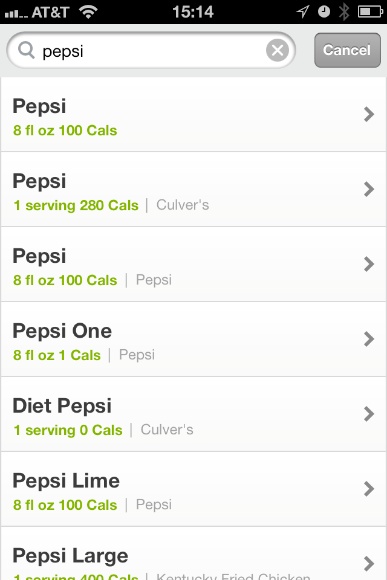
    That is a UX nightmare. That makes me want to avoid this entry screen at all costs.

    I entered what I ate everyday for a week and I regret wasting that time. It was an effort in futility and frustration.

    There are three current shortcomings of the system:

    1. Too many duplicates.
    2. Too much user knowledge required about portions and calories.
    3. **Too few assumptions**.

    Why not just simplify the screen and instead respond to me wanting to enter “Pepsi” as an item by saying the following:

    How big?

    – Small Cup
    – Medium Cup
    – Large Cup
    – XL Cup
    – Can
    – Standard Bottle

    Pepsi’s calories are a knowable quantity. You can estimate the rest of the sizes and be close enough — we don’t need everything broken down by: Taco Time Medium Cup, 8fl oz, 2 cups, Large KFC Cup, Mexican sub-full-sized-Cancun-special bottle. That’s just confusing for the user and will encourage them to not use this functionality.

    Adding what you ate should be fun in the best case scenario and fluid in the worst case.

    Strip out the shit and take some guesses. A bad guess is infinitely more useable than no input. We must embrace the inaccuracy of such a system.

    Further, what if I eat a home cooked bowl of chili?

    How do I input that? I need to guess the serving size and calories? I don’t even know where to start with such a guess. The Fitbit app lists a slew of “chili” options, which only confuses me more. None of these were my wife’s chili recipe — nor would I expect that they would be. ((I am pretty sure she makes it up every time. Still delicious.))

    Just let me enter “chili w/ cheese, 1 bowl”. From there you guess at the rest — I can assure you that your guess will be far more accurate than mine.

    That’s step one and it is a necessary one.

    Step two is eliminating a stupid little sensor that I must carry with me while adding in more useful sensors.

    Imagine this: you place a small film sensor under the lining of your shoes (these sensors would ideally be cheap enough that you get a few so as to keep them in more than one pair of shoes).

    More sensing activity is gained from your phone/ watch. (In other words: things you already have on your person.)

    There is an additional sleep sensor and it’s all built in to your pillow or a pad underneath your sheet.

    All of this syncs with your phone constantly — with no user input and no need to every worry about carrying additional items.

    That’s how you make a useful system.

    The pad in your shoes detects two things:

    1. Weight
    2. Weight distribution

    Using the weight sensor everything knows how much you actually weigh and if you are carrying additional weight with you (in other words is has a baseline for your weight). This will give a more accurate sense of calorie burn when you are carrying a computer bag and other items and a recommended activity level.

    These weight sensors could also be a better way of counting a step, as a step would theoretically reduce the weight on that foot. Coupled with the GPS sensor talked about later this could give very precise measures of distance walked with a low false-positive rate. Likewise it would stand to reason that when running the pressure hitting each foot would be different in such a way that he software could determine you are running and adjust calorie burn accordingly.

    The second shoe sensor would be able to help with posture problems that likely plague many people. This is done much in the same way that the Wii Fit module detects these things. For instance I stand all day and it would be really nice to know if I have good posture, or if I should work on something. Perhaps I stand on the balls of my feet too much — a weight sensor would know this.

    The phone/watch sensors would track:

    1. Pedometer
    2. Altitude
    3. Distance
    4. GPS ((Yeah, battery life. This is make believesy.))

    What we want to know is just how active we are and what we *should* change. I want to add in the GPS portion so that we can disregard data gained while traveling on major highways (it is not likely we are walking down them). It would also be coupled with the movement tracking to see if a person is actually moving about, as opposed to shaking a leg. This would give a better idea of actual calories burned.

    Now that we have most of what we need to track down, I want to look at how we use that data. As I see it a good device needs to do a few things:

    1. Encourage me to be more healthy.
    2. Show me how **and** where to be more healthy.
    3. Explain what I am doing right.
    4. Explain what I am doing wrong.

    This is where the Fitbit falls on its face.

    Please do not confuse my saying the data needs to be useable as my saying that the data should be infographic in nature — that’s not what I want. Instead the data must be understandable without prerequisite knowledge and instantly understandable to every user. Such a device shouldn’t be scaring off users because they can’t understand what the device is telling them.

    Telling me that I burned 2400, of 2560 calories consumed is nice — but what should I do with that? Is that good? Is that bad?

    What would be better is saying something more like: You maintained your weight today, loosing weight at today’s activity level would have been as simple as not drinking that Coke at lunch.

    This may sound offensive to some, over stepping to others, but it is hard to deny the helpfulness of such a response. More importantly that information is incredibly actionable. It encourages the user with the knowledge that they are on the right track and gives them something tangible that they can act on: drinking one less Coke.

    That seems pretty simple to implement. Further such a device should be willing to recommend things when a users asks. If I get home from work and want to know if I was active enough during the day and the software says I wasn’t — why not then say:

    – “You still have some energy to burn, may I suggest a 20 minute walk around your block?”
    – “Maybe walk the dog to walk off today’s stresses.”

    That is helpful.

    Perhaps the user can even ask what they should eat:

    – “Given your consumption today snacking on a Clif Bar would be great about now.”
    – “You had a light day today, perhaps just a salad for dinner?”

    Those in the proper mindset would thrive with such an intimate and personal tool — likely you are in this mindset if you are willing to buy such a system. This is something that is locked away in a computer that you control instead of in the, perhaps, judgmental eyes of a trainer or nutritionist.

    Most importantly the information is clear and actionable. A chart that says you have walked 2,467 steps out of your 5,000 step goal doesn’t tell you much. But telling a user that they should go walk around for 30 minutes *is* actionable — and something that is far less daunting because we know what 30 minutes of walking is like.

    Is a user more likely to try and hit a goal of 5,000 steps if they see that are only halfway there, or are they more likely to accept that they need to walk for 30 minutes? How long does it take to walk 2,500 steps? I don’t know and I doubt most people know.

    ### The Goal

    As you can see I think that a device that is truly useable is one that helps the user make decisions driven from data by recommending actions. Not one that helps provide the user with data.

    Data is nice and fun to look at, but many users can’t quantify and translate that data into actionable information. A consumer device needs to be designed to be used and understood by any user.

  • Quote of the Day: Matt Gemmell

    “Simplicity is a powerful thing, if you can find it.”
  • Show Me the Money

    A wise Chinese company secured the rights to the ‘iPad’ name trademarks long before Apple released the iPad. Apple fought them in court and lost. The entire saga seems like a Chinese company saying to Apple: “Show me the money!” ((I immediately regret typing this.))

    We’ll see.

  • The National Defense Authorization Act Is the Greatest Threat to Civil Liberties Americans Face

    E.D. Kain for Forbes:
    >If Obama does one thing for the remainder of his presidency let it be a veto of the National Defense Authorization Act – a law recently passed by the Senate currently which would place domestic terror investigations and interrogations into the hands of the military and which would open the door for trial-free, indefinite detention of anyone, including American citizens, so long as the government calls them terrorists.

    I particularly like how [Wired’s Spencer Ackerman puts it](http://www.wired.com/dangerroom/2011/12/senate-military-detention/):

    >Here’s the best thing that can be said about the new detention powers the Senate has tucked into next year’s defense bill: They don’t force the military to detain American citizens indefinitely without a trial. They just let the military do that.

    This is not a good thing. [Obama is poised to veto this](http://loyalopposition.blogs.nytimes.com/2011/11/30/president-obama-veto-the-defense-authorization-act/), but we should still be loud about wanting it vetoed.

    [via My Wife]
  • Bloggers Are Journalists in Washington State

    Just an FYI to Washington State bloggers. From the sounds of it we would be protected by shield laws.

  • Oregon Blogger, Isn’t a Journalist, Concludes U.S. Court

    Curtis Cartier:
    >A U.S. District Court judge in Portland [Oregon] has drawn a line in the sand between “journalist” and “blogger.” And for Crystal Cox, a woman on the latter end of that comparison, the distinction has cost her $2.5 million.

    There are two things to point out:

    1. She represented herself and I see that as a big mistake.
    2. The case is for defamation where she claims that she has a source that she will not reveal.

    What it comes down to is that she represented her claims as factual (according to the ruling) and would not reveal the source to prove that the claims were indeed factual. I wouldn’t reveal my source either, but I would certainly hire an attorney — or two.

  • Quote of the Day: John Appleby

    “First, Founder and former co-editor Michael Arrington sold out to AOL then whined about their involvement. What amazes me here is first, his naivety, and second his desire for self-importance.”
  • EU Urges US to Bolster Data Protection Practices Newspaper

    Slobodan Lekic for the AP:
    >The EU wants the United States to strengthen data protection practices in order to create a uniform “privacy landscape” on both sides of the Atlantic, a top official said Tuesday.

    >Internet companies in Europe are now offering cloud computing services whose selling point is that they shelter users from the U.S. Patriot Act, European Union Justice Commissioner Viviane Reding noted. The anti-terrorism law has been widely criticized by civil libertarians.

    I hadn’t thought about this much before, but I can see how it would make a non-US resident/user/citizen uneasy using a service like Dropbox.

  • Determine Which Base Station You’re Connected to on a Bridged Network

    A good tip that will come in handy for me.

    I’d also like to note that you can grab the BSSID by OPT-Clicking the WiFi status in the menubar. But you already know that.

  • The Arctic Butterfly

    About a month and a half ago I noticed that there was visible dust on most the images that I was shooting with my aging Canon 5D. ((I saying aging because the camera is circa 2003. I do not saying aging because the camera is not up to today’s standards. I still very much love this camera.)) As days past I noticed that the problem was actually very pronounced.

    I removed the lens and flipped the mirror up. Using a [Rocket Blower](http://www.amazon.com/gp/product/B0013J0502/ref=as_li_qf_sp_asin_tl?ie=UTF8&tag=brooksreview-20&linkCode=as2&camp=1789&creative=9325&creativeASIN=B0013J0502) I blew the sensor as clean as I could and tried again. Now the problem was noticeably worse. I tried several more times to blow it clean, but nothing worked.

    I really didn’t want to clean the sensor myself. I knew that it was a fragile piece of the camera — I just wanted someone else to clean it.

    A few people on Twitter suggested that I give [Sensor Swabs](http://www.photosol.com/store/pc/viewCategories.asp?idCategory=4) a go. I was told they were easy to use. I promptly wen to Amazon to order, but couldn’t get the cleaning solution component before the weekend (no Prime) and I wanted to work on the cleaning before the weekend.

    I called a local photo store ([Glazer’s](http://www.glazerscamera.com/) they rock) to see if they would clean the sensor. The sales rep said no, but they sold stuff to clean it — and again — it was easy.

    Ok I thought let’s clean it myself. I never make it home in time to get to Glazer’s so I stopped by a local camera store near my office: [Robi’s](http://www.rainierphoto.com/index.html).

    After talking with the two sales associates they did their job and sold me a much more expensive cleaning solution: [The Arctic Butterfly](http://www.visibledust.com/products3.php?pid=707).

    What actually sold me was that the Butterfly is a statically charged brush instead of a swab and solution that you wipe across the sensor. This seemed like less risky solution — so I bought one.

    The two sales associates said that if it didn’t do the trick I should send the camera somewhere to be cleaned — likely whatever would not come off would be really stuck. My fear was that I would have to do just that: send in the camera.

    I used the Arctic Butterfly twice on the camera sensor and then reassembled the camera. Boom it was perfectly clean.

    I’m not saying the sensor was better. I am saying the sensor was dust free — like new.

    The best part is that the Butterfly is completely reusable — unlike the Sensor Swabs. It is also one size fits all and is something you can easily stash in your camera bag.

    I don’t know how the Sensor Swabs work, but I do know that this method worked fantastically for me. I highly recommend that you get one of these for your camera kit if you are a dSLR shooter.

    At some point your sensor will get a speck of dust on it that will annoy the crap out of you.

    #### Buy It Here

    [Buy it from Amazon and I get a small kick back](http://www.amazon.com/gp/product/B004OPWQEA/ref=as_li_qf_sp_asin_tl?ie=UTF8&tag=brooksreview-20&linkCode=as2&camp=1789&creative=9325&creativeASIN=B004OPWQEA).

    ### Note ###

    I also used this to clean out the viewfinder — which is a bit tricky to get apart. After cleaning that my camera now looks completely dust free.

  • Amazon’s Kindle Fire Lets Kids Charge Up a Storm

    Mitch Lipka reporting on the Kindle Fire’s lack of a password prompt before you buy things, especially items from Amazon.com:
    >Others suggest turning off the wireless, which would allow only the use of previously downloaded items, such as books and games. Some forums on Amazon are filled with user after user trying to come up with ways to beat the system with limited success, including turning off the “1-Click” option.

    This was very uncomfortable for me when I was testing the Fire. So much so that once I realized this could happen I set a passcode lock on it that only my wife knows. The Fire is not a kid friendly device in any way — yet because of the price I bet many kids will get them this Christmas.

    Parents should have fun with those bills.

    “The Kindle Fire: a great gift for kids that keeps giving and giving.”

    [via The Beard]