“This issue of the big boys buying up all the talent is built upon the bedrock concept that widespread web services have to be free.”
Month: July 2012
-
Amazon Item of the Week: Seagate GoFlex Desk With Thunderbolt Adapter
I purchased the GoFlex Desk 3TB a while back, when I bought the retina MacBook Pro, but I only went with the USB 3 version. The retina MacBook Pro had some USB 3 hiccups (now resolved for me) and so I never was happy with the USB 3 connection. It was quicker than USB 2, but wasn’t all that impressive. Luckily this drive can be [swapped out for a Thunderbolt connector](http://www.amazon.com/exec/obidos/ASIN/B007IJ7UKE/ref=nosim&tag=brooksreview-20), and I purchased that a few days back.
Thunderbolt is fast, like move 5GB in “less than a minute” fast — and that’s to a spinning platter drive, not an SSD. It’s really expensive to go with Thunderbolt drives right now, which is why I only have one, but it is the future and makes a huge difference given that I keep my iTunes library and photo archives on the drive.
I highly recommend this.
[There’s also a portable version](http://www.amazon.com/exec/obidos/ASIN/B007IJ7T4G/ref=nosim&tag=brooksreview-20), but I haven’t tried it so I can’t speak to its quality.
-
‘Marissa Mayer Has a Secret Weapon’
Steven Levy following up his fantastic post about Mayer last week, adds this fuel to the fire:
>In short, Marissa Mayer has developed a deep connection to over three hundred of most talented tech people in Silicon Valley. They may still be at Google, they may have moved to companies like Facebook or Dropbox, or they may have started their own budding enterprises like Optimizely. But in some sense they are all Marissa’s acolytes.He’s referring to the fact that Mayer ran the coveted APM program — the program that Google created to train future Google leaders. It was her program Levy notes and those then went through the program are “bonded” to Mayer.
What’s interesting in the above quote is that Levy uses the term “Marissa’s acolytes” and not “Google’s acolytes”. Those two words are telling not just for the future of Yahoo, but for the future of Google.
The more I reader about Mayer, the more obvious it is to me just how big of a loss she was for Google — what remains to be seen is if she can translate that value to another company.
-
Automatically Clear the Full Log of Your Mac Download History
[Last week I saw this post on the Mac OS X Hints site](http://hints.macworld.com/article.php?story=20120717025305161), and I was concerned. I had no clue that your Mac kept a full log of your download history. I know I am more paranoid than most, but hey, even Mac OS X Hints recommends clearing it out.
It’s a quick terminal command, but I’ll never remember to do it.
Instead I created this Keyboard Maestro macro to clear it for me:
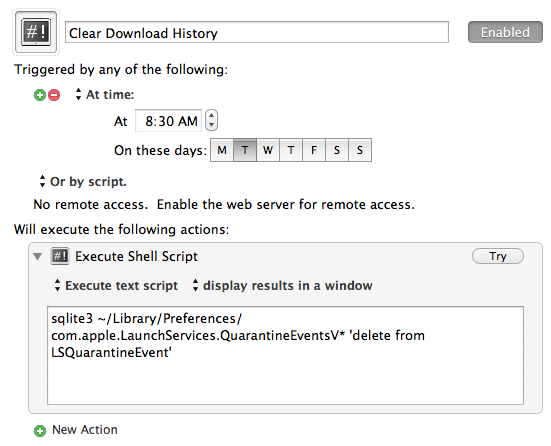
The simplest macro I have I ever created. Now it will always be cleaned out, without me ever having to think about it.
[You can download it here](http://c276381.r81.cf1.rackcdn.com/Clear_Download_History.kmmacros.zip).
-
Squarespace 6
Squarespace recently launched version 6 of their web hosting/CMS system. I have personally used Squarespace for a while now for a personal site and for my company’s website — it’s a fantastic platform on rock solid hosting.
[David Sparks now has MacSparky](http://macsparky.com/) on Squarespace 6, if you want a look at what a good blog looks like on it (including the ability to do proper linked list posts).
If I were just getting started with blogging I would go with Squarespace without hesitation for a few reasons:
1. The themes are stunning.
2. Incredibly easy to build, with tons of later flexibility.
3. Solid hosting, done inexpensively.What I don’t know, and what I would like to know more about, is how easy it is to move from Squarespace to WordPress — if it is as easy as it is to go the other way, then it is a no-brainer to go with Squarespace. (Unless of course you do something crazy like implement a paywall.)
-
‘Append to Dropbox Note With Drafts App’
Speaking of [Drafts](http://itunes.apple.com/us/app/drafts/id502385074) and Hazel, Gabe the Macdrifter as come up with a way to append text to a Dropbox note using Drafts. This looks way more complicated than just buying [Scratch](http://gokarbon.com/scratch/) and using both apps, but hey — pretty neat thing to figure out.
One thing that I wish either Drafts or Scratch would build, is a way for me to set and action that appends text to one specific note file — making it easier to keep a running log/note in a file. This tip is to hacky for my liking, and Scratch requires a lot of taps to do it.
-
‘Skype Won’t Comment on Whether It Can Now Eavesdrop on Conversations’
Ryan Gallagher on the ability of Skype to eavesdrop on conversations:
>In May 2011, Microsoft bought over Skype for $8.5 billion. One month later, in June, Microsoft was granted a patent for “legal intercept” technology designed to be used with VOIP services like Skype to “silently copy communication transmitted via the communication session.” Whether this technology was subsequently integrated into the Skype architecture, it’s impossible to say for sure.Software developers are complaining that a change in the Skype architecture looks to make it more readily available to law enforcement eavesdropping, but no comment from Skype. I take the no comment stance as confirmation that they can do it, but that law enforcement would rather they not say.
Otherwise I think Skype would just market the technology as secure. This seems like a greasy used car salesmen saying: “You’re a terrorist, perfect app for you to use to plan things. What? Oh I can’t comment on that, but you *should* totally use this. Totally.”
Best just to assume — as with most web services — that what you do will be made public one day.
-
‘Core of the Disappointment’
Rian van der Merwe responding to all the misplaced anger on the web about the Google acquisition of Sparrow:
>It’s not about the $15 or less we spent on the apps. It’s not about the team’s well-deserved payout. It’s about the loss of faith in a philosophy that we thought was a sustainable way to ensure a healthy future for independent software development, where most innovation happens.[See also Matt Gemmell’s post about the misplaced anger](http://mattgemmell.com/2012/07/21/entitlement-and-acquisition/).
I completely see where people are coming from, I own the Mac app, but the truth of the matter is that there is nothing you can do to keep a company from being acquired — at least not as a consumer. It doesn’t matter how much you pay, or how many times you pay, if the company gets an offer they like, they are going to take it. Paying doesn’t prevent this.
My argument is that when the service or product is given away free, those that make that “thing” will have to actively seek a way to pay for their life. They will be looking for a way to make money. When you pay for an app the developer has already figured that part out, charge users, and now he just has to figure out how to get the paying users.
I know it’s a very fine distinction, but I don’t think it is fair to be upset at the Sparrow team, or at the fact that you paid for an app. I stand with Gemmell on this one when he says:
>Thanks for that $10. It did indeed keep the lights on between 09:30 and 09:35 this morning. So if you’ve used Sparrow for more than five minutes, I guess we’re even.
Did you get value out of the app? Will you continue to get value out of the app until it stops working on your Mac? Likely yes to both questions. Just because the product is no longer actively developed, doesn’t mean the rational thing to do is delete it off your computer — that’s silly if you still love and want to use the product.
-
Quote of the Day: Matt Gemmell
“You should be cheering these people on, not yelling ‘traitor’ in impotent fury like a jealous, confused teenager.” -
‘Control Your Mac Remotely With Drafts, Hazel & AppleScript’
Clever use of these tools by George Coghill, using Drafts to save text files quickly to Dropbox, Hazel to monitor the files for keywords and then execute AppleScript/Automator actions based on the contents of the file he saves.
I’d go one further and say that you could setup LaunchCenter Pro to add the text in Drafts for you, for your common triggers — thus automating this a bit more. Pretty clever, now I just need to decide what I want my iPhone to be able to tell my Mac.
-
‘The Geography of Gun Deaths’
Richard Florida wondered what factors he could draw statistical correlation with for death by firearms and concludes:
>While the causes of individual acts of mass violence always differ, our analysis shows fatal gun violence is less likely to occur in richer states with more post-industrial knowledge economies, higher levels of college graduates, and tighter gun laws. Factors like drug use, stress levels, and mental illness are much less significant than might be assumed.Very interesting analysis — by no means is it proof of anything, rather just a correlation between two data sets. Still, it is apparent that change is needed — whether or not you believe this data.
-
On Paid Apps Being Acquired, Apps Abandoned
Today we saw [two](http://blog.acrylicapps.com/post/27635101056/our-next-project-facebook) [companies](http://www.theverge.com/2012/7/20/3172222/google-buys-sparrow-mail) get gobbled up, both selling well known and respected paid applications in the Mac space. Both seemingly do a good business. Both acquired for the talent of the employees, not the products they sell — as such the products for both will be gone soon enough.
I wasn’t going to write about this, because neither was particularly interesting, but then a few tweets and emails later and I have been asked to defend a rather popular post of mine: “[Fragility of Free](https://brooksreview.net/2011/03/fragility-free/)”.
In that post I argue that choosing to use free apps is a bad idea, because often free apps will die off because the developer can no longer support the apps. I state (sorry for quoting myself):
>The fragility of free is a catchy term that describes what happens when the free money runs out. Or — perhaps more accurately — when the investors/founders/venture capitalists run out of cash, or patience, or both. Because at some point Twitter and all other companies have to make the move from ‘charity’ to ‘business’ — or, put another way, they have to make the move from spending tons of money to making slightly more money than they spend.
My argument is that nothing can continue to be free forever. At some point you are going to pay for it, by viewing ads, exchanging money, or having to switch to something else because your free thing is gone — dead. Now we see a situation where a paid app is gone and dead — the very thing that I was arguing for — but the truth is a paid app is simply *more* secure than free, certainly not foolproof.
I said:
>This happens with free software and services, sometimes with paid services (but that is far less likely). Sometimes the funding for free just runs out — perhaps it was just someones hobby, a hobby that you depended on — doesn’t matter because it is gone now.
Sparrow is gone now. Perhaps it lives on as part of Google, but Sparrow as we knew it yesterday is effectively dead.
So how do you stop this from happening to another app that you depend on?
[Marco Arment offers a suggestion](http://www.marco.org/2012/07/20/talent-acquisitions):
>If you want to keep the software and services around that you enjoy, do what you can to make their businesses successful enough that it’s more attractive to keep running them than to be hired by a big tech company.
I think the key part here is “more attractive”, it would be easy to say “more lucrative”, but inaccurate. I know far too many people who are willing to be paid less to do something that they enjoy more. Such is the case right here on this site, I took a pay cut to rid my site of ads — I did this willingly and (from a readers perspective) unnecessarily. It is simply more attractive for me to blog without ads, and more attractive for Marco (I assume) to work from home on his own schedule, on a product that he has passion for.
Paid doesn’t solve everything, but free solves next to nothing.
-
Is Kickstarter Selling Dreams?
Felix Salmon has a really smart analysis of Kickstarter, and specifically the psychology behind backing Kickstarter projects. It’s interesting to think about what Salmon is talking about, with regard to why people back things.
Do we back something because was see it as a pre-order? Do we back things because we want to support our friends? Why does this work on the web, when you would have laughed if it came in the mail to us? Are we backing ideas, or are we wanting products?
I am waiting for quite a few Kickstarter projects to actually ship the goods to me, so this last sentiment from Salmon rings close to home:
>But as consumers get wise to those risks, especially if one or two high-profile million-dollar Kickstarter successes end up producing nothing at all, then at that point we’ll realize that the funders weren’t just buying a dream after all. They really thought they were buying a product.
Elevation Dock, Flote Stand (to be fair I am not a backer, I just pre-ordered after it was funded), and a few other smaller projects have yet to ship anything to me. I knew the risks, but it has made me become very picky about what I do back now — and ultimately that hurts Kickstarter and other potential products.
-
The Nexus 7
This is not my first time around the block with a seven inch tablet, I reviewed the original Samsung Galaxy Tab ([here](https://brooksreview.net/2010/11/tab-review/)), I review the Amazon Kindle Fire ([here](https://brooksreview.net/2011/11/kindle-fire-2/)), and now the Google/ASUS Nexus 7 (here ((No, like really *here* — listen you are reading the Nexus 7 review right now, let me get back to it.)) ). I really didn’t want to buy the Nexus 7, but the more I read about it, the more it sounded like this probably would be the best seven inch tablet made to date. It had been a while since I used Android, so off I went.
I kind of knew what to expect from a seven inch tablet, but I was hoping for better hardware and smoother software. Both are things the Nexus 7 delivers on.
### The Short Version
The long and short of it is that the Nexus 7 has impressive hardware, a solid OS, but ultimately doesn’t hold up to the iPad.
Now, I ask that if you disagree with me, that you continue to read the rest of the post. But if all you wanted to know is if you should buy it: not yet.
### The Longer Version
The Nexus 7 is a truly good device. Solid in every aspect. For me, where it falls flat, is in giving me a reason to use it. It’s more awkward to type on than my iPhone or iPad. It’s easier to hold in one hand than the iPad, but not easier than the iPhone.
It awkwardly fits between my iPhone and iPad, and that’s not a good thing.
Let me use a car metaphor for you (because you love it when I do that). Imagine you own three vans: a “normal” 7-8 seat minivan, a 10 passenger van, and a 15 passenger van. Odds are that the two most used vans are the smallest and the largest. The 10 passenger isn’t *that* much larger than the minivan and isn’t *that* much smaller than the 15 passenger van. And so the 10 passenger van only has a 1,000 miles on it after 10 years.
The Nexus 7 *is* the 10 passenger van.
And here’s the thing about the Nexus 7, there isn’t one thing that is so demonstrably wrong about it that I can point to it and say: “haha, iPad wins”. Because truthfully the iPad doesn’t win, but neither does the Nexus 7.
I use tablets in two places: meetings and at home. For meetings the Nexus 7 has pretty much sucked every time for multiple reasons:
– Can’t get the apps I am accustomed to.
– The apps I do find are hideous.
– It’s too small.But really none of that matters because I simply have cut most meetings out of my life, so I rarely have them anyway. The ones I do have, are often short and don’t warrant anything more than my iPhone.
That brings us to the one place I use my tablet more than any other place: home.
At home I use my iPad for the following:
– Writing
– Reading
– Email
– RSS
– Web BrowsingThe Nexus 7 can do all of this, but in my use it can only do two things better than the iPad: reading in bed, and reading with one hand. For every other task the iPad is better, but only marginally so. Text/fonts/typefaces, all look better on the iPad screen. But it’s not just because the iPad screen is a “retina” display, the Nexus 7 and Android choose typefaces I dislike for reading and then render those choices poorly.
There is no better example than Instapaper — which has the same fonts on both devices, shown in the same manner. Instapaper on the iPad just looks far more readable.
So yes, the seven inch tablet is easier to carry around and works better in one hand, BUT…
But my iPhone is *even* easier to carry around and works *even* better in one hand than the Nexus 7. Do you see what I am getting at here?
It’s not that the Nexus 7 stacks up poorly to my iPad, it’s that the Nexus 7 stacks up poorly to my iPhone.
The way I look at this is that I would choose a seven inch tablet over the iPad so that I could have a *more* portable tablet than the iPad. I completely understand why people would want this. So I carried the Nexus 7 with me everywhere I went. I had it tethered to my iPhone and ready to go. I paid for every equivalent app I had on my iPad — including the $10 MLB At Bat app. For the entire first two days I made an effort to do everything on the Nexus 7.
After that I didn’t think about which device I used.
Nine times out of ten, I reached for my iPhone over the Nexus 7. And for those times when I did, specifically, sit down to use a tablet: I grabbed the Nexus 7 and then felt like I was handicapping myself and then reached for the iPad.
And yet [Shawn Blanc thinks this is the area that the Nexus 7 excels at](http://shawnblanc.net/2012/07/the-nexus-7/):
> It seems silly to buy such a capable tablet for the sole purpose of easier couch surfing and extended reading, but to me that is the Nexus 7′s strongest suit.
I wouldn’t fault anyone for owning a Nexus 7, but I will scratch my head at anyone buying one that already has an iPhone and iPad — because I can’t figure out a time when it is better to use than either.