David Heinemeier Hansson is on a roll — his latest post makes a fantastic point:
>We’re breaking down the stranglehold of formality everywhere. No more personal secretaries, memos on official letterhead, meetings that must happen in person. There’s never been less mental mask switching between work and play. We wear the same clothes, use the same technology. It’s a liberation of the mind and it’s the new world order.
Moreover, business cards are less important, as is the idea one needs separate work and personal cell phones. As you can probably tell from my pictures that I use of myself, I still dress rather “professionally,” but what you may not know is that I am my own boss, which means I dress however I want. I have never had a problem with someone’s dress code, and the points that DHH brings up in this article are fantastic.
The idea does seem to correlate with technology companies well; those that are stuck in formality seem to be dying, while those that focus on the work at hand seem to be thriving. Nothing is more stark than the difference between Apple and RIM.
I wish that more people my age dressed well, but I also recognize that *I* am the one that sticks out, not the other way around.
David Heinemeier Hansson on stock valuations and the collapse of Zynga, Groupon, and Facebook:
>So between just these three, some $40 billion has been extracted from the market caps that pension funds and other last-sucker-in-line investors bought into. While, in the process, soured many on the idea of the public markets and enriched investment bankers hawking the toxic stocks. Hey, at least someone got out while the going was good.
Heinemeier Hansson and I very much agree on the stupid methods with which stocks are valued — the method appears solely based on hype. I hadn’t done the math, but I can’t believe how high these stocks were, only to come tumbling back closer to reality.
I know that most stocks are bought by large buyers, but I also wonder how much places like Etrade have to do with this — allowing individuals to buy very small amounts of stock on a whim. I have to think that somehow, the pool of investors has shifted from people eager to look at the numbers, to a group of people that say: “hey, Facebook, yeah everyone uses Facebook.”
I wish it wasn’t that way — hard to keep a company honest when the investors don’t really care to read about what the company is doing behind the scenes.
Andrew Munsell has a pretty funny tale of trying to enter a captcha: those squiggly word-things on signup pages. They have become more and more difficult to solve, because as Munsell notes, computers are getting better and better at being more human with regard to solving these puzzles.
Captchas might be one of the more user-hostile things on the web, but we need them to stop SPAM and AHH, we need them!
The thing is (at the risk of sounding like a broken record) if you just charge every user for a sign up, then you never need to worry about captchas. Because even if a SPAM bot signs up, well, you get paid, and that’s not a sustainable model for spammers.
As most saw over the weekend, [Apple released three new ads that focus on their ‘genius’ support team](http://www.apple.com/mac/videos/#tv-ads-laborday). The ads show helpless users of Macs, all wanting to do something, and needing help.
There’s been a lot of debate, and over the weekend about these ads, but I never saw the ads, so I just knew about them from what I saw in Twitter and my RSS feed. The reaction was a bunch of less than happy Mac users:
>In the effort to show that the Genius is the most helpful guy in the world, Apple has created customers who, shall we say, are on the dim side. In past ads, Apple has shown “ordinary people doing extraordinary things,” simply because Apple products are so easy to use. Now we have thick people who want to be better, but need a Genius to help. Not exactly flattering.
Lastly, [Gruber’s comments](http://daringfireball.net/linked/2012/07/30/segall) on Segall’s post really made me go watch the ads:
>The idea is these on-screen Mac users in need of help are supposed to make the viewer at home feel like, “Hey, I’m smarter than that guy.”
Of the three ads, ‘Mayday’ is the only one I care for. I think ‘Labor Day’ is kind of funny, but doesn’t do much but show off the iPhoto products you can order. ‘Basically’ is, basically, a warning that you should go to the Apple Store to buy your Apple goods — because otherwise you don’t *actually* get a Mac.
But I want to talk about ‘Mayday’ because I think it is a great ad — an ad that I can relate to first hand as a non-dumb-Mac user. Most of the ‘Mayday’ ad is just so-so, but it is the ending that I think is great, subtle, but great. At the end the flight attendant comes to get the Genius to help with a Keynote presentation — after the Genius just finished helping with an iMovie project — the Genius springs to action, but so does the Mac user he was just helping.
Let that sink in for a moment.
The guy that was so “helpless” before is filled with confidence and proclaims: “Let’s do this” — gets up with the Genius to go help *another* Mac user.
So Apple just subtly told all would-be Mac users that:
– If you come to the Apple store for help, we *will* help you;
– You won’t need to come back for more help;
– You can now help *others* with Mac problems.
This is something I have seen time and time again, once you show a new Mac user how to do something — they find it so easy to do again, and now they tend to be more than willing to actively help *other* Mac users. It used to be a game — dodging being a Windows tech support friend — but with Macs I have found that most users are all too happy to help other users.
To me, that *is* what this Apple ad is showing — and Apple is just giving new users an FYI that they can find Apple Geniuses in their stores.
I don’t think the ads are bad at all, they just aren’t geared towards anyone reading this site.
This ad tells new users that there is great help available, help that will teach you — not lecture you. That Mac users band together. Some say these ads aren’t great, but I think ‘Mayday’ is pretty great — it’s just telling a story we aren’t used to seeing Apple tell.
It’s almost to the point now where I don’t expect any new weather apps to be worth even thinking about, but I am glad I gave [S°lar](http://thisissolar.com) a try after [Jon Mitchell](http://twitter.com/ablaze/status/228353678095024128) pointed it out to me on Twitter. Let’s get something clear first, it’s not an ideal weather app for me, but it is really interesting and worth talking a bit about — because it does weather a bit differently.
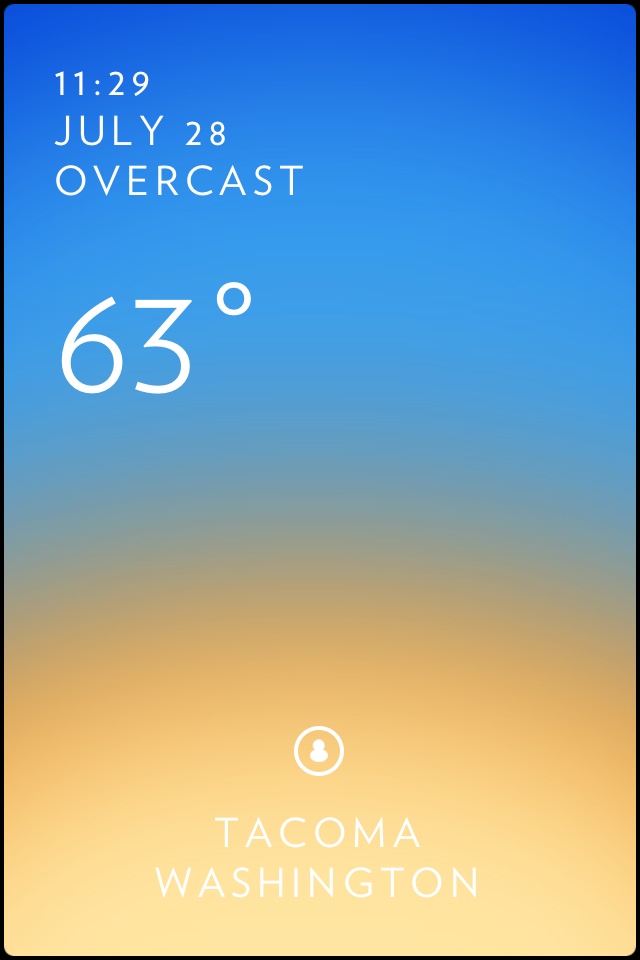
The first thing that immediately struck me about S°lar is how much I love the way the weather data (just temp and conditions) is displayed:
Default S°lar view.
That’s a pretty minimal set of data, but it does two things really nicely:
1. Shows the temp in an easy glance able manner.
2. Shows a background that isn’t some silly image of the weather, or static thing — instead it gives your a hint of the temp and an indication of the weather (it drips from the top if raining, or shows colors to indicate clouds or blue sky — in this case it is warmish with a blue sky).
S°lar isn’t like Dark Sky, but it’s better than most any other app for giving you an idea of the weather in a traditional manner.
If that was all this app did, I would likely keep it around — but as it turned out this was only scratching the surface.
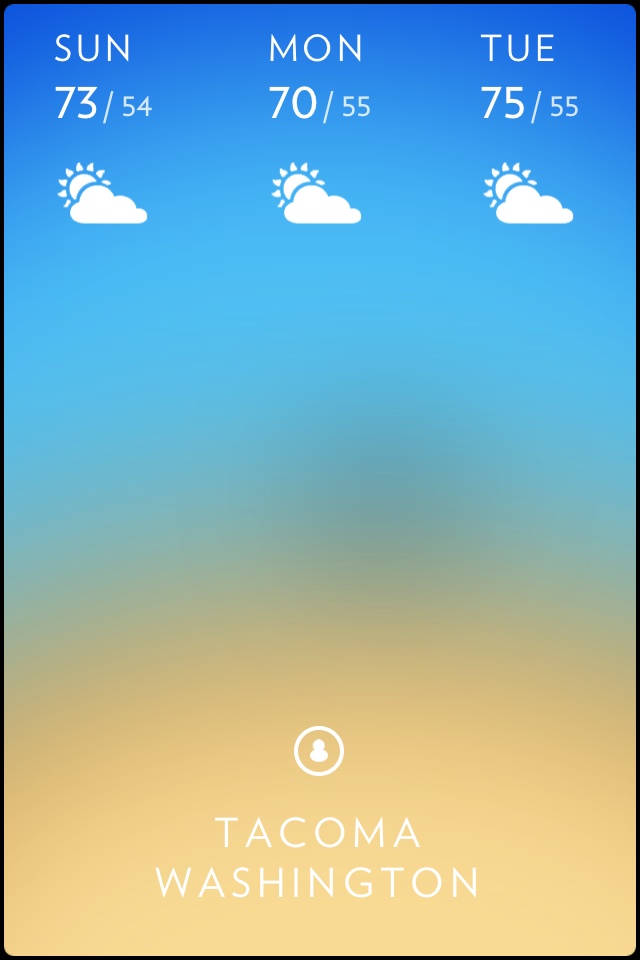
Pull down, and you get the three day forecast:
Drag down to get this forecast.
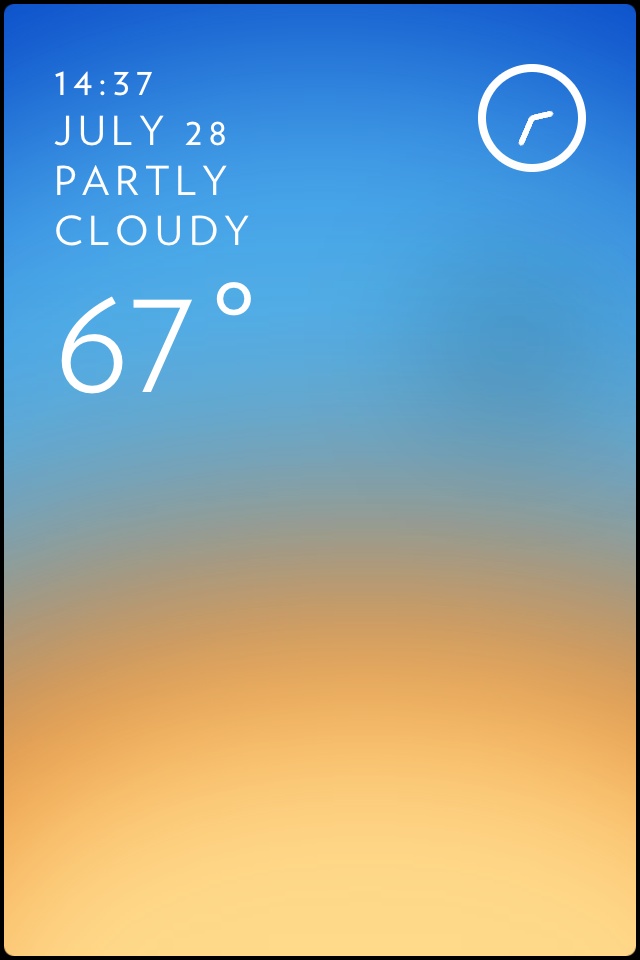
Slide your finger from the bottom up, you can see the weather info change based on the hourly forecast — this is pretty neat:
The hourly forecast, shown by sliding your finger from the bottom up.
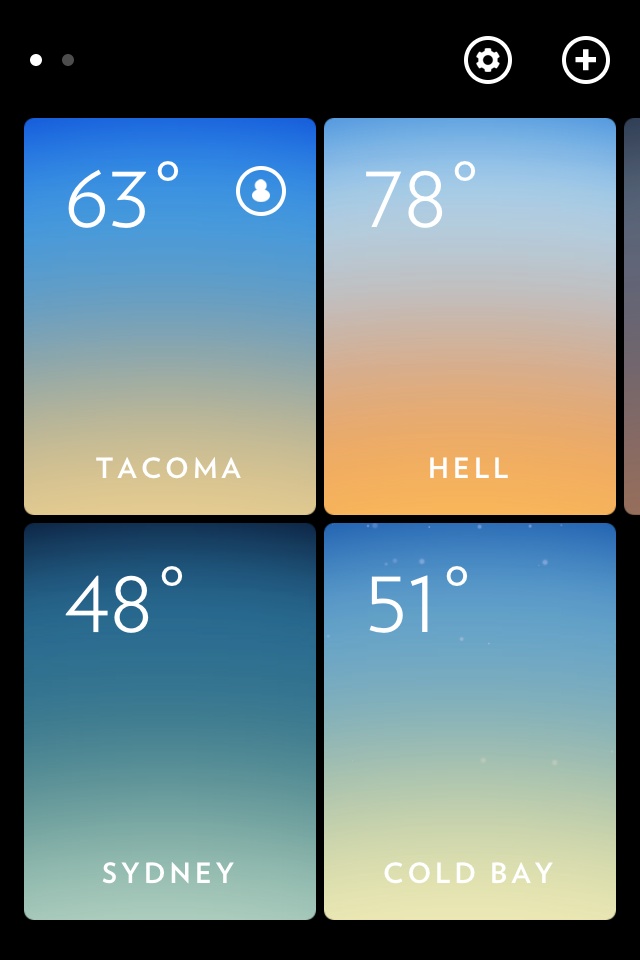
Double tap to pull back and see all of your locations:
All my locations.
What I love about this is that the view is actually useful, and not just a switcher (you can swipe from side to side to change locations without pulling back to this view). Many weather apps make you select a location before they show you any data, so I love that this app gives you useful data before you even dive into a location. It just works “out of the box”.
The settings screen is equally simple and well designed:
The settings screen.
Ok so none of those screens are unique — because while beautiful, they certainly aren’t revolutionary.
Here’s the reason that I like this app though: go back and look at those swipes and taps I mentioned — each one can be done with only your thumb and iPhone in one hand. That’s not something I can say for many apps.
### Why Ben, Why
I really like this app, the UI and interface is really nice and really invisible — S°lar is the [Clear](http://www.realmacsoftware.com/clear/) of weather apps — and I really like Clear.
Overall I don’t know how useful S°lar will be to me (I love Clear, but I don’t use it anymore), but I do think that S°lar is a very solid weather app, and a perfect convince-someone-they-want-an-iPhone-app.
[Get it from the App Store for $0.99.](http://itunes.apple.com/us/app/solar-weather/id542875991?mt=8)
Stacey Higginbotham:
>Granted, that profit might not be as large as the broadband profits that Comcast or AT&T currently enjoy, but it’s a profit.
Woah, wait — Google is expecting to actually profit from Google Fiber. That *is* impressive, I had assumed that they were doing this as a break-even or small-loss business entity to drive ad viewers, but if they can actually turn a small profit from it, well that is impressive.
Hopefully, buy making it profitable, they will roll it out in more areas. If for no other reason that to put pressure on Comcast. ((Fucking Comcast.))
Interesting post from Ryan Whitwam, arguing that Google as an ISP is actually a very good thing. I’m still skeptical, but Whitwam makes an excellent point with this:
>For Google’s business to remain strong, it needs us to use the services and feed in more data. However, Google knows full well that if it loses the public’s trust, its business goes down the tubes. It simply cannot afford to do anything untoward as an ISP unless it wants to risk its real source of income: our data.
He’s right that it *is* in Google’s best interest to “not be evil” with regards to their ISP service, but I also think there is a secondary problem with this argument. What I, and other geeks, see as “evil” — most users just see as no big deal. If you told my mom she could have free internet, but Google gets more data about her, she wouldn’t even hear the words past “free internet”.
That’s the reality. I think Google will try to be a good, respectful ISP, but I think they also know that they don’t always *have* to be.
I have changed the weekly review from a post on the site, to an email newsletter. First one goes out later today, so hit this link and subscribe. Or subscribe [anytime here](https://brooksreview.net/category/weekly-review/).
Remember that video a while back, the one where you could swipe along the keyboard on an iPad to select text — everyone drooled over it, and it was made for jailbroken devices? Yeah, remember that?
[Version 3.2 of WriteUp now has that](http://writeup.prasannag.com/2012/07/26/writeup-supports-swipe-selection/). Pretty neat stuff.
I don’t use WriteUp regularly, but I just checked out this feature and now I want it for the rest of iOS. It works and it works really well. I don’t know the ramifications of it if you are a fast typist — that is, will it move the cursor accidentally because you type fast? I don’t know, but just moving around the cursor like this is magical.
If you are an iOS dev that has an app where users write chunks of text, you really need to consider this addition.
>When you think about it, the apps that don’t get along with sandboxing are doing things I now realize I don’t want my apps doing. TextExpander for example works by being a system-wide keylogger. Apps that can use stuff from your iPhoto library do so by just reading it, with or without permission.
Short post, but I think it is clear that sand boxing and the like is a fine restriction for many apps. It’s the edge cases that do odd stuff that really cause problems.
[Marco Arment follows up on his post](http://www.marco.org/2012/07/26/not-just-geeks) [from earlier](https://brooksreview.net/2012/07/mas-marco/) about the Mac App Store, clarifying ((I don’t think this is a direct response to my post.)) :
>Geeks aren’t the only people who have the problems that these apps solve, and we’re not the only people who can figure out how to find, buy, and use these tools. Give the rest of the computer-owning world some credit.
>This isn’t about a few geeks being inconvenienced. It’s about a very large number of Mac users, far beyond geeks, being discouraged from buying (or being unable to buy) the software they need from the Mac App Store, and why that’s not in Apple’s best long-term interests.
Again, I disagree. Arment undoubtedly knows more about the intricacies of Apple’s App Store, but I simply don’t buy this argument. In my last post I misconstrued Arment’s post as him giving up on the Mac App Store, and I also pegged this as a “geek” problem. While I am wrong about those two issues, I still don’t believe there is a risk of the Mac App Store becoming a wasteland of any sort.
Arment is right about non-geeks being able to easily find and purchase apps outside of the Mac App Store — it’s how software has traditionally been purchased, well once software started being sold as digital downloads — but here I really think Arment and I disagree is on his last sentence that I quoted above, again:
>It’s about a very large number of Mac users, far beyond geeks, being discouraged from buying (or being unable to buy) the software they need from the Mac App Store, and why that’s not in Apple’s best long-term interests.
I don’t disagree with the notion that there are problems with the Mac App Store, but how exactly are users being “discouraged from buying” apps in the Mac App Store? I am guessing that this comment is related to Arment’s earlier statement:
>My argument was more nuanced: many previously-acceptable apps have been effectively kicked out of the App Store because they’re incompatible with the current implementation of sandboxing, and this hurts the *customers* of those apps enough that *they* will lose confidence in buying nontrivial software from the Store in the future.
To clarify this in my own head, I do a bit of role playing. Let’s say there’s an app I love called iBanana. iBanana uses some hack-y stuff that Apple hates and that prevents it from being sandboxed, so they are forced out of the app store. But I bought iBanana in the app store, now I don’t get new updates and am forced to (likely) re-buy the app.
This is likely the most discouragement that I will see from buying other apps in the app store (I am assuming no developer is ridiculous enough to petition customers to boycott the Mac App Store).
I am guessing the thinking is that when I go to buy another app, I stop and remember the iBanana fiasco, go to the developers website and buy from there — thus leaving crappy apps in the store. That makes sense, but I have two issues with this thinking that — in my mind — make it a trivial issue.
### Not a Recurring Event
The big problem is that Apple changed their mind about what was allowed in the app store, they forced out apps because they wanted/needed/whatever reason to implement sandboxing. Such a change is not likely to occur again, so while apps had to recently leave the store — it’s not *likely* to be a regular occurrence for Mac App Store customers.
It sucks this time around and *current* Mac App Store customers might have a bad taste in their mouths, but all will be forgotten in time — assuming Apple doesn’t pull crap like this on a regular basis, or really, ever again.
That is, I don’t expect us to be regularly talking about apps that have been “forced out” of the app store by rule changes.
I do, however, agree that if Apple continues down such a path of constant rule changing and forcing out apps — that at that point geeks should begin petitioning users not to buy from the Mac App Store. But I don’t think that is where we are now. What we are seeing right now is the side effect of launching a platform before it should be, and moving that platform to where Apple wants it.
### Mac OS X Petitions You to Use the Mac App Store
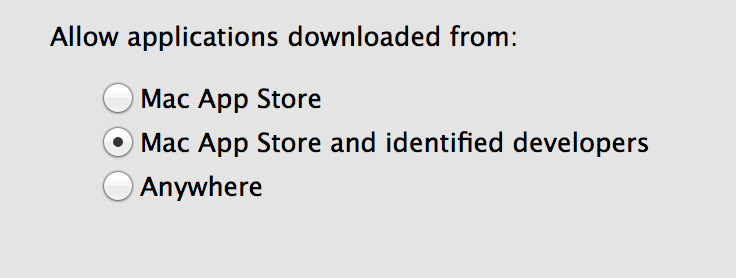
System Preference panel for app warnings.
With Mountain Lion, Apple set the OS to *warn* users if the app is *not* from a trusted developer or the Mac App Store. That’s the default setting, with users having to navigate to System Preferences to change this.
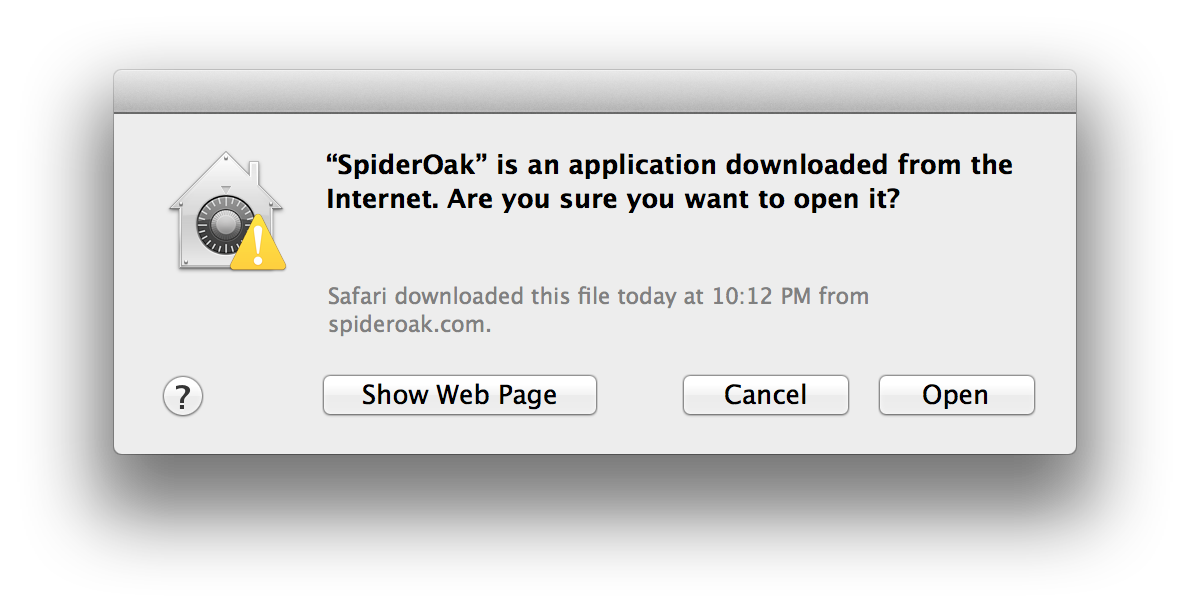
So whenever a user opts out of the app store, downloads an app from an “unknown” developer they see this warning:
The warning dialog for SpiderOak — a “untrusted” Mac app.
That dialog is Apple’s way of telling all of its users — by default — that they should be wary about installing such apps, when most of the time they really don’t need to be wary. I can see why Apple did this, and it’s likely not primarily to promote the Mac App Store, but to combat malware and such.
At the same time, it hurts developers who aren’t in the Mac App Store because now a user has to pause and think: “do I trust this person?” Ouch. Then again, installing software from the web has always been a bit like the wild west, so maybe one question won’t hurt. But I have to think that it does stop today’s youth in their tracks — you know those that don’t remember scanning their PC every hour and finding new viruses on it.
### Going Forward
The reality is that Apple’s Mac App Store, as devised, (as a clone of the iOS App Store) in OS X is a rather big mess. However if I have to choose as to whether this dies the slow death of Ping, or is constantly pushed until it’s the default, well I think the latter is the likely case and I don’t see that as being a very big leap from where Apple currently is.
Arment is right, it’s not *just* a “geek problem” as I inappropriately labeled it. It is an Apple problem, but it’s also a developer’s problem. Here’s the thing though, I don’t see Apple giving in on this and I certainly don’t see Mac developers “jumping ship” over this.
That leaves developers with the issue of having to get customers to trust them enough to run their software, even though their OS is telling them to be wary.
>And the Mac App Store, in its current incarnation, just isn’t built for us. It’s built for people looking for casual apps and games. (Sorry, there’s one more category: Apple’s own apps, which don’t have to play by Apple’s rules.)
I don’t see that as being the case either, because if 1Password can find a way to stay in the store and Adobe can ship Lightroom to it I think it stands to reason that solid, powerful apps can and will always be a part of the Mac App Store.
[Marco Arment is done with the Mac App Store, and worries](http://www.marco.org/2012/07/26/mac-app-store-future):
>The Mac App Store is in significant danger of becoming an irrelevant, low-traffic flea market where buyers rarely venture for serious purchases.
His arguments are not new and he certainly is not alone, but I think he is wrong.
Arment feels burned by the fact that he embraced the Mac App Store heavily, only to later see apps he purchased leave the Mac App Store — thus offering him no more updates — because of sandboxing rules (among other things). I don’t disagree that some of Apple’s rules are heavy handed and over reaching for geeky Mac users, but for the general Mac user, I think Apple has done a nice job creating a trusted place to buy Mac apps.
Some of the best apps will never make it to the Mac App Store, apps like:
If any of those do make it, they will likely be crippled. With the exception of Dropbox, every single app on that list is an app that I have tried to get my wife to use, and failed to do. Because she’s not a geek. And non-geeks tend not to be as effected by the apps leaving the Mac App Store as their geek counterparts are.
It *is* a big deal that some apps are leaving, it’s important, but let’s not kid ourselves here — it’s pretty much only important to geeks.
I’ve managed to survive on iOS without these geeky apps — where TextExpander exists, but isn’t as useful.
Additionally, if you look at the “quality” of the top-grossing apps in the iOS app store, you can see that they aren’t *great* apps in the same way that those listed above are. They are inexpensive or free games with paid currency you have to buy to use in the game. Apple doesn’t seem to care, because 30% is 30% and users like those apps.
As geeks we don’t want to see App Stores overrun with crap, but crap sells.
As for the worry of ‘low-traffic’, well Apple addressed that yesterday — ensuring that the Mac App Store will forever have high traffic: they made the Mac App Store the only place to get your OS updates for OS X, putting a notice in the Notification Center when you need to check for updates. Every Mac user will have to go into the Mac App Store from time to time, and I am certain many will click over to see what apps are featured. I can’t think of a better way to assure an app store of continued traffic.
As a geek, I’m right there with Marco, but I just don’t think it matters to Apple or non-geeks.