> More than the number of users, Twitter’s future rests on the amount of engagement it can show those users having with content from advertisers — and the data it can provide to those advertisers and partners such as TV networks.
I don’t like Twitter, but I think it is a stronger business than Facebook. That said, I don’t see how their business (the part that makes money, ads) is sustainable while they allow third party services to use the API. The most “engaged” users are the ones actively trying to avoid ads. That’s the biggest threat to Twitter making money.
> In an official public forecast discussion, the Anchorage National Weather Service office – whose employees are working without knowledge of when they will be paid during the ongoing Federal shutdown – encoded this secret message: “Please pay us.”
> You can pretend all you want that ads won’t be intrusive, annoying or awful, but they will be. They’re ads. You’re putting unwanted crap into a feed of photos from people I hand-selected to follow.
Did I mention that [Favd launched][2], and that it’s great? [I think I did][3].
Ivan Vicevic:
> Dennis M. Hope is, at first glance, just a normal guy. But what makes him unique is that he’s the President of the Galactic Government, and the owner of the Moon, Mars, Venus, Mercury, and Io (one of Jupiter’s moons). He makes his living selling acres on the Moon and on Mars.
His clients include former Presidents — as in U.S. Presidents.
With real estate being my day job, I regularly get a lot of paper files and these files typically end up crumpled at the bottom of my bag unless I immediately do something with them. Therefore I try to scan things with my iPhone as I get them. I use ABBY Business Card reader for all business cards, and had been using JotNot Pro for all other documents.
JotNot works really well, and quickly. However, as you may know, Smile Software recently launched [PDFpen Scan+][1] — a new iOS app for scanning. The biggest feature it offers is the ability to do OCR conversion on your iOS device. That sounded killer, so I immediately bought the app.
In my testing, Smile’s Scan+ is *mostly* better than JotNot. The biggest point in JotNot’s favor is how cropping is handled. With JotNot the auto-edge-detection is much better. Even more in JotNot’s favor is that manually adjusting the corners brings up a nice magnifying glass making things easy and fast. With Smile’s Scan+ I would recommend not even wasting your time trying to adjust the edges — it’s that difficult. This is the only point not in Scan+’s favor.
As for the final file output? Smile wins hands down. Scan+ leaves you with a better PDF image and accurate OCR of the document. There’s little to no good reason to recommend anything but Scan+ right now for iOS scanning — great app.
For those that want to see a comparison, I took a printed page and scanned the page in each app — adjusting the image as best I could within each app. Here’s the result from [JotNot Pro][2], and here’s the result from [PDFpen Scan+][3]. It’s important to note that Scan+ has a much larger file size, but it also looks better and has OCR (OCR is not required).
Now that you can see the massive difference I suspect you want the link to buy Scan+. [PDFpen Scan+ is $4.99 in the App Store][4].
> And thus, a digit-collection device attached to a lone purse snatcher’s telephone set the legal precedent used, three decades later, to justify the bulk collection of the same information on every single American.
Nice bit of reporting here by Kravets in looking at how the legal basis for NSA spying was formed off of a case that likely doesn’t have the implications that current courts are purporting it to have.
If you read the article, what you find is that FISC took a Supreme Court decision, which upheld the sentence of man that was specifically being targeted, and turned that into the legal basis for collecting everything on everyone (more or less). ((I see no reason for me to be more accurate than “more or less” if the NSA and FISC are going to play fast and loose with the Constitution.))
> After more than a year of work, 1Password 4 for Mac in the [Mac App Store][2] and will be available here in [our web store][3] in the next day or two!
I haven’t seen many people touch on this, but that last bit is suspicious to me. Why wait to release the version on *your own* site?
With an app like 1Password, I’d recommend you get it *outside* of the Mac App Store, not *from* the Mac App Store. You never know what features you may not be able to use in the future because of App Store restrictions — I wouldn’t buy it from the Mac App Store at all. I *will* be buying it from Agile Bits directly as soon as I can, but why make me wait?
I don’t get it.
UPDATE: Oddly enough, and without reason, 1Password 4 is now available on the website for purchase and download. Odd stuff. I bought it, installed it, and it is working.
As of today, Kyle and I have decided to make Begin free. We are keeping the in-app purchase to support the app.
You can read more on the announcement post, but the biggest reason we made it free was to garner enough revenue to actively develop the app for the long term.
[Go check it out](https://itunes.apple.com/us/app/begin-your-daily-todo-list/id687455038?ls=1&mt=8), no reason not to now.
[CIRONLINE.ORG has a fantastic report on how easy it is to get personal data on people][1]. This is all the reason anyone should need for getting out of Google and other big email providers:
> Even if an investigator faces some hurdles with your inbox, such as Google insisting on a warrant, email is not entirely protected. With a court order that doesn’t reach probable cause, Google will give up your name, IP address, the dates and times you’re signing in and out, and with whom you’re exchanging emails.
Well worth the read of the entire report, but none of the report is good news for privacy advocates.
[Fraser Speirs on LA students “hacking” their iPads][1]:
> Imagine you’re 14 and, one summer, you hear on the news that you’re getting iPads when you go back to school. You go back, are handed an iPad, and then they tell you that you can’t browse the web, can’t use it for personal projects and all you can do with it is look at Pearson apps.
> Total heartbreak.
Speirs makes some fantastic points backed up by his experiences in the deployment at his school. I still wonder how anybody thought a fully locked down iPad was worth, well, buying an iPad for?
[Mike Elgan making a fantastic point about FaceTime][1]:
> From the user’s perspective, FaceTime should work like iMessage. If Apple did it right, you’d be able to simply use it to make all your calls — video and audio. If the person you’re calling has FaceTime, great! If they don’t, that should be when the phone fails over to either the regular carrier’s phone system or another VoIP alternative. Or, it would connect to the other user’s FaceTime-compatible app.
If you haven’t had a chance to make a FaceTime audio call, do it now. It is actually amazingly better than a “normal” phone call. The depth and clarity of the audio is astounding. However FaceTime audio is buggy as shit. There’s been several occasions where one or more of these things have happened:
– Call unable to connect after reading connecting for a minute.
– Call dropped because I got another call.
– Call dropped because I got an iMessage.
– Repeatedly calling and not getting an answer, then cell call works.
It’s about a 49% success rate for me. I have my wife setup on my Favorites to default to FaceTime audio, we both love it, but it is more of a hassle. I wonder why FaceTime wasn’t built like iMessage whereby everything defaults to FaceTime and falls back to cell calls if FaceTime cannot work, I’d love that.
*(I also wonder if the dropped call problem is a Verizon issue, or AT&T suffers this as well.)*
Wikipedia entry on Australia’s ‘double dissolution’ provision:
> The double dissolution provision comes into play if the Senate and House twice fail to agree on a piece of legislation (in section 57 called “a proposed law”, and commonly referred to as a “trigger”). The government may use this trigger (or any number of triggers) to recommend the Governor-General dissolve the House and the entire Senate – pursuant to section 57 of the Constitution – and issue writs for an election in which every seat in the Parliament is contested.
This would be great to have in the United States, and probably would mean a lot more shit would get done.
Just posted the first in a series of posts about Begin, and the decisions that lead to the shipping version of the app. The first post focuses on why Begin is only today and tomorrow. (Of course, it also includes some early screenshots.)
[Bruce Schneier summing up the latest bullshit from the NSA](https://www.schneier.com/blog/archives/2013/10/nsa_storing_int.html):
> This is getting silly. General Alexander just lied about this to Congress last week. The old NSA tactic of hiding behind a shell game of different code names is failing. It used to be they could get away with saying “Project X doesn’t do that,” knowing full well that Projects Y and Z did and that no one would call them on it. Now they’re just looking shiftier and shiftier.
If you haven’t read the key tag lines for the latest news about the NSA, I can sum it up as such:
– They are preparing to take in 20 *billion* records a day and having those records ready for analysis in 60 minutes.
– They collect all travel records.
– There was some scary stuff about their social network mapping also.
The bottom line is that the more we learn, the more it is realized that the collection is almost total. The safest assumption is that the NSA can collect everything, with an also safe assumption being that the NSA will eventually be able to crack just about any encryption you put in place. And yet the bickering in congress is over funding health care when this level of spying hurts everyone and most certainly should be debated vigorously.
Hey, Congress, I know where to find you billions of dollars in extra cash…
> A much simpler and more honest approach would be to either “recommend” a product, or to “not recommend” it. Perhaps there could also be a “highly recommended” ranking, for particularly good things (and, for the pessimists out there, an “avoid” ranking, for truly terrible things). This system appears to be more vague, but it is no less accurate than an arbitrary number score.
The simple yes or no when recommending a product is the most honest way to end a review.
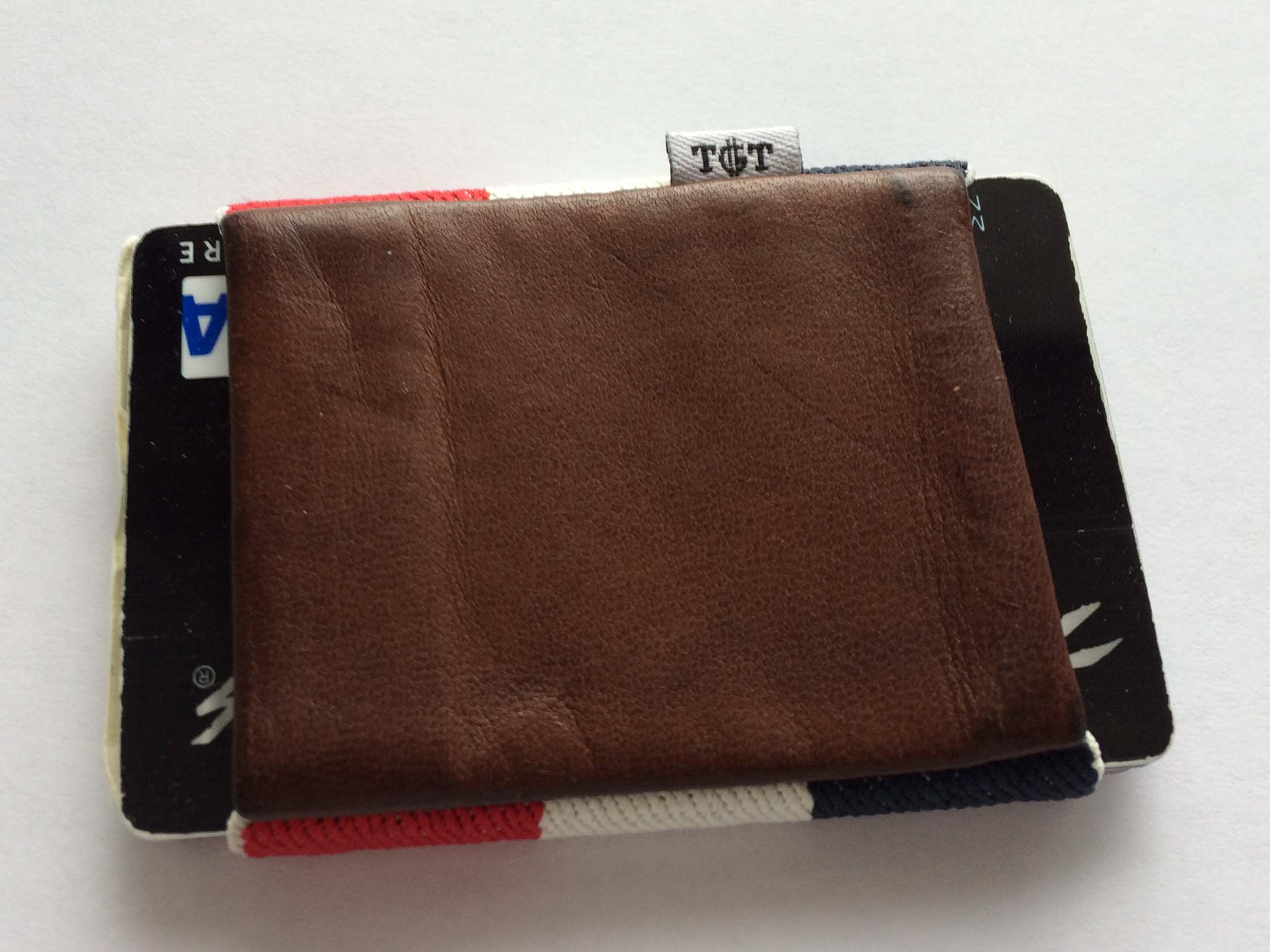
A while back, one of my favorite little curated deal sites,[Huckberry][1] ((Sign up with that link and you get $5 and I get $10 when/if you buy something.)) , was selling the [TGT Americana 2.0 wallet][2]. I don’t remember what I paid, but the wallet is sold through TGT for `$34.00`.
TGT Wallet
Until I got this wallet I had been using the [ill-fated Supr Slim][3] wallet — not a huge fan of that wallet. The TGT is another elastic band type of wallet, but it offers two differences that intrigued me:
1. Instead of the cards sliding into a pouch, they are free on the ends, more like how a band holds something. For some dumb reason this sounded like a huge improvement to me. (Spoiler: *meh*.)
2. What I liked more was that the wallet added a little pouch in which you can store a couple of bills (e.g. cash money). I don’t often have cash, but it is nice to be able to carry a bill or two when I need to carry it.
This wallet is substantially better than the Slim, it works easier and holds things in a secure, but yet more useable manner. I like it — I don’t love it, but I like it. Of course, before I get into why we need to address the shortcomings:
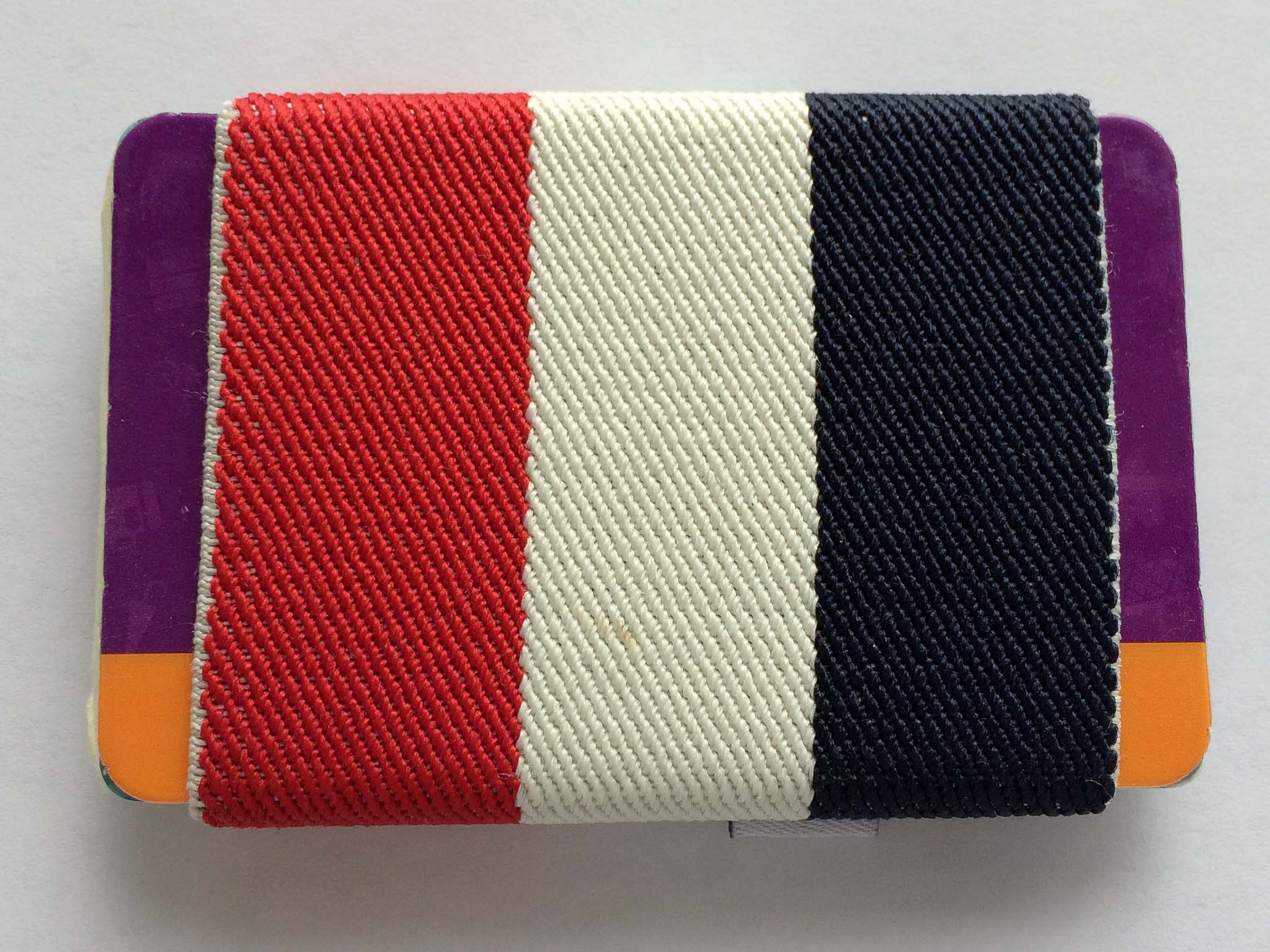
– The wallet looks more [French flag][4] than “Americana” — which would be fine, except that (for no good reason at all) I loathe French things.
– The leather pouch for holding your cash has a bad habit of sticking to your iPhone and thus causing the wallet to fly out of your pocket when you grab your phone. This is by far the biggest issue with the wallet.
– Like any elasticky wallet, it’s near impossible to elegantly get at the cards stuck in the middle of the stack in and out of the wallet.
I carry about six cards in the wallet, one being a business card, and it feels comfortable with that much stuff. I could carry less, but that’s what is in the wallet right now. I have carried up to eight cards with no issues.
French Flag
I’ve come to really like the cash pouch on the wallet and now consider such a compartment to be a must have for any of my future wallets. If that pouch was nylon on this wallet, it would be much better.
If you like elastic band type wallets, this is the best I have used. For me it is acceptable, and leaps better than the Supr Slim, but I am still looking.
Just released, App.net based, Instagram-like, photo sharing app. I tested this a few times while it was in development and it really is a nice app. It’s free with in-app purchase for buying some lovely photo filters to add to the base set.
You can still share to Twitter, Facebook, and App.net too. I can’t think of a single reason to use Instagram over this, and several reasons to run screaming from Instagram.
[Daniel Markovitz arguing for less todo lists and more calendaring][1]:
> Putting your work in the calendar enables you to better determine whether or not you can (or should) say yes to a new project. And if you do say yes, you can better determine when you realistically might be able to get it done.
On the flip side, super productive guy, [Justin Blanton][2]:
> These days I throw *everything* into OmniFocus: projects/tasks (obviously), birthdays, anniversaries, meetings, etc. Why split any of this stuff across two different apps (*if* you can get away with using just one)?
I think both are getting at the same point: everything needs to be in one view so you get a better idea of what you actually have to do. This is one of the reasons why the OmniFocus Forecast view (showing your tasks and calendars) is so powerful. Getting to see both at once is extremely helpful, but to date no app has done a very good job at this (even OmniFocus’ attempt is limited).
I have tried both methods mentioned above, the timeboxing-ish method that Markovitz is arguing for is stifling from a creative standpoint for me. Whereas Blanton’s method worked a little bit better for me, I still found it feeling a bit like the wild-wild-west. (Though I will say I love keeping birthdays and anniversaries in OmniFocus, that’s an excellent use.)
The problem that both are trying to solve is finding an intelligent and workable way to tell you one thing: how busy am I, and can I do this too? I wish I could say there was a software solution, or a workflow solution to this, but as far as I have found there isn’t. Instead I just consistently say I am too busy, and hope for the best.
Every solution I have come up with adds a massive amount of “upfront” burden on the workflow. Meaning you need contexts, projects, start dates, due dates, reminders, and time estimates in order to get a good sense for how busy you are. And it hinges on your time estimates being accurate. I suck at being accurate on most time estimates.