Category: Links

  • TBR Podcast: Episode One: Apathy and Horniness

    This week Ben is joined by Pat Dryburgh to talk about social media. What does it mean, and what is its impact on our lives? Is blogging social media? Ben and Pat also dive into the fear surrounding the NSA and Facebook’s “research” projects.

    I’m still working on getting the production quality up, but I’m extremely pleased with this show. The discussion was really great. Thanks for listening.

    Brought to you by:

    • Macminicolo.net: The best and most productive hosting you can buy.
    • Keyboard Maestro: Ben’s favorite Mac app, and ultimate power tool. Enter TBRPOD at checkout to get 20% off for a limited time.
  • A review of the Blackphone

    Sean Gallagher:

    What’s really important in the end about the Blackphone is that it has made the idea of a privacy-focused phone a reality—and it opens a conversation about what security technology can do for average people. And if it brings enough people into the conversation, the next generation of the Blackphone, and of mobile security products in general, could reach a much wider audience—and perhaps force some of the bigger mobile players to pay more attention to privacy.

    It’s about what I expected: good at privacy not great at the “other” phone stuff. I do like the above quote because it is what I hope happens. I hope that this phone pushes Apple to make their phones even more secure.

    Side note: How did these guys miss a prime opportunity to color their UI with green text on a black background? It’s like they’ve never seen a hacker movie.

  • Polymo – A better place for photos

    I’ve had a chance to test out this app for a while now, and it is quite useful. It won’t replace my standard app, nor is it a substitute for VSCO cam, but it is pretty handy.

    The app works like this: you set a tag for the pictures you are taking, or about to take, and then snap photos. The app then allows you to view photos by tag.

    For me, the neatest use of this app is in my day job. Often I do site visits to buildings and I need to snap a bunch of photos — this is the perfect way to keep all those photos together. Just tag with the building name and snap away — the app remembers the tag until you remove it.

    Pretty clever, and could be useful for travelers as well. $1.99 on the App Store.

  • Sleep as a Competitive Advantage

    Tony Schwartz:

    Too many of us continue to live by the durable myth that one less hour of sleep gives us one more hour of productivity. In reality, each hour less of sleep not only leaves us feeling more fatigued, but also takes a pernicious toll on our cognitive capacity. The more consecutive hours we are awake and the fewer we sleep at night, the less alert, focused and efficient we become, and the lower the quality of our work.

    It seems to me, at least from what you see in popular culture that napping used to be more socially acceptable, but now it seems to have a pretty nasty stigma associated with it.

    I’ve never been a napping type of person, but I am a big believer in getting enough sleep at night. I’ve started napping a bit here and there on the weekends since the kids nap, and it is quite refreshing.

    What I like best about getting lots of sleep most nights is that on those odd occasions where getting lots of sleep isn’t possible — it feels like I can more easily “bounce back”.

    Getting more sleep doesn’t mean you can’t stay up late, it just means you need to allot enough time for sleep.

  • Code Keyboard Tenkeyless on Massdrop

    I swear by this keyboard, but this is the model with the Green switches, not the Clears that I love. Either way, fantastic keyboard and a great site to save $10 on it. ((I already own two CODE keyboards.)

    Sign up with my link and I get something — though I don’t know what.

    FYI: I wouldn’t send you guys somewhere I haven’t tested. I’ve bought a few things on Massdrop and its been painless and as described.

    Also, Massdrop is so nerdy they have a devoted category to mechanical keyboards.

  • Facebook Added ‘Research’ To User Agreement 4 Months After Emotion Manipulation Study

    Kashmir Hill:

    Four months after this study happened, in May 2012, Facebook made changes to its data use policy, and that’s when it introduced this line about how it might use your information: “For internal operations, including troubleshooting, data analysis, testing, research and service improvement.”

    So not only did Facebook sneak in the “OK” later, but according to Hill there is no reason to believe that Facebook excluded people under 18 from the study.

  • Supreme Court Rejects Google’s Street View Appeal

    David Streitfeld:

    The prospect of a long-running case in which Google is accused of exploiting that trust and misappropriating data will work against this ambitious program. Google was sued for breaking federal laws by secretly collecting people’s email, passwords and other personal information as part of its Street View mapping project, which began in 2007. The data was drawn from unencrypted household computer networks.

    Man, poor Google, ya know?

    I personally hope that this case, and Google not getting it dropped, causes Google to actually stop and think about what they are doing. Google has no doubt created some of the best web services out there — I don’t think anyone can deny that. If you live in the Google domain, you have it pretty easy, but Google is doing all of this by plucking away user privacy at an exponential pace.

    Show me ads, but don’t delve this deep.

    There was no reason for street view cars to collect emails and passwords — none — and yet that’s what Google did. And the best answer that can really be given as to why it was done is simply: because we could? And you simply have to end that statement with a question mark to correctly convey the naive lack of common-sense that Google consistently hides behind.

  • Windows ‘Threshold’

    Threshold? I know it isn’t a final name, but I think it is telling. That name conveys a sense of anger, grit, and desperation — it’s aggressive — and I am not sure that is what you want being conveyed for an operating system.

  • Dryburgh Design Co.

    Pat Dryburgh on his new venture:

    And so, after working through a number of design directions and even more iterations, I’m finally ready to introduce Dryburgh Design Co. If you’re in need of a new website, a site re-design, a software interface, album artwork, or simply advice on a project you’re working on, please get in touch.

    Pat’s a good friend and a great guy. Be sure to check out his new site’s homepage, one of the best I’ve seen.

  • BlackBerry Passport “Review”

    I could write 10,000 words on why this is poorly done, but instead I think I'll just convey the deftness in two words: hardware keyboard.

  • Some Good Safari Extensions

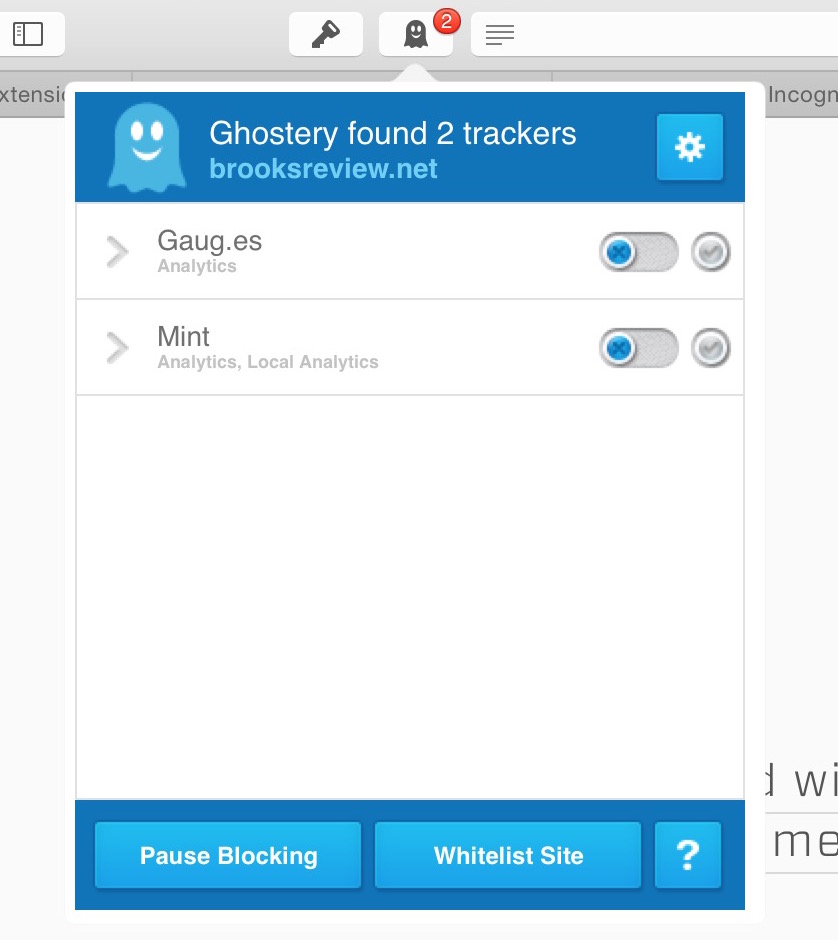
    I have two Safari extensions installed both with the purpose of blocking trackers. Now, my site does have trackers too — you should see one for Gaug.es and one for Mint.

    Here’s the plugins that I use to do my best to keep myself from being tracked:

    It might be redundant to have both running, but I’ve yet to experience a problem having both running.

    Two other useful Safari extensions:

    UPDATE: Quick note to let you know that blocking things like TypeKit means those fonts won’t load. Obvious, but still.

  • Facebook tinkered with users’ feeds for a massive psychology experiment

    William Hughes:

    Scientists at Facebook have published a paper showing that they manipulated the content seen by more than 600,000 users in an attempt to determine whether this would affect their emotional state. The paper, “Experimental evidence of massive-scale emotional contagion through social networks,” was published in The Proceedings Of The National Academy Of Sciences.

    This story is incredible and should be the only reason you need to immediately leave Facebook. It's just not worth it.

    Facebook is essentially telling people that they care so little about users that they see no reason to refrain from directly trying to control users emotional state. You'd be pissed if anyone tried to manipulate you in this unapologetic way, so don't let Facebook get away with it.

  • Sitting and Cancer

    Hannah Newman:

    The researchers examined close to 70,000 cancer cases and found that sitting is associated with a 24% increased risk of colon cancer, a 32% increased risk of endometrial cancer, and a 21% increased risk of lung cancer.

  • The Demise of Aperture

    CJ Chilvers:

    I’m hoping Apple is smart enough to figure out what the majority of photographers need (which is probably 10% of what Lightroom CAN do), and concentrate on making that feature set fast, lightweight and fun. That may get me to switch from using separate apps for everything.

    Here’s the features, off the top of my head, which I use in Lightroom:

    • Rating
    • Develop Presets
    • Noise Reduction
    • Exposure adjustment
    • Print dialog (for ICC color profiles)
    • Export Presets

    That’s all I need. If Apple wants me to use Photos.app all I need are VSCO presets (or let me make my own) and excellent noise reduction. Lightroom has the best noise reduction, Aperture’s wasn’t even close. Give me those things and I will be very happy.

  • When I get to work, offer to open OmniFocus

    Well that is a hell of an IFTTT action.

  • Apple stops development of Aperture

    Jim Dalrymple:

    Apple introduced a new Photos app during its Worldwide Developers Conference that will become the new platform for the company. As part of the transition, Apple told me today that they will no longer be developing its professional photography application, Aperture.

    End of an era. Thank God.

    I loved Aperture when it came out, but Lightroom got better exponentially faster than Aperture — right now Lightroom 5 is absolutely great.

    I’m excited to see the new Photos app, but I am tempering that.

  • The Amazon Dash Commercial [YouTube]

    Reader Joseph S. pointed me to this video from Amazon as a response to my post about Amazon’s terrible marketing.

    This video is much closer to what a good marketing video should be, which makes me wonder why the Fire Phone video is so poor. But now I have two questions about this video:

    1. Why in the world is a little kid narrating it? That makes no sense, adults are using the product. Is this to bang me over the head with the idea that “it’s so easy a kid can use it?” Stupid.
    2. Why is there even narration? The video would be much better if we just heard the muted sounds of life with a lovely melody accompanying those sounds. Get rid of the narrator.

    So close Amazon, so close.

  • Workaholism in America

    Bryce Covert:

    Former NASA scientists found that people who take vacations experience an 82 percent increase in job performance upon their return, with longer vacations making more of an impact than short ones. Putting in too many hours, on the other hand, does the opposite. More than 60 hours a week will create a small productivity flurry at first, but it’ll start to decline again after three or four weeks. Other studies have found the same initial burst followed, but a worse decline.

    A couple people have noted that they have noticed a large change, for the better, with my writing and this site. What could it be?

    Well, I’ve taken more time off in the past six months than I have in the past three years combined. I can’t say that is the only factor, but it’s pretty compelling.

    (I’m also getting a lot more done.)

  • Google Now

    Ben Thompson:

    I question, though, if Now will turn out to be as meaningful to most people as Google thinks it will be. In other words, how many people actually want a personal digital assistant? There is an alternative view of computers in which they are more akin to a tool, something you pick up and use to do a job, and then set down when you are done with it. To be sure, that tool is incredibly powerful and capable of doing a great number of jobs, but it still operates in service of something outside of computers.

    That’s such a huge question, because as Thompson notes it is a big departure from what Siri is doing. It’s: I know what you want, versus I can answer that for you.

    Or, to pull in Star Trek: The Next Generation, it’s Picard walking up to the Replicator and the computer just spitting our some Earl Grey (even though it is the most predictable thing ever the computer never did this), instead (like with Siri) Picard asked for what he wanted and then got it..

    In fact, the entire advanced computing system on TNG centered around the idea that the computer knew everything very quickly, but never offered that information — you had to ask. Google sees that as a fundamental problem that needs solving, and Apple seems to see that as the goal.
  • xScope 4

    I love it when good apps get even better. I can’t wait for the next project I need this on.