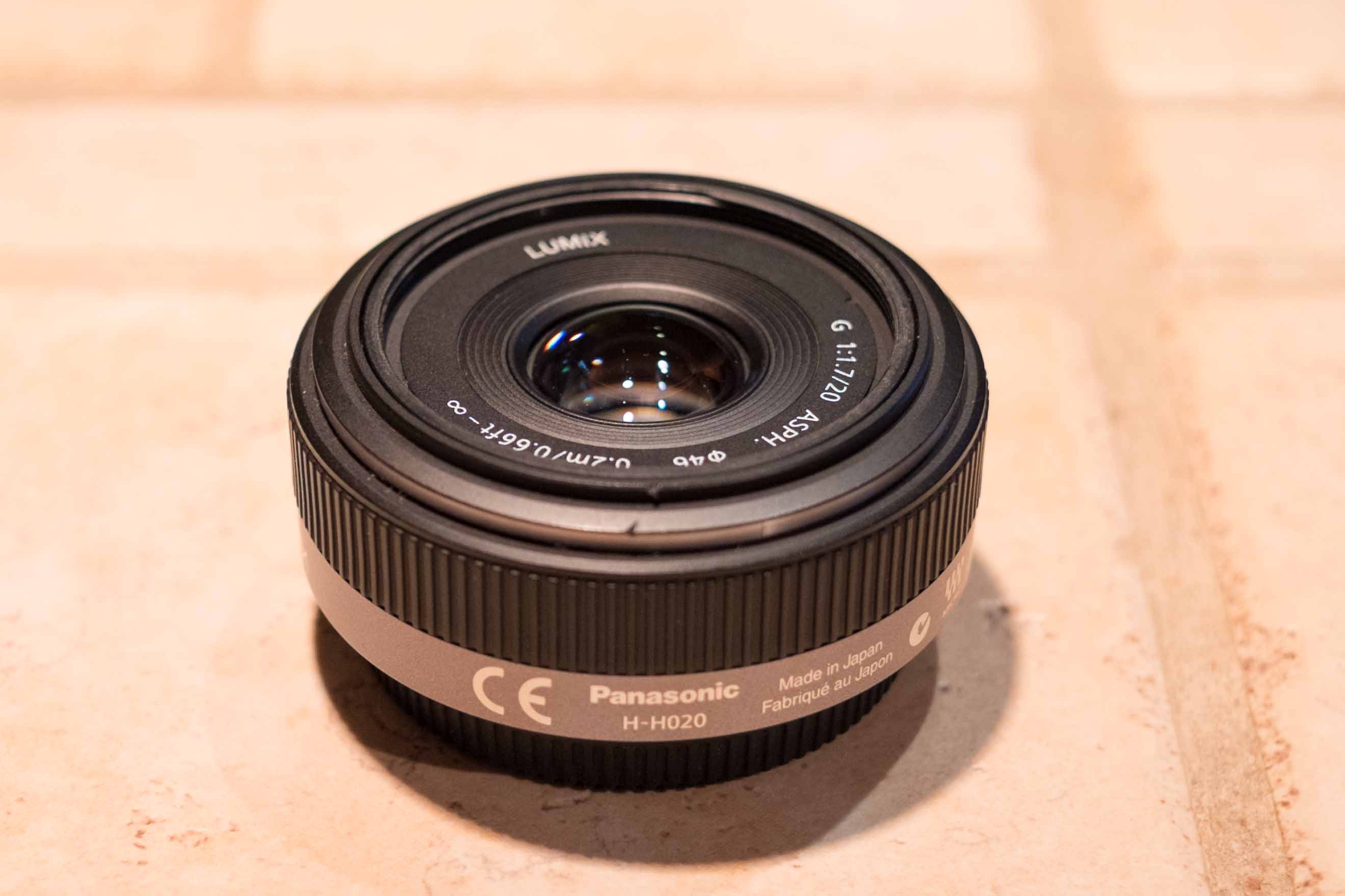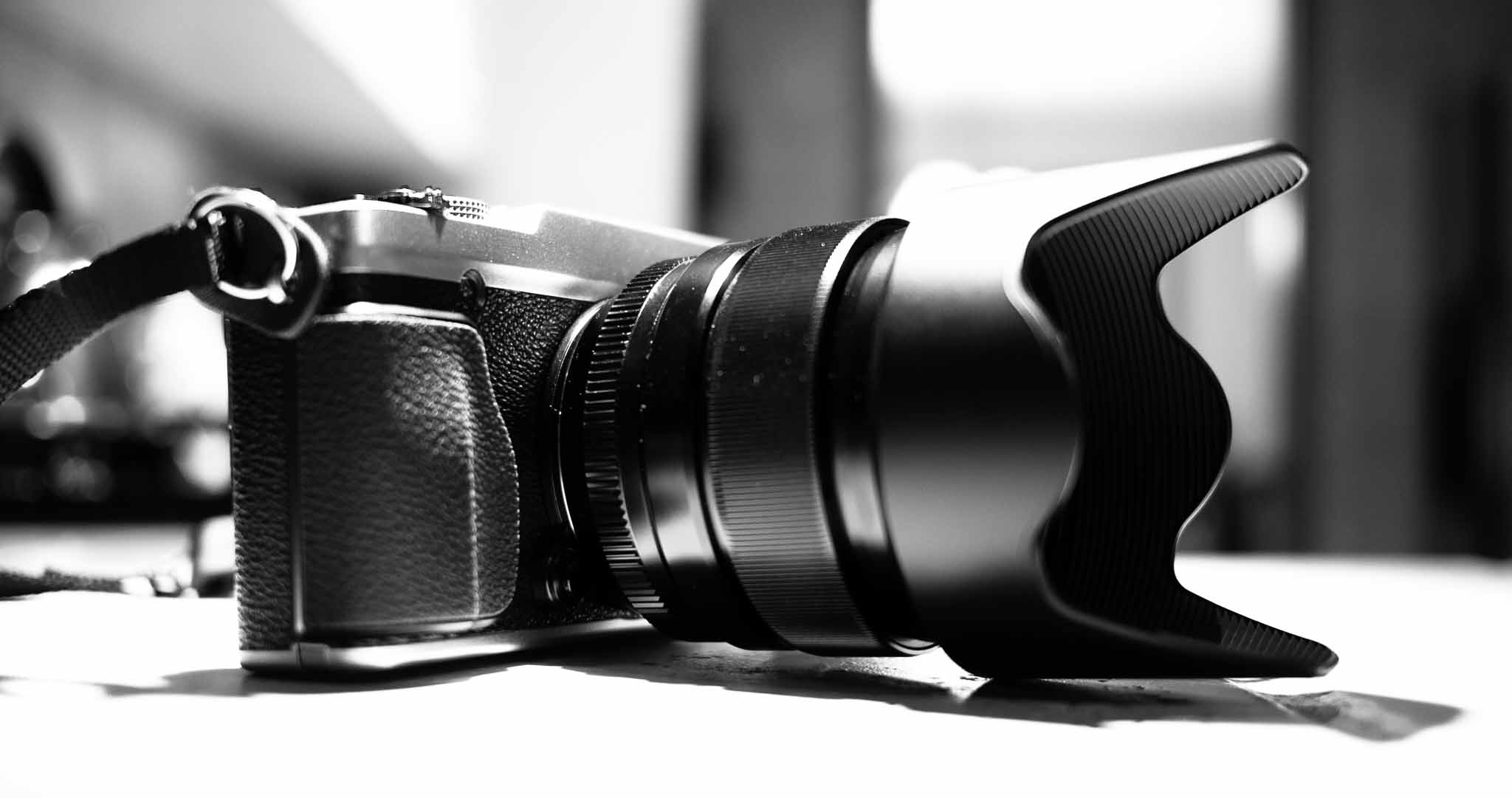
After using the Olympus OM-D E-M5 for a month I was pretty sure I had no need for my full-frame Canon gear any longer. That gear was outdated and to upgrade it (to a modern body) would be costly, and the benefit of doing so would be low because it would still be a bulky kit. At the beginning of January I decided to sell all my Canon gear and buy at least one more micro four-thirds lens — having that be my only camera system.
Except that’s not _quite_ what happened.
Instead I had several deals fall through while trying to sell my gear and I just wanted it gone so I could move on. I walked into my local camera shop to sell it, knowing I wouldn’t get top dollar, and walked out with a trade. The only doubt in my mind about this switch was that *perhaps* micro four-thirds wasn’t the system for me. Perhaps Fujifilm was a better choice for _me_, or even, overall.
So I walked out of the shop without my Canon gear, carrying a [Fujifilm X-E2](http://www.amazon.com/exec/obidos/ASIN/B00FPKDSGS/ref=nosim&tag=brooksreview-20) with Fujinon 23mm f/1.4 lens. ((I wanted the 35mm lens — alas they did not have one in stock and the 23mm is generally said to be a better quality, so I was fine with that (it’s also more expensive).)) I knew I could sell the Fujifilm gear right away, for a good price, but I had to know if I was missing out.
On first use of the X-E2 it becomes apparent just how much bigger it is than the micro four-thirds stuff. Camerasize.com shows that (at least in part) that’s not a wholly true statement. While the X-E2 is larger than the E-M5, that doesn’t tell the entire story.
Here are some comparisons of the X-E2 to other popular micro four-thirds cameras, from Camerasize.com:
– [X-E2 v. E-M5](http://camerasize.com/compare/#289,493): The E-M5 is 6% narrower, 20% taller, and 13% thicker and also weighs 14% more.
– [X-E2 v. E-M1](http://camerasize.com/compare/#482,493): E-M1 is 1% wider, 70% thicker, 25% taller, while also weighing 42% more. Wow.
– [X-E2 v. GX7](http://camerasize.com/compare/#472,493): GX7 is 5% narrower and 6% shorter, but the GX7 47% thicker and 15% heavier.
– [X-E2 v. E-P5](http://camerasize.com/compare/#459,493): E-P5 is 5% narrower, 8% shorter, the same thickness, and weighs 20% more.
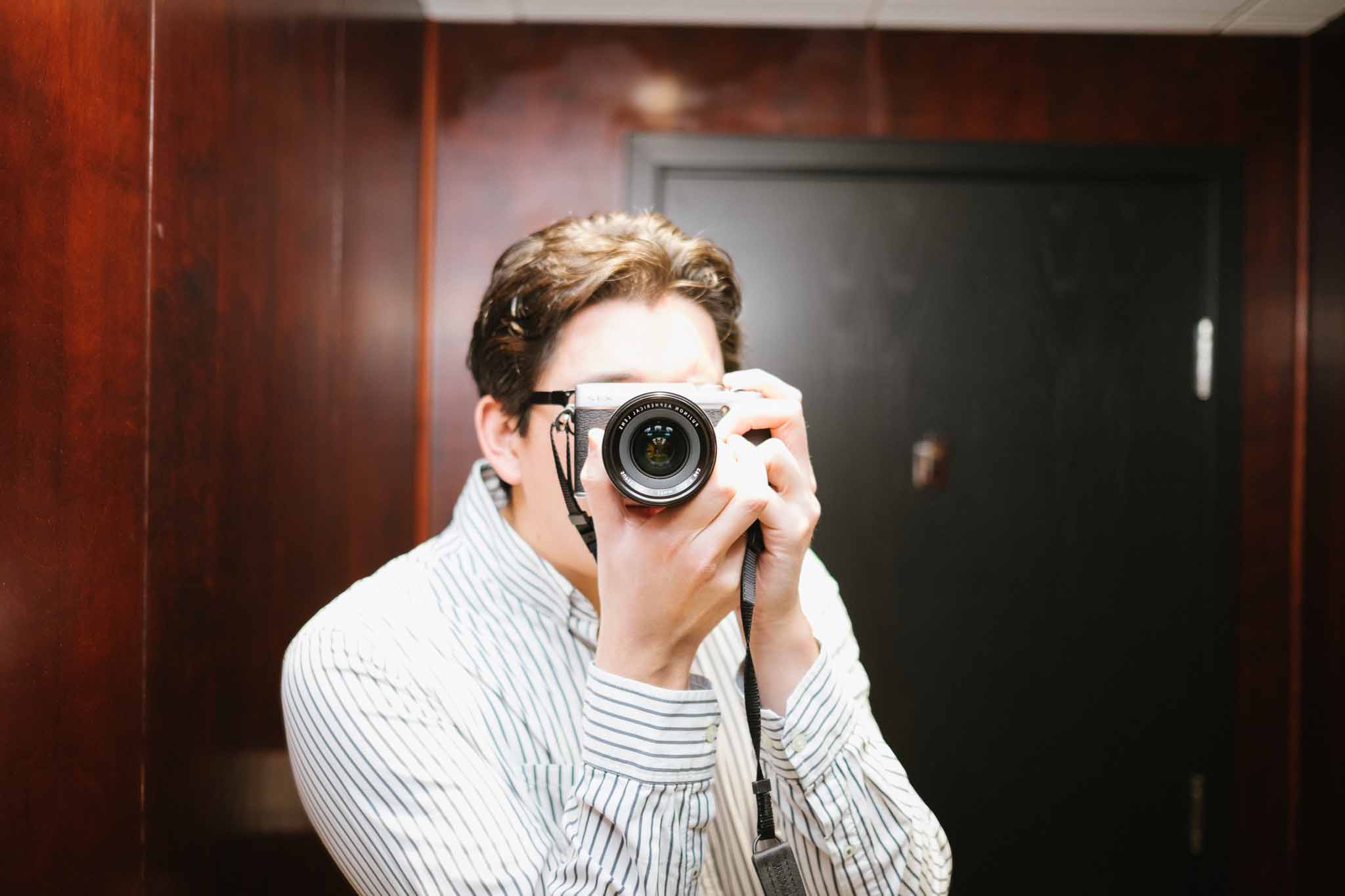
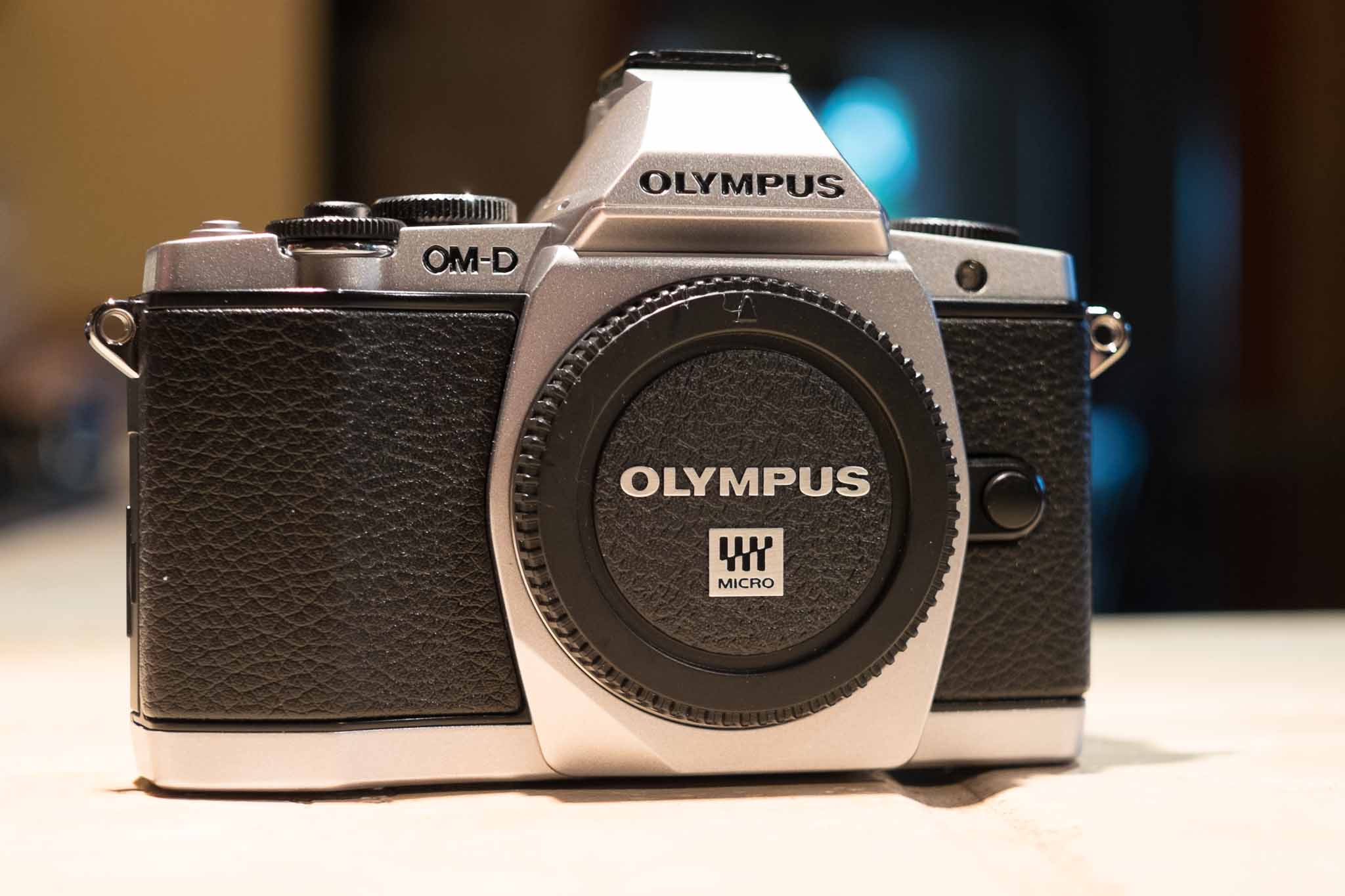
It’s astounding how well the X-E2 compares to other high end micro four-thirds cameras even though the camera looks like it is much bigger. Here are some pictures I took with the X-E2 and the 27mm pancake lens mounted, compared to the E-M5 with 20mm pancake lens:
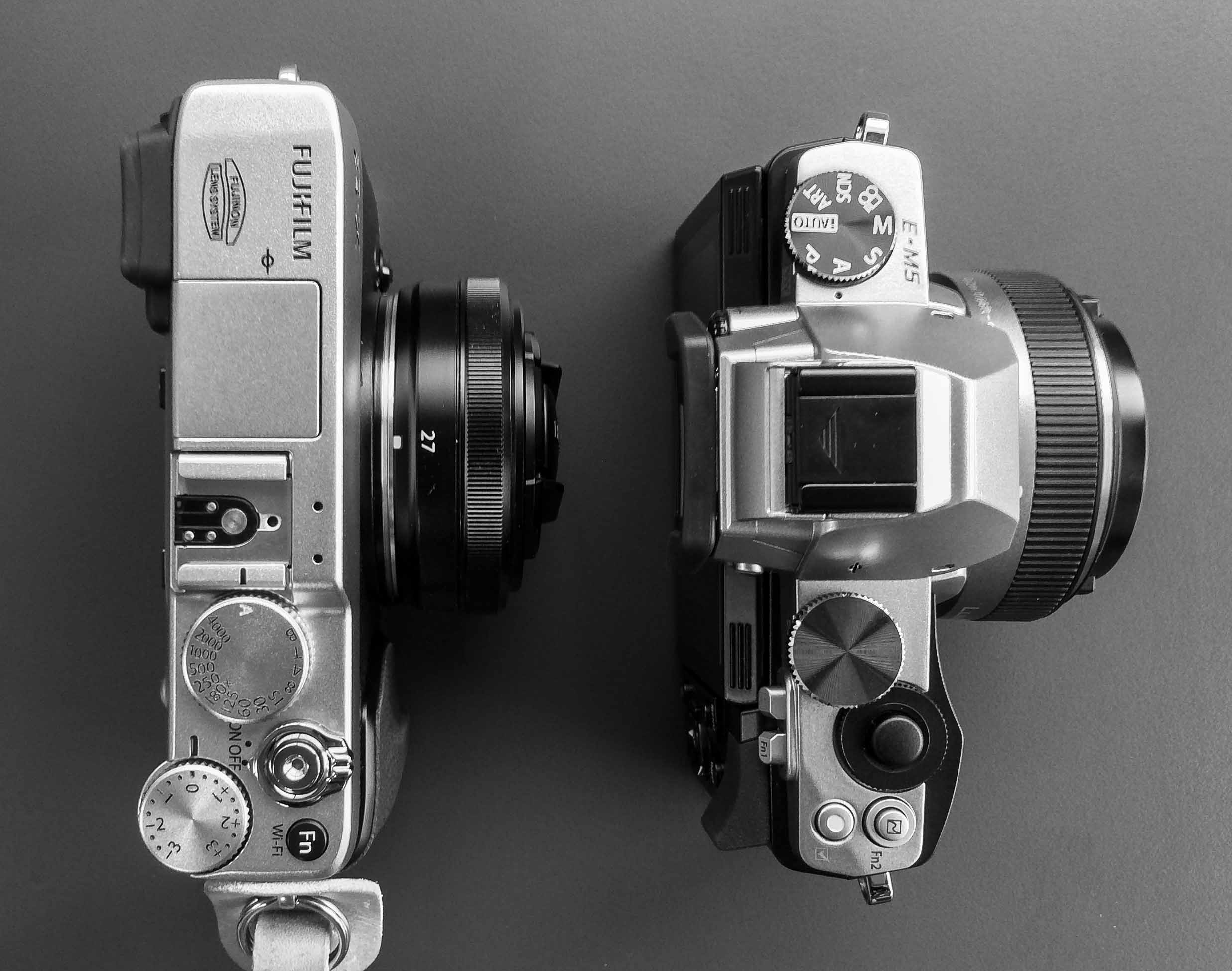
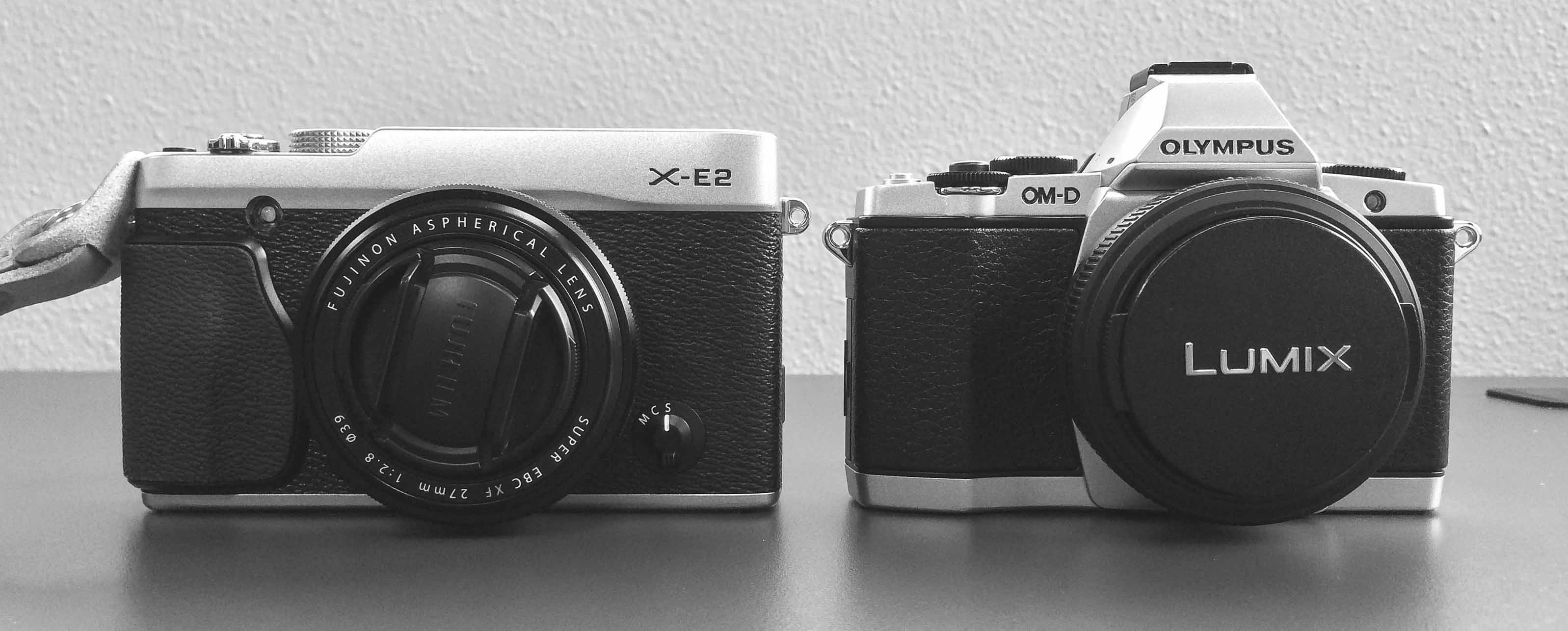
The first thing to note about Fujifilm cameras is that in general the lenses are bigger, but the Fujifilm bodies are lighter than many other cameras. In other words, the body is only a bit bigger, but much lighter, however the lenses are bigger _and_ heavier.
*As of this writing I own the 27mm f/2.8 pancake lens with the 23mm and have rented the 35mm f/1.4 and 18-55 f/2.8-4 OIS lenses.*
## The Sensor
Unlike Sony, Fujifilm isn’t using full-frame sensors, but unlike micro four-thirds, Fujifilm isn’t using tiny 2x sensors. Fujifilm is using the well known APS-C sized sensor with a 1.5x crop factor (m43 is 2x crop, full frame is 0x crop). Fujifilm calls their latest line of sensors the X-Trans II, which lacks a low-pass filter but is still a 16 megapixel system like many micro four-thirds cameras.
Theoretically the X-E2 should produce better images. In my testing the quality isn’t shockingly better, but the noise control is noticeably better.
[Here’s what Fujifilm marketing says](http://fujifilm-x.com/development_story/en/processor/) about the removal of the low-pass filter:
> To maximize the resolution capable by the lens, the function of reducing moire and false colors previously handled by the low pass filter were realized by pixel distribution and signal processing.
> By using a structure without a low pass filter, high image quality surpassing those of single lens reflex cameras with 35mm full frame sensors was realized. This achievement was highly praised by many of our customers.
Like I said, it’s not immediately noticeable to my eye. [Shutterbug has a good overview](http://www.shutterbug.com/content/low-pass-or-not-low-pass-optical-low-pass-filters-debate-has-been-ongoing-more-decade) on the issue of using low-pass filters, as does DPReview in their [X-Pro 1 review](http://www.dpreview.com/reviews/fujifilm-x-pro1/18).
On the practical side I have found that you can shoot from ISO 200-6400 on the X-E2 and not worry about the noise level — and I am truly not trying to over state this fact. It’s astonishingly good at noise control.
With the Fujifilm sensor there are three other benefits that you don’t get with other sensors:
1. Shallower depth of field than micro four-thirds sensors. Not as much as full-frame sensors, but it’s more than enough to get you into all kinds of focusing trouble.
2. Fujifilm color. This is what these cameras are known for — even without the JPEG film simulations — the color with the Fujifilm camera is distinct. I love it. People that shoot Fujifilm typically do so because they love the color rendering, but it’s not to everyone’s taste. In the reviews I have seen people either love it or hate it.
3. A very low-noise sensor. [I read that it is hard to tell the noise difference](http://www.photographyblog.com/reviews/fujifilm_x_e2_review/) between ISO 200 and 6400, but didn’t believe it. While I still think that is an overly generous statement, I certainly understand the sentiment.
For me, the allure of the Fujifilm sensor was both the colors (which I find stellar) and the size of the sensor — since it is something I am more comfortable with as my “only camera” than a micro four-thirds sensor.
In fact, the generous sensor size is the main reason that — even when I was prepared to move fully to micro four-thirds — I still kept adding Fujifilm gear to my Amazon wish list.
## The Lenses
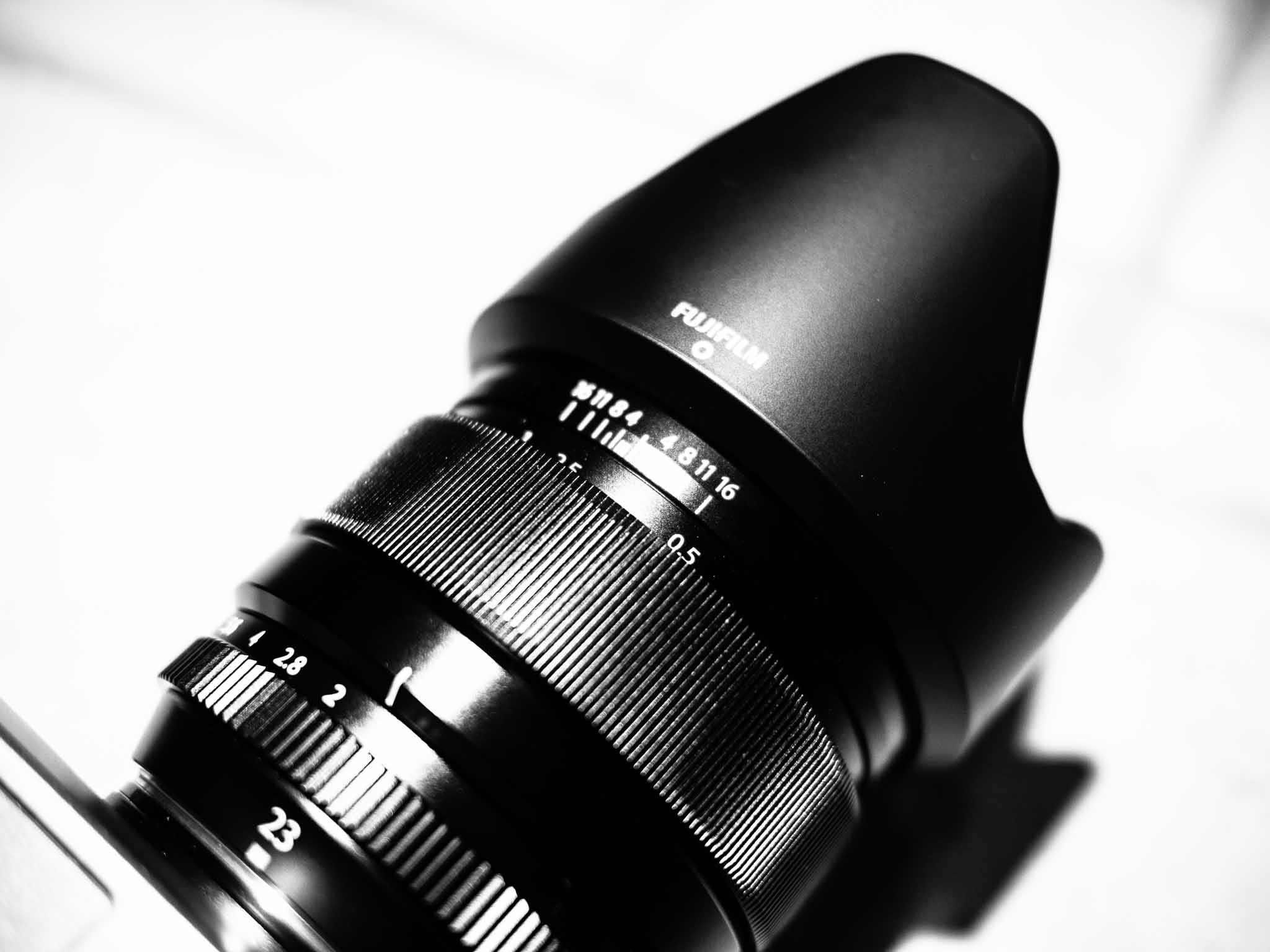
What really sets the Fujifilm system apart is the Fujinon lenses, which in my opinion, are some of the best out there. The mount is proprietary to the Fujifilm system, so you won’t be able to select from a ton of great lenses unlike other systems, though adapters are available if you don’t care about autofocus.
As of right now, here is the complete listing of Fujinon lenses:
– [14mm](http://www.amazon.com/exec/obidos/ASIN/B0092MD6RQ/ref=nosim&tag=brooksreview-20)
– [18mm](lhttp://www.amazon.com/exec/obidos/ASIN/B006UL00U8/ref=nosim&tag=brooksreview-20)
– [23mm](http://www.amazon.com/exec/obidos/ASIN/B00EZ8BEXK/ref=nosim&tag=brooksreview-20)
– [27mm](http://www.amazon.com/exec/obidos/ASIN/B00DCM0DUU/ref=nosim&tag=brooksreview-20)
– [35mm](http://www.amazon.com/exec/obidos/ASIN/B006UL00R6/ref=nosim&tag=brooksreview-20)
– [60mm macro](http://www.amazon.com/exec/obidos/ASIN/B006UL010W/ref=nosim&tag=brooksreview-20)
– [18-55mm](http://www.amazon.com/exec/obidos/ASIN/B0092MD6S0/ref=nosim&tag=brooksreview-20)
– [55-200mm](http://www.amazon.com/exec/obidos/ASIN/B00CNZTPGA/ref=nosim&tag=brooksreview-20)
There have been [two](http://www.amazon.com/exec/obidos/ASIN/B00FPKDPF2/ref=nosim&tag=brooksreview-20) [more](http://www.amazon.com/exec/obidos/ASIN/B00HK8Z9AG/ref=nosim&tag=brooksreview-20) lenses announced and I left off a shitty 16-50mm. But it’s such a short list I was able to compile it from memory. I couldn’t even get through half the available micro four-thirds lenses from memory — nor Canon, nor Nikon. So, a much smaller lens selection, but overall the lenses seem to range from ‘good’ on up.
What also set’s the Fujifilm system apart is that (with the exception of the 27mm) all the lenses have an aperture ring on them — which many of you may not be familiar with. I’ll get into that in the next section.
I have been very impressed with the build and feel of the four lenses that I have handled. The resolution from each lens is fantastic in my opinion.
## The Film Simulation
Stuff of legends. No, _really_. I have the VSCO Film Packs for Lightroom and those renditions of the Fujifilm films, like Velvia, pale in comparison to the JPEGs that come out of the X-E2. ((In comparison the VSCO packs look *over* processed compared to what the camera is rendering — that’s not a slight against VSCO as those film packs are excellent.))
In fact before owning this camera I never saw the point in shooting RAW+JPEG. With this camera I am absolutely shooting RAW+JPEG just to get the great looking film simulations from the camera. Many, *many*, of the images that I love from this camera are only getting a slight crop on my Mac and then being shared — as opposed to being edited for color/feel and so forth — because the images are just JPEGs and I never touch the RAW files.
The film simulations are so good that they have changed the way I have been shooting and processing my images. Great stuff. ((I should also mention that shooting JPEG allows the camera to make lens corrections and noise corrections, which is just one more really nice thing.))
## The Controls
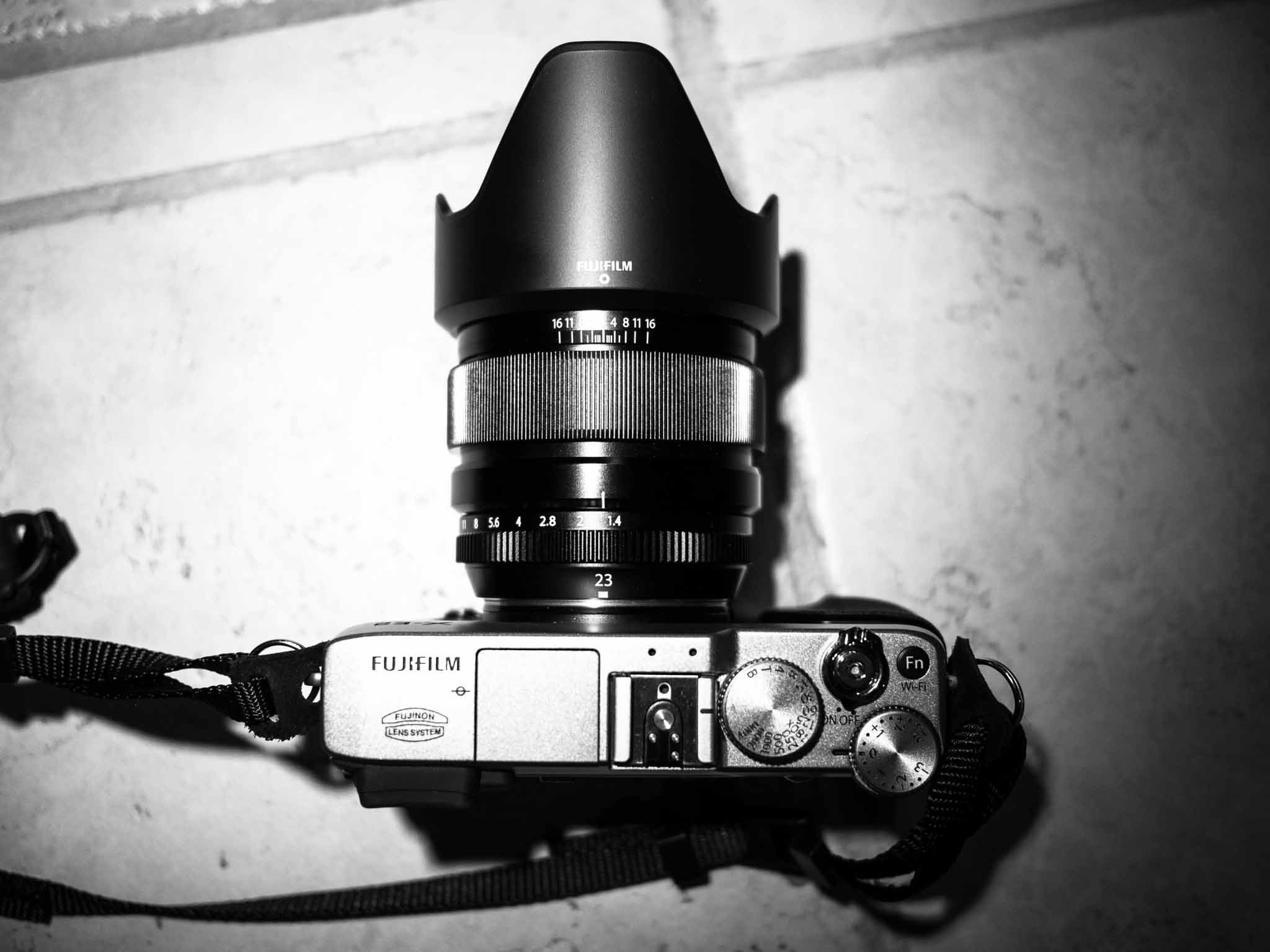
When I first started using the Fujifilm system I didn’t love the controls — fast forward a week and I was convinced that the controls are *the* best attribute of the Fujifilm system. Menu controls aside because those suck (they do on every camera if you ask me).
On most interchangeable lens cameras you typically get a dial to select the shooting mode: Program, Aperture Priority, Shutter Priority, Manual, Bulb. There’s a few more options on some cameras, but those are the basic ones.
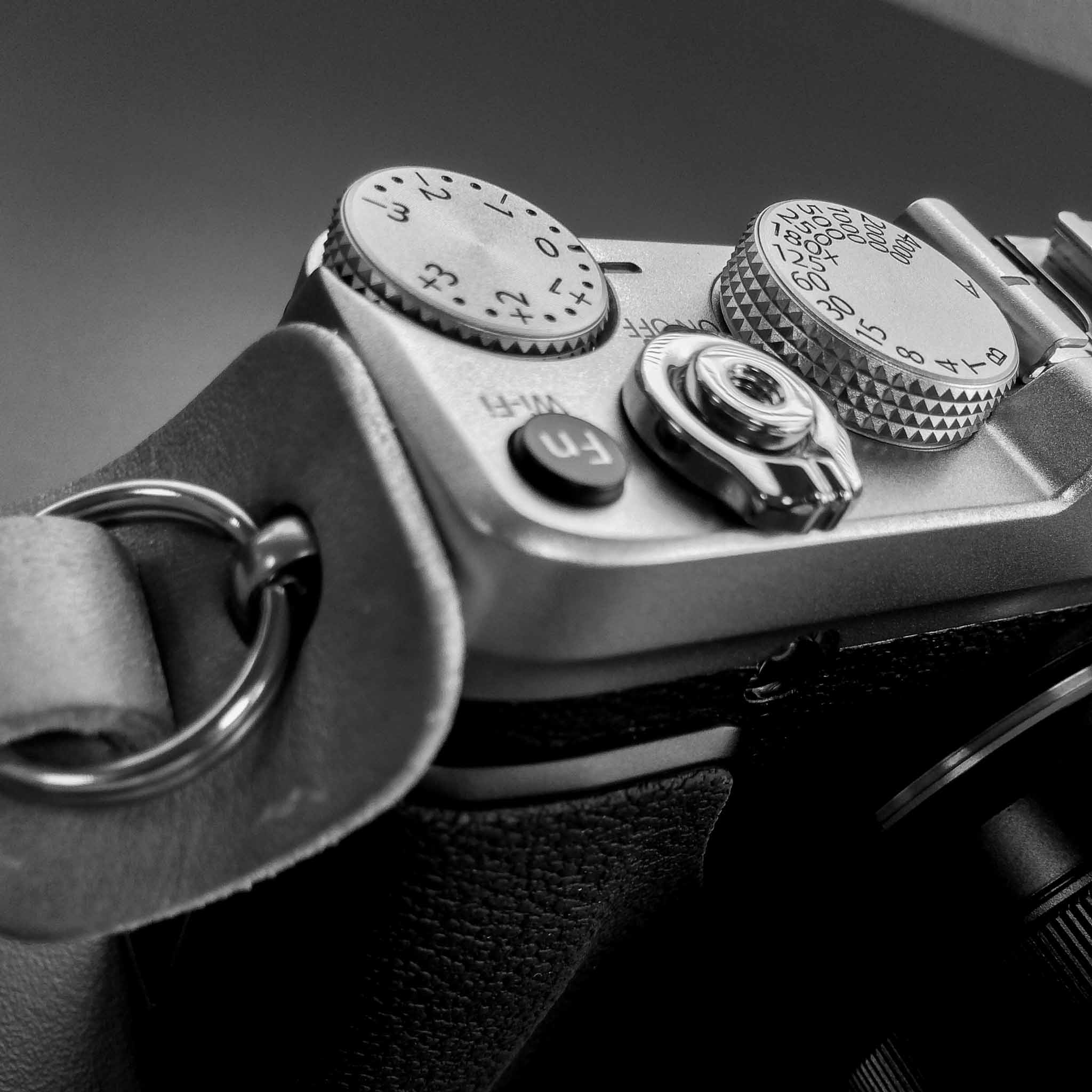
On the X-E2 there is no such dial. Instead the largest dial is the shutter speed. That’s right, the shutter speed. On the lens is an Aperture ring and spins just like a focus ring, but instead it adjusts only the aperture (there’s still a focus ring).
So: what the hell, the camera is only manual?
No, not at all. The Fujifilm still has these modes: Program, Aperture Priority, Shutter Priority, Manual, Timer, Bulb. It just depends on the combined settings of those two dials. And that’s not nearly as complicated as it sounds — it’s the best part of the system actually.
Set the shutter dial to A, and control just the aperture ring for Aperture Priority. Boom.
I shoot in Aperture Priority mode 95% of the time and I find the X-E2 setup to be massively faster than any other camera’s controls — and again I am trying to downplay that a bit.
These controls are what I love most about the X-E2. With my eye in the viewfinder I can keep one hand on the lens, and one on the body (as God intended) and still adjust every setting very quickly. My right thumb can jog the shutter speed and exposure compensation, while my left hand can adjust the focus modes, aperture, and focus. It sounds like a lot, but it only took a week for me to get lost with the random dials on the E-M5, while wishing every camera was setup like the X-E2.
I can keep my eye in the viewfinder and easily fly through setting adjustments.
*Side note about the 27mm f/2.8: For me this was a desirable lens to shrink down the size of the camera system, but it is the only lens that is pancake, and therefore it doesn’t have an aperture ring on it just the focus ring. To control the aperture you have to jog the dial on the back of the camera. This is a bummer for sure, but an acceptable tradeoff for such a tiny lens.*
## The Bad
As with all things in life, there’s a few negative things the X-E2 has going for it. Some of you will find these to be a deal breaker, but I’d suggest you use the X-E2 before you make that proclamation as they are all are surprisingly minor if you ask me.
#### The Image Stabilization
There is none on the X-E2. Where the E-M5 and many other cameras are stabilizing the sensors — Fujifilm has gone the more traditional route of only stabilizing the lenses. There are, at current, only three stabilized lenses for Fuji x-mounts.
I prefer stabilized sensors, over stabilized lenses, as it seems like a better method of stabilizing the image. However, the real question is how much of a problem is this for *you*? It’s a question only you can answer.
If all your photography consists of shooting kids indoors — higher ISO ratings will be better for you (so you can get a higher shutter speed and freeze their motion), as image stabilization only helps steady the frame with slow shutter speeds (and fast ones too I suppose).
So, really, image stabilization is better suited for still imagery in low light when you don’t have, or don’t want, a tripod. Image stabilization can, and will, help with moving objects to a degree, but if your shutter speed is slow there is no saving motion blur with image stabilizers.
It’s likely that a higher ISO with better noise handling will outweigh good image stabilization. For me, the X-E2 handles noise better than many cameras — full frame or otherwise — but that doesn’t mean other cameras don’t do the same. You could get an E-M1 and have the best of both worlds for the most part.
#### The Size
As I showed at the top, it’s a big camera system. This isn’t a camera you can stuff in your pocket. You *can* but it won’t be comfortable. That said, it’s still considerably smaller than most dSLRs and competes well with the sizes of other mirrorless camera systems at this level.
I find the size to be fine considering the image quality. More importantly I love the weight, or lack thereof. Lighter is better in my book when it comes to something you are carrying around and trying to hold steady.
#### The Creature Comforts
Ah, this is where the big difference between Fujifilm cameras and Olympus/Panasonic/Sony seems to be. The latter three brands all like to pack in what I call creature comforts — and with the exception of WiFi, Fujifilm isn’t cramming many creature comfort features in. ((Though the recently announced X-T1 may change that.))
I think this is where a lot of people get tripped up. The X-E2 and most Fujifilm X cameras, are geared towards photography only — not video, not sharing, not anything else. There’s no touch screen, no manual video controls, no tilting screens — and that seems to be “the point” in a sense. These are purpose built devices, which Fujifilm purists see as polar opposite to cameras from other brands trying to be everything to everyone.
Many will hold this against the system, but I see it as a company focusing on the most important aspect of a camera: the image. That said, a tilting screen would be fantastic — I couldn’t care less about a touch screen.
#### The SD Card Slot
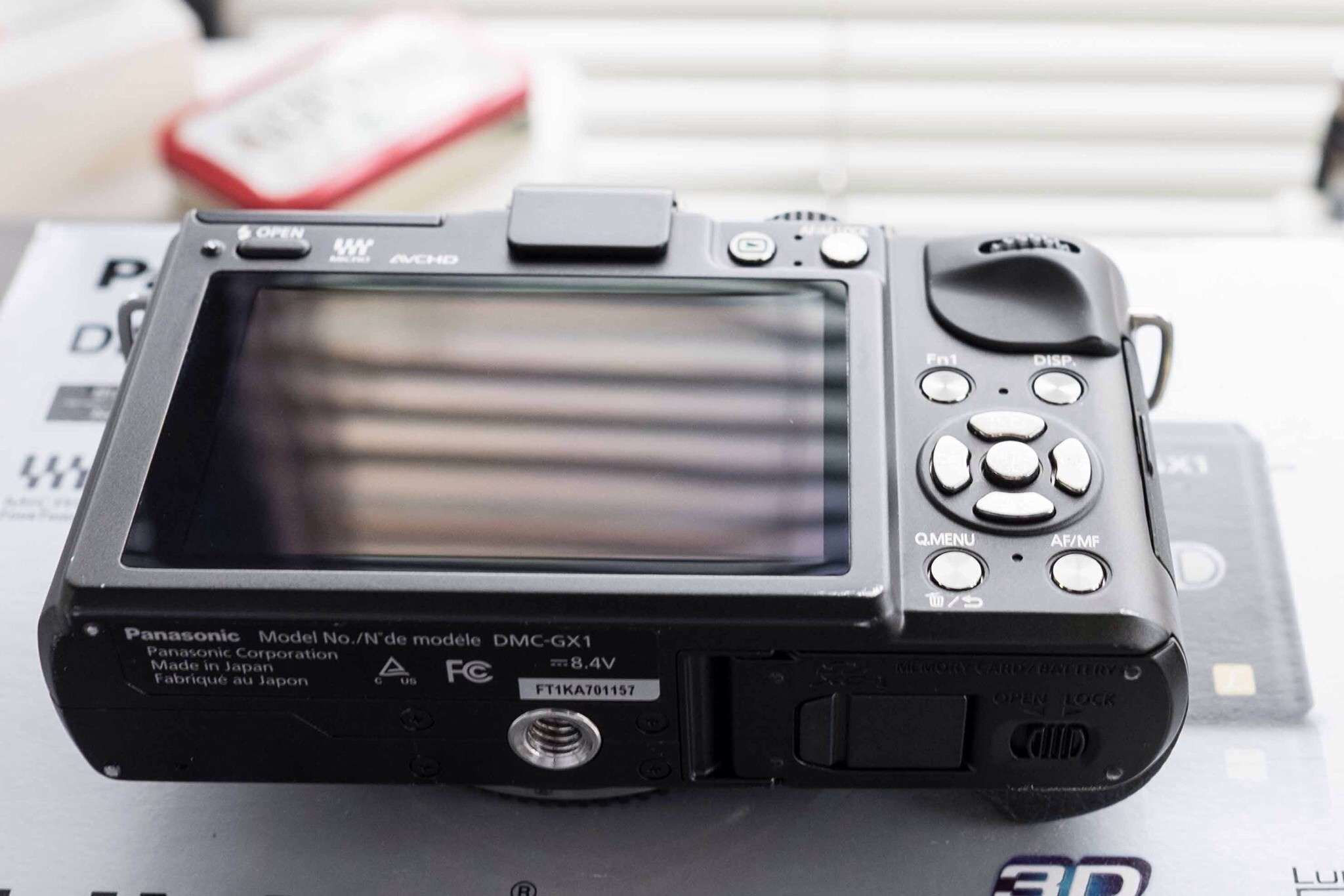
It’s shit. The SD Card slot is combined with the battery compartment, so you access it on the bottom of the camera. Screw on a tripod, or quick-release plate for a tripod, and you can forget about getting to the SD card.
This was horribly thought out.
### The Over Hyped Autofocus Issues
One of the biggest complaints about the X-E2, and Fujifilm cameras in general, has been the poor autofocus system. With the X-E2 and subsequent firmware updates these issues are mostly gone. In my average shooting scenario I noticed no difference between the X-E2 with 23mm f/1.4 and the E-M5 with 12mm f/2 lens on each.
In lowlight the autofocus can hunt at times, but it still out performs my E-M5 when the 20mm f/1.7 is on the E-M5. Though the E-M5 does do better with the 12mm f/2 in low light than the X-E2 does.
Tracking is weak on the Fujifilm system but this isn’t a camera you buy to track fast moving stuff. If that’s what you want, you need to be looking at more expensive gear.
Overall, there seems to be an awful lot of smoke billowing out of a very small, and now smoldering, fire of “bad autofocus” complaints. ((Fujifilm claims that the X-E2 has one of the fastest autofocus systems out there. I don’t believe that.))
## The Sum
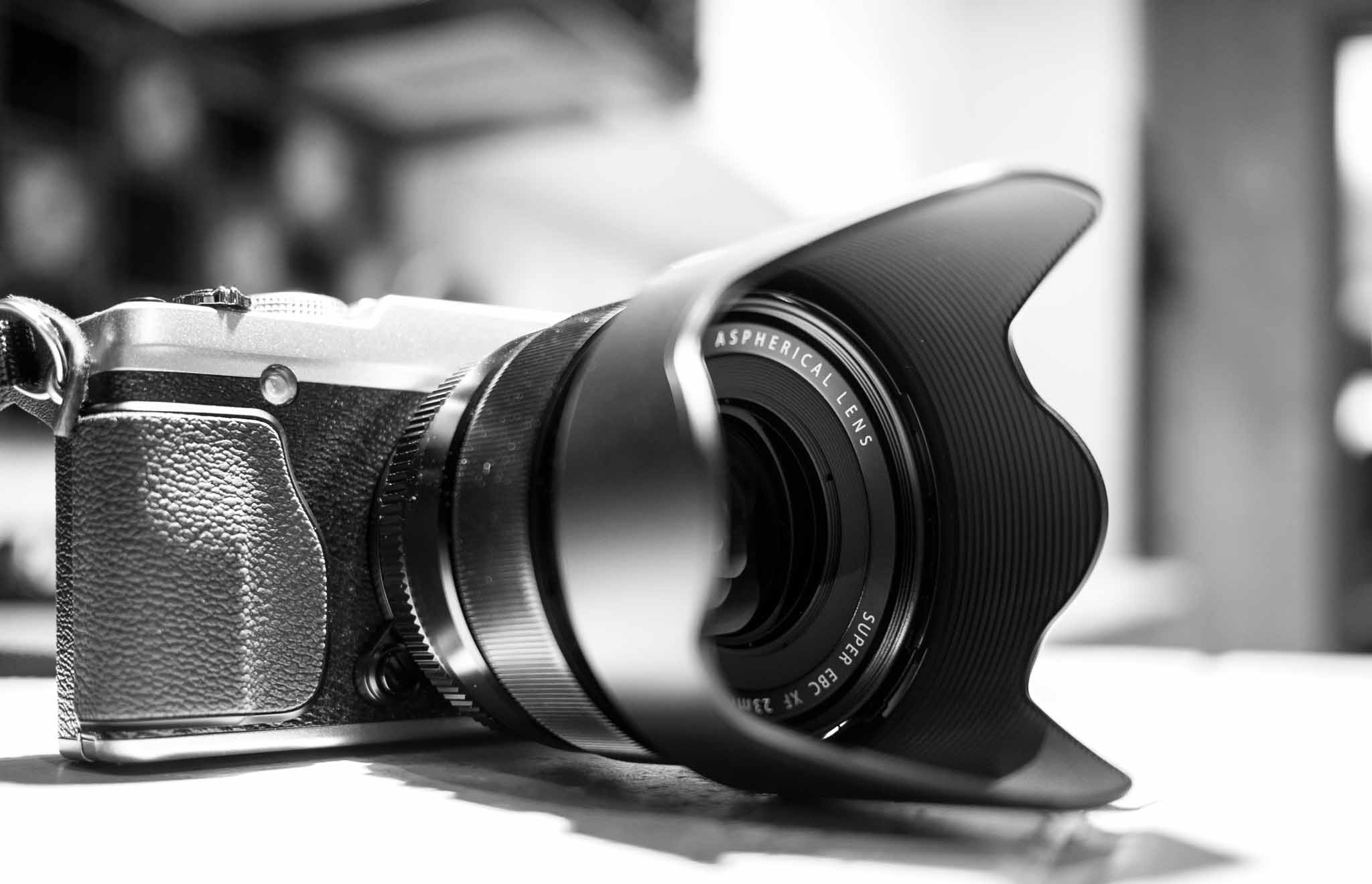
It used to be that when you dove into photography you bought a low end dSLR, something you would find packaged together at Costco. It would be an APS-C sized sensor with an 18-55 lens that would be something like f/3.5-5.6 — it’s a basic and not stellar kit. The jump used to be Camera Phone/Compact Camera (i.e. Point-n-Shoot) to a low-end dSLR. When you wanted to upgrade, then you had to jump to the full-frame bad boys that would cripple your wallet and lenses that would make you weep just thinking about their prices.
Then the mirrorless stuff started coming out, and smaller cameras started to get a *a lot* better. Cameras like the Canon G9, S100, the Sony RX100, the Sony NEX lineup — and yes, micro four-thirds systems started to muddy the water. Things got pretty confusing.
The truth is: any camera can yield an amazing image in the right hands. But another truth is that you can get better images with better gear (to a point).
If you are stepping up your photographic pursuit, I would recommend the micro four-thirds systems. It has all the creature comforts, is cheaper to get into, and is everywhere. It won’t cripple your wallet and you can get a camera body that fits your current needs well that can still be upgraded, keeping the lenses for later if your needs change. I’d say the micro four-thirds stuff is well positioned where the old entry-level dSLR gear was (and that’s not to put down the system at all, just price wise it is positioned there).
So where does that leave Fujifilm?
To me, Fujifilm is something you buy for the style of it. The color rendering, the feel, the controls. It’s not a system that is quantitatively better if you ask me, but it is a system that just makes you feel like you have the chance to create something special every time you press the shutter release because the cameras and lenses themselves feel very special to use.
I’m all in on Fujifilm and I consider this matter settled.
***
Do try to remember this, from [Henrik Ersgård](http://www.stevehuffphoto.com/2014/01/27/my-thoughts-about-photography-gear-by-henrik-ersgard/):
> Maybe there are many of you out there who has gone nearly as insane as I have about cameras/lenses/sensors so that you nearly forgot about that it should be fun to photograph. Smile when you pick up your camera instead of gently picking [it] up with rubber-gloves so that it won’t be any scratches on it. If there are scratches, then I may not be able to sell it later when I get a new one!!!… That really sounds terrible. It really does.
I love gear, but I need to stop, now.
***
Buy it here and I make *billions*: [Fujifilm X-E2](http://www.amazon.com/exec/obidos/ASIN/B00FPKDSGS/ref=nosim&tag=brooksreview-20)