This is the opening statement by Florian Mueller on his latest report of a Microsoft victory over Motorola in a German lawsuit:
>The Munich I Regional Court today ordered a German patent injunction against wholly-owned Google subsidiary Motorola Mobility because the Android operating system infringes EP1304891 on “communicating multi-part messages between cellular devices using a standardized interface”.
Emphasis is mine. I emphasize that part because this is a PR problem that Google now has to deal with. Prior to acquiring Motorola Mobility, Google was only defending itself against the, non-consumer facing, Oracle ((To the best of my knowledge.)). Now though, every lawsuit against Motorola Mobility is essentially a lawsuit against Google — because Google owns Motorola Mobility.
That may not be an immediate problem, but the more lawsuits that Motorola Mobility loses, the darker Google’s black eye gets.
Take for example Mueller’s closing paragraph in this same post:
>Most Android devices sold in the United States already have an Android (and Chrome) patent license from Microsoft. Major device makers like Samsung, HTC and LG have opted for legal certainty, and every ruling that Motorola loses against Microsoft validates their decisions to prefer licensing over litigation.
With Motorola Mobility now owned by Google, could they even license a patent without significant repercussions? Think about it, because in my eyes, Motorola Mobility licensing a patent, from anyone, is admitting that Google itself needs to also license that patent for Android as a whole. Oops.
Dan Misener scraped the Kickstarter website, only to find out that there are in fact no readily visible failed projects. Misener brings up the interesting point that it is hard for new project creators to learn from the failure of others if they can’t see those failures. I understand why Kickstarter hides failures, I would too, but a bigger point that Misener didn’t touch on is the projects that were funded that *still* failed.
This is not uncommon, but it’s rarely (if ever) talked about. It’s going to take a major failure for a change to be made. Imagine if the runaway success project for the Pebble watch fails to ever see the light of day. Kickstarter can rebound from that, but they need to have much better communication than they currently have with backers. Right now all I ever hear from Kickstarter is what new projects they think I should back.
What about the projects that are massively behind schedule? What responsibility should Kickstarter have to backers over those failures?
Both questions are going to need to be answered, clearly, sooner rather than later.
Hot on the heels of Coda 2 is Diet Coda, which just became the best code editor with built in FTP by a large margin on the iPad. Seems like a bargain at, the soon to change price of, $9.99.
John Gruber explaining how Apple could keep a 4″ iPhone under wraps while still getting developers ready for the larger screen before hand:
>If Apple introduced something like this in iOS 6, they could encourage iOS developers to adopt the recommended APIs to be responsive to changes in available vertical screen space. For now, they could pitch this in the context of *shrinking* screen space in response to on-screen notification banners, but, come October, apps that do the right thing would automatically be responsive to, say, a new device with 176 more pixels.
That would be clever and answers one of the biggest doubts that I have/had about the rumored ‘tall-skinny’ iPhone.
HP Press Release:
>HP (HPQ) today outlined plans for a multi-year productivity initiative designed to simplify business processes, advance innovation and deliver better results for customers, employees and shareholders.
That’s business speak for: “We are firing 27,000 employees.”
Paul Kafasis tried to reenact the Samuel L. Jackson Siri commercial and it sounds like Apple needs a “results may vary” disclaimer.
There’s no doubt in my mind that I am better off with Siri than without, but she can be a very frustrating woman. What makes Siri even more frustrating (at least to me) is that Apple is always changing things on the back end. People often comment that Siri has gotten worse or better, but what’s really happened is Apple has tuned Siri to *be* more accurate and thus we notice the changes on the user end.
This would be a good thing, if as humans we didn’t adapt, but we do adapt. When I tell Siri: “Call my Wife.” I get back a prompt that says something like: “Sorry, I don’t have a number for ‘My Wife’.” Which is stupid. So I put my Wife’s contact as my spouse on my contact info, aaaaannnndd Siri still couldn’t figure it out.
I even told Siri to remember that “My wife is Erin Brooks” — to which she said “OK” — no go.
Then I added “Wife” as the nickname to my Wife’s contact and tried that. No dice. What does work for me: “Call Wife.” It took me all of 20 minutes to get that working when Siri came out, now it’s my default behavior.
That’s just one thing, but there are tons of corrections that *I* have made to the way that I talk to Siri to make her work better for me. Now, when Apple tweaks Siri on the back end, sometimes they fix the workarounds I was using and the end result is that my workarounds don’t work as well.
I don’t see this changing because Apple *must* make Siri more accurate and in the process Apple is going to (unintentionally) break things periodically that we, as users, adapted to.
Rene Ritchie makes the case for iOS 6 to have a ‘Files.app’ of sorts:
>Files deserve equal status under the OS. Since Apple has has already done a lot of interface work for Documents in the Cloud, the material is all their. They just have to give it a face.
It’s an interesting proposal to a problem that Apple very much does need to address. I wonder though if something like this is just annoying to power users/ nerds, or if this is a problem that all iOS users face.
Because unless it falls under the latter, I don’t see Apple creating a solution.
Dan Frommer:
>**One opportunity would be to formally split Android devices into three tracks:** Plain-old-Android, do what you want with it; the Nexus program (significant Google control, available to select partners); and a third line (complete Google control, exclusive to Motorola, ideally the highest-quality line). We’ll see if that happens — and if it does, whether it works. Everyone has different motivations for Android: Google, phone manufacturers, carriers, and consumers. They might never harmonize.
I think the third is where Google will eventually *have* to end up, but once that happens why would any other Android phone manufacturer (Samsung, HTC) bother making Android powered phones?
When one has a baby, they quickly realize that baby gadgets/toys/furniture is almost universally horrible. No, honestly.
By that I mean that if you think you are “good” or “pro” at putting together IKEA furniture, then you are going to be dumbfounded by the unnecessarily complex procedure that has been “designed” into baby furniture. Anyways, this post isn’t about baby furniture.
This is about the [iBaby Monitor](http://www.amazon.com/exec/obidos/ASIN/B005FPT51K/ref=nosim&tag=brooksreview-20).
This is a video baby monitor that works with iOS and that’s pretty much perfect sounding on the face of it. I haven’t tried any other baby monitors, so I can’t say if others are better, but here are my thoughts as a first time parent using this baby monitor.
### The Good
– First things first, it’s not a bad looking unit. That doesn’t mean it’s good looking, but for something that I mounted on the wall, white is a pretty good choice.
– Setup was pretty easy, no Mac needed. Just plug it in via ethernet and boom, good to go.
– The feed is secured by username and password.
– Setup is all easy and can be done on your iPhone or iPad.
– Pan/tilt is great and works.
– It has never once not worked when we needed it.
– Push notifications means you can use your phone for other things if you want.
– The packaging was great, Apple-like.
– Swiping your finger on the image moves the camera.
### The Bad
– Ditto the mount for the wall, it feels more like an afterthought.
– Image quality isn’t great. You can see what’s going on and make out faces, but at night it’s more like shapes.
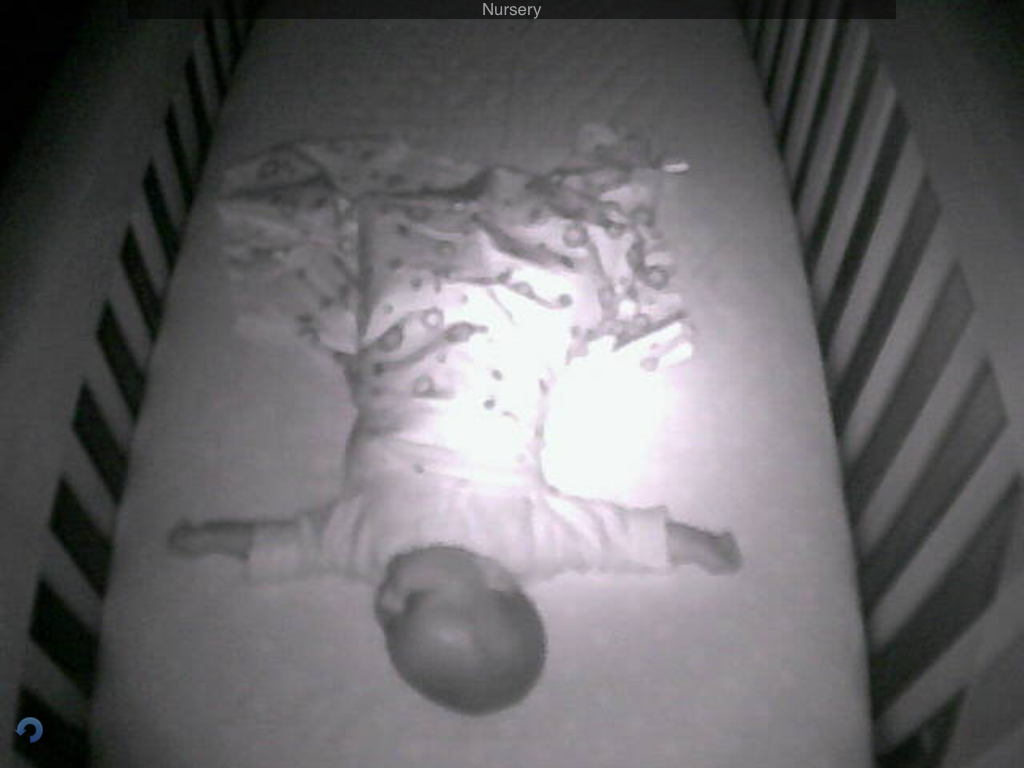
– The infrared lighting is nice, but is too concentrated. This means that you need to have the baby off center on the screen, or her face will be a white spot.
– The iOS app drains the battery crazy fast.
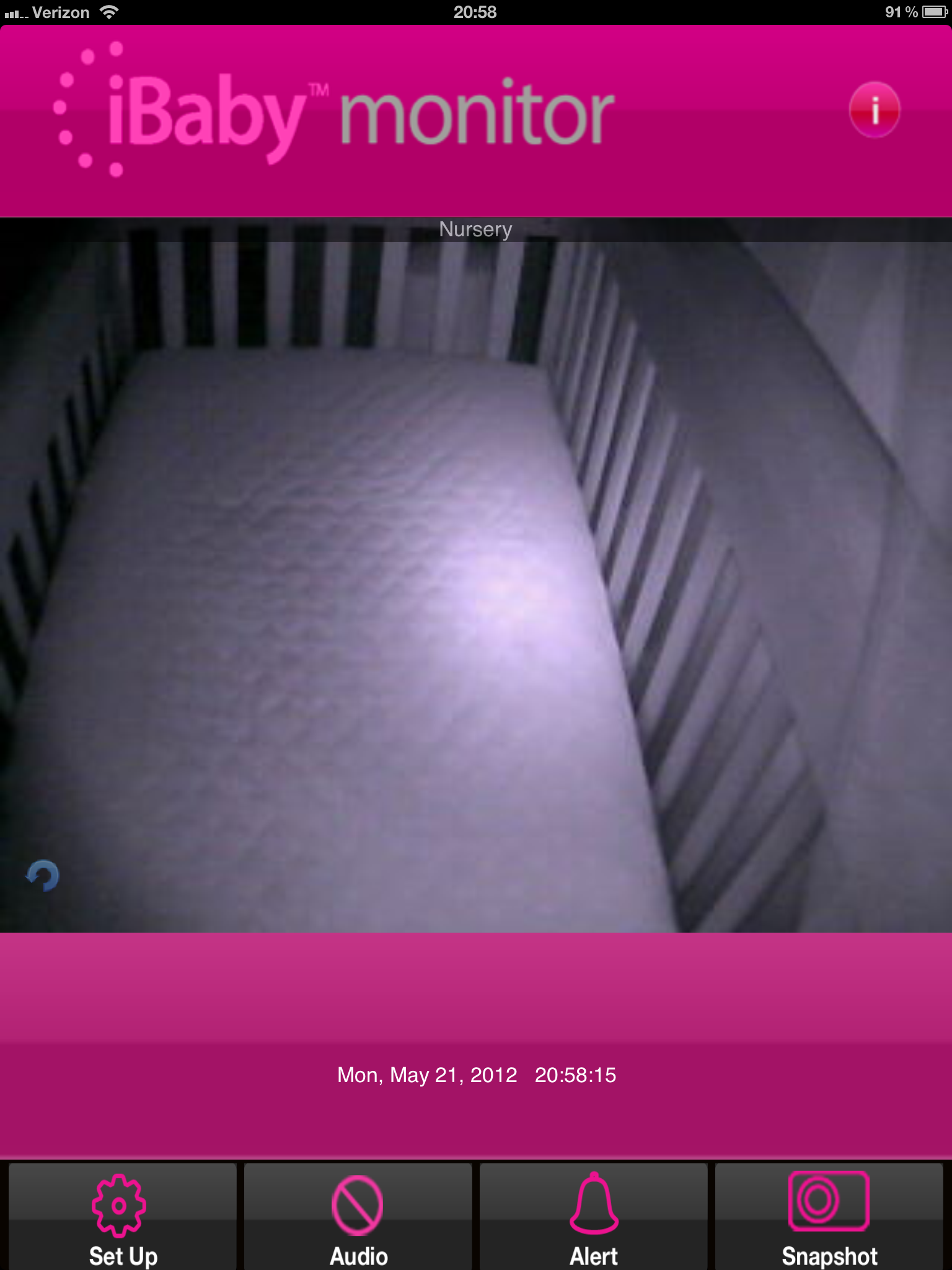
– The iOS apps are crazy ugly.
– The monitor says it will work over any internet connection (meaning you don’t have to be on the same network to view), but I have yet to get this to work despite forwarding the right ports. The app seems to connect, but never loads an image.
The infrared highlight blowout.
### Overall
Here’s the thing, I like this baby monitor. I know it’s not perfect, but it does a few things that make it a winner in my book:
1. It just always works. The power went out, I didn’t do anything, and when the power came back it was still working like normal. I unplug it and move it to another spot in the room, it just keeps working. In fact the app is stable and the camera software is stable — that’s probably the most important facet of any baby monitor.
2. It works with iOS and therefore I don’t need to carry anything else with me. I don’t even need to have the app running — it will alert me of movement or sound in customizable settings.
3. I love that I can pan and tilt the camera, because I never have to worry about if we can see her in the camera view or not — we can remotely move the camera to see her if needed.
All that said, I wasn’t lying when I said this app drains the battery fast. If you are listening to audio and video, you need your charger on hand. I did find that my original iPad makes for a nice dedicated viewing device (we use it in the living room). For a point of reference this is the only app running on the iPad and the battery drained to 40% in 1.5 hours. So yeah, this app eats batteries. But you don’t need to have it running, so there’s a nice tradeoff there.
For as much as I like the way this works, the app is horrendous looking. Here’s what it looks like:
The horrible UI.
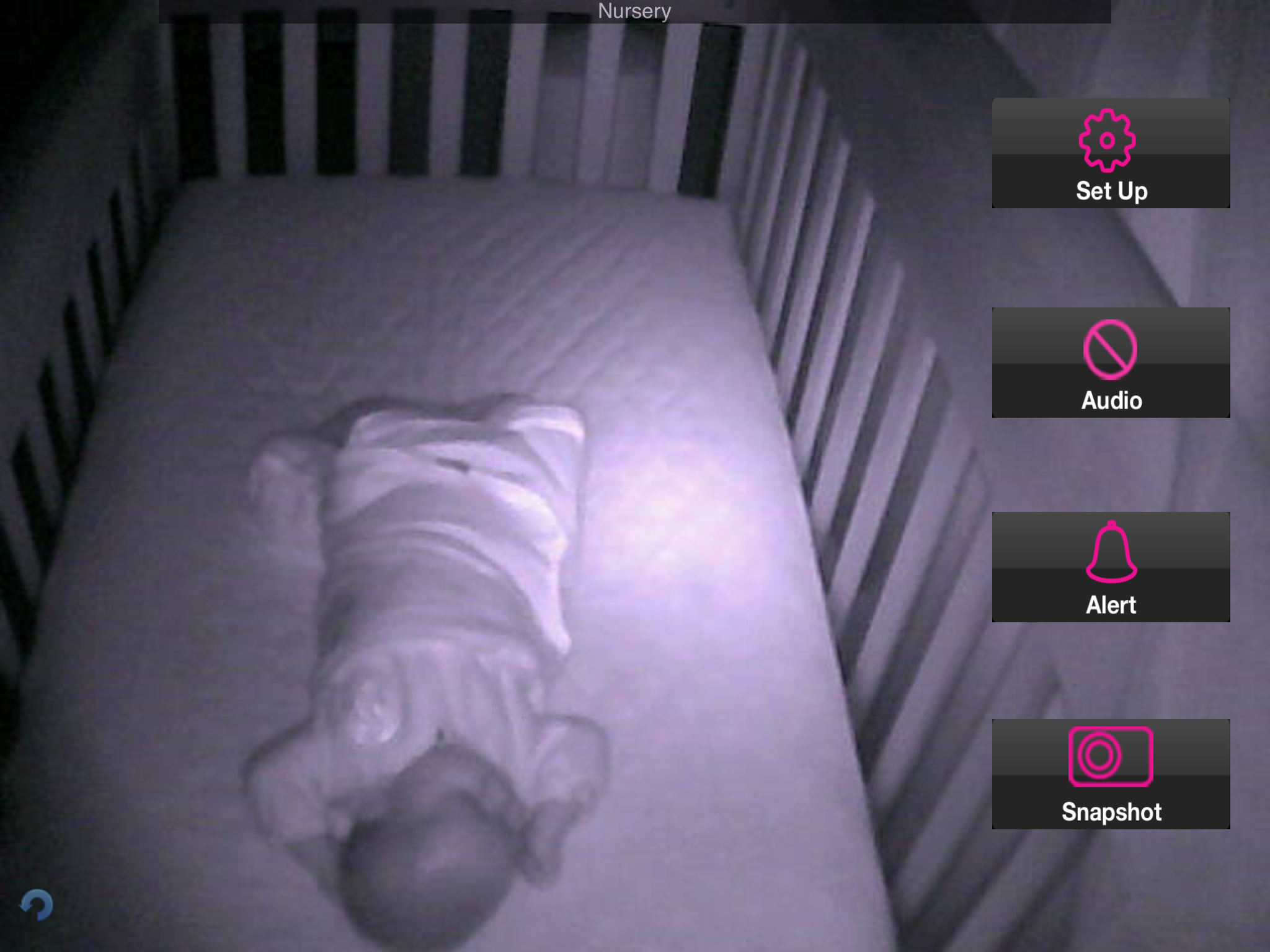
That’s why I run the app in landscape, because here’s what that looks like:
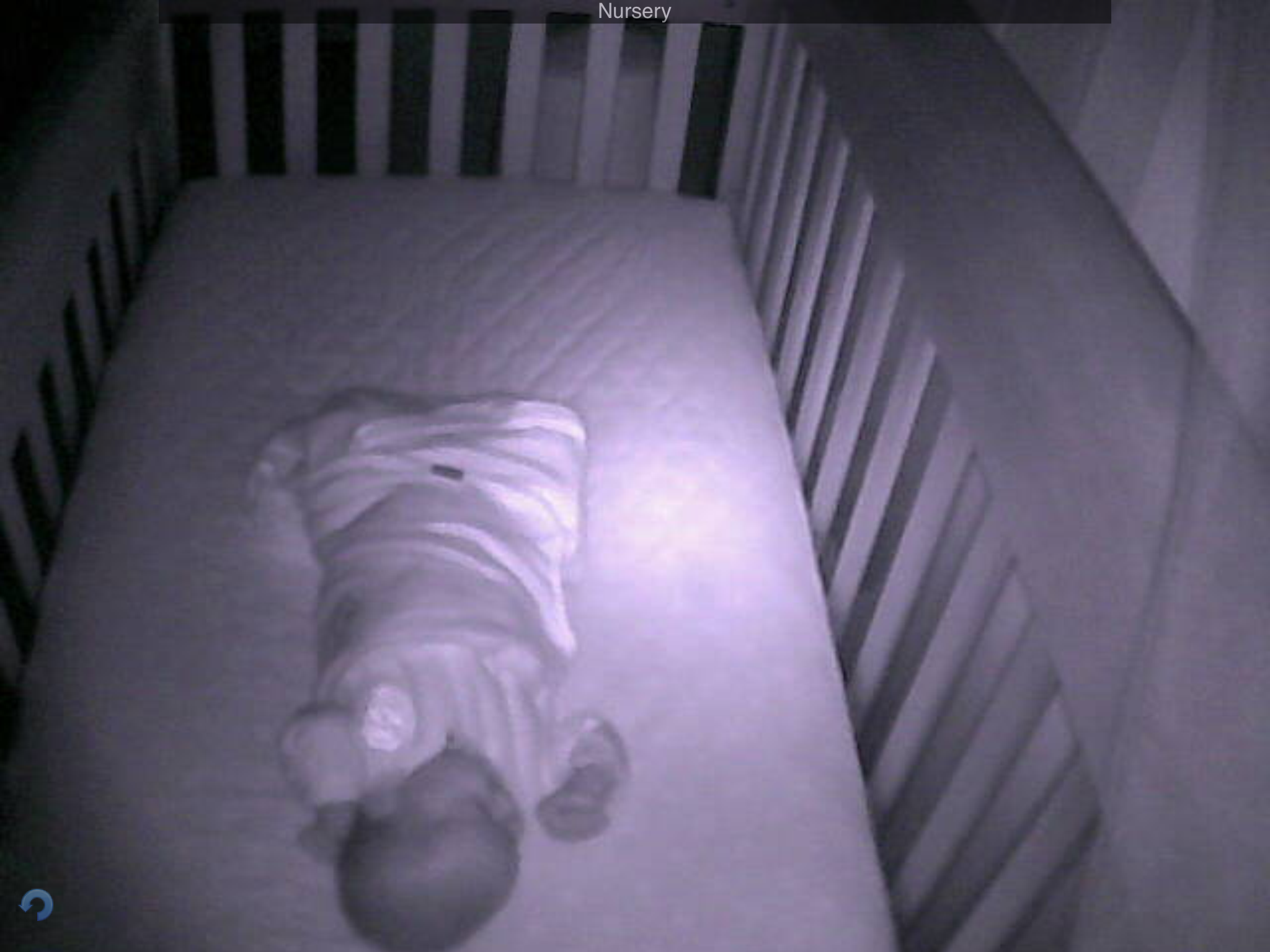
Less horrible landscape UI.Even better: Landscape UI, picture only.
Much better.
You can focus the camera manually, but it never seems to be crystal clear for me on the iPad. [It’s not cheap either, but hey, I like it](http://www.amazon.com/exec/obidos/ASIN/B005FPT51K/ref=nosim&tag=brooksreview-20).
Michael Wolff:
>Facebook is not only on course to go bust, but will take the rest of the ad-supported Web with it.
That’s the opening sentence, and it only gets better and harder to argue with from there. Wolff makes some great points, not only about Facebook, but about web advertising in general.
Typically when I read a post I am able to pick out one section to quote, with this post I could have quoted just about any sentence.
I rate this post: fifteen seconds of slow clapping.
CEO of Google, Larry Page, today (May 22, 2012):
>Sanjay Jha, who was responsible for building the company and placing that big bet on Android, has stepped down as CEO. I would like to thank him for his efforts and am tremendously pleased that he will be working to ensure a smooth transition as long-time Googler Dennis Woodside takes over as CEO of Motorola Mobility.
[Phil Goldstein](http://www.fiercewireless.com/story/motorola-exec-product-strategy-wont-change-after-google-acquistion/2012-03-01) on March 1, 2012:
>Andy Rubin, Google’s senior vice president in charge of mobile, said he is aware of the concerns that Google will favor Motorola, but stressed that Google has “literally built a firewall” between the Android team and Motorola.
I guess “literally” doesn’t include putting a loyal Googler in charge.
I debated about writing this, but I can’t stand to be silent on this matter. Some of you will think this is a vendetta I have against Readability, so you can ignore me if you honestly believe that.
Today I was made aware of [Readlists](http://readlists.com) which is a service from Arc90 and Readability. Essentially a user can make a “Readlist” of articles that they like that pertain to a common theme. A good example of this is the Readlist comically titled: “[Instapaper is Better](http://readlists.com/a49d6191/)” (for the record I did not create it).
As you can see, on a Readlists page, you can publicly share the page, as well as download a packaged eBook with all of the content in it. At first glance this doesn’t look different than what Instapaper does, by allowing users to download articles to a Kindle — but it is actually very different.
With Readlists you are essentially publicly sharing an eBook that contains a writer’s content — content that was never granted permission to be redistributed. In Instapaper (as far as I know) you can’t grab an article list from another user and package an eBook that you can then download.
This is where I call bullshit on Readlists.
Readlists is a service to allow people to completely avoid reading a content producers site, allowing them to repackage and redistribute their content all without permission.
This is utter crap and shady as hell.
I sent Readlists an email requesting my site be blocked (I think they have done so now as a post of mine was on that above Instapaper Readlist), if you write on the web I urge you to do the same.
**Update:** Nope, looks like my site hasn’t been blocked — I was *too* generous to them.
A fun new game from Lex Friedman and Marco Tabini where you pick a competitor and then hum the tune of a song (out of three choices, where you can listen to the songs as well), they they have to guess the song.
As I tell Shawn all the time on our podcast, I am tone deaf, pitch unaware, rhythmically challenged, and generally embarrassing when it comes to musical pursuits. That said I asked my wife to play this last night against Lex while I tested it out — even just being a spectator I had good fun. There’s a free version and a [paid](http://itunes.apple.com/us/app/lets-sing!/id519518278?mt=8), no ads, version.
It’s a pretty fun little game, if you find me on there you may just get to play against my wife.
I’ve had this printer for a while now and I have to say: it’s the best printer I have ever owned. I specifically chose this printer for the quality and the size.
Because looking at 8×10 prints is neat, but looking at 13×19 prints is fantastic.
My wife and I don’t really buy artwork to hang on our walls, we buy frames and fill them with pictures of *our* life.
Yes, the paper I use is expensive because I want the prints to look great.
Yes, the ink doesn’t last long and is massively expensive and requires all the colors to be full before printing in black and white.
Yes, it is a printer in an increasingly digital world.
But — man — it’s a hell of a printer, and after all it’s much more satisfying to look at your photos when they are hanging on the wall.
Oh, and this printer used to retail for about $900, but through Amazon can be had for the bargain price of $535.71 after rebates. So there’s that too.
Chuck Skoda:
>One thing though of which I’m convinced — the child confused that her swipes and pinches leave the magazine unaffected will not find it any less strange to have a laptop screen ignoring her gestures en masse.
Personally I don’t see a point in touchscreens on computers, but when you put it the way Skoda did, well… yeah that makes sense.
Sarah Jacobsson Purewal commenting on the $75 **trillion** in damages that the RIAA is seeking from LimeWire:
>That’s right, the music industry wants LimeWire to pay more money than exists in the entire world.
Nick Bilton concluding a great post about privacy and trust differences with Twitter and Facebook:
>In the long run, people will trust Twitter more than they do Facebook. And when it comes to building a long-term, trusting relationship with its users, Twitter will take it slowly and steadily, and in doing so, could win the race.
It’s a really interesting point to think about if you ask me. At what point, or what thing, would Facebook have to do to get you to say: “That’s it, I am done.” For me that happened a while ago, for reasons that truly don’t matter to *you*.
To me, Facebook is currently the Microsoft Windows from 1997. Everyone used Windows and *everyone* complained about Windows. Fast forward to today and everyone is on Facebook and (it seems) any user that has been on the site for over a year *is* complaining about Facebook.
That’s not to say Facebook can’t change, but it’s something to think about every time you use a new service that requires personal information, ask yourself:
– Do I trust them?
Do you trust Microsoft more than Facebook? I do. Do you trust Google? Hell no. Should you?