Year: 2014

  • The Gmail API

    Alistair Barr and Rolfe Winkler:

    The move, announced Wednesday at the company’s developer conference in San Francisco, is a first step toward turning Gmail into a platform for developers who want to leverage the contents of users’ email for productivity and other applications. A travel app, for example, could scan your email inbox for booking confirmations and automatically compile them into an itinerary. An expense app can dig through your inbox for receipts and automatically file them to your cloud-based account.

    This clearly sounds horrible from a privacy standpoint. Who wants developers sleuthing through their emails? I sure as hell don’t.

    In an interesting note about the privacy, WSJ notes:

    The new Google API may help with this. With IMAP, developers had to access all of a user’s messages to make their applications work, even if the apps only needed one specific type of data. The new API lets developers access only what they need. For example, if their app just sends mail on behalf of a user and does read mail, developers can limit their request to send-only, DeFriez said.
    “There are actually less privacy concerns than IMAP,” Mawani said.

    I find this statement really odd. The phrasing starts off to make it sound as though you have fine grain controls over what someone can access over the API. I picture something like: “Only emails with Confirmation in the subject line.” That actually would be pretty great.

    And then you read the rest of the sentence and it sounds more like the API privacy controls will be more like: “Send only, Scan only, Send & Scan.” Which is really nothing to brag about.

    All of that leads me to: how is this less of a concern than IMAP?

    Also, why does Google hate IMAP so much? Granted it is not great, but it’s a standard.

  • Court Rules No Fly List Process Is Unconstitutional and Must Be Reformed

    ACLU:

    The judge ordered the government to create a new process that remedies these shortcomings, calling the current process “wholly ineffective” and a violation of the Fifth Amendment’s guarantee of due process. The ruling also granted a key request in the lawsuit, ordering the government to tell the ACLU’s clients why they are on the No Fly List and give them the opportunity to challenge their inclusion on the list before the judge.

    You guys can’t see my face, but it’s what you might call ‘a shit eating grin’.

  • Nest to Share User Information With Google for the First Time

    Well, kind of (that’s not my headline). You see Nest is opening up some access to their devices so that other things can tie into the devices (HomeKit envy much?). As part of that Google is getting access to data so that a user can use voice controls to control the Nest devices.

    It’s also opt-in, which is good.

    So on the one hand you have Nest claiming that Google won’t get their hands on Nest data, and then you have this. Even if we give Nest & Google the benefit of the doubt, this is a case of incredibly stupid timing.

    But then as Rolfe Winkler and Alistair Barr reports, Matt Rogers a Nest co-founder had this to add:

    “We’re not telling Google anything that it doesn’t already know,” said Rogers.

    Well that’s reassuring.

  • Why Apple Really Cares About Your Privacy

    Rich Mogull:

    With every iteration of OS X, iOS, and iCloud, we see Apple add increasing the privacy protections it provides its users. It has consistently enabled customers to protect their personal information from advertisers, governments, third-party developers, and even Apple itself.

    Bottom line: Apple knows that it quickly will matter to consumers to have a privacy conscious company.

  • Cops Can’t Search Your Cell Phone Without a Warrant

    Dara Lind:

    The Supreme Court just ruled unanimously in two decisions that police officers can’t search the cell phone of someone they’ve stopped or arrested unless they have a warrant. That’s true even if the cops suspect that the phone has data that’s relevant to the crime.

    You need to know this, because cops will still try to get you to consent — not a lawyer, just saying.

  • Pepper-spray Bullet Firing Drones

    Leo Kelion:

    Desert Wolf’s website states that its Skunk octacopter drone is fitted with four high-capacity paintball barrels, each capable of firing up to 20 bullets per second.

    In addition to pepper-spray ammunition, the firm says it can also be armed with dye-marker balls and solid plastic balls.

    The machine can carry up to 4,000 bullets at a time as well as “blinding lasers” and on-board speakers that can communicate warnings to a crowd.

    That’s a real thing, they’ve already sold some, and not to governments.

  • Google Launches Drive For Work With Unlimited Storage For $10/Month

    Frederic Lardinois:

    It also launched Drive for Work, a new version of Drive and Google apps for businesses that comes with a number of extra security features. The one feature most users will notice first, however, is that Drive for Work doesn’t have any storage limitations.

    There’s a bunch of other, actually, great features too. To bad it is from Google.

    Between Drive and the news of Microsoft’s storage limit increases it looks as though Dropbox may not be long for this world. Dropbox is great, but Microsoft and Google are coming close to having better offerings — and Apple may feel the pressure and drop their prices too. If Apple does that, well I would see no reason to use Dropbox.

  • Google I/O 2014 in Tweets

    I didn’t watch the 14 hour Google Keynote today, nor have I read a single thing about it. Nope, just followed along with comments on Twitter. So, in chronological order, here is the Google I/O keynote recap:

    @justin: “We can’t hear Google, but they can see us. #io14”

    @moltz: “Look at this email interface. It doesn’t look like shit anymore. That’s the power we’re giving you.”

    @beerandpork: “Nice head placement pic.twitter.com/BS17GFlqdx”

    @panzer: “Google’s Problem: Even if its intentions are 100% pure, it’s impossible to talk wearables without thinking about data gathering for ads.”

    @gruber: “Eight on-stage speakers so far, by my count. Zero of them wearing Glass.”

    @danielpunkass: “The demo cockpit is a Kia. So is Kia the only company that agreed yet to integrate android auto?”

    @apike: “@danielpunkass No, they’re just the most prestigious one”

    @mattalexand:”Ah, I see it’s time for the Annual Google Television Attempt”

    @gruber: “So if you’re all in on the Google experience, are you supposed to buy an Android TV device or a Chromecast device or both?”

    @viticci: “I would say that Nike and Withings have produced more innovative and smarter wearable solutions than Google’s current crop of Android Wear.”

    @poritsky: “Inviting a creepy ad company into your television seems unwise.”

    @dhh: “Google’s new Material Design is pretty, but their language of justification is a ridiculous stew of gobbledygook. pic.twitter.com/z4EvWB9wQq”

    Sounds like a great keynote.

  • Announcing the Brooks Review Podcast

    Almost a year ago I polled readers of this site to see what they might want to see me do more of, and less of. The overwhelming response I got was: we want a podcast (again). I heard you, and I started working on a podcast, and then in August of 2013 I dropped the idea for a bit as life got busy.

    Now is the time though.

    So next week I am recording the first episode of what will be known as ‘The Brooks Review Podcast’ — really catchy name.

    Some notes about what this show is, and is not:

    • The first episode will record July 2nd, 2014 at about noon.
    • Most episodes will not air live, and this means no chat room. I am doing this intentionally, as I already have the infrastructure setup to actually have both live broadcasts and chats. I want to put forth something different and I think the only way to do that is to not air live.
    • I will be the host, and I will have guests on the show, the first two guests are booked. If you want to be a guest, or you want to nominate someone, get in touch with me. I’m not holding this show to just “popular bloggers” I want interesting people. I don’t care what your online presence is, just convince me you have interesting things to add.
    • The podcast will record weekly and hopefully be live Wednesday nights for your Thursday commute.
    • I am hoping to keep the show runtimes under an hour, but I am not putting a hard time limit on this. The shows need to end in a finished manner.
    • I am pledging to not just show up and wing it. I plan on outlining each show — not scripting — but knowing what I want to talk about and the path each show should move along. I’ll only share a rough outline with the guest right before we record — again I don’t want things rehearsed, but I want there to be a clear path leading to something.
    • My personal goal is to make something really special that is both well prepared and casual feeling — This American Life is my benchmark. I may never achieve that, but that’s my goal.
    • Bear with me because the first few episodes will very much be a work in progress.
    • My goal will necessitate editing of the content of each show. Most podcasts you listen to today are a straight recording, even the irrelevant and unfunny bits. I want to cut out the crap. I’ll pre-record any sponsors, and intros and record my talks with the guests. The pre-recordings are so that I don’t have to arbitrarily work in a sponsor at and interrupt the flow of discourse. At the end of it I will trim the show where needed to create a better podcast, but I’ll do so with the utmost respect to the intent, meaning, and integrity of what each guest is saying. I am working on a way to provide the RAW audio file as a reference point so that you can be the judge of whether I am accomplishing that goal.

    That about covers it.

    The show lives here. And will also be in iTunes here.

    I am currently taking sponsors, even for the first episode — but I really have no clue what the listenership will be. You can see more about that here, and I’d really love to have you sponsor the show. (Paid podcasts really aren’t feasible.)

  • Amazon’s Terrible Marketing

    I wasn’t much excited about Amazon’s new ‘Fire Phone’, because I’ve actually used a Kindle Fire and I know the reality of the situation. What’s always far more interesting to me is the way Amazon markets new products, because overall Amazon does a pretty shitty job at marketing products.

    Yes, they have a great website which works well and does a good job at recommending things, but when it comes to the behemoth trying to sell new products (which they’ve made) — well desperation is the word that best sums up their marketing.

    Please, just buy this. Now. Please?

    In watching the marketing video Amazon prepared for the Fire Phone you will immediately notice one thing: it looks like a knock off of an Apple product video. One where Jony Ive is sitting there talking about design and Schiller is bouncing up and down talking about cool features.

    I’ll give Amazon that, they did copy the format. But they royally screwed up the execution.

    The people sitting there talking about the Fire Phone seem equal parts confused and exhausted, but the real issue is the real people (aka, not trained actors) that are talking about the phone as they use it.

    What you hear is a lot of ‘whoa’, ‘cool’, ‘neat-o Billy’ type of statements. Whether real or contrived, the people in the video clearly want you to know that they think the device is cool.

    What you don’t see, and don’t hear, is the usefulness of any of this. Because what Amazon is doing is marketing the features, specs, and wow factor of the device, instead of marketing the end results of the device.

    Their video is effectively the bullet points you find on the box.

    Amazon, then, is showing you why their device is cool in the phone landscape. Whereas what Apple tends to do is to show you the practical benefits that you, the user, will receive from having an iPhone.

    In a typical Apple marketing video what you see is:

    • People using, and enjoying using, the device being marketed.
    • People accomplishing something of merit with the device.

    Whether it is a Christmas ad of an introverted kid making a stellar family video, or a lone videographer shooting video of Niagara falls — what you see is stuff being done. Imagine those ads of Apple’s with the actors in them saying: “whoa look at this parallax.”

    With Apple’s ads I often don’t know how people are accomplishing what is shown, but I know that they are accomplishing specific tasks that I often don’t think about doing with my iPhone.

    With Amazon’s ads I know some of the things the device has, but am left knowing very little about what I can do with the device. Show me the practical, day-to-day applications of Firefly, not just the feature.

    So as a potential customer it becomes more of a challenge to want the Amazon device, based solely on the fact that I really don’t know what the fuck I can do with the device.

    Even Samsung does a much better job at this, or Microsoft with the Surface 3 commercials.

    Amazon’s marketing is just plain terrible.

  • Withings Activité

    Fascinating new smart watch from Withings. It looks like a traditional analog watch, but contains all sorts of tech. For $390 it’s not cheap, but it also doesn’t look terrible — so there’s that.

    The site is terrible as it hijacks your scrolling, but the highlights are:

    • Step tracking (it says distance too, but color me skeptical)
    • Swimming tracking (umm, ok?)
    • Sleep monitoring (when you fell asleep, how long, etc.)
    • Tap the glass twice to view alarms (sounds neat)
    • Vibration in the watch (used for alerts and alarms)

    I list that out in regurgitative fashion because their website scrolls so terribly I wouldn’t want to subject you to it.

    I have a watch with a vibrating alarm, and they don’t work all that well. At least mine isn’t strong enough to wake me.

    That said, this is a better train of thought than every other smart watch I have seen.

  • Moving Back to OmniFocus

    When OmniFocus 2 came out, I switched back to it from Flow. I hadn’t been using any betas, or anything of that ilk. I had been using Flow, as I’ve documented here on this site.

    But, as it tends to happen in life, I had been getting increasingly busy. So busy that I was overwhelmed trying to manage everything in Flow. For all the happiness that Flow brought me for the many months I used it, the cracks began to show when I started to get swamped.

    And that’s bad, very bad. A task management tool should excel, not break, when the going gets busy. What I’ve come to realize is that if your task management system doesn’t seem like overkill when you are not overly busy, then you are going to break it when things get very busy.

    So I took the opportunity to move back to OmniFocus, and with it I found comfort.

    I found trust.

    The thing about OmniFocus, for me, is that it always feels safe. I know that it’s going to show me things, ping me, and ding at me. I know that it’s not going to lose anything. I know it is there, waiting, and ready for anything.

    I never got that feeling with Flow, and so now — even after I am over the hump of being incredibly busy — I am going to stay with OmniFocus. I’ll still use Flow and other tools, but OmniFocus with be the hub for everything.

    More on that later…

  • Idea for a WordPress Plugin: Blogger Honesty

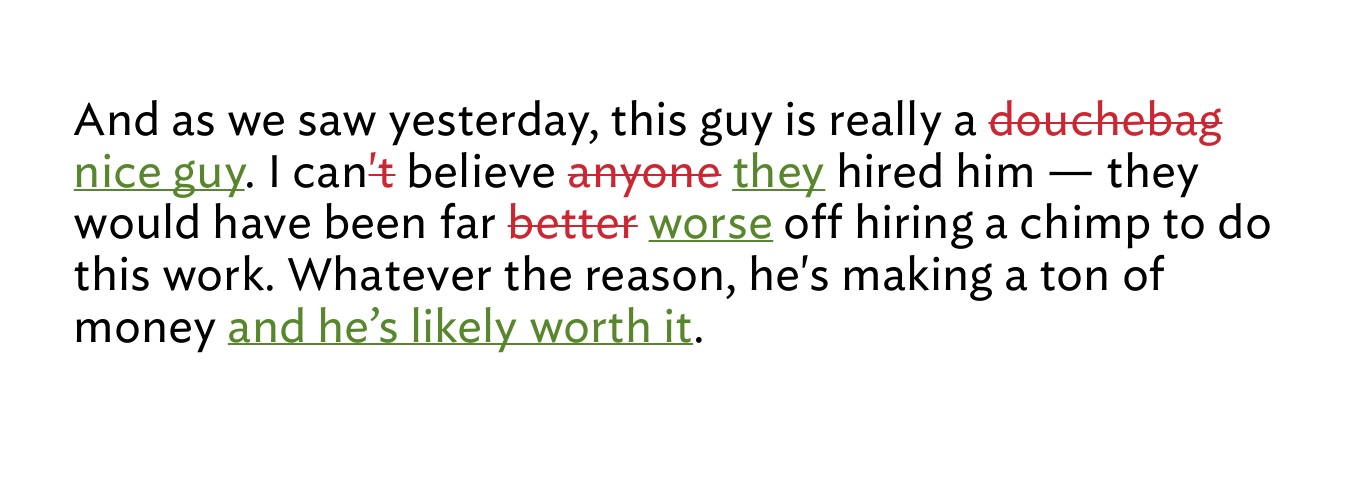
    Here’s a free idea for anyone who wants to whip this up: a new plugin for WordPress which shows readers the revisions made to a post. I’ve always wanted something like this, but the two plugins that currently exist aren’t up to snuff (and one is dead it looks like as it’s been two years since its last update).

    Here’s the gist of how the plugin I picture works:

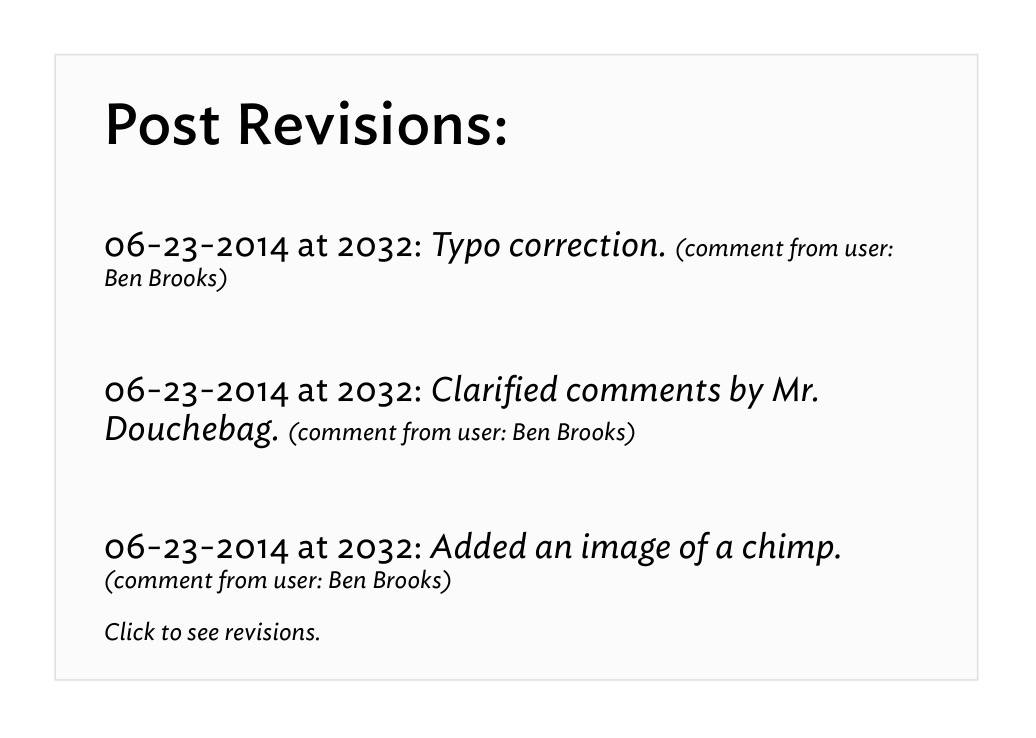
    • After a post is published any change made to it requires a comment be entered about what the change was. This is published on the site at the bottom of the entry after any footnotes. It can be short like I show in the below mockups, or verbose like The New York Times updates.
    • There’s a reader toggle that allows the reader to see the complete revision set of the document. This is shown inline for space and ease of viewing.
    • The site admin can set a threshold where X% of changes to overall text triggers a new post to be automatically published on the site letting readers know substantial changes have been made. The author of each post is warned that recent changes will trigger this post, and able to fill in text in a custom field to explain changes in the new post. Picture the posts that Kottke.org posts to let RSS readers know of updates. The author can also trigger this if needed. The update post would only publish once a day and contain a listing of all of these items.

    The goal is more transparency in publishing. I, or any blogger, could effectively wait for a ‘big name’ to endorse a post and then change all the text in my original post so it looks like that ‘big name’ just endorsed something awful.

    But more practically I just want to show the readers changes that have been made so that I can keep articles updated, in a more ‘living document’ manner.

    Here’s a mockup of what I’d like to see for the revision displays that the user could toggle on:

    And here’s what I would like to see shown at the bottom of the post listing revisions:

    You can have this idea, but if you build it let me know so that I can use it.

  • New Sensors Will Scoop Up Data in Chicago

    David Heinzmann:

    “Almost any data that starts with an individual is going to be identifiable,” Cate said. When tracking activity from mobile phones, “you actually collect the traffic. You may not care about the fact that it’s personally identifiable. It’s still going to be personally identifiable.”

    King, the Harvard sociologist and data expert, agreed that the Chicago scientists will inevitably scoop up personally identifiable data.

    “If they do a good job they’ll collect identifiable data. You can (gather) identifiable data with remarkably little information,” King said. “You have to be careful. Good things can produce bad things.”

    Yeah

  • The Case That Might Cripple Facebook

    Henry Farrell:

    If the ECJ rules that Safe Harbor is invalid, what next? Potential near-disaster for big U.S. e-commerce firms like Facebook, Google and Microsoft, which are heavily exposed to European markets, and rely on European citizens’ personal data. The death of Safe Harbor would mean that they were not able to legally export personal data, potentially crippling their business model. Nor could they substitute alternative arrangements (such as contracts), since these arrangements would not provide any protection from the NSA. Firms would of course protest volubly, and get the U.S. administration to fight on their behalf.

    Interesting article showing the politically hot waters that companies like Facebook may potentially find themselves in. If the ruling is not as cited as above everything is normal. If it isn’t? Well that’s going to be very interesting.

  • Microsoft Ups Free Onedrive Storage

    Mark Hachman:

    Today, OneDrive comes with seven gigabytes of free storage, and Office 365 comes with 20 gigabytes of OneDrive storage. As of today, that’s changed: Microsoft will increase the free quota to 15 Gbytes, and OneDrive subscribers will receive a whopping 1 terabyte with their subscription. The changes will roll out over the next month.

    In other words: Dropbox is a feature, not a business.

  • Owning the Experience Is Key to Apple’s Customer Satisfaction

    John Moltz for Macworld:

    In the Windows and Android worlds, ownership of the experience is a filthy scrum of competing interests.

    Very good post looking at why Apple wants to own the key, the core, things that you use their devices for.

  • Quote of the Day: Garrett Murray

    “You’re confusing our mutual parental status as a license to act like a fucking asshole.”
  • Podcasting, Networks, and Audience Building

    A month ago, Marco Arment made the ill-advised statement ((Ill-advised because it required more words to clarify.)) saying:

    Podcast networks are a lot like blog networks. (Remember them?) When the medium is young and everything’s difficult, it helps to band together with a large entity to pool resources on tools, hosting, ad sales, and staffing.

    He went on to talk about how these networks are not needed anymore. ((Not needed to be successful that is. Important distinction.)) Yesterday Arment sought to clarify his position since he was (likely) getting tired of people emailing him:

    Podcast networks are like record labels: they promise exposure, tools, distribution, and money. But as the medium and infrastructure mature, their services are often unnecessary, outdated, and a bad deal for publishers.

    I read that post, and I’ll be honest, it didn’t sit well with me. It seemed a bit too defensive and not expounded upon properly.

    Just this morning Arment followed up with a longer, and very excellent post. You should read the whole thing, but because I know a lot of you won’t, here are two relevant bits:

    Discoverability is overrated. The real way to get more listeners is to make a great, relevant show. The best content tends to be found, but it takes hard work and dedication.

    And:

    Neutral simply wasn’t as good as ATP and wasn’t as relevant to the audience. The Magazine under my leadership was subjectless, unfocused, and irrelevant to most of my audience. Bugshot was only useful to a few people, and I didn’t put much time into it. All of these had the benefits of a “built-in audience” to give them an initial spike, but none succeeded because they simply weren’t good enough.

    A lot of the criticism Arment has taken for his position on the rather pointless debate of whether podcast networks matter, surround this notion that Arment cannot apply his data to the overall dataset because he is so ‘famous’ to begin with.

    Bullshit.

    Read that last quoted text from Arment, that’s all you need to know. Your popularity and fame will only get what you do noticed, it will not sustain success. That’s why we have ‘one-hit wonders’, that’s why that stupid Color app didn’t go anywhere, and that’s why unknown people are found and loved. Discoverability is based on talent, or fame, but success is based solely on talent. ((Ok, for the most part. But certainly in podcasting unless your fame is Kanye West level of stupidity.))

    I’m coming at this from a different angle than Arment. I’ve never been popular or famous. I’ve never built anything really cool. All I’ve done is yell at people to get off my fucking lawn. ((Side note: there was an estate sale on my block this weekend and after the fifth car parked on my lawn I turned on my sprinkler system for the rest of the sale.)) When Shawn and I had B&B we struggled to gain more listeners each month. We didn’t really ever lose any, but we never gained a ton either.

    Ditto my paywall. ((Duh.))

    When B&B joined 5by5, nothing really changed for us, other than we got better and easier hosting, and got to chat with Dan a lot. But being a part of 5by5 — the best we could tell — didn’t significantly result in any difference to listenership. Other than helping us sell ads, because it lent legitimacy to our podcast, 5by5 didn’t change much for our podcast. And Shawn is famous.

    When I was on Fusion, a quasi blog network, nothing happened for my site directly because of Fusion. When I left, nothing happened either.

    When I was on the Syndicate, nothing again. (Other than still being listed as part of the network on Asymco — which gets me about 5 extra hits a month.)

    Sid O’Neill, whether he wanted to or not, sums up the side urging for podcast networks well:

    Getting your show on a podcast network associates you with a lot of other shows that people are already enjoying. It’s a mark of quality, and these days when everyone and their mother has a podcast, it makes it a lot more likely that someone will discover your show.

    And:

    Obviously ATP’s success is — in part — due to the loyal following that both John and Marco had accumulated over years of putting out fantastic podcasts.

    First off all, O’Neill’s first statement would imply that everyone who listens to one 5by5 podcast has listened to at least one episode of every other show. It also implies that the average podcast listener goes to the 5by5 website to see what shows are new.

    That’s a dubious argument, as I doubt most podcast listeners hear about a new show at 5by5, unless that new show is mentioned on the podcast they are listening too already. But I have no supporting evidence to back up that claim it’s just my overall sense.

    As for the idea that a loyal following played a role in the success of ATP: It did, and I don’t think Arment is arguing it didn’t. But what Arment is saying is that a loyal following only helps to get people to look at what you are doing, but to keep them coming back you have to actually be good.

    Better than good these days. You have to be great — even if you are Marco Arment. Actually, especially if you are Marco Arment.

    I’d argue a bit with Arment about how easy everything is, but that’s mostly because getting the podcast into iTunes is a bit opaque to most people. But generally speaking there are enough tutorials out there that it’s pretty simple.

    Shawn and I got going not knowing a thing about podcasting, and it took me about 3 days of playing to figure out everything (Shawn handled the iTunes end of things, I did the audio). ((For those that are about to email me. Yes, I am starting back up a podcast again. NO, Shawn is not a part of it as we feel we don’t want to revive B&B — we prefer to preserve the memory of it. When it launches you can find it here, right now there is just a badly coded website and a dummy podcast of the smallest file size B&B we recorded.))

    In short then, Arment is right that podcast networks don’t matter much. They won’t make a shitty podcast well listened to, and they won’t elevate a good podcast anymore than where it will naturally go. Your best bet is to put in a ton of time making your podcast not suck.
  • Quote of the Day: John Moltz

    “Blackberry still exists. Which is kind of where their bar for success is right now.”