“Just as it would have been bullshit a generation ago to say that TV Guide was 20 times better than The New Yorker because it had 20 times more subscribers.”
Year: 2014
-
Six-Hour Workday Experiment
Chris Gayomali:
The year-long project, set to officially begin July 1st, will divide some workers into two groups. One enviable test group will work shorter days, while their colleagues will work eight hours each day. It is unclear how this will be decided exactly, but it is an experiment designed to test growing assumptions that fewer, more-focused hours could be a boon for employee productivity.
It will be interesting to see what they learn. A lot of people love working “Four Tens” where you work four ten hour days instead of five eight hour days. However research seems to point to that being a poor choice overall for workers. I’d be a big fan of six hour work days overall, as I am pretty sure that is about the total amount of productive hours I get out of people.
-
Math Victory in Seattle
Cliff Mass on the Seattle School Board’s vote to remove bullshit math courses from Seattle elementary schools:
Finally, Seattle students will be spared fuzzy, discovery math in which senseless group learning, essays, and excessive calculator use have been the rule.
This makes me happy.
-
Continuity is the future of Apple
Serenity Caldwell:
Apple has made a promise here: The future of computing should be free of file limitations and processor speeds, of screen sizes and portability. It should render the hardware invisible and put the focus on the work you’re doing.
It all comes down to how well the system works. It must always work or people will stop trying to use it.
-
Tobias Frere-Jones on Helvetica for Yosemite
Interesting thoughts, but nothing that we haven’t heard. I can’t speak to non-retina displays, but for a retina display MacBook Pro, I don’t see any issues with Helvetica.
Though, I still don’t like to read articles set in Helvetica.
-
WWDC Around the Web
All developers I’ve talked to over the past few days share a common thought: this year’s announcements are creating new possibilities. New technologies can empower users in new and better ways. We can’t wait to start coding.
I’ve heard this same thing too. Developers are really excited.
Apple has a newfound confidence in itself. It’s at the top of its game, and it knows it.
I wouldn’t say ‘newfound’, I think a better word is: recharged. I don’t think Apple ever lost confidence, but I think they questioned their confidence a bit.
Apple feels good about itself, and that trickles down to the community. You can feel it in the air.
It’s palpable.
We are seeing what the post Steve Jobs Apple is like, and my friends, it is awesome.
If I summed up the direction Apple has decided to take, it would simply be: bold. They aren’t resting on their laurels the way Microsoft did when Ballmer took over. They are banging shit out and getting it done as fearless as they can be. But they are tempering that enthusiasm with patience and thought. They are doing a lot, but are being careful to do it right the first time.
A lot of people have told me I am too excited about iCloud Drive, but the thing is I think Apple will finally get the cloud stuff right. Their stream for WWDC was perfect, and their iCloud offerings really have been nearly flawless recently.
Over the next year, there will be innovations that surprise and delight users, and they won’t be trapped inside a single app interface—they will be able to spread themselves across many more parts of the iOS interface.
All of a sudden things that used to be very tedious to do on iOS will become so simple that it will feel magical. There’s no need to talk about customer lock-in with iCloud — that’s all the lock-in most people need.
-
Quote of the Day: Chris Bailey
“Productivity isn’t about how much you produce, it’s about how much you accomplish.” -
Updates to ‘The Best’
I just updated my ‘best’ listing page to add in a few more great apps. I should have some more larger product updates in later this week.
UPDATED (on Jun 4, 2014): Added a bunch more products to the page.
-
Bing will be default for Apple’s new Mac OS X Spotlight
Todd Bishop:
An overhauled version of the Mac OS X Spotlight search will rely on Bing for web searches, the Redmond company confirmed this afternoon, after Apple listed Bing among the service providers powering the feature earlier today.
Apple knows that the general consumer has too big an affinity for Google to change the default search in Safari, but by doing these little changes with Siri and now Spotlight, Apple is really squeezing Google. If Spotlight starts gaining traction, that is. And that's a big if, as it isn't widely used now (from what I see).
(Via Jamie Smyth) -
John Oliver On Net Neutrality (YouTube)
I watched this last night with my wife and it is just perfect. Nothing new for those following the topic, but very well put and something the average person can understand and get behind.
-
Blixt for iPhone
A few nights ago I got an email from Bryan Clark, and he explained that he and Jesse Herlitz teamed up to make a new App.net client, and they are still excited about it even if App.net seems to be in a bit of limbo. I’ll be honest, I wasn’t too excited to test the app, but I checked out the other app these two worked on and was impressed with the app. Then, I accepted to promo code so I could see the app before launch ((If you don’t know, developers can have an app approved, but hold it so you cannot download it. Then they can share promo codes and people can download the app from the App Store that way.))
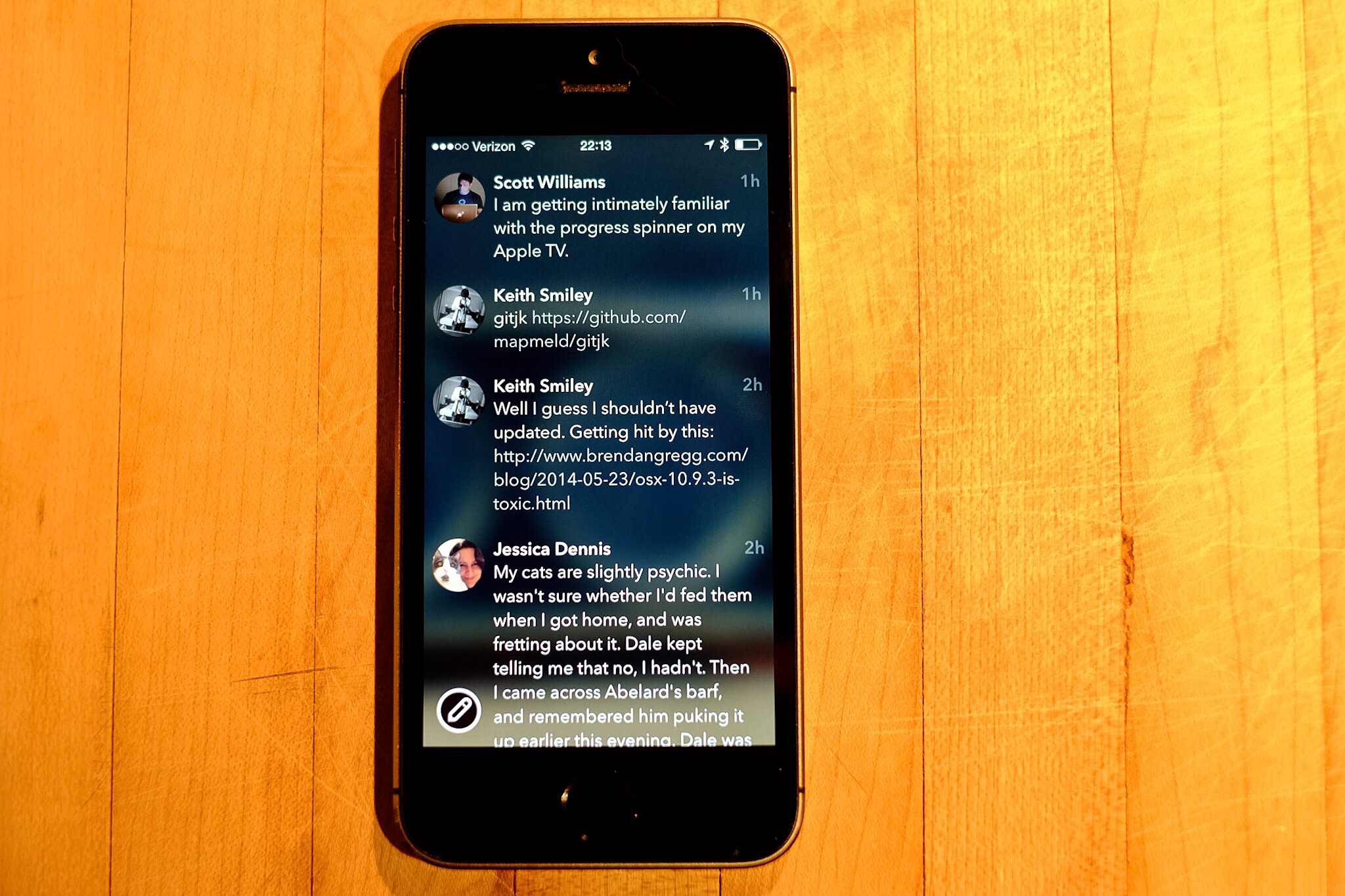
Boy am I glad I checked out the app. It’s called Blixt and it is an App.net client, though it doesn’t do private messaging.
It is gorgeous.
It is damned smooth.
I love so many things about this app that I wish people posted more on App.net so that I might use it more.
The Highlights
The scrolling in this app is possibly the smoothest scrolling I’ve seen, it’s like a plastic disc on an air hockey table. Simply fantastic, you just want to scroll around. I don’t know what gives it that feeling, but man is it silky smooth.
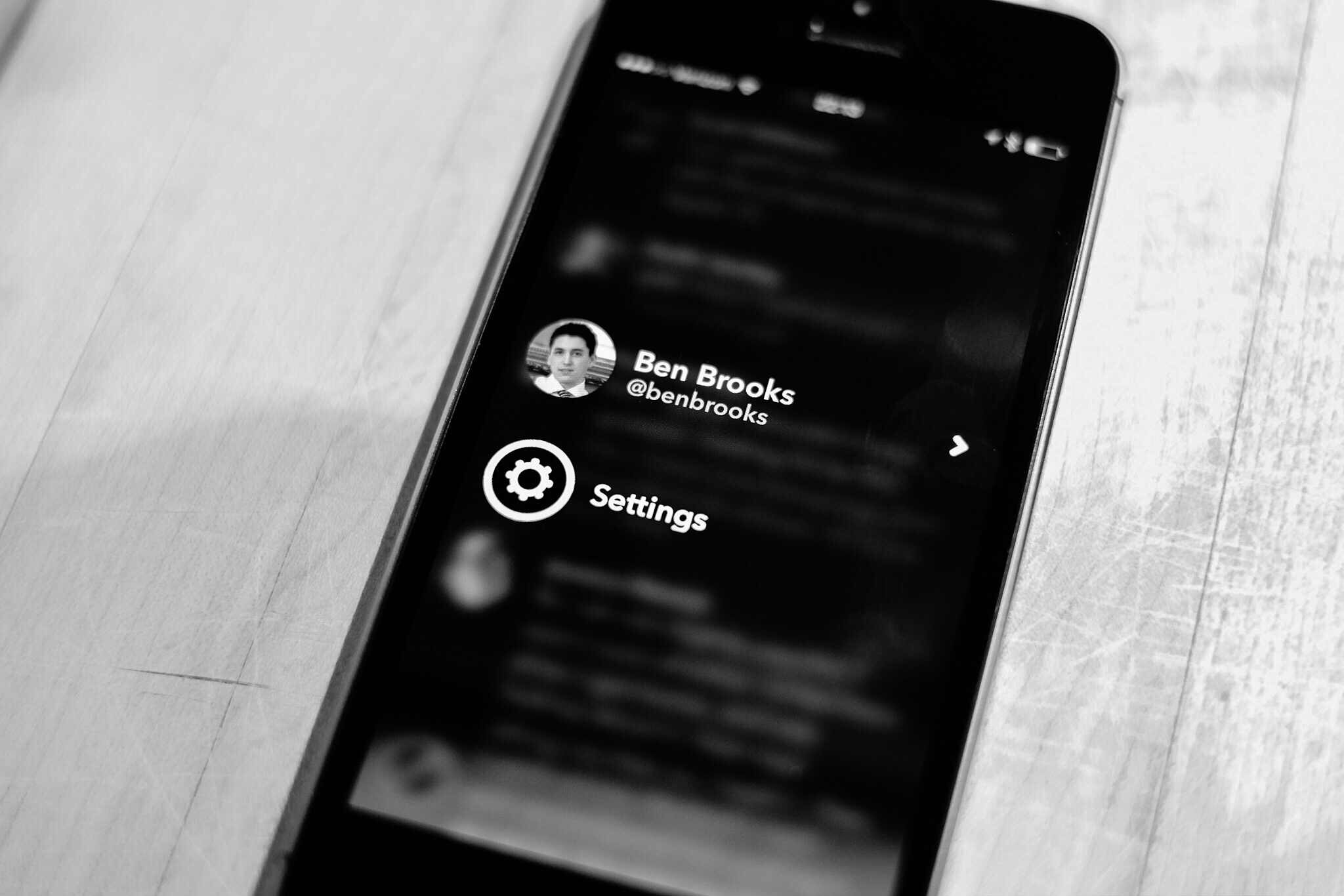
There are no delineating lines between posts, but somehow nothing looks cluttered and nothing is confusing. It’s really clean feeling and super flat, but yet it feels like slick glass. It feels made for the iPhone.
The animations are great. From the little bounce a post does when interacted with, to the loading indicator when using the browser. All these small touches make for an app that visually doesn’t get in the way, but never leaves you feeling lost.
I was confused at first as to what the image is that is blurred out behind your timeline, as it turns out it is your cover image. However, when you browse to another user, or simply view the post view for a post that is not yours, the image switches to that user’s cover image. Very nice touch, and amazingly not distracting at all, it simply gives a little depth and character to the app. In fact it is a great way to skin the app a bit if you want.
Another nice touch is how large the few buttons are. This is best seen when composing a new post, as the buttons are a bit in your face, but thankfully easy to tap, which isn’t something I can say about most of iOS 7. Even though the buttons are larger they feel right, but not something you tend to see in iOS anymore.
The Misses
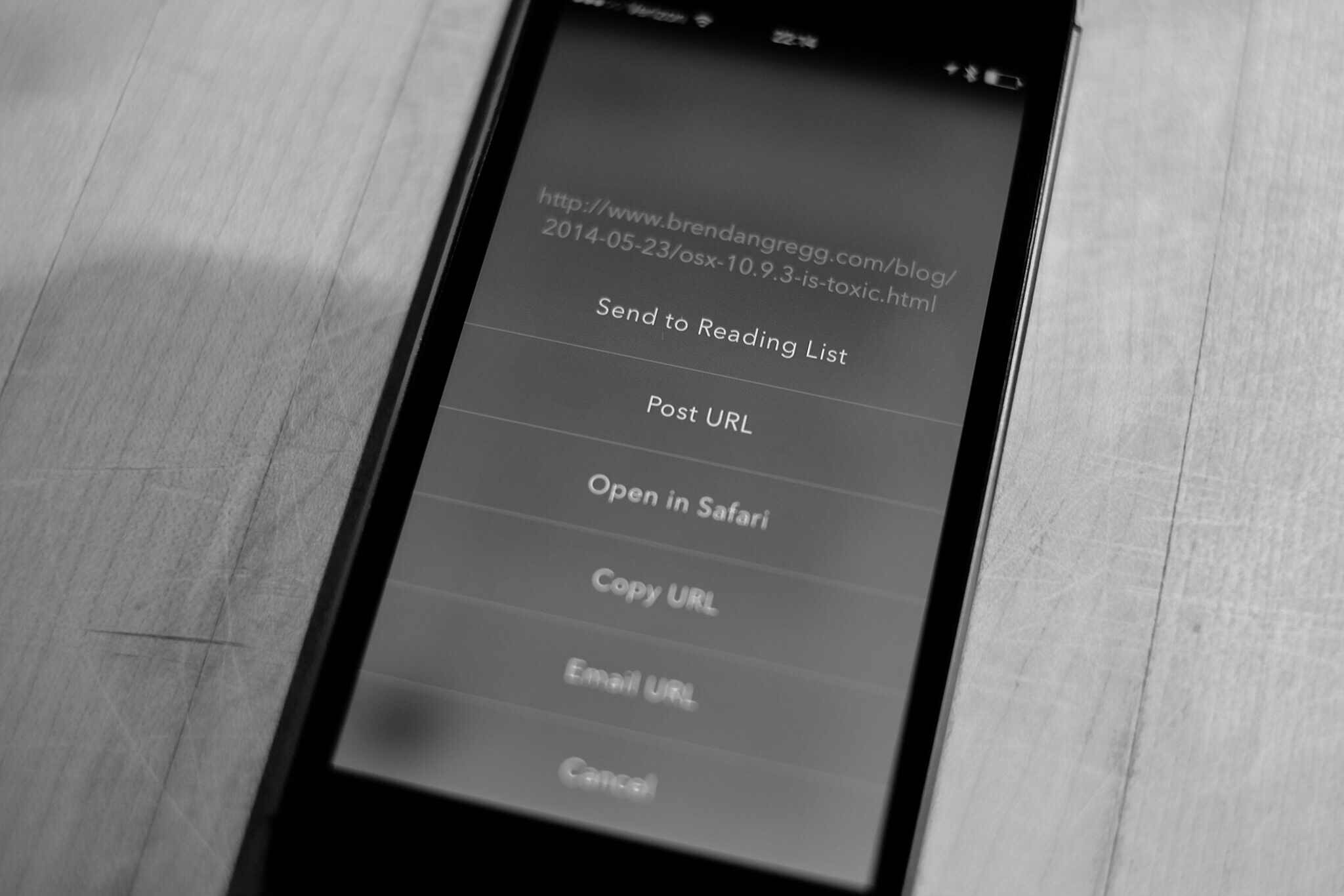
There’s a bug that I’ve run into when I tap on a post with a link the app seems to freeze (the developers are looking into it), all you have to do is go back to the home screen and back into the app (no force quitting needed) and all is fine. It’s odd and annoying, but a testament to just how good this app is that I am more than fine with putting up with that bug.
The swiping is a bit un-iOS, in that going back, say from mentions to timeline, requires a swipe starting near the middle of the screen to the edge. If you swipe from the left edge to the right, you pull up the account switcher and settings screen — I pull that screen up a lot. This isn’t consistent with the rest of iOS so it is likely to always be a challenge for me.
The Icon
I wanted to give the icon it’s own section, just because it is stellar. Of all the icons on my main home screen, this is the only one worthy of being there.
More like this please.
Go Buy It
Who gives a damn about what’s going on with App.net, this app is one of those apps you will appreciate the hell out of no matter what you think of App.net. Rarely do I like apps this much, but this app is very impressive in such a very simple and smooth way.
-
SKRWT – TUTORIAL on Vimeo
Really great tutorial for SKRWT which is an awesome app. One thing I didn’t know was that you could tap the dial for incremental adjustments — very clever. Great app.
-
Changing Your Mind
The other day I was talking with a client of mine. It was after hours and I was out running personal errands. This client likes to talk, as in I spend hours on the phone with people at one time, and he was going on about a meeting. How the guy at the meeting said he couldn’t ‘read’ my client.
So my client, let’s call him Bud ((Because, great name.)) , asked me: “Am I hard to read?”
Now I replied that I think to so he was, to which Bud chuckled and asked: “Do you know why?”
Me: “Yes, because you never stop talking.” ((Bud’s a good client, and takes a ribbing well.))
Bud laughed again and told me: “No, well maybe, but it’s because I never know what I am thinking — and sometimes I just change my mind every time someone talks to me.”
And I can attest, Bud does change his mind often.
But so do I. In fact, and I relayed this to him, I see the ability to change your mind as one of the most intellectually honest things you can do. But I think I need to clarify that statement a bit.
It’s not intellectual in any sense to arbitrarily change your mind — simply for the sake of changing your mind. What is intellectual is if you know why you are changing your mind.
And in most cases the “why” is usually easily cited as ‘new evidence’. But that’s why I appreciate people who change their mind so much: I know they are listening, processing, and thinking constantly about new inputs they receive. They aren’t just hearing me for the sake of trying to figure out how to punch back at my argument, they are actively listening to my point.
To me, there is nothing more you can ask from a person than for them to keep the cliched “open mind” and hear you out. I’m wrong — a lot — but what keeps me alive (so to speak) is the fact that I recognize where I have wronged, why, and then try to change it (whether that be an action, decision, or thought).
Don’t be afraid to change your mind as long as you know why you are changing your mind. I cannot imagine a world where people were not willing to change your mind — all to often we are asked to make a decision on incomplete data. Imagine if you had to stick to that decision even after you get better data? That would be horrid.
Two hours after I talked to Bud on the phone I decided to join back up on Twitter. I waited a day just to make sure that I wasn’t missing anything, but I changed my mind.
In the post about rejoining Twitter I could have defended my action without ever admitting I was wrong. I could have. But that would have been wrong in itself.
So it’s good to change you mind, but don’t do so for the wrong reasons. And certainly don’t act like you didn’t change your mind — then you just look like a fool.
-
Looking For Focus
Matt Gemmell:
I’m looking for focus, and freedom from noise. More than that, I’m looking for stability; a metaphorical place where I have a chance of doing my best work.
-
The Distracting Open Office
Maria Konnikova on open offices:
What’s more, Evans and Johnson discovered that people in noisy environments made fewer ergonomic adjustments than they would in private, causing increased physical strain. The subjects subsequently attempted to solve fewer puzzles than they had after working in a quiet environment; in other words, they became less motivated and less creative.
She also notes that research shows headphones having no effect in counteracting this. The only thing that helps is a strong ability to block out distractions.
Which is likely why I am fine with these environments — I just forget about everything around.
-
Some iOS 8 Features
Viticci has some nice iOS 8 features for you, this one is particularly cool:
Travel time was previously exclusive to OS X Mavericks, and it’ll come to iOS 8 through (optional) notifications that’ll suggest you the best time to leave for your next calendar event. It’s not clear whether iOS 8 users will also be able to turn on travel time and get inline Maps previews when creating new events in Calendar, but notifications are a good start.
That’s awesome. So too is the emergency ID card, but it’s pretty convoluted to get to right now.
-
Adding Features
Jamie on the Signals v. Noise blog:
It’s always harder to take away features that are already there. But, I have no doubt Apple will try to continue making iOS easy-to-use while they layer on new power user features. At the same time, Google’s not afraid to take away features. Maybe Google will keep simplifying Android, pushing all you need to know from their sentient “cloud”.
That’s an interesting comparison, but I think it misses a big point. Google is pruning features not for clarity, but to push users to use their cloud services (Google Now) for everything. It’s an “let us know everything and we can make your life easier” approach.
Apple on the other hand is saying: “Look we have a dead simple system and we are slowly adding in features that make it really powerful to use daily.”
The approaches are misunderstood if only broken down by number of features, or simplicity. Apple wants you to easily be able to do a lot of things, eventually. Google wants to tell you what you need without you asking.
That latter is massively creepy.
-
More Apple Needs to Support Other Platforms Arguments
Bob O'Donnell on Tech.pinions:
Most people have a mixture of OS platforms—some Microsoft, some Google and some Apple. Of course, I’m sure that part of Apple’s strategy is to increase the all-Apple households (which their new Family Sharing feature should help with as well), but their vision could be made much more effective if they could somehow bring other non-Apple OS devices into the group.
To do this, Apple would have to take a more comprehensive view around multi-device services and figure out business models that enable them to benefit from people owning other devices.This is going to be a common argument for the next few months or more. It's wrong though.
It's always reasonable sounding to say that Apple needs to open up and offer its services on more platforms, but in the long run it won't matter for Apple. Apple always wants its best customers to have the best experience and those customers are all Apple, all the time.
iCloud drive will have a web based component and that will be good enough just like Apple has done with Pages. What will be key is how well all of this works once launched, it has to be seamless or no one will be compelled to get the devices they need to use it all the time.
-
Syntax Highlighting in Editorial
The power of Editorial is amazing.
-
Google Invests in Satellites to Spread Internet Access
This seems all sorts of crazy to me. Yes, I get it, Google wants more internet users so they have more targets, I mean, customers. Makes senses, but what's the payback period on spending one billion dollars to acquire 100-200 million potential new users?
My initial math was way off, pointing to a larger number. But if Google can capture 200 million users then it will only cost $5 per user. That seems reasonable, but I’m skeptical it’s a good use of money.
Google plays a game to increase revenue by pennies per user. Where companies like Apple play the game to increase revenue by tens of dollars per user.