Top Posts

Leica Sofort 2June 13, 2024
Grand Seiko SBGX261February 23, 2023

Recent Articles

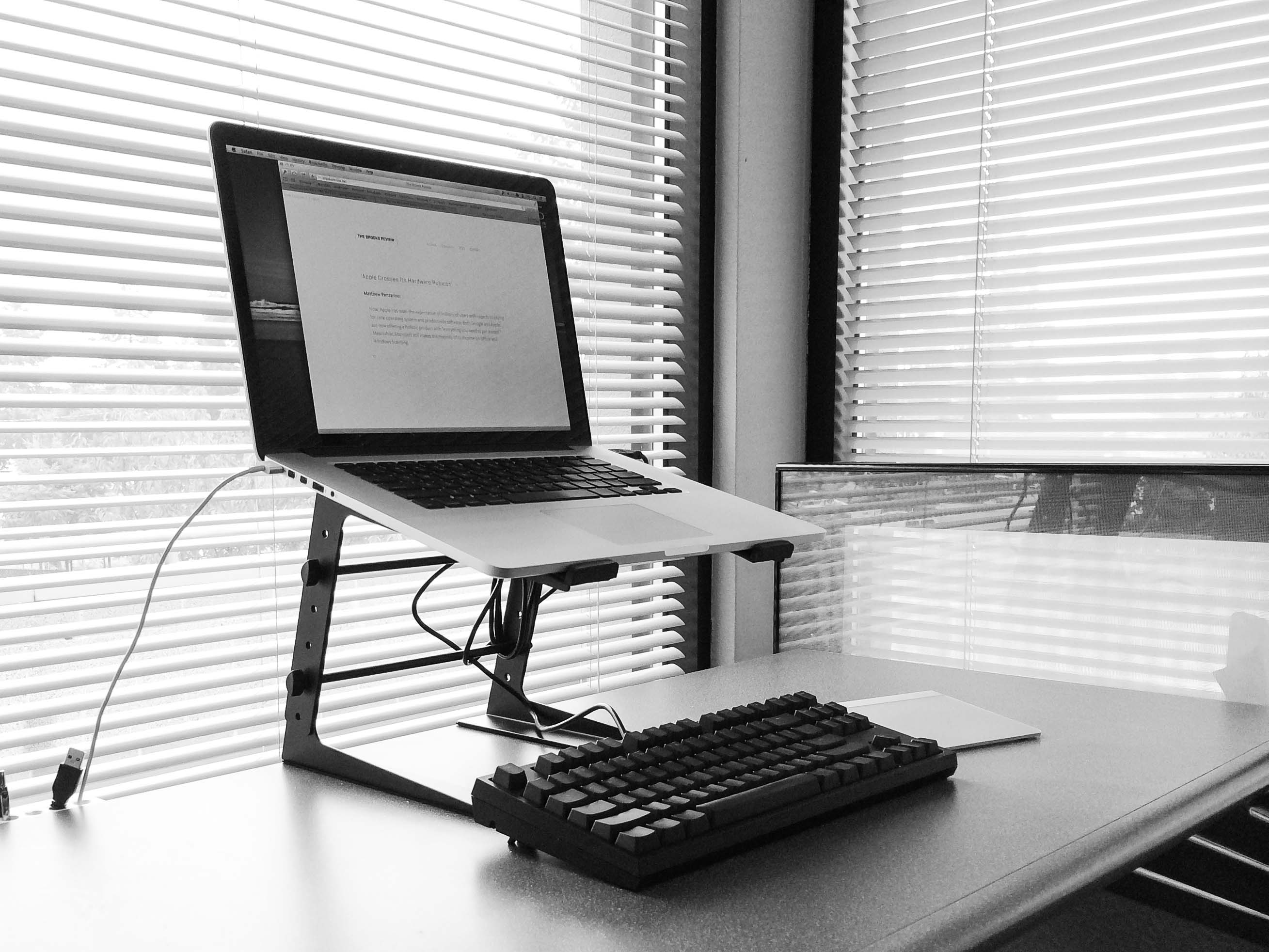
  • Amazon Item of the Week: PYLE-PRO PLPTS25 Laptop Computer Stand for DJ

    I ran into a problem a few weeks ago: my laptop wasn’t sitting high enough on my desk to get the monitor up to where I needed it. It was annoying and tiring. I have tried almost every well marketed Mac laptop stand and they universally suffer from one or both of these issues: 1.…

    I ran into a problem a few weeks ago: my laptop wasn’t sitting high enough on my desk to get the monitor up to where I needed it. It was annoying and tiring. I have tried almost every well marketed Mac laptop stand and they universally suffer from one or both of these issues:

    1. They don’t get high enough to place the display at a truly ergonomic level.
    2. They are wiggly or wobbly, or simply not confidence inspiring that your MacBook Pro won’t slide off if you sneeze.

    The PYLE stand at my office.

    So I went looking through the depths of Amazon (only Prime items, I’m not stupid). There I found this PYLE stand marketed for DJs. It looks horrible, but it looked like it would get really tall, be stable, and a bit adjustable.

    I’ve been using it for a while now and I actually really like the stand. It doesn’t look great, but it does a good job staying out of the way, getting high enough, and being rock solid. I really mean rock solid. You can push on your laptop when it is on the stand and there isn’t much of a wiggle at all. Amazing. I am buying one for my home too.

  • ‘Apple Crosses Its Hardware Rubicon’

    Matthew Panzarino: > Now, Apple has reset the expectation of millions of users with regards to paying for core operating system and productivity software. Both Google and Apple are now offering a holistic product with “everything you need to get started.” Meanwhile, Microsoft still makes the majority of its income on Office and Windows licensing.

    Matthew Panzarino:

    > Now, Apple has reset the expectation of millions of users with regards to paying for core operating system and productivity software. Both Google and Apple are now offering a holistic product with “everything you need to get started.” Meanwhile, Microsoft still makes the majority of its income on Office and Windows licensing.

  • ‘NSA Surveillance Creeps Onto Tech’S Lobbying Agenda’

    Tony Romm: > Apple shelled out $970,000 for D.C. lobbying in the third quarter, the most the company has spent in any three-month period here. To date this year, the company has spent $2.38 million in Washington, compared with about $1.4 million by this time last year. As it launched its first-ever lobbying push on…

    Tony Romm:

    > Apple shelled out $970,000 for D.C. lobbying in the third quarter, the most the company has spent in any three-month period here. To date this year, the company has spent $2.38 million in Washington, compared with about $1.4 million by this time last year. As it launched its first-ever lobbying push on government data collection, Apple also pressed for smartphone location privacy protections and patent reforms in the third quarter.

    Nice.

  • Quote of the Day: Jim Dalrymple

    “Everything you need to operate a Mac or iOS device is free. Spreadsheet, photo, music, presentation, word processing, and movie-making software, all free.” — Jim Dalrymple

    “Everything you need to operate a Mac or iOS device is free. Spreadsheet, photo, music, presentation, word processing, and movie-making software, all free.”
  • ‘A Huge Regression’

    [Clark Goble on the new iWork][1]: > I could go on about how almost none of the problems I’ve been griping about for four years in Numbers have been fixed. But what’s the point. Apple has spoken. It wants the OSX iWork to basically be the same as the iOS version and designed purely for casual…

    [Clark Goble on the new iWork][1]:

    > I could go on about how almost none of the problems I’ve been griping about for four years in Numbers have been fixed. But what’s the point. Apple has spoken. It wants the OSX iWork to basically be the same as the iOS version and designed purely for casual use. By making it free they kill the market for any competitors other than Office. So if you run a small office, even if you hate MS-Office, there’s really no alternative anymore.

    Goble is right that Apple wants to make iWork for casual users, but that’s not new. That was the premise of iWork from the outset. Business users don’t want pre-made letterhead, brochures, and flyers. Business users pay someone to design custom ones for themselves — they don’t need Apple telling them how a budget spreadsheet should work.

    From day one, iWork was for the normal person. Which was and is a huge win for everyone. Word and Excel are cumbersome, overwrought, tools for 90% of the people using them. iWork simply isn’t.

    Goble is also wrong that Apple has killed the third-party market. Apple just split it wide open. Create a spreadsheet app that rivals Excel, but works with Applescript and works with your sanity — worth $99 in my book. It’s a large shoe to fill, but it exists right now (especially given how crappy Microsoft Office is on the Mac).

    [1]: http://www.libertypages.com/clarktech/?p=6597

  • Software as a Feature

    Yesterday Apple made an announcement that we will not likely know the ramifications of (fully) for some time. That announcement centered around their software: iWork, iLife, and OS X are now free (as is iOS iWork and iOS itself). For many this will be seen as a nice little gift from Apple. iLife is solid,…

    Yesterday Apple made an announcement that we will not likely know the ramifications of (fully) for some time. That announcement centered around their software: iWork, iLife, and OS X are now free (as is iOS iWork and iOS itself). For many this will be seen as a nice little gift from Apple. iLife is solid, OS X is excellent, and iWork is mostly better than Office for 90% of users (power users being the 10% exempted). ((My argument here is that if you are starting fresh to office suites, iWork is easier to learn and get value out of. Excel is really the only reason Office is better, but that’s only for in-depth data analysis, as the rest of the features are largely replicated in Numbers.))

    With that single announcement Apple made their software a feature of their devices, and not the other way around.

    Now when a buyer compares a Windows laptop to a Mac, they need to factor the cost of Office to it, because you essentially get that software free with your Mac. You also need to factor in Windows upgrade pricing (not that Windows users upgrade).

    Your MacBook Pro, iMac, Mac mini spec sheet now includes a bullet point that reads: Office apps included.

    While it is obvious to draw the attack Apple lobbed towards Microsoft, it is also very much a direct response to Google.

    Google’s office suite is free, has better collaboration, and runs everywhere. (Even though I’ve never liked it, I am sure it is prevalent in schools.) There’s no way not to see the new iWork with iCloud integration for collaborating as anything but a response to Google’s offering.

    Apple’s two largest competitors are Microsoft and Google. On the Microsoft front Apple wants to kill them with free software (as software is where Microsoft makes their money). On the Google front Apple wants to kill them with with *better* software (as Google needs quantity of users to make money).

    It’s a smart plan. It may not work, but it’s a smart plan nonetheless.

  • Transporter 2.0 is Here

    Sweet update: > 2.0 works just like Dropbox using a regular folder on your computer and adding right-click support for quickly sharing files and folders. You no longer need to create top level folders using the web management software as everything can now be done using Finder on Mac or Explorer on Windows. When you…

    Sweet update:

    > 2.0 works just like Dropbox using a regular folder on your computer and adding right-click support for quickly sharing files and folders. You no longer need to create top level folders using the web management software as everything can now be done using Finder on Mac or Explorer on Windows. When you drag-and-drop files to your Transporter folder, they will now automatically sync across all of your Transporters with no further setup required.

  • OS X Mavericks

    It is likely that there are going to be a lot of reviews about Mavericks, including some ridiculously in-depth ones. I’ve been using it since the first beta, so here are my assorted thoughts on the first non-cat version of OS X. ## Calendar The new calendar is much improved over the ones of years…

    It is likely that there are going to be a lot of reviews about Mavericks, including some ridiculously in-depth ones. I’ve been using it since the first beta, so here are my assorted thoughts on the first non-cat version of OS X.

    ## Calendar

    The new calendar is much improved over the ones of years past. The biggest addition for me is the ability to list travel times. You can set a meeting from 1p-2p, and additionally specify that it will take you 1 hour to get to the meeting. The travel portion is then reflected on your calendar, as is the actual meeting time.

    The down side to the feature is that it doesn’t sync with iOS, or account for travel time *after* your meeting. So while your calendar will show that it takes 2 hours to get there, the calendar will have no indication of how long it takes to get back.

    I would love for a little more Apple magic in this space. Specifically why can’t I define places and have Apple tell me the travel time. So I could define my Office, client office A, client office B and the calendar then assumes I will always be at my office, unless otherwise specified. So if my day is: office, client A and then client B — the calendar shows the travel time from my office to client A office, then tells me if I have time to come back to the office, or if I should travel to client B office right away (and that time), then assumes I head back to my office afterwards. Sounds complicated written out, but I see no reason it would be complicated in practice once default locations are setup.

    So Calendar is a net positive, but the travel time addition is rather half-assed.

    ## Contacts

    I keep all my contacts in Apple’s Contacts app. Traditionally this app looked like a book and following that tradition I loathed the app. This version of the Contacts doesn’t look like a book, and actually looks worse.

    Contacts is easily the worst app that ships with Mavericks and that statement takes into account the Calculator app — an app that probably has never been updated.

    ## Maps

    This is actually a fantastic addition for someone who does’t use Google. With the added bonus of easily sending a route, or map view to my iPhone. I really love having Maps as a part of OS X.

    This is going to be really handy for those moments when you need to run to a meeting, but you don’t know where you are going. It used to be: get directions on your phone while still on wifi, then go. Now you can use a real keyboard, grab the directions quickly, shoot them to your phone. Way better.

    ## iCloud Keychain

    I used it, but didn’t like it. 1Password is a far superior choice.

    ## Get It

    [Mavericks is free][1], so I see no reason to not install it if you Mac is supported.

    [1]: https://itunes.apple.com/us/app/os-x-mavericks/id675248567?mt=12

  • TV Has Yet to Account for Reality

    As a nerd, you typically watch popular TV shows and think: *come on*. Hey, CSI, you can’t take a low-resolution and blurry security camera image and create a high-definition sharp image of a license plate. And you certainly cannot do that with just a few keystrokes and no mouse movement at all. *So unrealistic.* It’s…

    As a nerd, you typically watch popular TV shows and think: *come on*. Hey, CSI, you can’t take a low-resolution and blurry security camera image and create a high-definition sharp image of a license plate. And you certainly cannot do that with just a few keystrokes and no mouse movement at all.

    *So unrealistic.*

    It’s also fun to look back at old TV shows and movies and laugh at how the entire plot is moot if one or more characters had a cell phone or iPad. And for years nerds have *known* that you can’t just ‘hack’ into XYZ server in a few minutes time — even if you are Chloe.

    But then we found out that maybe if you are the government you *can* hack into these places. Not because you are that good of a hacker, but because the NSA had already spent months hacking into the system in preparation for you needing access at a future crucial point in the plot.

    Which now presents TV and movie writers with a really awkward problem: they know just how powerful the NSA is, and it is more powerful than they thought the public would find believable to begin with.

    This all came to a head last night when I was watching the most recent episode of Homeland (warning: possible spoilers ahead). In this episode the main character, Carrie (former CIA), is trying to escape the watchful eye of the CIA. Now pre-Snowden this episode would have been fine, but post Snowden (and even logically) it had a lot of problems.

    1. Carrie kept her cell phone with her. She called a CIA contact that had the CIA listening in on the call next to him on this phone. Yet the CIA couldn’t find her? Come on. First of all it was an Android phone and we should have every reason to suspect that not only could the NSA/CI,A working together, find her, but that they could tap the mic on her phone to listen in. Yet, the CIA, didn’t find her. Magic phone?
    2. Carrie also went to an ATM and into the branch of the bank only to find her accounts frozen. In reality the NSA/CIA would have known about this about 1 second after it happened, and yet… nothing. Dumb luck?

    Ok, it’s fair to say that (due to the “twist” ending) the CIA really didn’t want to find her, but even still wouldn’t a trained CIA person, well anyone at the CIA, still ditch their phone and stay away from banks and ATMs? That seems like “on the run” 101.

    Even if you don’t buy that, then what do you make of the fact that the kids in the episode who went on the run ditched their cellphones saying “they can track the GPS in these”. Yeah… oops the the former-spook didn’t think to do that, but a couple if dumb-shit teens thought of it? *Come on.*

    This is very likely to be an ongoing problem for TV and movies going forward. In order to make the show based somewhat in reality, writers now have to account for the fact that if the government is after you, you are likely screwed. And that is just going to cause all sorts of problems for future plots, as characters are going to have to go dark and no longer will there be that tense period of “the character doesn’t know the government is after them, but the character manages to luckily escape”.

    Basically all future characters will have to use pretend encryption on everything, thus talking to no “normal person”, and/or go on the run *before* anyone is after them.
  • ‘Experian Sold Consumer Data to ID Theft Service’

    Yes, it’s as bad as the headline implies.

    Yes, it’s as bad as the headline implies.

  • There’s Going to Be a Lot of “New” News Outlets

    [David Pogue, announcing his leaving NYT for Yahoo][1]: > It’s not easy leaving the Times, especially when you admire it as much as I do. No matter what happens to prose on paper, the Times itself, as a gatherer and curator of news, will always be necessary and important. The culture may be changing, and…

    [David Pogue, announcing his leaving NYT for Yahoo][1]:

    > It’s not easy leaving the Times, especially when you admire it as much as I do. No matter what happens to prose on paper, the Times itself, as a gatherer and curator of news, will always be necessary and important. The culture may be changing, and the readership may be shifting, but this paper steadfastly focuses on responsible journalism, ironclad ethics and superb writing. I’ll always be a loyal ally.

    I don’t have any particular interest in this news, but what I find interesting is the overall trend. The trend of, shall we say, “big name” writers for publications leaving larger publications to start their own. We are seeing this right now with Pogue, Greenwald, Mossberg and Swisher, Lessin, et al.

    How many of these sites can the web sustain? I ask that not because I think the web can only sustain a finite amount of web sites, but because the business models underlying the web seem to only sustain a finite amount. As ad dollars need to be spread around more, the overall ad rates drop will drop across the board. Paywalls will become harder to run, ((And that’s saying a lot.)) as the wallet share is being pulled in more directions.

    Advertisers can’t afford to pay high ad rates for every sites, and publishers already struggle to get advertisers to pay enough (and get advertisers to begin with). Readers cannot afford to “subscribe” to every site, and many *won’t* pay to subscribe to even their favorite sites. This doesn’t seem like an industry setup for success to me.

    I don’t like consolidation in general, but it seems to me that if every writer who reaches X level of fame leaves to start their own publication, then pretty soon these small publications will all have to merge, or face overall declining revenue and wages. Having an audience and traffic is only the smallest part of success. Getting someone, *anyone*, to pay is the hardest and most important part. [Trust me on this][2].

    [1]: http://pogueman.tumblr.com/post/64682813641/goodbye-and-hello
    [2]: https://brooksreview.net/members/

  • ‘Apple Patent on Touch Typing, Multitouch Upheld; Allows Ban on Most Androids’

    [Interesting turn of events for Apple][1]. The choice Apple now faces is how to enforce their patents. It seems HTC and Microsoft/Nokia are likely fine due to earlier patent licensing deals, but Samsung and Google aren’t looking to hot. However, I don’t think it is as dire as Jason Mick makes it out to be.…

    [Interesting turn of events for Apple][1]. The choice Apple now faces is how to enforce their patents. It seems HTC and Microsoft/Nokia are likely fine due to earlier patent licensing deals, but Samsung and Google aren’t looking to hot. However, I don’t think it is as dire as Jason Mick makes it out to be.

    Apple was out for blood with Google/Samsung, but that seemed driven more by “hot heads” than by business motivations (i.e. it was personal). It seemed like it was pushed by Steve Jobs with perhaps Forstall encouraging it. The read I have on Tim Cook is that he is a lot more analytical in his operations.

    The smartest move would be to make it *more* expensive to sell Android devices through licensing agreements with these companies. They could still be crafted, like Google does with Google Android apps, that would keep Android hardware companies “in line” but that would also make money for Apple with each handset sold.

    This should be very interesting to watch. ((I’d love for Apple to be a little cheeky and line-item Android patent licensing income. “And this quarter we made $793 million dollars from Android device sales. Off of Android sales of XX million units, note that is not the activation number Google touts, but the real ‘sold’ figure, as calculated by our licensing partners.”))

    [1]: http://www.dailytech.com/Apple+Patent+on+Touch+Typing+Multitouch+Upheld+Allows+Ban+on+Most+Androids/article33580.htm?utm_medium=App.net&utm_source=PourOver

  • That’s Not Enough

    [Thomas Brand](http://eggfreckles.net/notes/preliminary-results/): >My friends Merri and Stephen Hackett have to be strong now. They just got the preliminary results back from their son Josiah’s brain scan, and the diagnosis is frightening. The Cancer is back. It never went away. But now it is growing. >I am not a parent yet, and I cannot imagine the…

    [Thomas Brand](http://eggfreckles.net/notes/preliminary-results/):

    >My friends Merri and Stephen Hackett have to be strong now. They just got the preliminary results back from their son Josiah’s brain scan, and the diagnosis is frightening. The Cancer is back. It never went away. But now it is growing.
    >I am not a parent yet, and I cannot imagine the fear they are feeling right now. Knowing their child might have to go through another sixteen rounds of Chemotherapy. But they have to be strong. If not for Josiah, then for themselves, their daughter Allison Mae, and the rest of their family.

    [He’s raising money for his charity run](http://fundraising.stjude.org/site/TR?px=2008576&fr_id=4820&pg=personal), he needed $2,500, but he is well passed that goal. It’s still not enough, so donate if you can. ((Let me know if you need a refund for your membership here so you *can* donate — I’d be happy to do it.))

  • ‘France in the NSA’s Crosshair’

    Jacques Follorou et Glenn Greenwald for Le Monde: > Amongst the thousands of documents extracted from the NSA by its ex-employee there is a graph which describes the extent of telephone monitoring and tapping (DNR – Dial Number Recognition) carried out in France. It can be seen that over a period of thirty days –…

    Jacques Follorou et Glenn Greenwald for Le Monde:

    > Amongst the thousands of documents extracted from the NSA by its ex-employee there is a graph which describes the extent of telephone monitoring and tapping (DNR – Dial Number Recognition) carried out in France. It can be seen that over a period of thirty days – from 10 December 2012 to 8 January 2013, 70,3 million recordings of French citizens’ telephone data were made by the NSA.

    At this point it would be *far* more surprising if the NSA was *not* recording phone calls in a country — *any* country. (I bet Madagascar is safe…)

  • In Praise of One of the Greatest Concluding Lines Ever Written

    Jens Glüsing, Laura Poitras, Marcel Rosenbach and Holger Stark reporting for SPIEGEL ONLINE on the NSA hack of the email, text messages, and other communication means of the President of Mexico, concludes: >In response to an inquiry from SPIEGEL concerning the latest revelations, Mexico’s Foreign Ministry replied with an email condemning any form of espionage…

    Jens Glüsing, Laura Poitras, Marcel Rosenbach and Holger Stark reporting for SPIEGEL ONLINE on the NSA hack of the email, text messages, and other communication means of the President of Mexico, concludes:

    >In response to an inquiry from SPIEGEL concerning the latest revelations, Mexico’s Foreign Ministry replied with an email condemning any form of espionage on Mexican citizens, saying such surveillance violates international law. “That is all the government has to say on the matter,” stated a spokesperson for Peña Nieto.
    >Presumably, that email could be read at the NSA’s Texas location at the same time.

    *Boom.*

    The part of the article that I think will be far more interesting (and less political) to watch:

    > Brazil now plans to introduce a law that will force companies such as Google and Facebook to store their data inside Brazil’s borders, rather than on servers in the US, making these international companies subject to Brazilian data privacy laws.

    [BlackBerry had to do this to allow *other* governments access](http://crackberry.com/rim-installs-blackberry-server-mumbai) to BlackBerry data back in the day and this is something worth paying attention too.

  • Android Headed Away from ‘Open’

    An [excellent post about how closed Android really is](http://arstechnica.com/gadgets/2013/10/googles-iron-grip-on-android-controlling-open-source-by-any-means-necessary/), and is trying to be, by Ron Amadeo. Amedeo concludes: > While Android is open, it’s more of a “look but don’t touch” kind of open. You’re allowed to contribute to Android and allowed to use it for little hobbies, but in nearly every area, the…

    An [excellent post about how closed Android really is](http://arstechnica.com/gadgets/2013/10/googles-iron-grip-on-android-controlling-open-source-by-any-means-necessary/), and is trying to be, by Ron Amadeo. Amedeo concludes:

    > While Android is open, it’s more of a “look but don’t touch” kind of open. You’re allowed to contribute to Android and allowed to use it for little hobbies, but in nearly every area, the deck is stacked against anyone trying to use Android without Google’s blessing. The second you try to take Android and do something that Google doesn’t approve of, it will bring the world crashing down upon you.

    Well worth reading the entire post to see just how locked in Google is trying to make handset makers and developers. I’m not damning Google for this, it’s an incredibly smart move, I just wish Google would drop the ‘open’ propaganda.

  • An Additional Thought on iMessage

    [John Gruber has a very agreeable post ](http://daringfireball.net/2013/10/imessage_encryption) about iMessage security, but I was not sure of his side note: > My understanding is that Apple does not permanently store iMessage message content on its servers. Even in encrypted form, iMessage data is only in Apple’s hands while in transit. Once delivered, it’s gone. Gruber…

    [John Gruber has a very agreeable post ](http://daringfireball.net/2013/10/imessage_encryption) about iMessage security, but I was not sure of his side note:

    > My understanding is that Apple does not permanently store iMessage message content on its servers. Even in encrypted form, iMessage data is only in Apple’s hands while in transit. Once delivered, it’s gone.

    Gruber later updated to clarify the messages probably are held for a short time. I wasn’t sure I bought this idea, as I thought that the load more messages contradicted the idea. (If you scroll to the top of an iMessage thread you can load more messages.) If Gruber is correct all messages are on the device, but if he is not correct then Apple is keeping a copy for this feature to work — easy enough to test.

    My unscientific testing seems to confirm what Gruber is saying. If you delete a thread off of your iPad, but it is still on your iPhone, then you create a new message to that contact on the iPad, there seems to be no way to load in old messages from the device that deleted the thread. This would seem to ‘prove’ that Gruber is likely correct.

    (The best test would be to wipe a device and set it up as new. If any *old* iMessages are on the device, then Apple is keeping them on a server. That’s just a bit more testing than I want to do on a Sunday.) It would seem, though, that Gruber is correct and no old iMessages are stored on Apple servers. This is good news.

    UPDATE: Based on many readers that tested this out, your iMessages don’t carry over if you wipe to your iOS device and don’t restore from a backup. Additionally, if you have a new device and send and receive iMessages, and then restore from backup, you will lose the new messages. Seems pretty conclusive that Apple isn’t storing messages for anything longer than “hours”.

  • iMessage Privacy

    [This is a very interesting white paper][1] on the security built into iMessage. The outcome of which, [as summarized by Ars Technica][2], is that Apple theoretically *could* engineer iMessage in a way that it captures messages. [Not surprisingly Apple has responded to AllThingsD][3]: > “iMessage is not architected to allow Apple to read messages,” said…

    [This is a very interesting white paper][1] on the security built into iMessage. The outcome of which, [as summarized by Ars Technica][2], is that Apple theoretically *could* engineer iMessage in a way that it captures messages.

    [Not surprisingly Apple has responded to AllThingsD][3]:

    > “iMessage is not architected to allow Apple to read messages,” said Apple spokeswoman Trudy Muller in a statement to **AllThingsD**. “The research discussed theoretical vulnerabilities that would require Apple to re-engineer the iMessage system to exploit it, and Apple has no plans or intentions to do so.”

    Once again, this all comes down to trust of the company. Do you trust Apple to evade pressures from, say, the NSA for Apple to thwart this? For as big as Apple is, I trust them to do just that — flip off the NSA. Why? There’s lots of reasons I have, none of them particularly good, or worth sharing.

    I do want to point out, that Apple’s argument sounds a lot like [Ladar Levison of Lavabits][4] argument. The “yeah, we *could* do that, but it ain’t gonna happen” argument.

    [1]: http://blog.quarkslab.com/imessage-privacy.html
    [2]: http://arstechnica.com/security/2013/10/contrary-to-public-claims-apple-can-read-your-imessages/
    [3]: http://allthingsd.com/20131018/apple-no-we-cant-read-your-imessages/
    [4]: https://rally.org/lavabit

  • ‘Siri Response Times’

    [John Gruber][1]: > I think the single biggest improvement Apple could (and really must) make to Siri is to make it faster. And that’s exactly the sort of thing Apple has never really shown the chops for. I agree with the idea that Siri needs to be a lot faster, but it is the last…

    [John Gruber][1]:

    > I think the single biggest improvement Apple could (and really must) make to Siri is to make it faster. And that’s exactly the sort of thing Apple has never really shown the chops for.

    I agree with the idea that Siri needs to be a lot faster, but it is the last sentence that I find odd. Because it seems to me that long-time Apple fans are incredibly skeptical that Apple will *ever* be able to have good “cloud” offerings (e.g. Siri, iCloud, sync, file storage, etc.) for the same reasons the Wall Street is skeptical of long-term Apple success.

    These Apple-fans tend to point to past Apple failings as evidence of Apple will likely have future failings in cloud offerings — while at the same time these Apple-fans are mocking others that point to past Apple failings as indications of likely future failures in, well, anything. ((Notwithstanding the fact that I admit that .Mac and MobileMe were pretty crappy by general web standards.))

    Seems a bit *off* to me.

    [1]: http://daringfireball.net/linked/2013/10/17/siri-response-times

  • ‘Twitter’s Theoretically Temporary URL Messaging Ban Due to Massive Wave of DM Spam’

    This is simply an amazing bit of customer hate, as reported by [Matthew ‘The Panzer’ Panzarino at TechCrunch.][1] As I mentioned, Twitter is now rolling out the ability to DM people that don’t follow you. This, sounds like it is an unrelated problem, but proves my point that Twitter is *going* to have a DM…

    This is simply an amazing bit of customer hate, as reported by [Matthew ‘The Panzer’ Panzarino at TechCrunch.][1] As I mentioned, Twitter is now rolling out the ability to DM people that don’t follow you. This, sounds like it is an unrelated problem, but proves my point that Twitter is *going* to have a DM Spam problem. What arose last night is a bunch of “hacked” accounts sending spam via DMs containing URLs.

    Any smart service would have taken user reports and been all over this like white on delicious steamed sushi rice, but according to The Panzer, this is how it played out:

    > What we’re hearing is that the rise in DM spam ended up garnering attention inside Twitter up to the point where an executive inside Twitter’s C-suite got DM spammed. Hence the abrupt ban on URLs inside DMs until the issue can be sorted out.

    To many that seems reasonable. But here’s how I read this: Twitter wasn’t overly concerned about DM spam in the higher ups, until one of the higher ups received the spam. Then they squashed it by banning URLs in DMs. That’s not really a company working in the user best interest, but rather self-serving. It makes you wonder: if that executive hadn’t been spammed, would Twitter have done anything?

    “Ok, Ben, but you are reaching here.”

    Am I?

    > The inconsistencies that we noticed with regards to the sending and receiving of URLs is due to the fact that Verified users and advertisers are exempted from the ban on sending links in DMs. This would impede, of course, the efforts of marketers using Twitter’s legitimate advertising platform to send DMs {…}

    It makes sense to allow verified users to keep sending them, but advertisers? That’s just self-serving — advertisers (granted non-paying ones) were the ones sending the spam. Here’s what we have learned (or been reminded of):

    1. Twitter addresses the problems that bug them first.
    2. While “average” users will suffer from sweeping changes, verified “celebrities” and *braaaaands* won’t suffer, ever. EVAR.

    Enjoy that.

    [1]: http://techcrunch.com/2013/10/17/twitters-theoretically-temporary-url-messaging-ban-due-to-massive-wave-of-dm-spam/