File this under: why it’s important to read the story, not the headline:
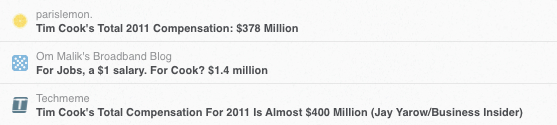
Depending on which headline you read Cook made between $1.4 million and “almost” $400 million.
File this under: why it’s important to read the story, not the headline:
Depending on which headline you read Cook made between $1.4 million and “almost” $400 million.
Nik Fletcher:
>The original iPhone was built on a different set of compromises to the competition – how it worked was (at least to begin with) more important than everything that it did.
I keep my original iPhone in a Pelican case because I love it so. That original iPhone: every time I see it I remember how desperately I wanted one after Steve Jobs announced it and how satisfying it was to use even though for 12 hours after getting it I could only slide for an emergency call. ((AT&T didn’t allow the iPhone to be on a business plan at that time and I had to wait until the next morning to get my number moved to a family plan to activate it through iTunes.))
Laura Owen for paidContent:
>In Barnes & Noble’s largest Nook promotion yet, the bookstore chain is offering discounted or free Nooks to those who purchase one-year subscriptions to the Nook editions of People or the New York Times. It’s the first time a major retailer has offered an e-reader free with a content subscription.
I don’t particularly care about the Nook, but I really wonder if this will work for all sides (consumer, publisher, gadget maker). This is essentially saying: the content is more compelling than the device.
So the question really is: in the consumer mind, which is more compelling the content or the device?
Bruce Schneier on the [TSA’s top 10 good catches of 2011](http://blog.tsa.gov/2012/01/tsa-top-10-good-catches-of-2011.html):
>And that the C4 — their #1 “good catch” — was on the return flight; they missed it the first time. So only 1 for 2 on that one.
Bravo, TSA.
Any reader of [Daring Fireball](http://daringfireball.net/) knows that one of the more interesting/annoying/unbelievable/sad things going in tech is the copycat business strategy. The strategy where company B sees company X doing thing Y, therefore company B decides that they too can find success in doing thing Y.
This certainly isn’t a new strategy, but I think the way that Samsung (and Acer now too) have been implementing this is pretty interesting. For the most part Samsung has resided to copying design facets of Apple’s products. [Whereby “facets” I really mean Samsung as gone down the rabbit hole of just copying the actual hardware designs of Apple devices.](http://inspiredbyapple.tumblr.com/)
That by itself is just a sad fact, not very interesting. I believe that the hardware design of Apple products is only 30% of what makes those products “good” and therefore copying just the hardware design doesn’t actually help as much as Samsung might think.
With the recent Samsung announcement of an [Airplay clone](http://b.akumar.me/2012/01/07/samsung-to-announce-swipeit-an-apple-airplay-competitor-at-ces-2012/) and Acer’s of the [AcerCloud](http://www.loopinsight.com/2012/01/09/acer-commits-most-blatant-ripoff-of-apple-yet/) I think things are about to get much more, well, dirty — because now these companies (Samsung especially) are getting closer to a full copycat strategy — something we can easily see with Coke and Pepsi.
### Pepsi v. Coke
If Wikipedia is to be believed, then [Coca-Cola was introduced in 1886](http://en.wikipedia.org/wiki/Coca-Cola), [followed by Pepsi in 1898](http://en.wikipedia.org/wiki/Pepsi). So Coke was first and then Pepsi came along to rip it off.
(For the sake of this please try to shake off your personal preference for either drink for a moment — that’s not at play right now.)
What’s interesting about the Pepsi versus Coke struggle is that they both are so very similar, that in the U.S. it is mostly a wash between the two. Now I don’t have any evidence to support this, but here is what I was taught in my business classes in college: In the U.S. one decade Coke will be ahead, the next Pepsi.
I don’t fully believe that statement, and in fact searching the web seems to turn up evidence that Coke is number one followed by Diet Coke in the U.S., even so Pepsi and Coke are very close to one another and for the sake of this argument it’s not entirely important. Both are successful companies.
What’s really important is how the two are competing. Pepsi and Coke clearly taste different to those that care, but the amount of people that actually prefer one to the other — probably don’t really prefer it because of the taste. That’s why the “[Pepsi Challenge](http://en.wikipedia.org/wiki/Pepsi_Challenge)” is so interesting. Pepsi usually wins in a side by side taste test, but is clearly not the more popular drink. ((See criticisms on the Wiki page, because there are some important ones.))
I am going to go ahead and say that most Americans don’t have a strong enough opinion to matter towards the taste of one over the other. A persons personal preference then isn’t something that most people will change their mind over if in a restaurant and they are told they can’t get the brand they prefer.
Cola seems to largely to just be cola to most Americans.
In fact the real competition for the two cola’s is done with marketing and nostalgia. A persons preference is usually from either good commercials that are swaying those on the fence from one to the other, or nostalgia of Coke/Pepsi “being the drink I grew up with” that keeps the non-fence-riders firmly in one camp or the other. That’s where most preference comes from — certainly where mine comes from.
Another important factor is that both colas are priced the same, eliminating price as a decision factor. ((Excluding periodic sales.)) Something that is also the case in the cellphone market.
This is relevant here because I don’t think a Samsung phone that looks like an iPhone 3G S will largely be accepted by most users as a sufficient equivalent to the iPhone in the same way that Coke and Pepsi are “sufficient” equivalents for cola to most people.
So unlike the Pepsi and Coke battle, Samsung is just selling a can that looks like the Apple can, but that tastes more like [RC Cola](http://en.wikipedia.org/wiki/RC_Cola). That’s not a winning strategy and it is not fully embracing the copycat business strategy that has worked so well for Pepsi.
However, with the recent introduction of cloud services by Samsung they are taking a huge step towards improving the “taste” of their offering. Essentially Samsung is beginning to fully embrace the copycat business strategy — to the point where they may actually make it successful.
If a consumer can buy a Samsung phone that looks like an iPhone and has the same bullet points as an iPhone (as far as extra services like iCloud go) — then it really just comes down to which phone *seems* like the better choice.
And when a consumer has to pick based on what *seems* best, well that’s when you start getting into the Coke v. Pepsi conundrum.
That’s interesting.
Samsung used to only copy the hardware design and that was a half-assed solution. Because Samsung can’t copy iOS that well with Android they have started to copy some of the things that Apple gives its users for free: iCloud. That’s why the entry into cloud services by Samsung and Acer is so interesting, it’s how these two companies are completing their copycat strategy — a strategy that has been proven to be pretty effective for Pepsi.
At HelpSpot we’re big supporters of open source software and simply couldn’t run our business without it. So, 6 years ago we created [Open Source Help Desk List](http://click.syndicateads.net/2012/01/Helpspot/brooksreview.html) to assist companies looking for an open source help desk software solution. It’s success has been beyond our wildest expectations; serving as an invaluable tool for thousands of companies to find the solution they need. We hope it can help you as well.
If you’d prefer a professionally developed and supported help desk application, then give us a look: [HelpSpot: Help Desk Software](http://click.syndicateads.net/2012/01/Helpspot/helpspot.html).
Thanks!
Ian Landsman
Founder, UserScape
P.S. Checkout the newest project we’re working on, the PHP framework [Laravel](http://click.syndicateads.net/2012/01/Helpspot/laravel.html)
Duncan Graham-Rowe on Samsung’s new software to detect the emotion of a smart phone user:
>But there are many more potential applications, says Lee. The system could trigger different ringtones on a phone to convey the caller’s emotional state or cheer up someone who’s feeling low. “The smart phone might show a funny cartoon to make the user feel better,” he says.
If I am pissed, the last thing that is going to make me “feel better” is some cheesy cartoon my Samsung phone picks out.
My dad bought these for all his kids this Christmas — when I opened it I thought it was a joke. I mean I really thought it was a toy for little kids, but he pulled up some [videos on YouTube](https://www.youtube.com/watch?v=vIJINiK9azc) and I was pumped to put this thing together.
The assembly is tricky and you need a [helium tank](http://www.amazon.com/exec/obidos/ASIN/B000WNIXZ4/ref=nosim&tag=brooksreview-20), but once together this is simply awesome.
I spent at least an hour playing with it at my dads, one of my cats is scared to death of it — best toy ever.
(Side note: We tried taking one outside and it floated away rather quickly. If you do this a fishing line tether is a smart play. Also achieving perfect neutral buoyancy is key.)
I have the [clown fish](http://www.amazon.com/exec/obidos/ASIN/B005FYCBR6/ref=nosim&tag=brooksreview-20), but the [shark](http://www.amazon.com/exec/obidos/ASIN/B005FYEAJ8/ref=nosim&tag=brooksreview-20) is just as awesome.
I’ll say it again: Dick’s burgers is *the* best burger joint out there.
As for the linked article, nice story — though I’d much prefer the last paragraph be omitted.
This really should have happened sooner — with NFC payments around the corner I can’t see the phone number plus PIN being a winning solution.
>We kick off the new year with another variety show. Shawn and Ben chat about the latest iPod nanos and why Ben says they aren’t that great, blogging and using an iPad as your only computer, and a few speculations on the next iPad and what it may bring.
Thanks to our sponsor [Verses](http://kepner.me/versesapp) for making the show possible.
Best Buy CEO Brian Dunn pens a post to respond to recent media coverage.
Specifically the [Forbes article](https://brooksreview.net/2012/01/best-buy-2/) from earlier this week. It’s a pretty boring post all around, but it is interesting that he didn’t try to refute or mention the most damning part of the article (most damning part in my mind). That as Larry Downes says:
>The reasons for the company’s dwindling prospects are easy to find. Just walk into one of the company’s retail locations or shop online. And try, really try, not to lose your temper.
The closest Dunn comes is by saying:
>We recognize people can and do shop from anywhere, and they expect thoughtful, helpful interactions from us every step of the way. We continue to invest in a number of areas – from employee training, to critical system enhancements – to ensure our customers always receive the kind of experience they deserve and expect from us, wherever and whenever they choose.
That comes close, but really you can see the lack of customer service is a top down problem. Dunn addresses the Christmas order cancellations by saying:
>The cancellation of some internet orders just before Christmas was our fault, and it’s not representative of how we EVER want to treat our customers. I’ll spare you the technical explanation of how and why it happened, but we know we did not deliver a good experience and we’re truly sorry. We’ve worked to make amends with customers whose holidays were made less happy because of our mistake, and we’re working diligently to make sure it doesn’t happen again.
“Less happy”?
Really?
Give me a fucking break.
Dave Copeland:
>Traditional media companies have been key players in lobbying for SOPA’s passage, with more than half of that funding coming from cable television providers, commercial TV and radio stations, and the entertainment industry.
And of course those that back the bill don’t cover it in their “fair and balanced” news coverage.
Brian Stucki on Macminicolo and its almost 1,000 Mac mini servers:
>We have some minis that have been here since day one serving for seven continuous years.
That’s crazy to think about, but then I remembered that I too have an original G4 Mac mini attached to my TV and it still works perfectly. Mac minis truly are great little machines.
I am breaking my newly established “don’t link to anonymous type sites rule” because turns out his name is ‘Mike’ — close enough for me, my rule is still intact — this is simply too awesome.
John Moltz responding to my statement that I have yet to see a Fire in public around Seattle:
>I’m not sure where Ben hangs out but I can tell you that I’ve seen a number of Kindle Fires on the Tacoma to Seattle Sounder which I ride every day (at least I do until the end of January). The older Kindles have traditionally been very popular with Sounder riders (iPads are also popular but less than the Kindle) and I would guess I’ve seen 10 or so Fires since they came out.
Makes sense that people who ride the Sounder train on a daily basis would have more of these types of devices.
Update: I can see this might be taken as a comment about the type of people that buy a Fire — those that ride a train. I actually just meant that people riding trains to work would likely want a tablet. Sorry for the confusion.
Microsoft:
>Many new PCs come filled with lots of trialware and sample software that slows your computer down—removing all that is a pain, so we do it for you! Every PC the Microsoft Store sells is put on a software diet and performance is tuned to run the best it can.
You have got to love the exclamation point here. It’s like the biggest pat on the back that I have ever seen in ad copy. Genius.
>We call this process Microsoft Signature.
Funny, I call it common sense.