Category: Links

  • Amazon Item of the Week: PYLE-PRO PLPTS25 Laptop Computer Stand for DJ

    I ran into a problem a few weeks ago: my laptop wasn’t sitting high enough on my desk to get the monitor up to where I needed it. It was annoying and tiring. I have tried almost every well marketed Mac laptop stand and they universally suffer from one or both of these issues:

    1. They don’t get high enough to place the display at a truly ergonomic level.
    2. They are wiggly or wobbly, or simply not confidence inspiring that your MacBook Pro won’t slide off if you sneeze.
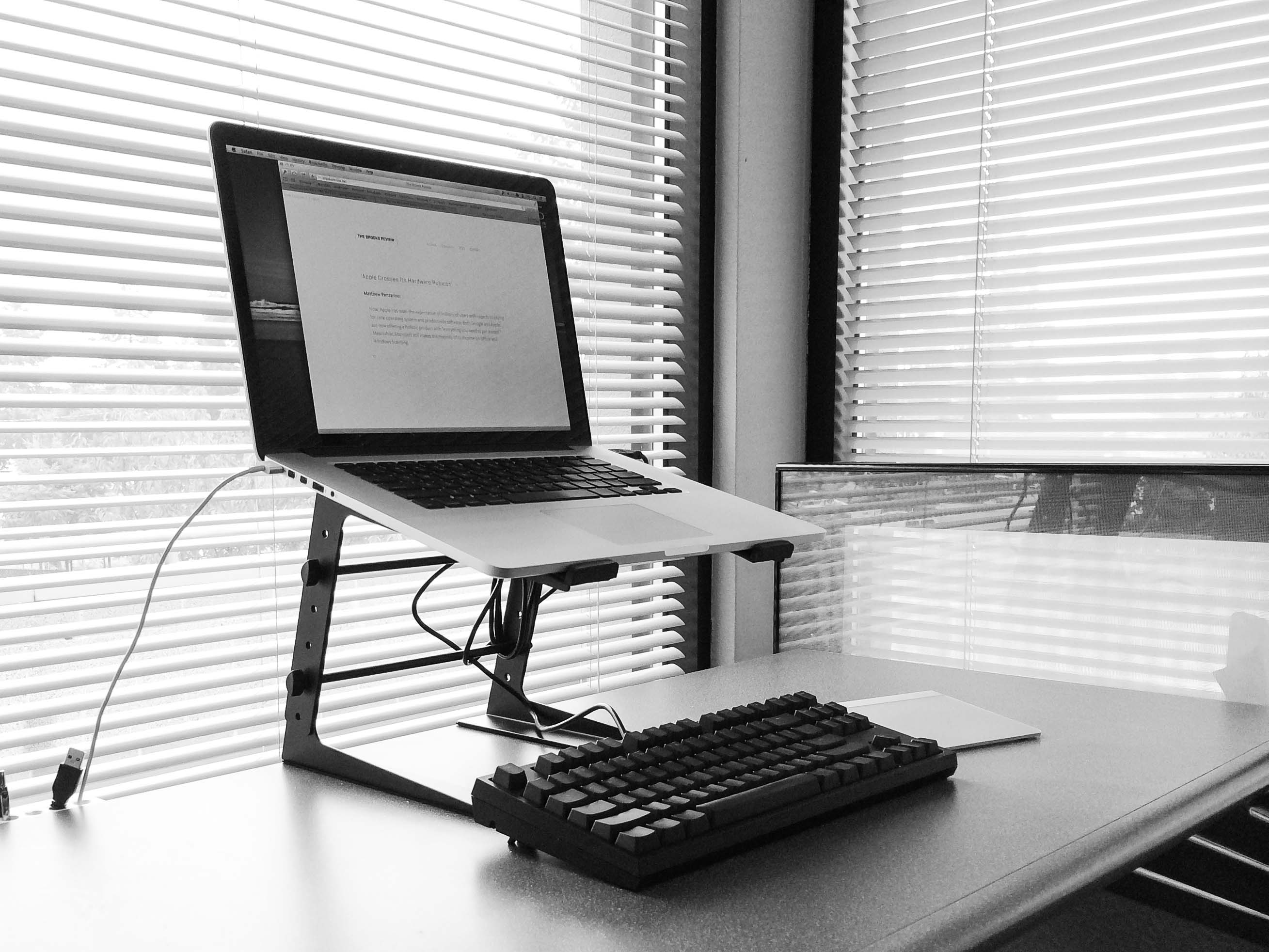
    The PYLE stand at my office.

    So I went looking through the depths of Amazon (only Prime items, I’m not stupid). There I found this PYLE stand marketed for DJs. It looks horrible, but it looked like it would get really tall, be stable, and a bit adjustable.

    I’ve been using it for a while now and I actually really like the stand. It doesn’t look great, but it does a good job staying out of the way, getting high enough, and being rock solid. I really mean rock solid. You can push on your laptop when it is on the stand and there isn’t much of a wiggle at all. Amazing. I am buying one for my home too.

  • ‘Apple Crosses Its Hardware Rubicon’

    Matthew Panzarino:

    > Now, Apple has reset the expectation of millions of users with regards to paying for core operating system and productivity software. Both Google and Apple are now offering a holistic product with “everything you need to get started.” Meanwhile, Microsoft still makes the majority of its income on Office and Windows licensing.

  • ‘NSA Surveillance Creeps Onto Tech’S Lobbying Agenda’

    Tony Romm:

    > Apple shelled out $970,000 for D.C. lobbying in the third quarter, the most the company has spent in any three-month period here. To date this year, the company has spent $2.38 million in Washington, compared with about $1.4 million by this time last year. As it launched its first-ever lobbying push on government data collection, Apple also pressed for smartphone location privacy protections and patent reforms in the third quarter.

    Nice.

  • Transporter 2.0 is Here

    Sweet update:

    > 2.0 works just like Dropbox using a regular folder on your computer and adding right-click support for quickly sharing files and folders. You no longer need to create top level folders using the web management software as everything can now be done using Finder on Mac or Explorer on Windows. When you drag-and-drop files to your Transporter folder, they will now automatically sync across all of your Transporters with no further setup required.

  • ‘Experian Sold Consumer Data to ID Theft Service’

    Yes, it’s as bad as the headline implies.

  • That’s Not Enough

    [Thomas Brand](http://eggfreckles.net/notes/preliminary-results/):

    >My friends Merri and Stephen Hackett have to be strong now. They just got the preliminary results back from their son Josiah’s brain scan, and the diagnosis is frightening. The Cancer is back. It never went away. But now it is growing.
    >I am not a parent yet, and I cannot imagine the fear they are feeling right now. Knowing their child might have to go through another sixteen rounds of Chemotherapy. But they have to be strong. If not for Josiah, then for themselves, their daughter Allison Mae, and the rest of their family.

    [He’s raising money for his charity run](http://fundraising.stjude.org/site/TR?px=2008576&fr_id=4820&pg=personal), he needed $2,500, but he is well passed that goal. It’s still not enough, so donate if you can. ((Let me know if you need a refund for your membership here so you *can* donate — I’d be happy to do it.))

  • ‘France in the NSA’s Crosshair’

    Jacques Follorou et Glenn Greenwald for Le Monde:

    > Amongst the thousands of documents extracted from the NSA by its ex-employee there is a graph which describes the extent of telephone monitoring and tapping (DNR – Dial Number Recognition) carried out in France. It can be seen that over a period of thirty days – from 10 December 2012 to 8 January 2013, 70,3 million recordings of French citizens’ telephone data were made by the NSA.

    At this point it would be *far* more surprising if the NSA was *not* recording phone calls in a country — *any* country. (I bet Madagascar is safe…)

  • In Praise of One of the Greatest Concluding Lines Ever Written

    Jens Glüsing, Laura Poitras, Marcel Rosenbach and Holger Stark reporting for SPIEGEL ONLINE on the NSA hack of the email, text messages, and other communication means of the President of Mexico, concludes:

    >In response to an inquiry from SPIEGEL concerning the latest revelations, Mexico’s Foreign Ministry replied with an email condemning any form of espionage on Mexican citizens, saying such surveillance violates international law. “That is all the government has to say on the matter,” stated a spokesperson for Peña Nieto.
    >Presumably, that email could be read at the NSA’s Texas location at the same time.

    *Boom.*

    The part of the article that I think will be far more interesting (and less political) to watch:

    > Brazil now plans to introduce a law that will force companies such as Google and Facebook to store their data inside Brazil’s borders, rather than on servers in the US, making these international companies subject to Brazilian data privacy laws.

    [BlackBerry had to do this to allow *other* governments access](http://crackberry.com/rim-installs-blackberry-server-mumbai) to BlackBerry data back in the day and this is something worth paying attention too.

  • Android Headed Away from ‘Open’

    An [excellent post about how closed Android really is](http://arstechnica.com/gadgets/2013/10/googles-iron-grip-on-android-controlling-open-source-by-any-means-necessary/), and is trying to be, by Ron Amadeo. Amedeo concludes:

    > While Android is open, it’s more of a “look but don’t touch” kind of open. You’re allowed to contribute to Android and allowed to use it for little hobbies, but in nearly every area, the deck is stacked against anyone trying to use Android without Google’s blessing. The second you try to take Android and do something that Google doesn’t approve of, it will bring the world crashing down upon you.

    Well worth reading the entire post to see just how locked in Google is trying to make handset makers and developers. I’m not damning Google for this, it’s an incredibly smart move, I just wish Google would drop the ‘open’ propaganda.

  • ‘Calorie burner: How much better is standing up than sitting?’

    BBC:

    >We wanted to see what would happen if we took a group of people who normally spend their day sitting in an office and ask them to spend a few hours a day on their feet instead.

    More fodder for my pro-standing agenda.

  • ‘Receive direct messages from anyone, even those not following you, on Twitter’

    Luke Edwards:

    > On the plus side this could be really helpful for companies to converse on specific problems with the public. Or, more sceptically, it allows them to deal privately with problems, taking away the user’s power t publicly embarrass them when an issue arises. Of course the option to talk publicly is there too.

    Another great move by Twitter to help braaaaaands and spammers. App.net was setup like this from day one, never had or heard of any abuse. I doubt that is going to be the case for Twitter users.

  • ‘What Stuck and What Didn’t?’

    Shawn Blanc:

    > Well, over the past three days I went through every single review and recommendation I’ve written in the past 6 years in order to take inventory of which products I still use and which I don’t.

    I don’t agree with him on a few of these picks, but that doesn’t mean they aren’t great apps/tools.

  • ‘Run While You Have to, Stop When You Can’

    Brett Terpstra:

    > Maybe you haven’t been as lucky. Maybe you haven’t been as careless to begin with. Still, do me a favor and step back to appreciate that you get to be picky about your coffee, snobby about your beer and pretentious about your text editors.

  • ‘Snaphack saves Snapchat messages’

    Alyson Shontell:

    >Called SnapHack, it lets you save and re-open Snapchat messages you’ve received any time you want. That means, no more disappearing photos or videos, which is the whole reason why Snapchat is appealing in the first place. 

    Simultaneously surprising and not surprising that Snapchat hadn’t thought about this approach before.

  • Meanwhile, in Belgium…

    Thomas Verschoren, responding to yours truly:

    > So even when the iPhone is seen as a luxury item, people still oppose to paying for apps.

    Verschoren offers some anecdotal evidence that in Belgium iPhones *are* expensive, and even still people balk at paying for apps.

  • ‘Mark Zuckerberg Buys 4 homes for privacy’

    Alyson Shontell writing for tech-blog equivalent of TMZ:

    >Facebook’s billionaire founder bought four homes surrounding his current home near Palo Alto, Mercury News reports. The houses cost him more than $30 million, including one 2,600 square-foot home that cost $14 million. (His own home is twice as large at 5,000 square-feet and cost half as much.)

    He bought those home so he could have privacy. NO, really.

  • ‘Air Gaps’

    Bruce Schneier’s advice on setting up an Air Gap:

    >Air gaps might be conceptually simple, but they’re hard to maintain in practice. The truth is that nobody wants a computer that never receives files from the Internet and never sends files out into the Internet. What they want is a computer that’s not directly connected to the Internet, albeit with some secure way of moving files on and off.

    In case you are wondering, no I do not have an air gap setup. I wouldn’t mind it, but no, I don’t.

  • ‘Is T-Mobile’s ‘Free’ International Data Roaming Worth Switching For?’

    Dan Frommer with the bad news:

    >The biggest roadblock, for me, is data speed. T-Mobile’s free international roaming is only for 2G data service, which you probably haven’t used day-to-day since the first iPhone. After getting used to LTE speeds at home, it will seem unusably — or at least uncomfortably — slow.

    YIKES. When I roamed in Canada a year ago I was bumped down to 3G speeds and I thought the world had ended. I’d expect my wireless carrier to pay *me* for using 2G, not the other way around.

  • ‘Google Sets Plan to Sell Users’ Endorsements’

    Claire Cain Miller and Vindu Goel writing about a sleazy marketing company:

    >If a user follows a bakery on Google Plus or gives an album four stars on the Google Play music service, for instance, that person’s name, photo and endorsement could show up in ads for that bakery or album.

    >Google said it would give users the chance to opt out of being included in the new endorsements, and people under the age of 18 will automatically be excluded.

  • The Fallacy of Success

    G.K. Chesterton (via Jason Kottke):

    > It is perfectly obvious that in any decent occupation (such as bricklaying or writing books) there are only two ways (in any special sense) of succeeding. One is by doing very good work, the other is by cheating.

    Kottke (as always) has chosen some great excerpts from this 1915 book — worth your time today.