Top Posts

Leica Sofort 2June 13, 2024
Grand Seiko SBGX261February 23, 2023

Recent Articles

  • Russian Invasion of Ukraine

    Adam Chandler: The Ukrainian Foreign Ministry has accused Russia of invading mainland Ukraine. This is the first reported presence of Russian troops beyond the Crimean peninsula. As many as 50,000 Russian protestors marched through Moscow to rally against Russian action and intervention in Ukraine. Russian authorities suggested that only 3,000 participated. The former is really bad,…

    Adam Chandler:

    The Ukrainian Foreign Ministry has accused Russia of invading mainland Ukraine. This is the first reported presence of Russian troops beyond the Crimean peninsula.

    As many as 50,000 Russian protestors marched through Moscow to rally against Russian action and intervention in Ukraine. Russian authorities suggested that only 3,000 participated.

    The former is really bad, but the latter is very hopeful. It seems pretty risky to protest in Russia at the moment, so for 50,000 people to do protest? That’s impressive.

  • Showing the Differences of Iridient versus Lightroom

    I just posted about how Lightroom doesn’t do the Fujifilm X-Trans sensors justice, and in the past I have linked to examples of this, but why not just show it to you here? I picked a very uninspiring shot with a ton of foliage in it. The shot itself was taken with the Fujifilm X-E2…

    I just posted about how Lightroom doesn’t do the Fujifilm X-Trans sensors justice, and in the past I have linked to examples of this, but why not just show it to you here?

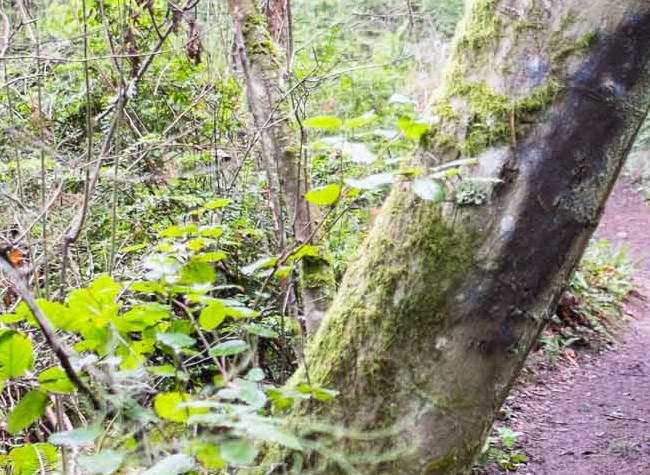
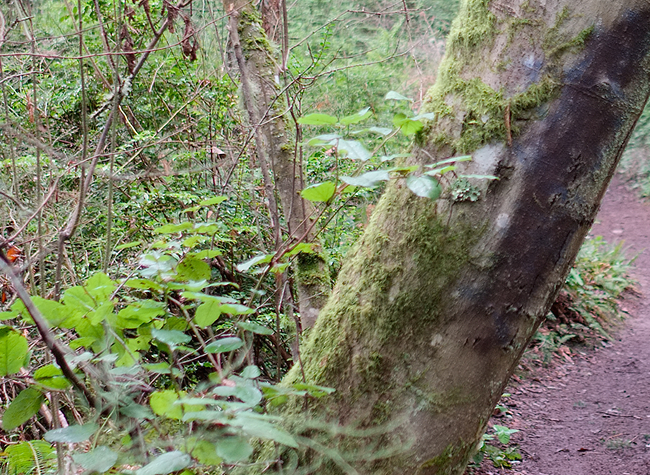
    I picked a very uninspiring shot with a ton of foliage in it. The shot itself was taken with the Fujifilm X-E2 at f/1.4 with a 1/110 second shutter sped at ISO 400. I used the Fujifilm 23mm f/1.4 R lens for this shot. To my memory I think I wanted to play with the winding path, but the shallow depth of field which threw the tree out of focus messed that all up. In other words this is a throw away shot, but one that has a lot of fine detail in it.

    Here’s the RAW file for the shot if you want to see the test for yourself.

    Here’s the shot as I would have processed it in Lightroom to get it sharp and the color where I want it:

    Here’s the same shot processed to my eye how I liked it in Iridient Developer:

    Here’s the shot processed in the Camera with the Velvia film setting:

    Right away the color shift is terribly obvious, but so is the detail of the Iridient shot. I like editing in Lightroom a lot better, but that detail is shitty compared to Iridient.

    For better comparison, here is a crop that readily shows the difference. Again, Lightroom:

    And Iridient:

    And out of the camera:

    There’s a huge difference and Iridient seems to do the best job by a large margin. So do keep in mind it’s not just the lens and camera, it’s also the software that makes the shot.

  • Sharpening and Finishing Fuji X-Trans in Lightroom

    Thomas Fitzgerald: Many of the comments I’ve received have been wondering if there’s a way to get close to the output of Iridient Developer or Photo Ninja using a combination of Lightroom and Photoshop. Surprisingly, the answer is almost. I’ve been working on this for a while now and I believe that by combining Lightroom…

    Thomas Fitzgerald:

    Many of the comments I’ve received have been wondering if there’s a way to get close to the output of Iridient Developer or Photo Ninja using a combination of Lightroom and Photoshop. Surprisingly, the answer is almost. I’ve been working on this for a while now and I believe that by combining Lightroom and a little bit of Photoshop you can get close. The advantage of this is that you can get clean and organic looking results without having to learn a new piece of software, and by using the droplet as a plug-in approach I blogged about last week, you don’t even have to leave Lightroom.

    Iridient Developer really does do the best job at rendering Fujifilm files, but the software is really clunky. Fitzergerald has a really complicated approach. I finish 99% of my Fujifilm files in Lightroom, but if I feel I am missing something that should be there, I won’t hesitate to use Iridient.

  • Quote of the Day: Tony Haile

    “A web where quality makes money and great design is rewarded? That’s something worth paying attention to.” — Tony Haile

    “A web where quality makes money and great design is rewarded? That’s something worth paying attention to.”
  • Huge Updates to Flow

    My morning routine when I get to the office is pretty set, step two is swiping over to the space where a fullscreen Fluid instance of Flow (my web based task management app) is running. I hit CMD+R to get it refreshed, look at the list and get back to what ever is urgent. Today…

    My morning routine when I get to the office is pretty set, step two is swiping over to the space where a fullscreen Fluid instance of Flow (my web based task management app) is running. I hit CMD+R to get it refreshed, look at the list and get back to what ever is urgent.

    Today there was a bit of a surprise: a new look. Now Flow looks awesome. It was just ok before, awesome now. Got it? Good.

    Then, in order to write this blog post, I went to look for their announcement and saw they added subtasks. Holy. Shit. Awesome.

    It’s nice to be using a tool that is getting serious, and regular, love to the design and feature set. It’s been quite some time since I left OmniFocus, but I really don’t miss it at all.

    This new subtask feature is going to be killer.

  • Why I Am So Hot on Fujifilm Right Now

    Most of you reading this will notice that I have been posting quite a bit about photography, and specifically Fujifilm, as of late on this blog. I’ve always tried to post only things that are interesting to me on the site, because I really don’t want to fake my commentary in order to seem “up…

    Most of you reading this will notice that I have been posting quite a bit about photography, and specifically Fujifilm, as of late on this blog. I’ve always tried to post only things that are interesting to me on the site, because I really don’t want to fake my commentary in order to seem “up to date” in the tech/Apple blogging world.

    So I’ve been posting a lot about Fujifilm and photography in general, because both have really been on my mind.

    More than anything else I have really started diving into Fujifilm since getting the X-E2. I’ve spent sometime thinking about why this is, why I am so drawn to the brand, and the best I can figure is that the reason is similar to why there are so many Apple bloggers out there.

    I tried, bought, and own a thing that has connected with me in such a way that I want to share, and be shared with, stories of that connection. Maybe in an attempt to convince others, or largely in an selfish attempt to find more products which react with me in this way, but I feel like this connection is worth diving into. Worth exploring.

    The first day I used my first Mac, a 2004-ish 12″ Powerbook G4, I had to setup up my printer on it. This was back in the days of “you dare not plug in your printer until you have installed at least the first 6 CDs of drivers” on Windows. But all I did with my Mac was plug in the printer, and it was ready to go, working perfectly.

    It just worked — like so many people that I thought were brainwashed Apple users had been telling me it would — my did it just work. It was astonishing, and from that moment forward the technology was no longer a tool I fought with, but something I trusted — it became a part of my philosophy for working with technology.

    Things should just work.

    I always loved computers before I switched to Macs, but now I had found a reason to be passionate about computers. This distinction between loving something and being passionate is much larger than people often credit and speaks mountains to why there are so many people wanting to write about it. ((That and the foolish notion you can easily make money doing it.))

    It’s a similar feeling that I had with my X-E2 from Fujifilm. I’ve always loved photography and cameras, and I’ve had tons of them over the course of my life, but it wasn’t until that first hour of playing with the X-E2 that I felt that same thing. The camera became a part of my philosophy — and photography a passion.

    I won’t say that Fujifilm is the “Apple” of cameras — that’s just not a comparison that I think any company can live up to. What I will say is that of the Fujifilm cameras I have spent time with, they have made me far more connected and apart of the photography than I have ever felt before.

    Is that corny? You bet, but it is also the truth. It’s not easily verbalized or understood. Like telling people that Macs just work (or did), you have to experience it first hand.

    With the X-E2 I can ignore the fact this is a digital image for the most part and capture imagery. I don’t have to worry about learning the tool because it just works. I’m not constantly in menus, or fiddling with software controls. I am shooting and trusting my tools.

    Like Apple, though, Fujifilm is full of unexpected surprises. When Apple announces an impossibly good new OS, and then also tells you it is free, and works on devices they haven’t sold in a good long time, people’s loyalty is rewarded and you feel taken care of. Fujifilm updates the camera and lens firmware more than any other company I know of and they add features because they can add them, not withholding them to encourage you to buy new models of their cameras. They eschew profit hungry practices so that they can instead build loyalty and trust.

    In that sense, the comparison of Fujifilm to Apple is apt — but I’d limit it just to that comparison.

    So, in a nut shell, you can expect to see continued posts from me on this matter. I’ve found something that turns my love into a passion once again and I think that is something worth sharing.

  • How Bad Are/Were iOS 7 Crashes?

    When I read Gabe Weatherhead’s post about how iOS 7, and its crash prone nature, should have ruined Apple’s reputation I really wanted to take him to task over it. I agree that iOS 7 crashes, but I don’t think it crashes that much — but the problem is that his argument faced the same…

    When I read Gabe Weatherhead’s post about how iOS 7, and its crash prone nature, should have ruined Apple’s reputation I really wanted to take him to task over it. I agree that iOS 7 crashes, but I don’t think it crashes that much — but the problem is that his argument faced the same flaw as my rebuttal would have: anecdotal evidence only.

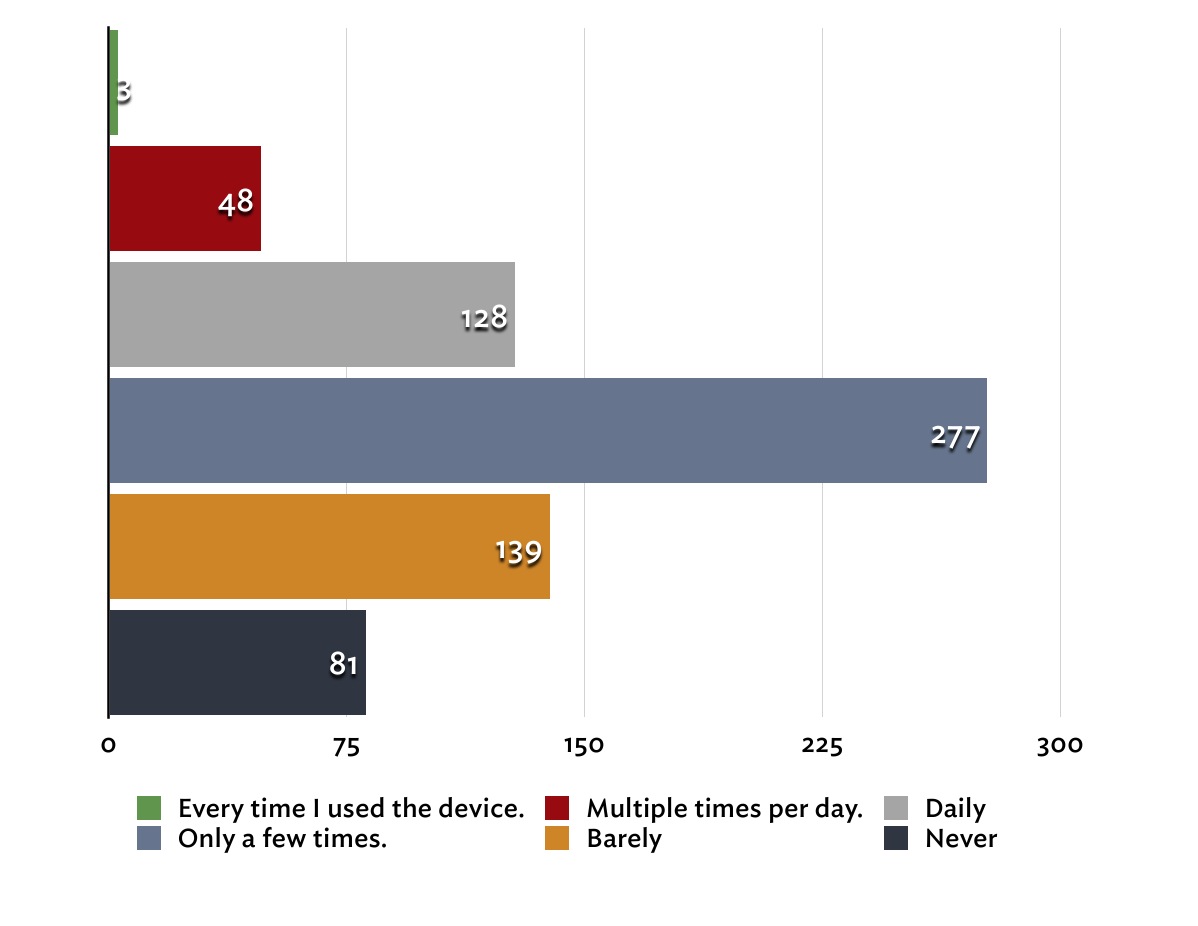
    In other words I needed to poll people to see how bad we collectively thought the crashing was on iOS 7. I created a vague poll with six possible responses. The polling software showed those choices in random order and used cookies to keep people from double voting. ((Not fool proof, but good enough.))

    This is the poll question and possible answers:

    “How often did iOS 7 (pre-7.1) crash on you?”

    1. Mulitple times per day
    2. Daily
    3. Only a few times
    4. Barely
    5. Never
    6. Every time I used the device

    Now, before we get into the results and analyzing them, we need to address fundamental flaws in this poll.

    Flaws

    • I did not specify what “crash” means. I left it open to interpretation. Some would damn the poll because of that, but in my opinion that is the most accurate way to conduct this research. A perceived crash in this case is no different than an actual crash. That is, a perceived crash will equally ‘ruin’ Apple’s reputation as a real crash would. You wouldn’t rebut an anger customer by telling them the device didn’t really crash.
    • I did not specify devices, or limit devices. I only specified iOS 7.
    • I used vague and slightly interpretive terms. I’ll address this more later, but it is of very little difference.
    • I posted this on a tech blog, not say Facebook — so the respondents are naturally more likely to notice a crash.
    • I didn’t ask for an opinion on if the crashes were better or worse than iOS 6. This is because human memory is shitty at recalling annoying things like this — either forgetting them completely or exaggerating them in hindsight.

    Overall is the poll flawed? Hell yes. But so is every poll, but knowing these key flaws can better help us interpret the data.

    The Results

    Here are the raw results in bar chart form, the total number of respondents was 676.

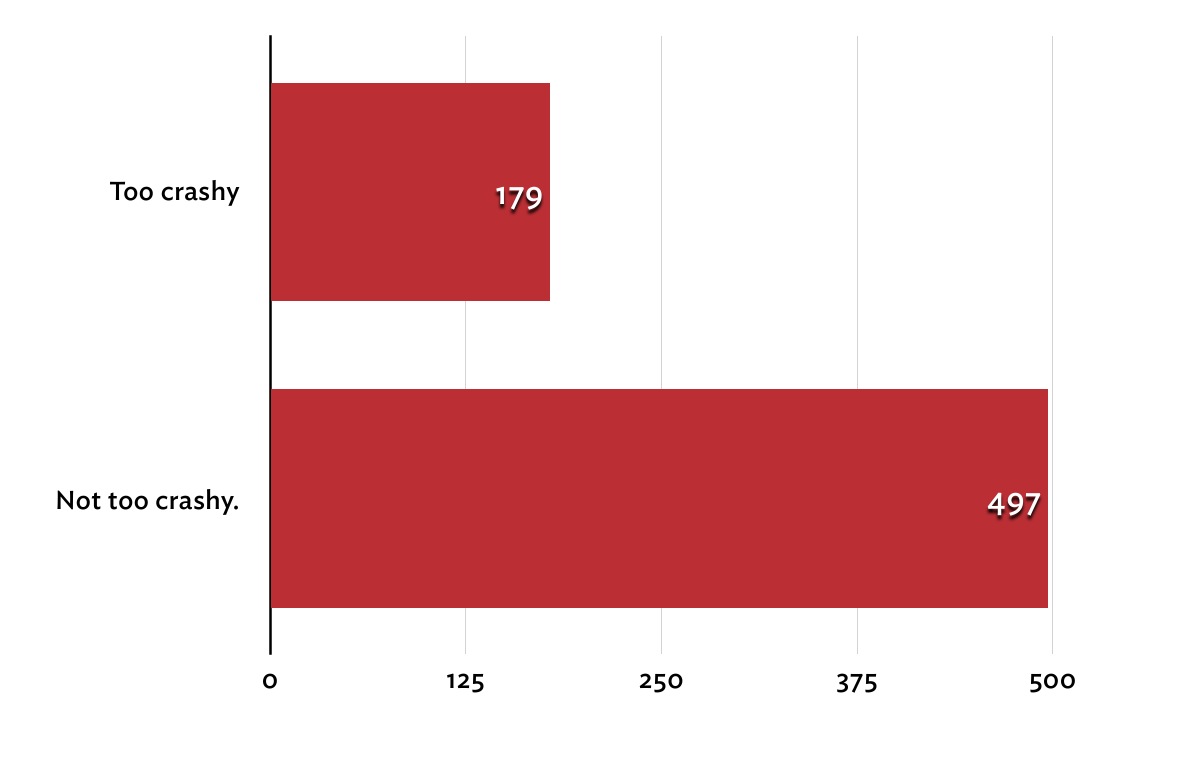
    I’ve now taken that same data set and consolidated the information into two categories, with “Barely, Never, Only a few times” being one category that I call “not too crashy”. The second category is “Every time I used the device, Multiple times per day, Daily”, which is called “too crashy”.

    In other words I boiled the results down to a yes or no answer of: Did you iPhone crash too much?

    The overwhelming answer is no, for most people their devices did not crash too much. But their devices did crash and one could make the unreasonable argument that even a single crash is too much.

    While that is a nice goal, it is completely unrealistic for any operating system on this scale.

    What this data doesn’t tell us, that would be most useful, is how these responses differ from iOS 6. Without that knowledge we cannot make a conclusion as to whether the software has become more crash prone or not. And it’s hard to judge the damage that iOS 7 did to Apple’s reputation.

    All I can say right now is that 26.4% of respondents to my poll claim iOS 7 crashed far too often to be considered acceptable by any reasonable person. I have no way of knowing if that is worse or better than anything else. It is just a number by itself.

    So the real question then: Did Apple damage its “just works” reputation with a 26% crash rate for users of iOS 7?

    You be the judge — honestly it was a lower percentage than I thought it would be, but higher than I would want it to be.

  • Feinstein the Hypocrite

    Matthew Cole for NBC News: “It’s clear the CIA was trying to play ‘keep away’ with documents relevant to an investigation by their overseers in Congress, and that’s a serious constitutional concern,” said Snowden in a statement to NBC News. “But it’s equally if not more concerning that we’re seeing another ‘Merkel Effect,’ where an…

    Matthew Cole for NBC News:

    “It’s clear the CIA was trying to play ‘keep away’ with documents relevant to an investigation by their overseers in Congress, and that’s a serious constitutional concern,” said Snowden in a statement to NBC News. “But it’s equally if not more concerning that we’re seeing another ‘Merkel Effect,’ where an elected official does not care at all that the rights of millions of ordinary citizens are violated by our spies, but suddenly it’s a scandal when a politician finds out the same thing happens to them.”

    Patrick Rhone:

    God bless hypocrisy.

    This should be fun.

  • CIA searched Intelligence Committee computers

    Ed O’Keefe and Adam Goldman: The head of the Senate Intelligence Committee on Tuesday sharply accused the CIA of violating federal law and undermining the constitutional principle of congressional oversight as she detailed publicly for the first time how the agency secretly removed documents from computers used by her panel to investigate a controversial interrogation…

    Ed O’Keefe and Adam Goldman:

    The head of the Senate Intelligence Committee on Tuesday sharply accused the CIA of violating federal law and undermining the constitutional principle of congressional oversight as she detailed publicly for the first time how the agency secretly removed documents from computers used by her panel to investigate a controversial interrogation program.

    That’s the CIA, imagine how fucking hard it would be to investigate the NSA.

  • Review: Tom Bihn Founder’s Briefcase

    A few months ago Tom Bihn announced the Founder’s series of bags — specifically creating a backpack and briefcase. Both looked neat to me, but the backpack wasn’t one I was likely to ever use. The briefcase, however, intrigued me a bit more. Tom Bihn sent me a review unit of the Founder’s Briefcase to…

    A few months ago Tom Bihn announced the Founder’s series of bags — specifically creating a backpack and briefcase. Both looked neat to me, but the backpack wasn’t one I was likely to ever use. The briefcase, however, intrigued me a bit more. Tom Bihn sent me a review unit of the Founder’s Briefcase to check out and I have been using it for about a month now.

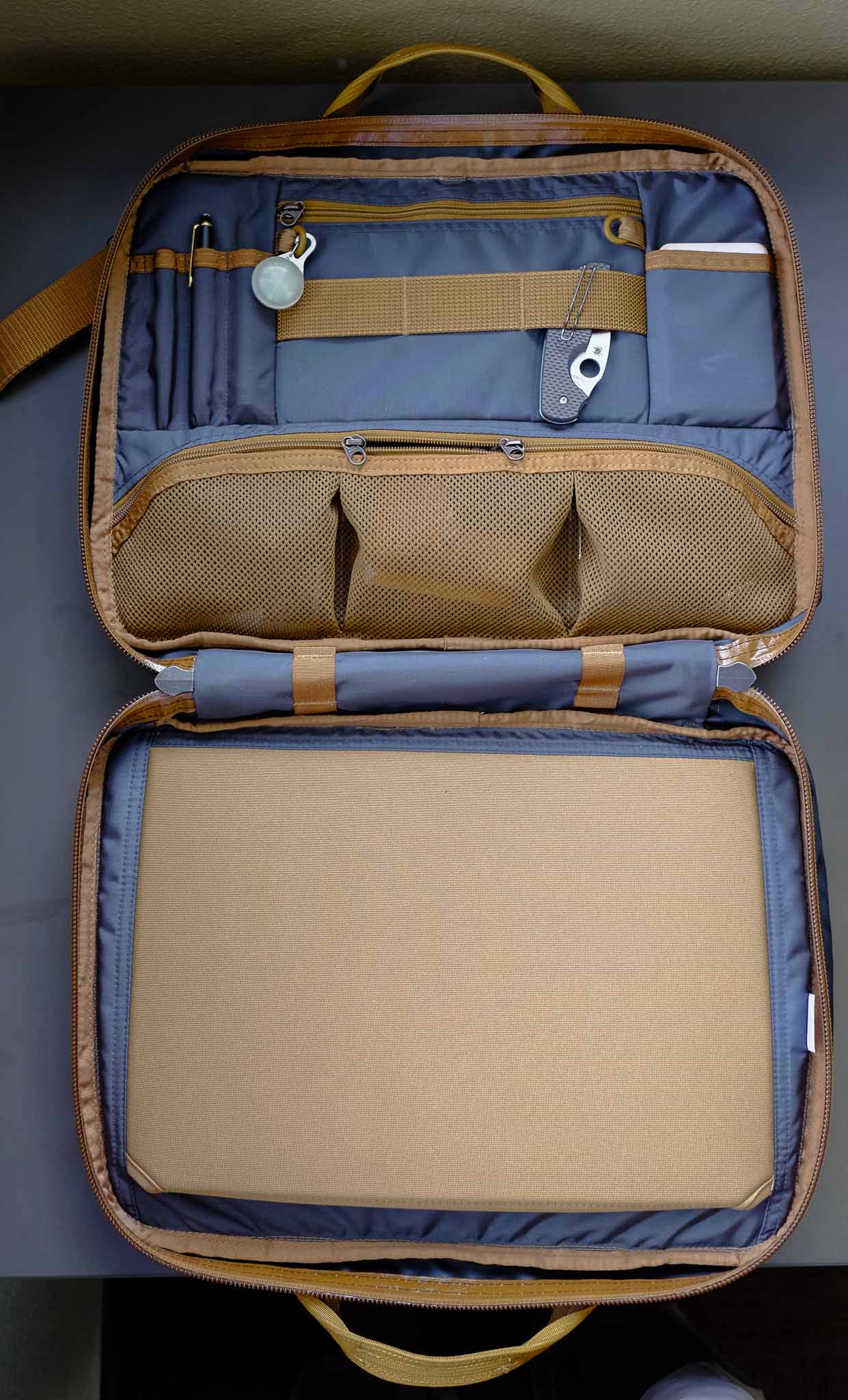
    This is a really odd bag. Over the course of using it I have gone from being in love with it, to being indifferent about the bag. It’s a clamshell design that has a very large zipper running around it — this allows for the bag to open completely flat so that you can leave your laptop in it as you go through TSA checkpoints, or you can just unzip the top and grab what you need (including your laptop).

    The Look

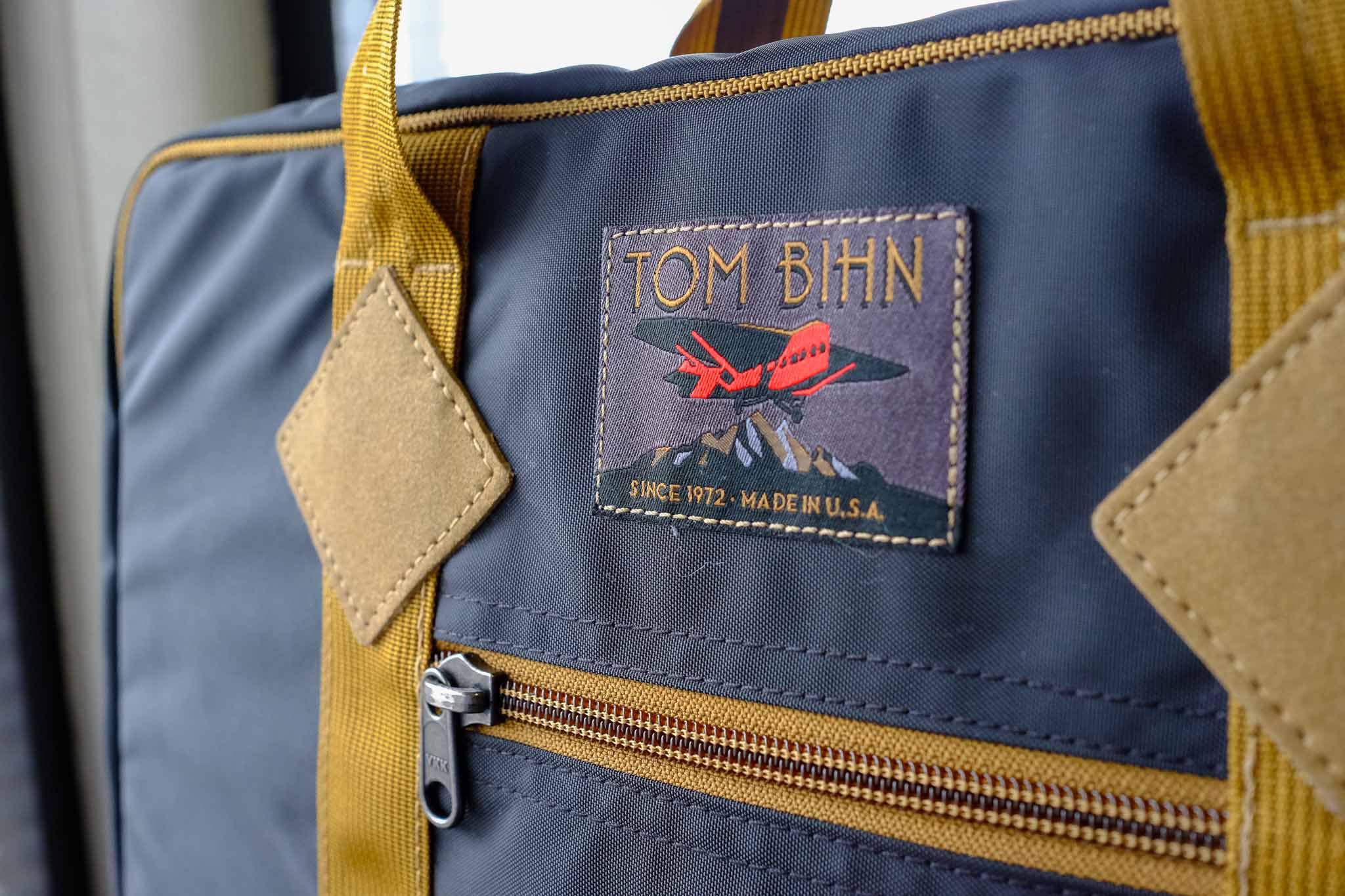
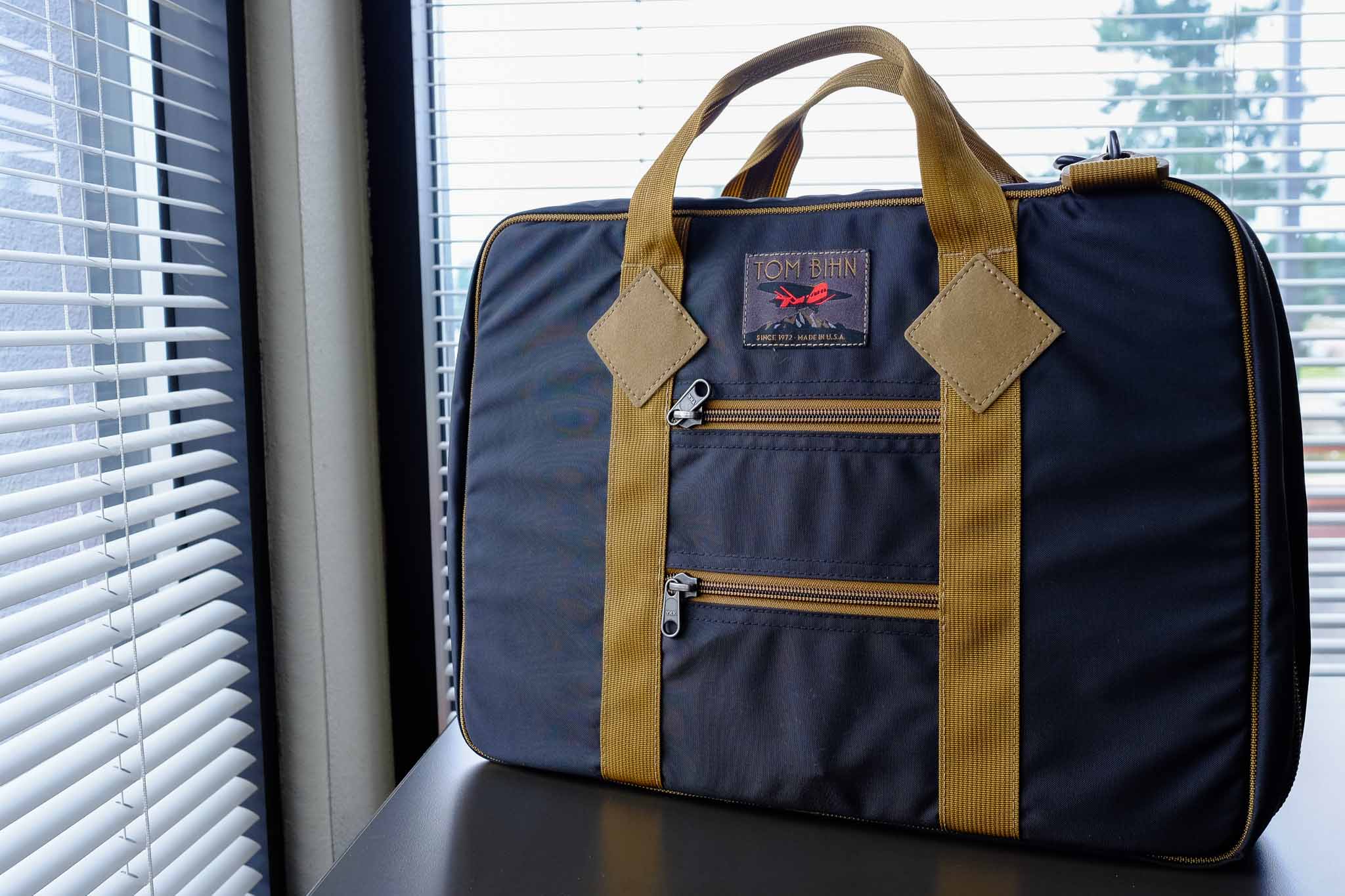
    What drew me to the bag initially was its look. Likely not everyone’s cup of tea, this bag screams Pacific Northwest style to me. You wouldn’t be out of place using this bag in Seattle with your Filson jacket on — it seems designed for the casual northwest businessman.

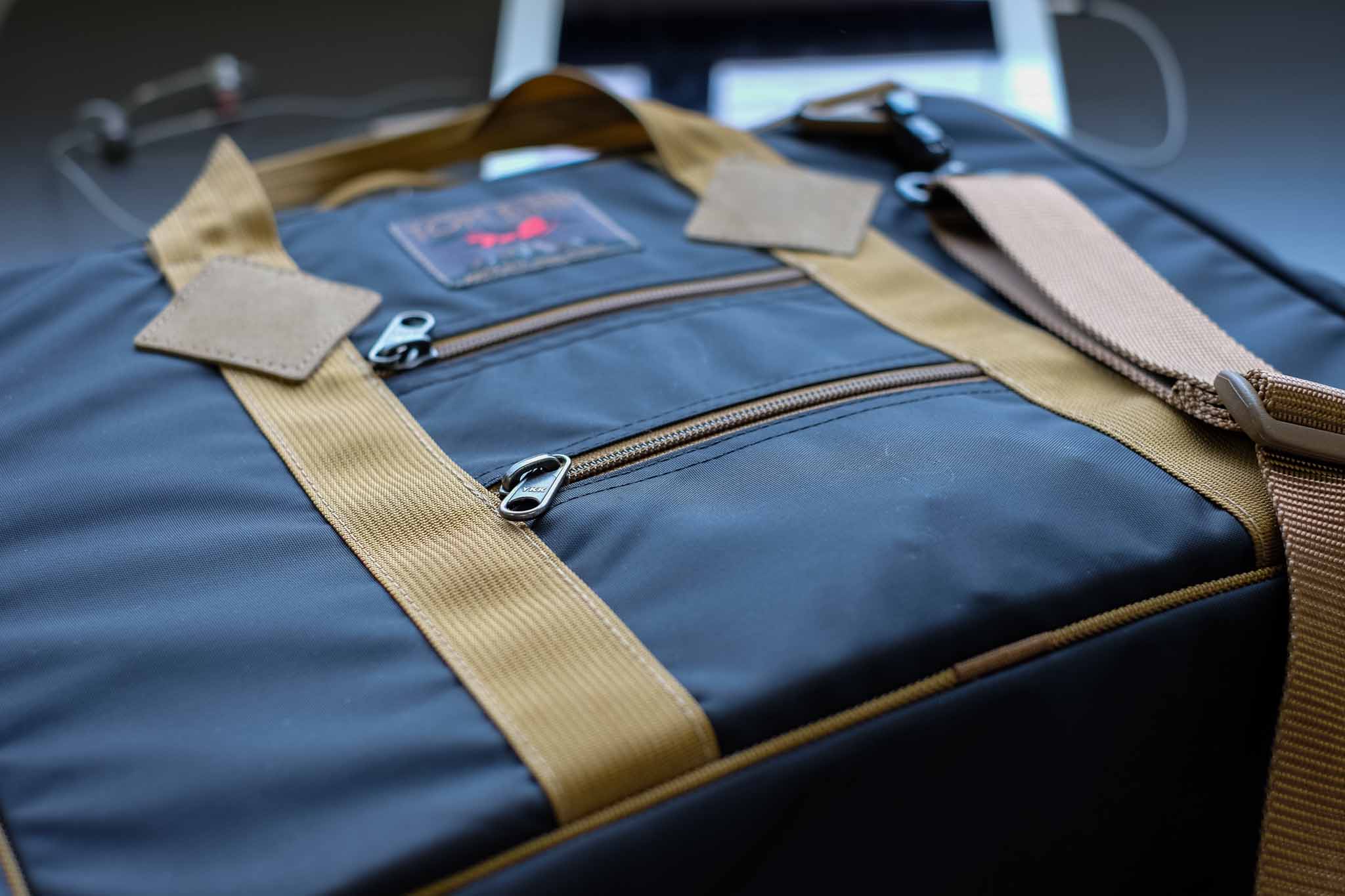
    Surprisingly the bag material had more of a sheen to it than I had expected, as the nylon used is a bit shiny for my liking. It’s not enough to ruin the aesthetic of the bag, but I personally think it makes the bag look too retro (even though that is the point), instead of making it look retro ‘inspired’. ((I really hate having to use that terminology.)) That’s a tough distinction, so you’ll have to judge from the pictures for yourself how you think the bag finishes.

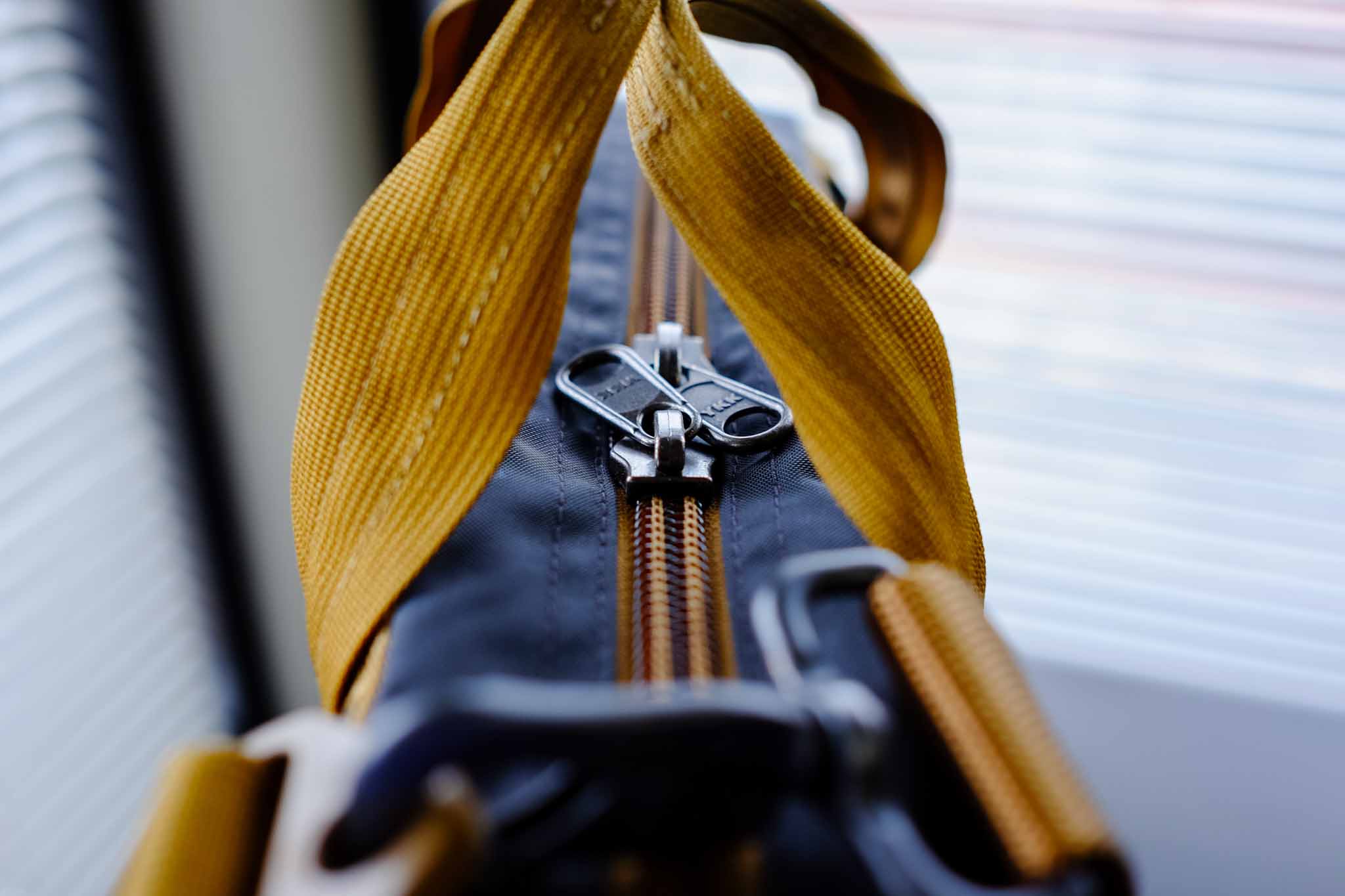
    There’s one other aspect of the design that I love: the clasps on the shoulder harness. They are a bit large and metal — seemingly out of place on the bag — yet they are my favorite part. They are such nice detail and the fact that they mate with plastic means you won’t get that metal squeak.

    I think of this bag like a plaid flannel shirt — it can be very handsome, but can also be woefully out of place. Personally, I have a couple plaid flannel shirts.

    The Function

    So the design is niche, but well done. How about the functionality of the bag?

    I hadn’t used a shoulder bag in quite some time, so I was leery that I would enjoy it. I was proven wrong on that account — and while I still think backpacks overall are better, I’m hard pressed to find faults with the bag other than “it’s not a backpack”.

    This briefcase functioned exceedingly well in my day to day usage. There’s an option for an interior packing cube, which Tom Bihn sent to me, that I find rather unnecessary as it seems much too small to be useful and I found it just got in the way for me. The packing cube could be useful if you are prone to carrying a really light weight rain jacket — or a t-shirt — outside of that I don’t see the utility.

    It’s nice to know you can add a packing cube, but I’d rather see the mount used for an iPad sleeve or something of that ilk. Speaking of which, there is a “tablet” pocket in the bag which is fantastic — but only if you own an iPad mini or smaller tablet. It’s a pocket on the inside of the bag that is lightly padded with a bit of rigidity added — overall a wonderful touch. I just wish it fit an iPad Air instead.

    This tablet pocket is a design element I hope to see in more bags.

    There are two things which, functionally, I don’t like:

    The hefty zippers.
    Faux Molle straps.
    1. The zippers around the clam shell are large, which makes them tough to get moving, often causing me to lift up the bag from the resistance met with the zipper. The zippers are also pretty loud, and I much prefer quieter zippers for the same reason I hate velcro on my bag — the Goruck zippers are great in this regard.
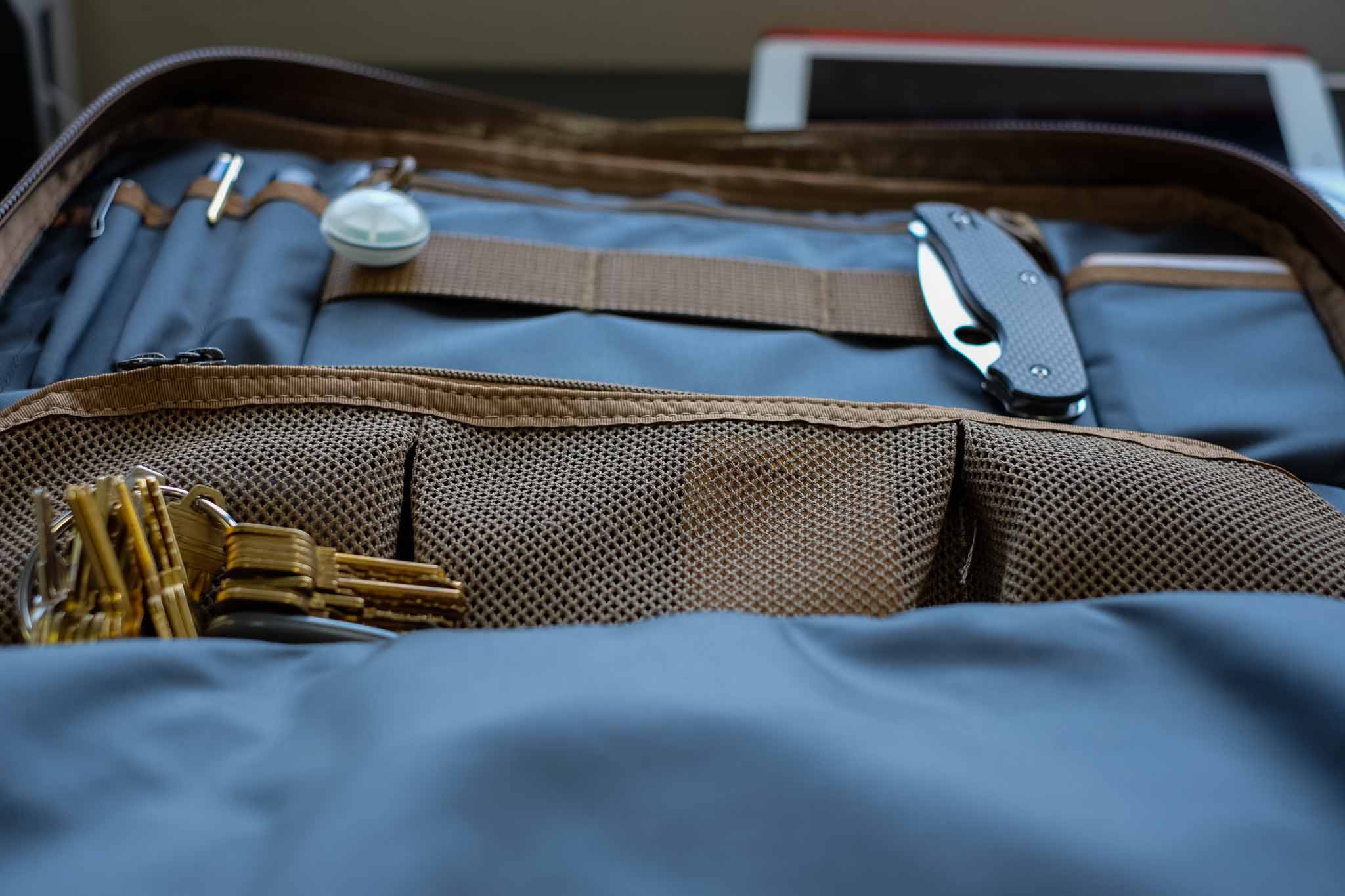
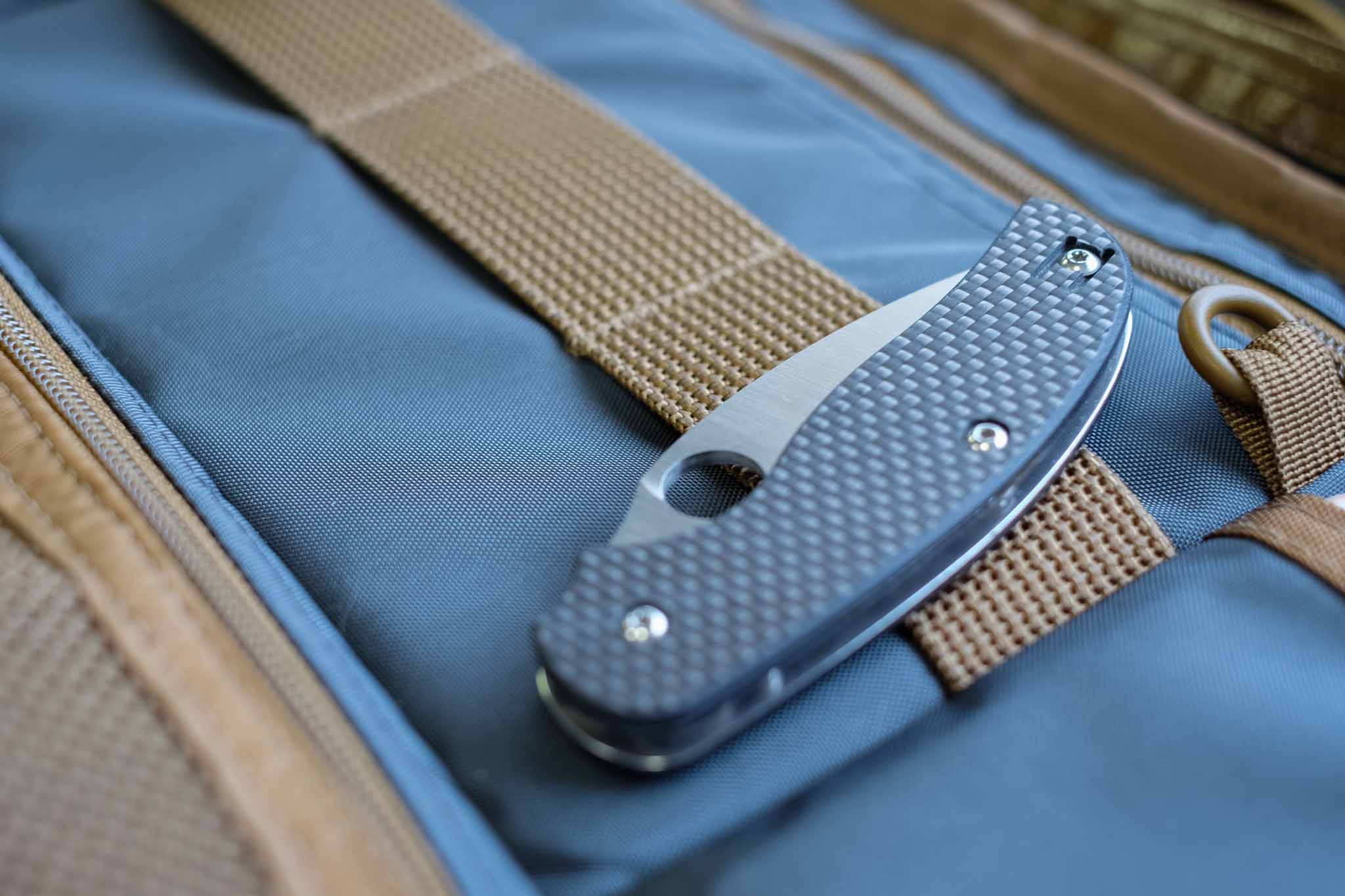
    2. There is a quasi Molle bit of webbing on the interior of the bag, three rather flat loops. They are really thick, and shown on Tom Bihn’s website as holding a great many things. I don’t get them. I think this space could be better served with more pockets instead of this strap system. Really seems like a waste.

    Aside from those two things, I have no other complaints. I like the two small exterior pockets and I really like the mesh pocket strip along the bottom on the interior of the bag — it holds a lot more than I would have guessed.

    Overall

    What I really liked about this bag was the ability to leave it standing (it stands well on its own) and zip just the top open to grab my laptop, or iPad — while reserving the option to lay the bag on its side and open it all the way. It’s a nice compromise in that you can easily use the bag as a top-loader (as I do 90% of the time), but it doesn’t bat an eye lash if you want to open it all the way up and lay it flat. This makes it a solid day-to-day option for the traveling person and excellent for neatly packing away your items for a longer journey.

    I really like the look of this bag when it’s gray and rainy here in the Northwest, it seems to fit in very well, but it stands out just enough to not be boring. I won’t be switching to this bag (since I prefer the extra room a backpack affords), but for those of you not on my backpack bandwagon you will find this to be a very solid alternative.

  • Should iOS7 Be an Embarrassment?

    Gabe Weatherhead: Even I consider iOS7 to be a great source of jokes about software crashing. That’s going to be a hard train to turn around. I really believe that Apple has harmed their brand with iOS7. It’s more devastating than any Samsung ad campaign. Really? That’s not been my experience at all. Yes, iOS…

    Gabe Weatherhead:

    Even I consider iOS7 to be a great source of jokes about software crashing. That’s going to be a hard train to turn around.
    I really believe that Apple has harmed their brand with iOS7. It’s more devastating than any Samsung ad campaign.

    Really? That’s not been my experience at all. Yes, iOS 7 has crashed on me more than iOS 6, but Weatherhead’s statement is pretty strong. I wonder what real data can tell us.

    Mind helping?

  • iOS 7.1

    Linking to CNET because they have a screenshot of the new call screen. This is the biggest change for me — that both the active call screen, and the answer screen have been changed. I won’t dive into the design, be it good or bad, but the end button is now something closer to 1/3…

    Linking to CNET because they have a screenshot of the new call screen. This is the biggest change for me — that both the active call screen, and the answer screen have been changed. I won’t dive into the design, be it good or bad, but the end button is now something closer to 1/3 the size it used to be.

    That’s going to take a lot of getting used to.

  • A Couple More Fujifilm X-T1 Reviews

    I’ve read a lot of X-T1 reviews, but there are only a couple that I think are well rounded enough for people to read. The first is by Michael Reichmann at Luminous Landscape. One part that he dislikes on the X-T1 — which I hadn’t considered — is the lack of custom control settings: Many, if…

    I’ve read a lot of X-T1 reviews, but there are only a couple that I think are well rounded enough for people to read.

    The first is by Michael Reichmann at Luminous Landscape. One part that he dislikes on the X-T1 — which I hadn’t considered — is the lack of custom control settings:

    Many, if not most cameras these days have grouped custom settings. This allow a wide range of desired settings to be combined into a single setting and this then assigned to a custom function button. That’s the way I always work. I have at least two custom settings, one for everyday walk-around shooting and one for a situation such as illustrated above, where I need settings appropriate for fast action. The geese may fly by, there could be a fight across the street, a scaffolding is falling off a construction site – press a single button and you’re ready to capture the shot.

    I think this is a strong point, but the same complaint could be made of using a manual focus lens. It’s a limitation of the style of the camera, not so much the camera — and therefore it is a choice the user makes. I think that just makes his point a ‘thing’ and not so much a detracting feature. Certainly an important ‘thing’ though.

    Steve Huff also posted his review and he is typically hard on Fujifilm, but not so much this time. His review I find to be fairly accurate and nothing sticks out at me as “hey, that’s wrong”. Having said that I don’t like the way he compared the noise between the X-T1 and the E-M1. ((These fucking camera names are going to be the death of us.)) I specifically don’t like that he is comparing the JPEGs and not the RAW files — now the X-T1 isn’t supported yet by a lot of software, so that could be the reasoning, but still.

    Personally I think Fujifilm has the best noise control of any camera on the market today — and I am not the only one. However Huff mentions that the JPEG noise reduction can cause “issues”. I know what he means, as I could only use X-T1 JPGs for my testing, this 1-month photo of our daughter looks overly smooth in the skin because of that noise reduction. So while I personally think the X-T1 bests the E-M1 in noise control by a strong margin, I do agree that I wish noise reduction could be turned off.

  • Apple’s iSight

    I had one of these, and one of the biggest tech regrets I have is selling it off. It was a fantastic design, and the mechanical privacy shutter was light years ahead of its time.

    I had one of these, and one of the biggest tech regrets I have is selling it off. It was a fantastic design, and the mechanical privacy shutter was light years ahead of its time.

  • Not Being Connected

    John Carey: This was just before the hysteria of smart phones took over our lives. If I remember correctly, I was carrying the recently released first generation of iPhone with me which went mostly untouched during the trip. While it was a cool device, my world didn’t revolve around it, I didn’t feel the need…

    John Carey:

    This was just before the hysteria of smart phones took over our lives. If I remember correctly, I was carrying the recently released first generation of iPhone with me which went mostly untouched during the trip. While it was a cool device, my world didn’t revolve around it, I didn’t feel the need to be connected at all times and share constantly to keep everyone in the loop.

    He may be known for his image, but the words accompanying his image is fantastic.

  • Choosing a Good Portrait Lens

    File this in the department of things I didn’t know. Mike Johnston, in talking about the Fuji 56 f/1.2 lens, talks a bit about why a portrait photographer doesn’t necessary want the sharpest lens: The texture of makeup and temporary pimples just aren’t needed for recognition purposes, and the brain tends to naturally “throw away”…

    File this in the department of things I didn’t know. Mike Johnston, in talking about the Fuji 56 f/1.2 lens, talks a bit about why a portrait photographer doesn’t necessary want the sharpest lens:

    The texture of makeup and temporary pimples just aren’t needed for recognition purposes, and the brain tends to naturally “throw away” that information. It’s not that we don’t see it, but we overlook it. To be psychologically accurate, portrait photographs should too.

    Worth reading his post, really interesting thoughts.

  • Analysis: Fujifilm X-T1

    This is going to be an analysis, more than review, of one of the ‘hottest’ cameras to come out: the Fujifilm X-T1. It’s an analysis because this camera has been reviewed to death. That said, I wanted to share a few of my thoughts on this new camera and take a practical look at what…
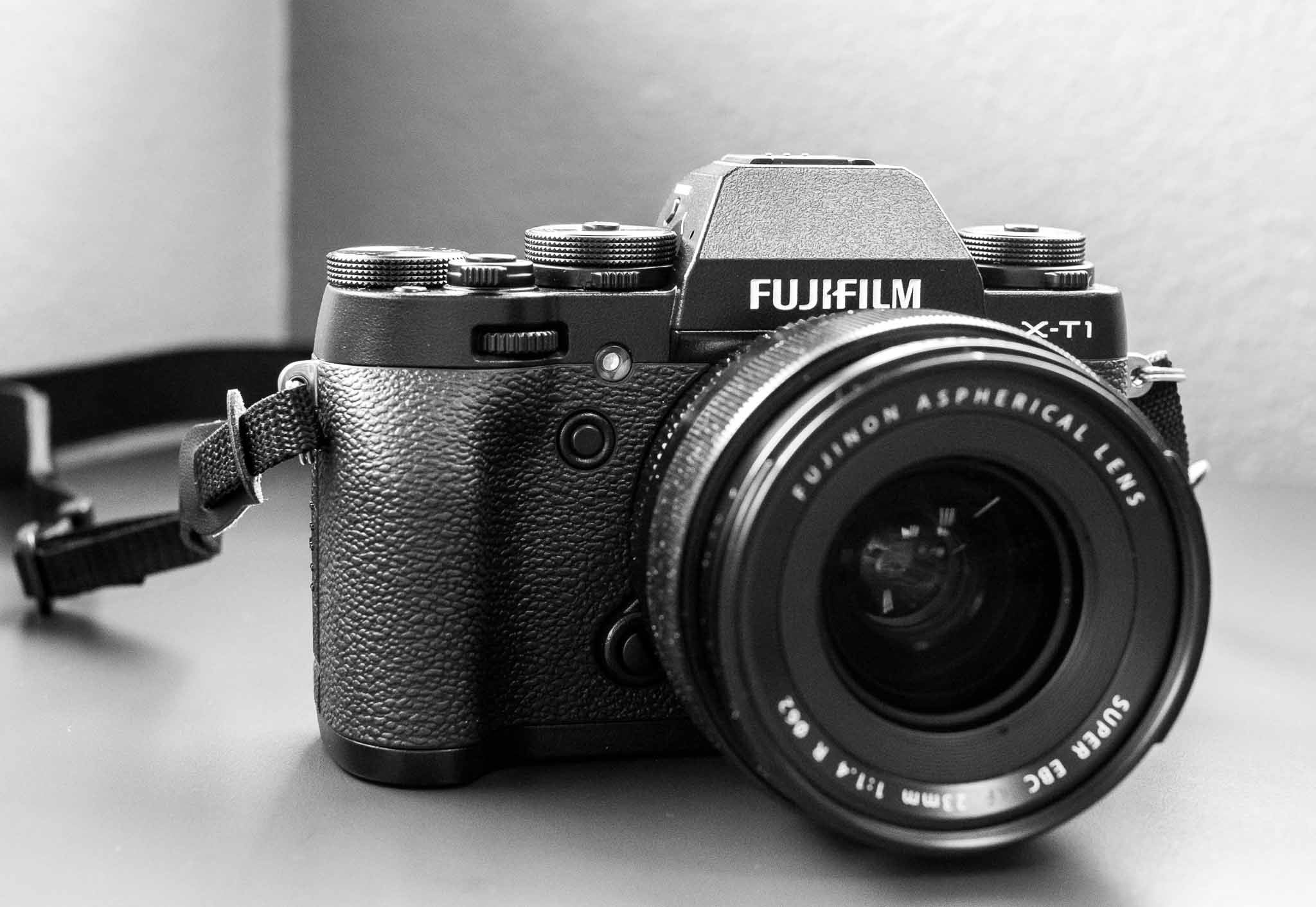
    This is going to be an analysis, more than review, of one of the ‘hottest’ cameras to come out: the Fujifilm X-T1. It’s an analysis because this camera has been reviewed to death. That said, I wanted to share a few of my thoughts on this new camera and take a practical look at what type of person this is ideally suited for.

    The Appetizer

    Overall the camera feels absolutely great in my hand. The balance, grip, and size are very well done. It feels solid too, but also light weight. As far as handling, it is near perfect for me. I personally think the camera balances best with the heavier 23mm 1.4 lens on it, but the 35mm 1.4 makes for a really nice and light setup if weight is of concern.
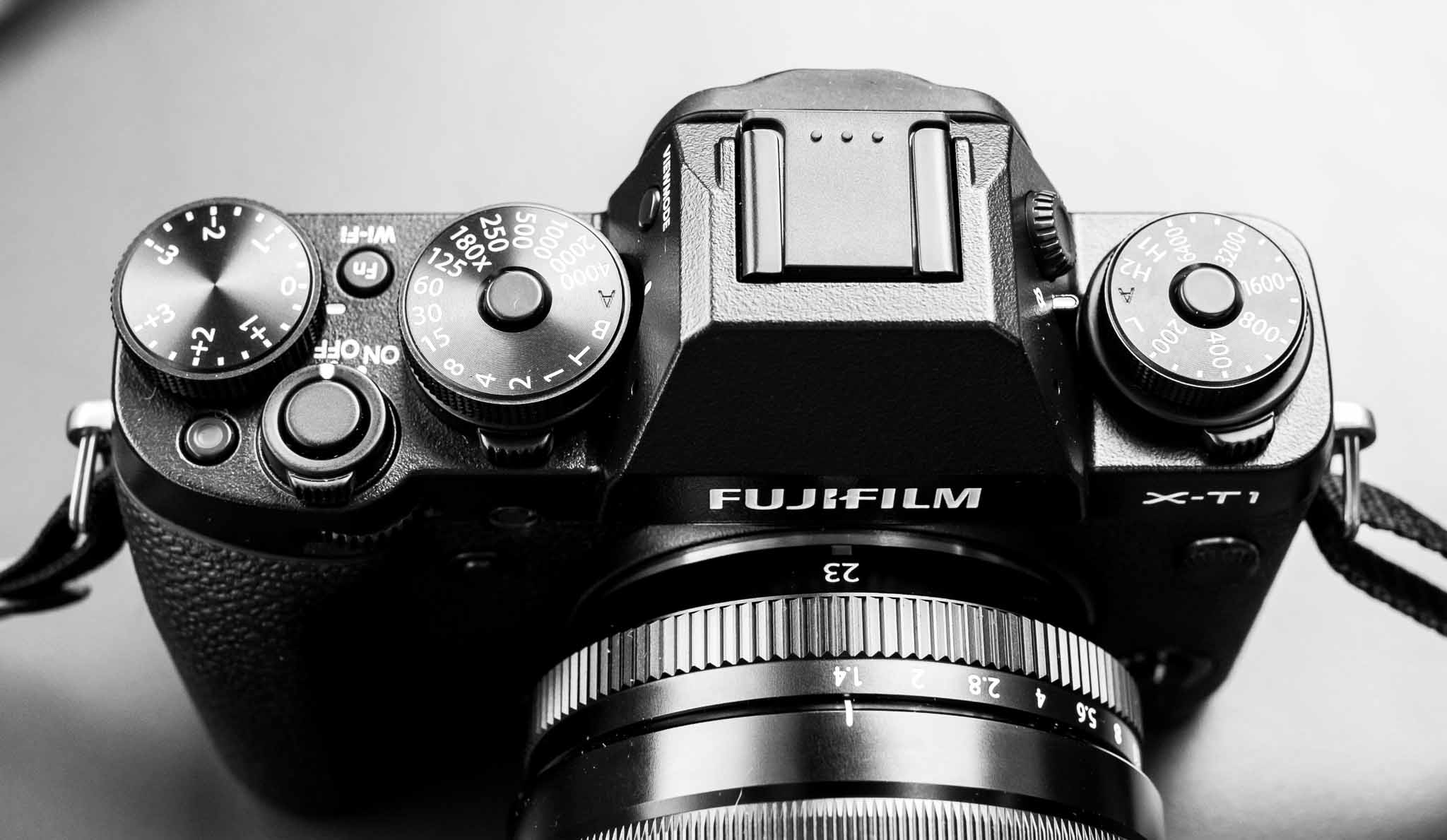
    The big draw of this camera is the fact that it has more manual dials on it for controlling camera settings. While it is rather overwhelming at first (a lot of what’s this, where’s that), within an hour or so of shooting I became very well accustomed to where and what each dial was — and in fact was really enjoying them.

    I do have a few concerns on the button and dial front:

    • The exposure compensation dial is difficult to turn with just your finger. This is nice because it won’t get as easily shifted as the X-E2 dial, but also hard to use if you want to hold your framing while adjusting it.
    • The ISO dial is a welcome addition, but the dial is locking. Unlike the shutter dial it locks at every adjustment (the shutter only locks when in auto). So you cannot easily change the ISO on the fly. This is very annoying. Even though I have taken to using auto ISO (because the noise control on Fujifilm is excellent), I still wish I could easily spin that dial with one finger while the camera was up to my eye. ((Someone is crowd funding a little sticker to go over the top and keep the button depressed.))
    • The 4-way buttons are atrocious. They are hard to press, mushy, and located very poorly. They are the single worst designed aspect of this camera.
    • Once again the playback button is in an odd spot. I’d prefer it where the Q button is, or at the very least flipped spots with the trash button.

    While I am trashing the camera a bit, there is also a rubber cover on the bottom that the grip connects to — yeah, that is going to get lost.

    Ok, that’s the extent of my complaints — seriously — because I love everything else about this camera. It is very fast, handles exceedingly well, and the quality is excellent (just as the X-E2 is). And that viewfinder is to die for, but you’ve read about that before.

    The Meat

    The big question I had about this camera is where it fits. That is, who should buy this camera? After using it for a week I came to the conclusion that this is a camera I would absolutely love to own, but not one that I would be likely to carry around as much as I do the X-E2 (which goes almost everywhere with me). While the two cameras are almost physically the same size, the addition of the viewfinder hump makes the X-T1 just too unwieldily as an everyday carry. It’s the change that moves the body from ‘kind of svelte’, to ‘you’re not stashing this away’.

    This is a camera that you purposefully choose to carry. When you get into that realm you start talking about Sony A7s, Olympus E-M1s, and of course all of your traditional dSLRs. That’s a huge market, and one that I am not going to tackle.

    Instead, I look at this camera a lot like a prosumer dSLR — and in that light how does the X-T1 stack up?

    I am a big Canon guy, so for me if I was looking to own an X-T1 I would also be comparing it with a Canon. Which brings into consideration the 5D MKIII, 6D, or 7D cameras from Canon — the price difference alone on some of these makes the decision easily in Fuji’s favor. But let’s ignore price for this.

    For me the real question here is whether the X-T1 would be a good option for someone to buy instead of one of those Canons listed above. These are cameras that are a bit too large to carry all the time, and yet are serious about taking pictures. The Canon’s across the board will take better video — not even close — so I want to caveat that now.

    The X-T1, then, offers something that the Canon lineup cannot: fun.

    I shot for many years with a Canon 5D, and I can tell you that I never enjoyed shooting with the 5D as much as I have with the X-T1. Canon’s are made for you to trust the camera, and the X-T1 seems to love you even more when you flip to manual and stop trusting it.

    The Canon wants to do things for you, whereas the Fuji wants you to take charge.

    It’s almost like the difference in car gearboxes. Point and shoots are all automatics for the most part, and SLRs used to be the manuals. That’s shifted, where now I see most dSLRs (certainly the ones I mentioned) as more of the sequential-manual gearboxes (the flappy paddle gearboxes as Top Gear would say). That is, you can still mostly control everything, but there’s a purposeful computer there to make sure you do it right. In that sense the X-T1 truly can be a manual transmission. It’s fun because you can make mistakes with it, but also because when you get it right, you really get it right and there’s a wonderful sense of perfect harmony there.

    Yes the sensors are bigger on some of those Canons, but I can tell you without a shadow of a doubt that you will enjoy taking pictures more with the X-T1 than with any of those Canons.

    Unless you are faced with the most demanding of situations for cameras (either sports, weather, or needing as much image quality as possible) then I don’t see how the X-T1 isn’t the better tool.

    It’s more fun, it’s smaller, and it’s cheaper.

    The Dessert

    We’ve come to a point with cameras where the image quality of the top of the line cameras is so good, that the sensor sizes are mattering less and less. The E-M1, X-T1, A7 cameras all offer superb image quality. You’d have to really look to find issues in any of them for most any shooting circumstance.

    This is excellent news for anyone who loves cameras, because that tech will not only trickle down, but it means you can just buy the camera that you like the best and rest assured it will serve you well even if you want to try and be a “pro” photographer some day.

    I like the X-E2 better, but that is only because the sensor is the same as the X-T1.

    Buy It

    Buy it at Amazon, or B&H Photo and you help support the site.

  • Ranking Jerry’s Girlfriends

    This is great.

    This is great.

  • Archiving Your Photos

    Good overview of the problems from CJ Chilvers. I am taking a new approach (which I am just starting) using BitTorrent Sync and my hosted Mac mini. More on that later.

    Good overview of the problems from CJ Chilvers. I am taking a new approach (which I am just starting) using BitTorrent Sync and my hosted Mac mini. More on that later.

  • Trusting iCloud

    Ben Bajarin: Without question, iCloud still has a long way to go. However, I still believe it is one of the more encompassing multi-device synchronization engines I have used in some time. If the app supports iCloud, it’s all I use.

    Ben Bajarin:

    Without question, iCloud still has a long way to go. However, I still believe it is one of the more encompassing multi-device synchronization engines I have used in some time.

    If the app supports iCloud, it’s all I use.