Top Posts

Leica Sofort 2June 13, 2024
Grand Seiko SBGX261February 23, 2023

Recent Articles

  • The Email Newsletter Brigade

    Two years ago I would have laughed at the idea of writing a quick post to point out some email newsletters — after all, that’s not the way we get news now days. We have ADN, Twitter, RSS, Push notifications and on and on. Yet the email newsletters are the only ones that I never…

    Two years ago I would have laughed at the idea of writing a quick post to point out some email newsletters — after all, that’s not the way we get news now days. We have ADN, Twitter, RSS, Push notifications and on and on. Yet the email newsletters are the only ones that I never miss — they are great. Here are some that you should consider.

    ## NextDraft

    [You are subscribed to this right](http://nextdraft.com), better yet you have the iOS app right? It’s fantastic. Dave Pell does an amazing job accumulating enough links everyday to keep your Instapaper queue overflowing.

    ## The Brief

    What [Evening Edition is for news](http://evening-edition.com), [The Brief is for tech news](http://thebrief.io). Except you get the tech news first thing in the morning. This is a great way to get a handle on the day if you are going to be away from your RSS feed — at least it is for me. At a conference, away on vacation, but don’t want to miss out? Here is your solution.

    ## The Round Down

    [This is a weekend newsletter with a more global](http://therounddown.com) (read: non-US centric) take on things. I’ve only been reading for a little while, but I do enjoy it quite a bit.

    ## Now I Know

    [Dan Lewis’ newsletter is awesome](http://nowiknow.com). Short little stories that leave me with *at least* one thing I didn’t know before I read it. It’s like getting a Wikipedia summary from a random truly interesting page delivered to you everyday.

    There’s four great newsletters to fill your inbox.

  • ‘Automatically Send Articles From Reading List to Instapaper’

    I asked on App.net for a tool to send stuff from Reading List to Instapaper, didn’t explain why, and Federico Viticci came up with a wonderful solution. Viticci figured out why I wanted it too: >The interesting fact about this workflow is that, at first, I thought it would be useless: *why would I want…

    I asked on App.net for a tool to send stuff from Reading List to Instapaper, didn’t explain why, and Federico Viticci came up with a wonderful solution. Viticci figured out why I wanted it too:
    >The interesting fact about this workflow is that, at first, I thought it would be useless: *why would I want to do this*? As TJ Luoma told me on App.net, though, Reading List is integrated on a system-wide level, while Instapaper isn’t. Sure, most third-party apps offer a “Save to Instapaper” feature nowadays, but it’s still very convenient to be able to add links to Reading List from Mail or Calendar.

    Bingo. I can send things to Reading List really easily in Apple apps and avoid having to open the page in Safari and then invoke the Instapaper bookmarklet — thanks Viticci!

    David Smith, well dressed man he is, [also came up with an app to do the same]( http://static.crossforward.com/ReadingListToInstapaper.app.zip) (that’s a zip file download link, FYI). The primary difference between the two is that with Viticci’s solution everything is automated, with Smith’s you have to manually send the items each time. Both work, and work well in my testing, they just are for different workflows. I’ll use both, but probably rely mostly on Viticci’s for the time being.

  • Seasonality Core

    This is a neat enough update to the Weather app, Seasonality, that I thought it was worth sharing. They added “particle mode” to the wind maps that show you how something would move across a given map with the wind that is currently happening. It’s hard to describe, but looks pretty sweet, kind of mesmerizing.…

    This is a neat enough update to the Weather app, Seasonality, that I thought it was worth sharing. They added “particle mode” to the wind maps that show you how something would move across a given map with the wind that is currently happening. It’s hard to describe, but looks pretty sweet, kind of mesmerizing. (Be sure to hit the options and up the amount of particles for the full effect.)

  • Send Everything to Instapaper

    There’s been more than a few times where I will have a couple dozen tabs open in Safari, only to have to leave and want to send those tabs (back) into Instapaper. In the past I just CMD+W and then CMD+2 to cycle through closing windows and sending them to Instapaper. I recently lamented that…

    There’s been more than a few times where I will have a couple dozen tabs open in Safari, only to have to leave and want to send those tabs (back) into Instapaper. In the past I just CMD+W and then CMD+2 to cycle through closing windows and sending them to Instapaper. I recently lamented that I wish there was an Applescript to do such a thing — well now there is.

    Martijn Engler put his Applescript that does just that on Github for all to enjoy. Sweet!

  • Amazon Item of the Week: Columbia River Knife and Tool’s M16-02Z Zytel Razor Edge Tanto Blade Knife

    [Patrick Rhone pointed me to this knife on his blog](http://patrickrhone.com/2012/09/06/columbia-river-knife-and-tools-m16-02z-knife-review/), and encouraged me to get it. It is actually the first “tanto blade” knife that I have owned. This is the style of blade that looks a lot better, but gives you two sharp points: one where the blade breaks to form the “normal” point,…

    [Patrick Rhone pointed me to this knife on his blog](http://patrickrhone.com/2012/09/06/columbia-river-knife-and-tools-m16-02z-knife-review/), and encouraged me to get it. It is actually the first “tanto blade” knife that I have owned. This is the style of blade that looks a lot better, but gives you two sharp points: one where the blade breaks to form the “normal” point, and the last one where the point of the knife actually is.

    I’ve been adverse to this type of blade simply because they didn’t seem as useful to me.

    Now having carried this knife as my everyday knife for a month I will toss out the above statement. This is actually a really good knife, but also a really quirky knife.

    ### The Good

    – Fast, I mean fast, deployment.
    – Solid lock.
    – Fantastic feeling handle.
    – Good weight and balance.
    – Good steel that ships really sharp.

    ### The Bad

    – Too big for me to use as an everyday carry.
    – The closing mechanism seems utterly ridiculous to me. Yes, you can close the knife with one hand — but that doesn’t explain why in the world I want a safety on the closing function. Essentially to close this knife blade you have to hold a little lever in place and then depress the inner blade lock. It works, but it’s clumsy and stupid — this knife opens so easily the safety should be on the opening, not closing side of the action.

    ### All-in-all

    I truly like this knife, but it takes a lot of getting used to. It’s found a home on my workbench and I’ve been very happy with it. [At $35.68 with Prime shipping](http://www.amazon.com/exec/obidos/ASIN/B000WAC7RM/ref=nosim&tag=brooksreview-20), it’s a bargain.

  • Beating a Dead Horse that Keeps Coming Back to Life

    For the last few days I was in Vancouver BC (Canada for those that don’t know). It’s a city I have been to a few times and I generally really like the city and the fact that I can drive to it in less than half a day. Even though I have been there a…

    For the last few days I was in Vancouver BC (Canada for those that don’t know). It’s a city I have been to a few times and I generally really like the city and the fact that I can drive to it in less than half a day. Even though I have been there a few times, I still have no sense of bearing in the city — it’s one of the few cities that I have driven in, that I have yet to figure out. ((San Francisco is another.)) This meant that for three days I was at the mercy of my iPhone and the (dun, dun, DUUUNnn) iOS 6 Maps application. I used turn-by-turn navigation the entire time, never once double checking the spot the iPhone was taking me to, here’s the result:

    – Times lost: 0.
    – Times frustrated: 0.
    – Battery drain: far less than expected.
    – Speed: fast.
    – Times I questioned the GPS and was proven wrong: 1.5.

    The one thing that actually blew me away about the navigation was just how fast the maps application loaded a route on the sluggish 3G network I was roaming on. ([Here’s just how slow that network was](https://f3a98a5aca88d28ed629-2f664c0697d743fb9a738111ab4002bd.ssl.cf1.rackcdn.com/maps-3.PNG), and [how fast my iPhone is only an hour back into Washington state](https://f3a98a5aca88d28ed629-2f664c0697d743fb9a738111ab4002bd.ssl.cf1.rackcdn.com/maps-2.PNG). Additionally are there no LTE networks in Vancouver, or can USA iPhone’s not roam to them?)

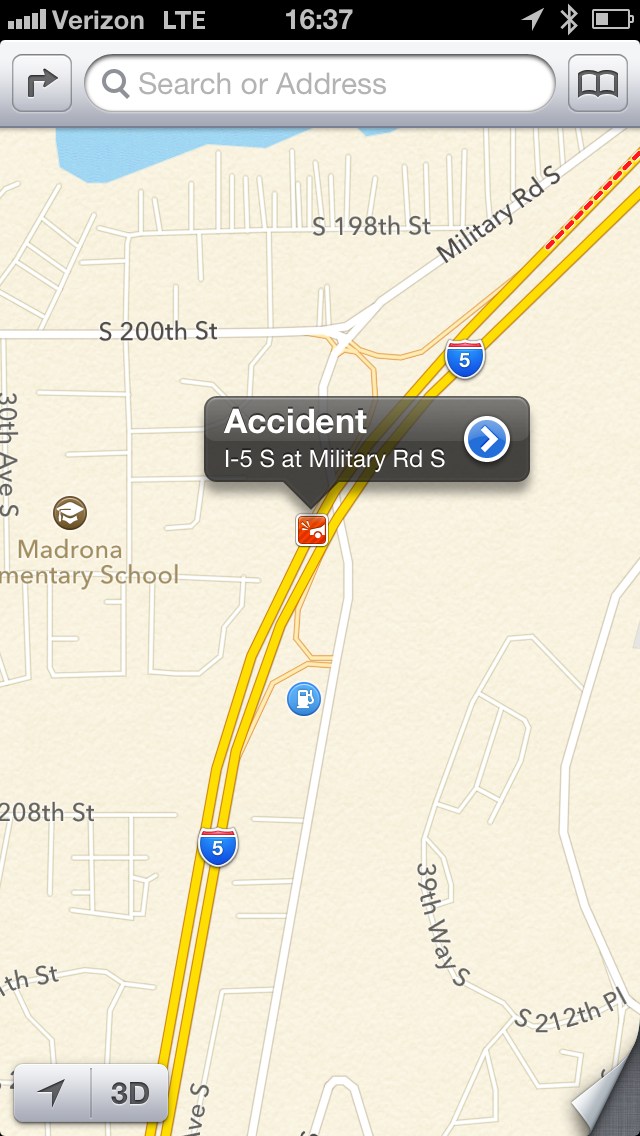
    I wasn’t going to write any of this up, but an odd thing happened on my way home — something that absolutely made me fall in love with Apple’s mapping solution — I hit massive traffic long before I expected to and naturally I checked the traffic flow on the Maps.app and scrolled down to see this:

    Accident icon.

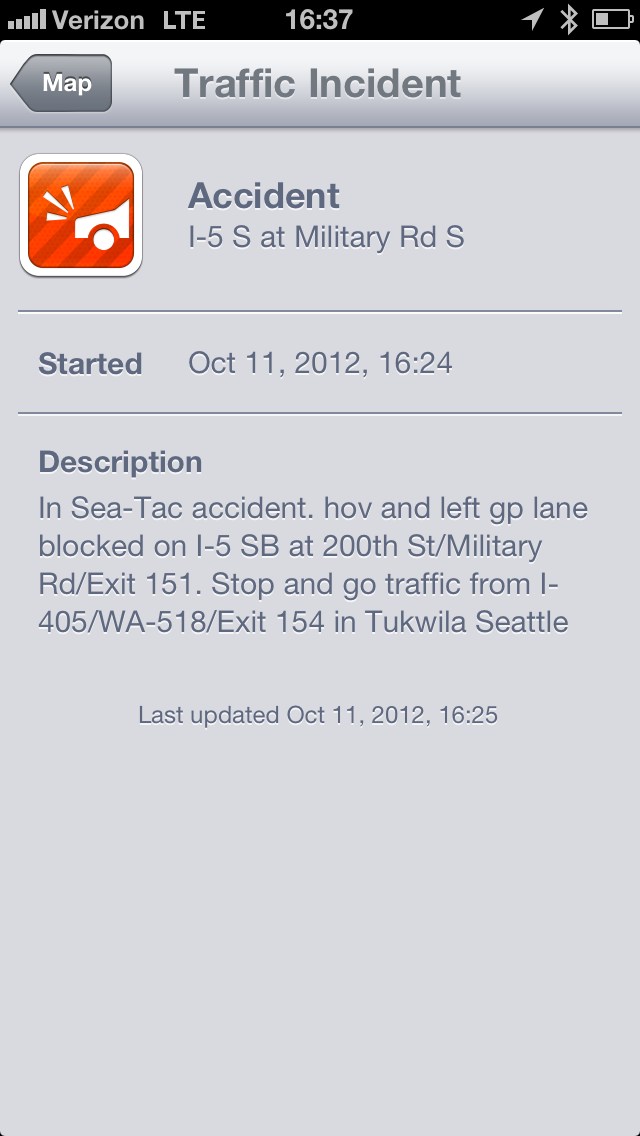
    So I tapped the icon, here’s what came up:

    Accident detail.

    Holy. Shit.

    That ladies and gentlemen is what I call useful information. Red, yellow, and green lines don’t tell you much other than what you likely already know. However knowing that there is an actual accident ahead, where it is, and the lane it is blocking is nothing short of awesome.

    For me this was the equivalent of using visual voicemail for the first time.

    #### The So You Don’t Email Me Section

    1. Yes I know Maps isn’t that great in *your* country.
    2. I don’t use public transit.
    3. I know you rely on street view, I don’t, nor do most other people.

    ## Bottom Lining It

    I never thought three days in Canada would make me fall in love with a maps application, but it did.

  • The B&B Podcast #80: Tips and Tricks: OmniFocus

    >Ben and Shawn share their favorite tips, tricks, and workflows for OmniFocus. Fun show, let us know if we missed your favorite OmniFocus tip/trick.

    >Ben and Shawn share their favorite tips, tricks, and workflows for OmniFocus.

    Fun show, let us know if we missed your favorite OmniFocus tip/trick.

  • The Magazine

    Marco Arment on his new business, *The Magazine*: > Many publications focus on reviews and comparisons, or bring you as much news as quickly as possible. The Magazine will not serve those roles. Instead, it takes a measured approach to the big picture: rather than telling readers everything that happens in technology, The Magazine delivers…

    Marco Arment on his new business, *The Magazine*:

    > Many publications focus on reviews and comparisons, or bring you as much news as quickly as possible. The Magazine will not serve those roles. Instead, it takes a measured approach to the big picture: rather than telling readers everything that happens in technology, The Magazine delivers meaningful editorial and big-picture articles.

    I’ve known about this for a bit now, but only saw the finished app yesterday. It’s simply fantastic, everything I would put in an iPad magazine is there. I can’t think of a single reason not to get the free trial to see just how good this will be and already is.

    Something that Marco didn’t say, but that I will, is that Marco is the type of guy that *will* deny your article if he doesn’t think it is good enough. Plain and simple. That is what it takes to pull something like this off: calling it like you see it, focusing on only the best, putting the reader first.

    **Update:** Since everyone else is mentioning it, I will be in an upcoming issue and I am honored.

  • Tim Bray Wants Off OS X, OK

    Tim Bray, complaining about the direction Apple is taking OS X: > In Particular · Since Snow Leopard, there’s been exactly one useful new OS X thing: windows you can resize at any edge. And there have been brutal amputations (most painful for me: loss of the Apache GUI and the moronic refusal to tell…

    Tim Bray, complaining about the direction Apple is taking OS X:

    > In Particular · Since Snow Leopard, there’s been exactly one useful new OS X thing: windows you can resize at any edge. And there have been brutal amputations (most painful for me: loss of the Apache GUI and the moronic refusal to tell me what screen resolutions I’m using).

    One new feature?

    + iCloud
    + VIP email inbox
    + Omnibar in Safari
    + How about just the overall stability of Safari
    + Fullscreen apps

    I’ll stop. What Bray is really upset about, from what I can infer, two things:

    1. The new features are obfuscating the nerd parts of the OS. Like the screen size resolutions Bray complains about, these changes are vastly more useful to non-geeks and should be irrelevant to geeks since there are plenty of tools that can hep mitigate this that are asily found using any search engine, even Google.
    2. I think the biggest problem Bray is having is one that plagues a lot of people. Which is, unless you buy fully into the Apple environment you get limited benefit from new OS updates. So if you use an Android phone, iCloud is irrelevant to you. Likewise if you don’t use Safari the massive strides there won’t effect you. And so on. This is typical of Apple, you need to fully “buy in” to the Apple environment or you risk wondering why in the hell you keep upgrading.

    Bray won’t be better of on Ubuntu, most people aren’t. I tried doing that same thing a few times now, because it sounds so appealing to the inner geek in me: more trouble than it’s worth and I could never fully be just Linux.

    Bray’s points are valid, but not a fault of OS X. Rather they are the fault of the user only wanting to have one foot in the door of an ecosystem that requires you to dive in head first.

  • Blanc’s Hidden Radio

    Shawn Blanc: >The Jambox is certainly not as clever as the Hidden Radio. Nor is it as complementary to the decor of its surroundings. Oh, I think we know where this is going… Shawn mentions that the Hidden looks better and has better battery life, neither of which matter after you have smashed it with…

    Shawn Blanc:

    >The Jambox is certainly not as clever as the Hidden Radio. Nor is it as complementary to the decor of its surroundings.

    Oh, I think we know where this is going…

    Shawn mentions that the Hidden looks better and has better battery life, neither of which matter after you have smashed it with a sledge hammer out of frustration. Hidden sent out a Kickstarter survey and typically I ignore these, but I felt compelled to let them know how and where they failed in my eyes.

    Contrary to what Shawn says, I think the Jambox looks far better. It’s less clever, and has shorter battery life, but then again it works — so there’s that.

    I’ve had a Jambox for what seems like decades and I barely use it, every time I go to use it I find the battery dead. Yet I like it better.

    The Hidden could have won me over if the battery lasted a month when off and it could play for an hour straight. Not much else matters, and that’s where it failed for me. Truly, it didn’t even have to sound that great.

  • Opt-out of Verizon Marketing Bullshit

    As [pointed out to me on App.net](https://alpha.app.net/bryanjclark/post/843872), you have less than 30 days to opt-out of some Verizon marketing sharing program. Who knows what it is other than a privacy violation in exchange for a few bucks going to Verizon. You have to sign into your Verizon account and say no to three things. Pretty…

    As [pointed out to me on App.net](https://alpha.app.net/bryanjclark/post/843872), you have less than 30 days to opt-out of some Verizon marketing sharing program. Who knows what it is other than a privacy violation in exchange for a few bucks going to Verizon.

    You have to sign into your Verizon account and say no to three things. Pretty simple, go do it, then photo copy your middle finger and send it to Verizon.

  • ‘Without Keyboards’

    Interesting thoughts from Craig Grannell on a TechCrunch post about the future of writing in a keyboard-less world. One thing that grabbed me was this sentence from Grannell: >Like with every other creative medium, it’s the edit that’s so often important with the written (or spoken) word. Like most people, I talk differently that I…

    Interesting thoughts from Craig Grannell on a TechCrunch post about the future of writing in a keyboard-less world. One thing that grabbed me was this sentence from Grannell:

    >Like with every other creative medium, it’s the edit that’s so often important with the written (or spoken) word.

    Like most people, I talk differently that I write. To be specific: when I talk I formulate my thoughts on the fly, but when I type I am forced to think about what I ultimately want to say and how to get there. So the idea of dictating to my Mac was never something that I wanted, it certainly is something nice to have, but I never use it.

    However, on my iPhone, I seek out the dictation. It is simply much easier to dictate on my iPhone than it is to tap things out with my thumbs. Because of that, I tend to steer clear of my iPhone for anything long form.

    Which brings me to software keyboards and my odd love and fascination with them. Specifically the iPad software keyboard. Because of the, shall we say, clunkiness of typing on the iPad’s software keyboard I have found that you must type a bit slower to be more accurate (editing is a pain). And because of the slower rate of typing, I find that I transcribe my thoughts a bit more clearly.

    This, I think, is why I like using the iPad so much — having nothing to do with the one-app-at-a-time viewports — instead more accurately getting my thoughts out of my head. Ideally, then, I would love to have a writing device that is the iPad, but with width to accommodate a full-sized software keyboard — I may be the only one who wants such a device though.

  • Quote of the Day: Jonathan Poritsky

    “‘Exclusive’ is a way to dupe readers into taking you seriously, into believing that yours is the only page upon which they can devour the freshest and the latest. But that’s a lie. It always has been.” — Jonathan Poritsky

    “‘Exclusive’ is a way to dupe readers into taking you seriously, into believing that yours is the only page upon which they can devour the freshest and the latest. But that’s a lie. It always has been.”
  • CDMA versus GSM Call Quality

    In the thoughts I wrote up about the iPhone 5, I had mentioned that the call quality seemed worse to me on Verizon. [I said](https://brooksreview.net/2012/09/iphone-5-2/): >Call audio quality seems worse when you are in an area with low reception, worse than with the previous iPhone. What I suspect is that this is a difference between…

    In the thoughts I wrote up about the iPhone 5, I had mentioned that the call quality seemed worse to me on Verizon. [I said](https://brooksreview.net/2012/09/iphone-5-2/):

    >Call audio quality seems worse when you are in an area with low reception, worse than with the previous iPhone. What I suspect is that this is a difference between AT&T and Verizon and not a difference in the iPhone itself, but I cannot be sure.

    I received a long and detailed email from a reader, who wished not to be named or the email shared, that pointed me in the direction of looking at CDMA versus GSM technologies. The hint that I was given was the CDMA doesn’t limit the users a cell tower can receive, instead CDMA drops the bandwidth to each person to accommodate the traffic, whereas GSM limits the users and fixes the bandwidth each user can have. That made a ton of sense, so I did some digging to see what in the world is actually happening. I started with LTE and found this note on the [LTE Wikipedia page](https://en.wikipedia.org/wiki/LTE_(telecommunication)) under voice calling:

    >While the industry has seemingly standardized on VoLTE for the future, the demand for voice calls today has led LTE carriers to introduce CSFB as a stopgap measure. When placing or receiving a voice call, LTE handsets will fall back to old 2G or 3G networks for the duration of the call.

    So from everything I could gather, in a lot of cases, Verizon calls are dumping back to the CDMA networks. Ok, so what can we unearth about CDMA. [Again, Wikipedia](https://en.wikipedia.org/wiki/Cdma#Advantages_of_asynchronous_CDMA_over_other_techniques):

    >There is no strict limit to the number of users that can be supported in an asynchronous CDMA system, only a practical limit governed by the desired bit error probability, since the SIR (Signal to Interference Ratio) varies inversely with the number of users. In a bursty traffic environment like mobile telephony, the advantage afforded by asynchronous CDMA is that the performance (bit error rate) is allowed to fluctuate randomly, with an average value determined by the number of users times the percentage of utilization. […]
    >In other words, asynchronous CDMA is ideally suited to a mobile network where large numbers of transmitters each generate a relatively small amount of traffic at irregular intervals. CDM (synchronous CDMA), TDMA, and FDMA systems cannot recover the underutilized resources inherent to bursty traffic due to the fixed number of orthogonal codes, time slots or frequency channels that can be assigned to individual transmitters.

    This is why at sporting events your AT&T service goes tits up while Verizon users can still actually use their devices — albeit damned slowly. Basically, the anonymous emailer was correct, CDMA is one big shared pipe with a finite amount of resources and no cap on the users.

    Now, I tried to verify the claim the GSM does not act this way, but couldn’t find any kind of resource. I did however [come across this page, titled](http://www.nordicgroup.us/ssub/voicequal.htm): “Voice Quality CDMA versus GSM”. The page seems to confirm that CDMA quality will degrade with the more simultaneous users on it, but that overall call quality is in parity between the two networks. ((Full LTE voice calling should be way better sounding.))

    So what I have learned is: “call quality” is a dodgy bugger. All things being equal the two standards should have relatively equal “call quality”. However, if CDMA gets congested, the call quality will drop. Whereas if GSM gets congested, you just won’t be able to make a call — roughly speaking.

    There’s obvious advantages to both. If you know more, please share.