>Shawn and Ben talk about the Nexus 7, Android, the tablet market, the UK ruling for Apple to place ads saying Samsung didn’t copy them, and how to grill a steak.
[Shawn also *made* me do an After Dark](http://5by5.tv/afterdark/197).
Top Posts
>Shawn and Ben talk about the Nexus 7, Android, the tablet market, the UK ruling for Apple to place ads saying Samsung didn’t copy them, and how to grill a steak. [Shawn also *made* me do an After Dark](http://5by5.tv/afterdark/197).
>Shawn and Ben talk about the Nexus 7, Android, the tablet market, the UK ruling for Apple to place ads saying Samsung didn’t copy them, and how to grill a steak.
[Shawn also *made* me do an After Dark](http://5by5.tv/afterdark/197).
This post makes one huge assumption: I assume that Marissa Mayer does not want Yahoo to continue to suck. If that assumption holds true, here’s two acquisitions Yahoo should make to become awesome, and a service that I use daily. ### Acquire 500px [Just yesterday I pondered about Yahoo buying 500px](https://brooksreview.net/2012/07/photo-tip/), I awoke today thinking…
This post makes one huge assumption: I assume that Marissa Mayer does not want Yahoo to continue to suck.
If that assumption holds true, here’s two acquisitions Yahoo should make to become awesome, and a service that I use daily.
### Acquire 500px
[Just yesterday I pondered about Yahoo buying 500px](https://brooksreview.net/2012/07/photo-tip/), I awoke today thinking it is an even better idea than it was yesterday. The play here is simple: buy 500px and rebrand it as “the new Flickr”. Migrate the entire existing Flickr user base and instantly make them all happy.
Next get hard to work on a mobile app for iOS uploads and see about getting direct integration into iOS from Apple for iOS 7/8.
This is smart because 500px is a business already, not some free service that Yahoo would need to figure out how to monetize.
I doubt every Flickr user would be happy with this, but it’s a better option than the “dying the slow death” path that Flickr is currently on.
### Acquire DuckDuckGo
It would pain me to see DuckDuckGo bastardized with ads, but I think there is a smart play here. Yahoo buys DuckDuckGo and starts serving ads on it, and make it the default Yahoo search engine. Yahoo is already an option on most browsers and devices (like iOS) so the potential user base is there. Putting the Yahoo brand behind the DuckDuckGo power, might be a win-win for both.
Of course the awesome privacy features of DuckDuckGo may suffer, but I have a solution for that: charge users to keep DuckDuckGo as it is — if they want. Figure out how much each user is worth to you in ad dollars. Divide that in half, and charge that a year for “pro” DuckDuckGo users. I bet it comes out to less than $10/yr — cheap!
This *is* a better option than [partnering with Google](http://searchengineland.com/yahoo-microsoft-search-alliance-google-127843).
### Who This Hurts
This is a play against Microsoft and Google. Yahoo would become a better search engine than Bing, and an excellent alternative to Google. Yahoo would also have (once again) the strongest photo offering for everyone from mom and dad, to pro level photographers. Both businesses would be easy to integrate, have a place in the company, and be able to immediately contribute to the bottom line.
Notice who this doesn’t come after: Apple. The enemy of my enemy is my friend, right? If Yahoo can show it is savvy, it would make itself a far more attractive partner to Apple than Google — and that could pay off in spades.
This is pretty clever, whether or not it is true. I think the worst of all the symbols on current Mac keyboards is the Launch Center / Spaces key that is three randomly placed rectangles. Everything else on a Mac keyboard is so very neat and tidy, then you have that F3 keys and it’s…
This is pretty clever, whether or not it is true. I think the worst of all the symbols on current Mac keyboards is the Launch Center / Spaces key that is three randomly placed rectangles.
Everything else on a Mac keyboard is so very neat and tidy, then you have that F3 keys and it’s unorganized mess — it drives me nuts.
Which brings me to one last point: the option key on Macs doesn’t show that symbol — it’s something that you see in menus when looking for keyboard shortcuts. So how long before Apple rids their keyboards of the Command key symbol? The word is already clearly spelled out and it would lend to a cleaner look. There’s got to be a traditionalist at Apple keeping that symbol on Mac keyboards.
“If given the choice between writing for free or censoring myself, I’ll write for free.” — Marco Arment
A great curves video tutorial from Aaron Nace on the 500px blog. If you take photos at all, then you should watch this because it can really do wonders for your photos. This got me to thinking about something else though — and so excuse this tagent. One the last remaining, somewhat relevant, Yahoo! properties…
A great curves video tutorial from Aaron Nace on the 500px blog. If you take photos at all, then you should watch this because it can really do wonders for your photos.
This got me to thinking about something else though — and so excuse this tagent. One the last remaining, somewhat relevant, Yahoo! properties is Flickr. But Flickr hasn’t been great in years. I [recently stopped using it in favor of 500px](https://brooksreview.net/2012/04/500px-2/) and think you should give 500px a shot if haven’t yet.
Now thinking about Mayer being the new Yahoo! CEO, Flickr, and 500px — it seems to me like right now 500px is the ultimate realization of what Flickr could have been. The photos on 500px are stunning, the design is top notch, the site is easy and fast to use — it’s a great site and a better product.
So it occurs to me, what with Mayer being branded a product person, that 500px seems like it would be an exceedingly smart acquisition for Yahoo!. ((Note: I have no clue what to do here. Yahoo has an `!` at the end of the name, but what happens when I need to say then name and then end the sentence? What a mess.)) Yahoo! could give it the funding, backing, and exposure — transition all Flickr users to it and boom: instant relevance.
Just a thought.
Be sure to watch the video in this linked post. Frog design has partnered with Sharp to make a new smartphone for the Japanese market. They are using Android with a high customized skin — but really the customization goes deeper than just the skin. The way to think of this is like this: base…
Be sure to watch the video in this linked post. Frog design has partnered with Sharp to make a new smartphone for the Japanese market. They are using Android with a high customized skin — but really the customization goes deeper than just the skin. The way to think of this is like this: base Android is a Mr. Potato head with body parts randomly put on him, this Frog version is the same Mr. Potato head with the body parts arrange correctly.
The video makes the design and interaction look fantastic — I’d love to try one out.
[Marco Arment brings up a really good point with regard to Marissa Mayer leaving Google to become the CEO of Yahoo!](http://www.marco.org/2012/07/17/the-real-reason-marissa-mayer-left-google): >Every time Apple loses one of its Senior VPs, we see stories questioning Apple’s leadership and future, suggesting that there may be significant inner turmoil. >Well, Google just lost one of its top people.…
[Marco Arment brings up a really good point with regard to Marissa Mayer leaving Google to become the CEO of Yahoo!](http://www.marco.org/2012/07/17/the-real-reason-marissa-mayer-left-google):
>Every time Apple loses one of its Senior VPs, we see stories questioning Apple’s leadership and future, suggesting that there may be significant inner turmoil.
>Well, Google just lost one of its top people.
Mayer was the 20th employee at Google and has been with the company for most of the company’s existence. So I think Arment’s statement is very interesting. What happens when Google loses top “talent” — is that bad for the company?
Steven Levy seems to have had a lot of access to not only Mayer, but Google itself, [and in his post for Wired he notes](http://www.wired.com/business/2012/07/why-marissa-mayer-the-ultimate-googler-makes-sense-for-yahoo/):
>And it must have been disappointing that she was not included in the “A” team of top product lieutenants that Larry Page chose when he became CEO last year.
That surprised me, I always thought she was one of the top people at Google — certainly the only non-creepy Google execs. ((Looking at you Schmidty.)) So Levy is painting a picture of someone who seems to have hit their peak at a company — only natural then for an ambitious person to leave.
More to Arment’s point though is this passage from Levy in the aforementioned Wired article:
>I did an informal survey of the young managers and asked each to guess if he or she would be working for Google in five years. Not a single one answered in the affirmative. When I reported this to Mayer (we were in Israel by then), she was unruffled. Actually, she told me, it would be a positive thing, because Google DNA would be spread throughout Silicon Valley, to the benefit of all.
I certainly wouldn’t want to run a company, and train new employees, if every one of those employees didn’t expect to be there in five years time. That line about spreading Google DNA just seems like a bunch of PR brush-off speak to me — this matters. Should be interesting to see how Google changes as they continually turn over managers.
“This feels like an email client designed to appeal to people bereft of emotion.” — Craig Grannell
I’ve only been using Scratch since yesterday, but I have to say it looks to have ousted Drafts as my go to note/scratch pad app. In my testing it launches faster than Drafts, and offers a lot of little clever features. For one, it supports Markdown with a special row of keys — but that’s…
I’ve only been using Scratch since yesterday, but I have to say it looks to have ousted Drafts as my go to note/scratch pad app. In my testing it launches faster than Drafts, and offers a lot of little clever features.
For one, it supports Markdown with a special row of keys — but that’s almost trivial now in iOS apps. What’s really nice is that it has a special row of keys that give you other keys that would before cause you to tap and change the keyboard. In my case: the em dash is there. I use a lot — a lot — of em dashes, so for me this is a time saver.
What’s odd is that the app doesn’t have a new note button, instead a delete this note button. Which at first was annoying, but really it’s more like taking the current page of paper you are writing on and tossing it aside, only to see a new — fresh — sheet of paper.
Ok, before I wrap up this mini-review, let me point out two other features:
– You can append what you just wrote to a text file in Dropbox. Append people. Very cool.
– You can export just the text you select, again, nice touch.
Did I also mention you can customize that custom row of buttons?
The icon is blue-ish though, so that was a strike against it, but then I looked harder at it in my dock and the icon has grown on me. So note the time and date (July 17, 2012) because this is a blue icon that I like.
The biggest rub I have with the app is that when I export to Dropbox I have to navigate my entire list of Dropbox folders. I would love to setup the app so that exports to Dropbox always go to folder X and that when I append they always go to file X. That’s a nitpick though. What’s more impressive is how much this app does without ever showing a settings screen.
It’s [$2.99 in the App Store](http://itunes.apple.com/us/app/scratch-your-quick-input-notepad/id533320655?mt=8) and I applaud them for charging a premium price. It’s not for everyone, but — right now — it *is* for me.
Checkmark made the rounds a couple of weeks ago when it was announced. I have been beta testing the app for a good while now and can say that it is a really solid app. I don’t personally use it, but that has more to do with my love affair with OmniFocus than Checkmark itself.…
Checkmark made the rounds a couple of weeks ago when it was announced. I have been beta testing the app for a good while now and can say that it is a really solid app. I don’t personally use it, but that has more to do with my love affair with OmniFocus than Checkmark itself.
[Shawn Blanc uses the app](http://shawnblanc.net/2012/07/review-checkmark-for-iphone/), and after talking with him, I agree that Checkmark is best thought of as a Reminders Pro — that is Apple’s own Reminders app taken to the next level.
The best explanation I can give as to why you should use Checkmark: if you love location based reminders, but you don’t love having to enter them by hand in Reminders. Checkmark really excels at this and has an added nicety of delaying the reminder when you arrive or leave a place — that’s actually exceedingly helpful.
It’s $0.99 in the App Store and really worth checking out.
My wife and I just picked up two of these over the weekend and I have two main things to say about this chair: 1. It is ridiculously inexpensive. This Amazon price is about what we paid at IKEA and it really is surprising that you can get this chair for that cheap. 2. It…
My wife and I just picked up two of these over the weekend and I have two main things to say about this chair:
1. It is ridiculously inexpensive. This Amazon price is about what we paid at IKEA and it really is surprising that you can get this chair for that cheap.
2. It is a really comfortable chair. I know you may not believe this, but it is very comfortable. Not only that but it has a nice bounce to it that our daughter loves.
Every item like this that I post is an item that I have tried and really like — this is no exception. You may not like IKEA stuff, but if you need a comfortable armchair for any purpose — you could do a lot worse than this chair.
(It comes in three different wood colors and many different fusion colors and fabrics — this is just a link to one option.)
Wells Riley on designing with retina screened computers: >Whether Photoshop scales a 1x image or not, I’m still not getting a real-world representation of a pixel-perfect 1x image on a 2x screen. It just can’t happen. The screen is too good to be backwards-compatible. The problem isn’t designing for the new retina MacBook Pro, the…
Wells Riley on designing with retina screened computers:
>Whether Photoshop scales a 1x image or not, I’m still not getting a real-world representation of a pixel-perfect 1x image on a 2x screen. It just can’t happen. The screen is too good to be backwards-compatible.
The problem isn’t designing for the new retina MacBook Pro, the problem is designing *on* the new retina MacBook Pro *for* non-retina screens.
Due to some unavoidable circumstances I scrambled to work up a new theme for this site before I launched the paywall — so the entire site was designed on my retina MacBook Pro. No problem, I whipped the site up using Coda 2, tested it on my iPhone and iPad — everything looked great. Then I got to my office and tested the new design on my MacBook Air, and — oh shit — things didn’t look right. So unless you view this site on a retina machine, you are *not* viewing it how I designed it. Luckily I don’t use any image files for the design, so I haven’t had to deal with that. Also it’s a pretty basic site, but still it was a bit of trouble.
It would be difficult, if design was my job, to not have a retina MacBook Pro, but just as difficult to design with a retina MacBook Pro. Should be interesting to see how this plays out long term.
Stephen Shankland writes about how people might be using Google in the future and brings up a lot of great questions. Questions about how all of this is funded in the future, the trust problem with Google, and most importantly — to me — the privacy implications of it all. One incredibly interesting quip that…
Stephen Shankland writes about how people might be using Google in the future and brings up a lot of great questions. Questions about how all of this is funded in the future, the trust problem with Google, and most importantly — to me — the privacy implications of it all.
One incredibly interesting quip that Shankland makes is about Google Glass and what ads a person sees. The Glass project doesn’t look like a cash cow product to me, but what if the intended benefit to Google is that now *they* see exactly what *you* see.
Take the grocery store for example. The loyalty card programs were developed as a research tool — telling stores what items a person buys together in different locations. Things like: when people buy tortilla chips, they also buy salsa. The more data like this that stores get, the better they can optimize their shopping aisles so that what you need is grouped together — in such a way that you end up spending more than you normally would. What if instead of knowing buy looking at an individuals purchases, stores started knowing by virtually ‘seeing’ how customers browse a store. That is exactly the kind of data that most stores would kill to have.
Same too with website owners looking to optimize content. I can see where you mouse is if I install the right software, but I cannot see where your eye is. Google Glass could change that, and as Shankland says — this both excites and terrorizes me.
“It could even be said that today Samsung is the only Android profit engine.” — Horace Dediu
Rob Walker looking at the odd Graffiti language that Palm use on its Palm Pilot devices: >It seems unnatural to have invented symbolic stand-ins for the alphabet. Then again, the alphabet itself is a symbolic stand-in; the word “tree” doesn’t reflect the reality it refers to any more naturally, as it were, than its Graffiti…
Rob Walker looking at the odd Graffiti language that Palm use on its Palm Pilot devices:
>It seems unnatural to have invented symbolic stand-ins for the alphabet. Then again, the alphabet itself is a symbolic stand-in; the word “tree” doesn’t reflect the reality it refers to any more naturally, as it were, than its Graffiti Alphabet equivalent.
Graffiti was an odd duck, but if you mastered it you could really fly with writing on a Palm device — I know this because I used to take notes on one during class. Walker interestingly started off talking about how silly he feels using gestures on an iPad, and then he found his Graffiti reference card and realized how silly that was, concluding something interesting:
>Probably what matters more in judging post-language touch-screen navigation — and this can be a little unnerving — is watching a toddler, too young to speak, but evidently hard-wired to swipe and poke, navigate a touch-screen device. No reference card required.
This is a really interesting difference between mid-90s tech and modern technology. More and more we are creating devices that we interact with in a seemingly natural way — except that none of it is really natural because we’ve never before had to do some of these things before.
Sure moving content is natural, but why does pinching to zoom seem natural? I mean it’s not like I walk around my house and when I come across a photo I have printed, I then walk up to it and pinch it to make it smaller or bigger… Never before have we used that gesture in this way, yet the first time you do it everything clicks and it makes no sense to do zooming any other way.
Anybody who follows Apple with any sort of regularity knows that two things: 1. The company is tight-lipped about plans and products. 2. Bloggers will go crazy trying to report rumors about anything Apple may do. That’s two incredibly simple facts that most any Apple watcher/lover knows. Hell most avid web article readers probably even…
Anybody who follows Apple with any sort of regularity knows that two things:
1. The company is tight-lipped about plans and products.
2. Bloggers will go crazy trying to report rumors about anything Apple may do.
That’s two incredibly simple facts that most any Apple watcher/lover knows. Hell most avid web article readers probably even know that.
The one website that doesn’t seem to know that? The New York Times.
[Nick Wingfield and Nick Bilton wrote an article yesterday title](http://www.nytimes.com/2012/07/16/technology/apple-may-meet-tablet-competition-with-smaller-ipad.html?_r=1&pagewanted=all): “As Tablet Race Heats Up, Apple May Try Smaller Device”. The title isn’t misleading at all because they used the word “may”.
As you start to read the article though, that ‘may’ seems like a distant memory.
Case in point #1:
>The company is developing a new tablet with a 7.85-inch screen that is likely to sell for significantly less than the latest $499 iPad, with its 9.7-inch display, according to several people with knowledge of the project who declined to be named discussing confidential plans. The product is expected to be announced this year.
This is just a terribly misleading paragraph. “The company is developing” is an outright incorrect statement, they are reporting on a rumor that they have now stated as fact. They only hedge that statement at the end by sourcing this to “people with knowledge”. So now all the casual readers of The New York Times are certain that Apple is making this device — when the one thing we know about Apple is that they don’t share these details.
If it was just this one statement I would leave well enough alone, but it gets worse.
Case in point #2:
>Apple’s plan for a tablet with a smaller screen is part of a textbook business strategy: to lure customers who want different sizes of tablets into the iPad product family, say analysts and technology industry executives.
Again they state as fact that Apple is doing this as part of a textbook strategy that they seem to “know” about — again only hedging that statement at the end by saying this info is from “analysts”. You know, the analysts that are wrong about every prediction they make regarding Apple — yeah those guys.
Case in point #3:
>Either way, Apple has warmed to the idea of a seven-inch device.
Really they have, you now have gone from saying that this “may” happen and hedging statements by stating your information is from anonymous (to us) sources, to what, all of sudden knowing that Apple has “warmed” to seven-inch devices? What changed from the title to this line?
I think Bilton is one of the better tech journalists out there, but this article is perpetuating rumors as if they are fact — and that is just egregious reporting.
Marco Arment responding to [this post from Stephen Hackett](http://512pixels.net/part-time-gig-full-time-frustration/): >I think I’d have a hard time ever working for someone else again. Not because everyone else sucks, but because I suspect I’ve lost the ability, if I ever had it, to be a very good employee for anyone else. Fun fact, once I graduated from…
Marco Arment responding to [this post from Stephen Hackett](http://512pixels.net/part-time-gig-full-time-frustration/):
>I think I’d have a hard time ever working for someone else again. Not because everyone else sucks, but because I suspect I’ve lost the ability, if I ever had it, to be a very good employee for anyone else.
Fun fact, once I graduated from college I never worked for another person. I’ve been my own boss since 2005 and even before that I only had worked for my Dad’s company — so my traditional office experience is non-existent. Since college I have had half a dozen companies.
Working for yourself isn’t for everyone, in fact the most crucial part is being able to own your fuck ups. By that I mean walking up to a client/customer/reader and saying: “I screwed up, it was my fault.” The second most crucial part is having a solution.
I don’t say that to sound like I know it all, but I’ve started and failed at my share of companies and yet I support my family, with my wife, off of a company I created (she also created her own company). I do this because literally the only thing I knew about how I was going to make money when I graduated from college was that I wasn’t going to make money working at someone else’s company.
The hardest part is making the decision to do it, everything else is just doing the work.
I have been thinking about this idea for quite a while now, approached a few developers I know to see if they wanted to take the idea and run with it, but now I just want the app. So here is my idea, you can have and I only ask for two things in return…
I have been thinking about this idea for quite a while now, approached a few developers I know to see if they wanted to take the idea and run with it, but now I just want the app. So here is my idea, you can have and I only ask for two things in return for you taking this idea:
1. That you get me on the beta.
2. That you charge for the app.
Now that that is out of the way, my idea is essentially a [Dark Sky](http://darkskyapp.com/) like app for traffic. The idea is simple: when I am driving down the road and I see traffic coming up I always have two questions, ‘how bad’ and ‘how long’. Of course right now I grab my iPhone and pop open Google Maps and take a look at the traffic. That’s not ideal though for a couple of reasons:
1. I often turn off the traffic data on Google Maps so that I can see the street names.
2. Google Maps zooms in on the area where you are, but that’s often too close to see the traffic ahead since Google centers your location on the screen.
Google Maps is just too cumbersome to try and use (safely or not) while you are driving a car. Enter “Open Road” (you are welcomed to choose your own name, I just need something to refer to).
### The Idea
My idea for Open Road is to create an app that does one thing: shows you the traffic ahead of you in a quick and glance-able format so that it can be used one handed without much thought or interaction while you drive. Here’s how I envision this looking:
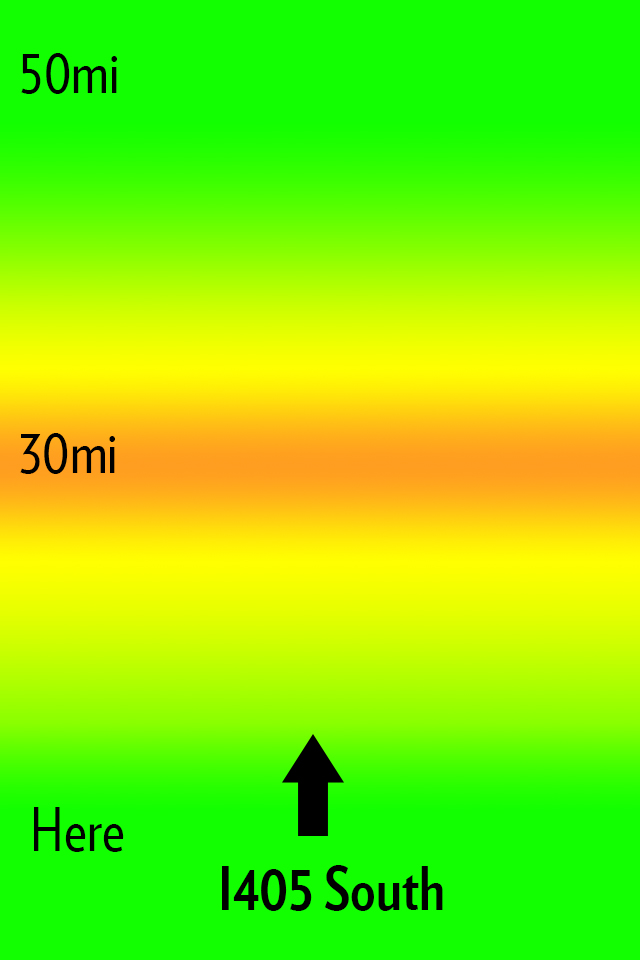
All that you see is a screen with a heat map, the distances from you, and the road that the app thinks you are on. Green is open road, yellow is slower, orange sucks, red is the makings of a bad day. Pretty simple, here’s some more mockups:
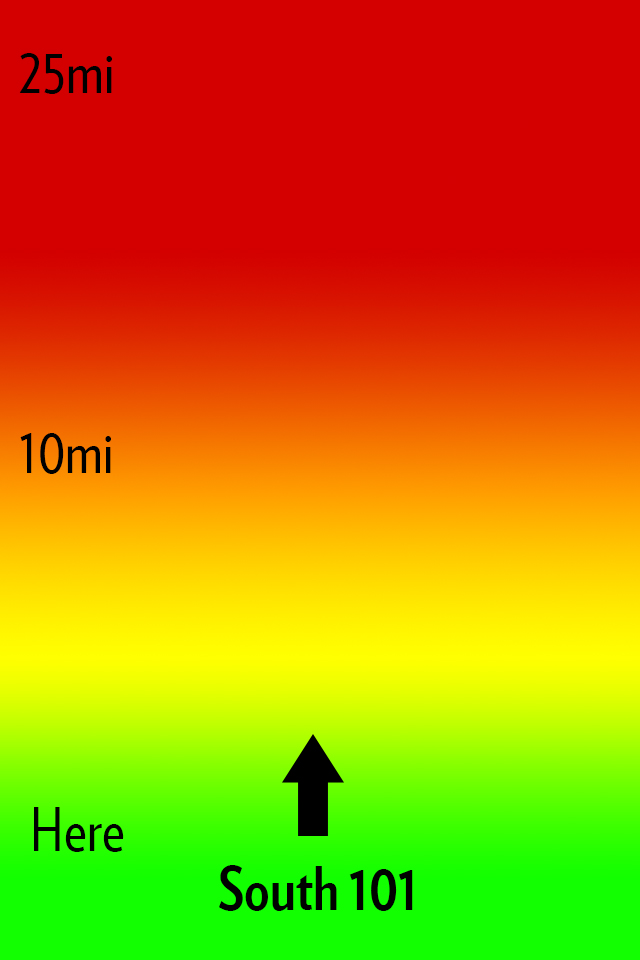
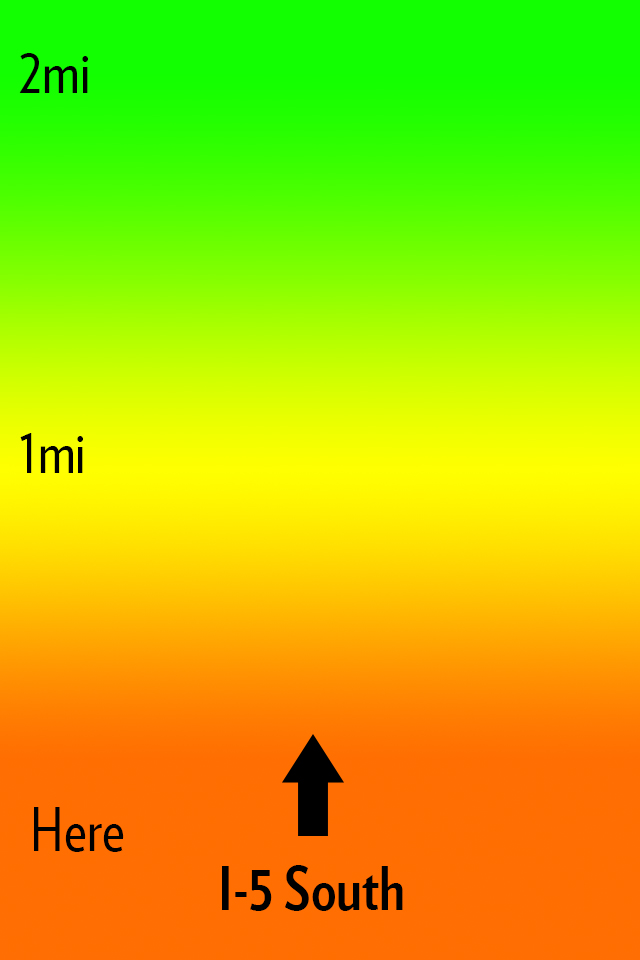
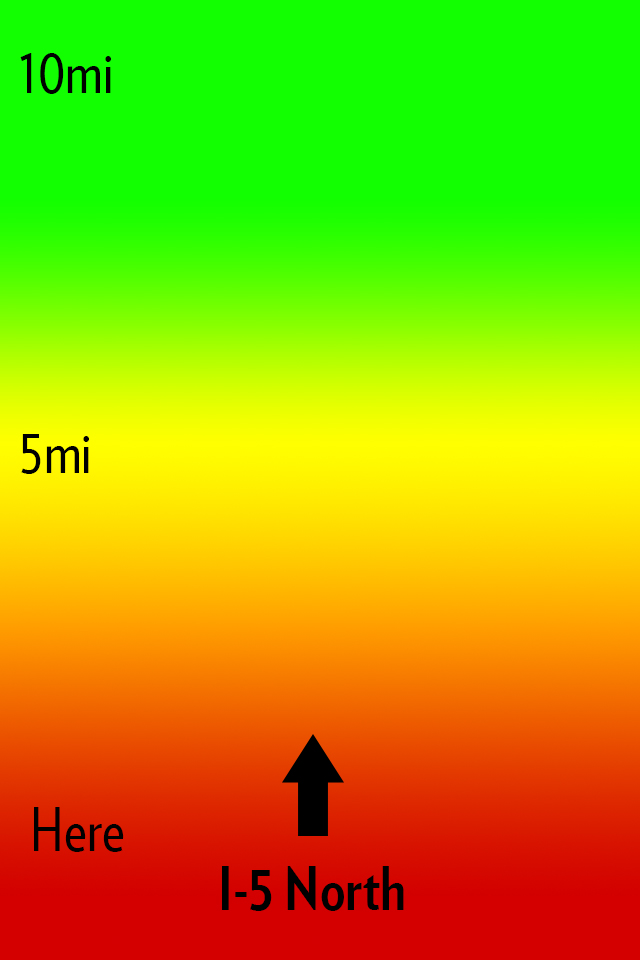
Now you might notice I changed the distances in the screenshots. The way I see the app working is that a driver can slide his finger up or down the screen to change the distance of the traffic from him. Perhaps I am only driving for another 5 miles on this road and I need to know if I can tough out the traffic — maybe I am on a long haul for 100 miles.
This is the idea in a nutshell.
### The Warning
iOS 6 is bringing a new map platform with crowd sourced traffic data. I have no clue how this looks or works, but there is potential it could compete with an app like this. I do not however see Apple making an app like this, but if they enabled push notifications of upcoming traffic then it’s game over.
### That’s All
If you like the idea run with it. Good luck.
*Let me just state again that I won’t pay for someone to develop this, and I certainly do not want any kind of equity or my name attached to any apps you may build. The idea is one I had, but the execution (the hard part) is all you.*
Dalton Caldwell is fed up with being exploited by ads on social networks: >Why isn’t there an opportunity to pay money to get an ad-free feed from a company where the product is something you pay for, not, well, *you*. To be clear: I’m glad there are ad-supported options, but why does that seem like…
Dalton Caldwell is fed up with being exploited by ads on social networks:
>Why isn’t there an opportunity to pay money to get an ad-free feed from a company where the product is something you pay for, not, well, *you*. To be clear: I’m glad there are ad-supported options, but why does that seem like the *only* option? For example, I have the option of buying a Mac if I don’t want to buy a crapware-infested PC, right? I have no interest in completely opting-out of the social web. But please, I want a real alternative to advertising hell… *I would gladly pay for a service that treats me better*.
He’s got a Kickstarter like campaign going where you can pledge $50 to get the project going. I’m in for $50. It’s for a Twitter like service, but one where they make the best product — not the most creative ways to inject ads. I like for pay services, so I am excited to see if this gets funded.\
[More info about the project here](https://join.app.net).
The old adage is that a question in the title of an article can usually be answered with “no”, right? Here’s Rob Walker in an in-depth article for the New York Times on Tumblr’s founder and CEO, David Karp’s strategy to start making money: >This strategy means a brand must use Tumblr and use it…
The old adage is that a question in the title of an article can usually be answered with “no”, right?
Here’s Rob Walker in an in-depth article for the New York Times on Tumblr’s founder and CEO, David Karp’s strategy to start making money:
>This strategy means a brand must use Tumblr and use it well — which, actually, lots of brands already do, free. In fact, Tumblr helped many of them do so — again, free — during the years it was more concerned with boosting its audience than with making money. Karp argues that this is a strength: “A lot of these brands showed up on Tumblr, figured out how to use the tools, created value for our community and got a response.” Now they have the option to “elevate” what they’ve created within Tumblr, by way of a sponsorship.
Everything about this idea seems to be akin to what Facebook is doing to business pages: charging business page owners a few bucks in order to show new updates to all of that pages fans. Guess what, that’s not going over so well with users.
This is a tough issue, the same issue that I faced with changing the business model of this site. When you take away something that was previously free people get mad, and they get mad because you previously made them feel they were entitled to what you gave them for free.
The difference between this site and Tumblr? I don’t have to answer to VCs that want to be repaid. Tumblr would be smart to just start charging for their service (at the very least to brands), but hey I don’t like ads so what do I know?
Update: There is a [great post from Derek Powazek](http://powazek.com/posts/3024) about this very thing where he asks:
>What if we designed a social network to be small, self-supporting, and independent from the outset?
His entire post is worth a read, as he talks about what does and doesn’t work and what *has* worked for MetaFilter.