Matthew Lasar:
>But whatever you think about this issue, the letter shines light on the degree to which Facebook and Google not only identify with advertising companies, but see themselves as such companies.
Top Posts
G-SHOCK DW-H5600 After 7 MonthsJuly 31, 2025
The Hype: Yoshida & Co’s Porter BagsAugust 26, 2025
GSHOCK GBD200December 14, 2021
Recent Articles
-
Why User Privacy is Bad for Google / Facebook
Matthew Lasar: >But whatever you think about this issue, the letter shines light on the degree to which Facebook and Google not only identify with advertising companies, but see themselves as such companies.
-
Why the 13″ Air Is Better Than the 13″ Pro
After posting about “Macs and Cars” yesterday I received a lot of great comments from readers, none more annoyed at me then those that actually like the 13″ MacBook Pro. To each your own and all that, but truly the 13″ MacBook Pro is a pretty silly choice at this point. Instead of refuting each…
After posting about “Macs and Cars” yesterday I received a lot of great comments from readers, none more annoyed at me then those that actually like the 13″ MacBook Pro. To each your own and all that, but truly the 13″ MacBook Pro is a pretty silly choice at this point. Instead of refuting each claim let’s just try to do it all here.
Reasons the 13″ MacBook Pro is silly:
– Lower screen resolution than the 13″ Air
– To get everyday use performance equal to a MacBook Air you will need the SSD. Making the cheapest 13 Pro option $1449 ((Honestly this is the only way you can make the Pro better than the Air.))
– Disk drives are going the way of pagers — you are buying something you will never use.
– It’s heavy.Here’s the crux of the issue: you are essentially paying a premium for “specs” that you are likely to never use or notice. While at the same time forgoing things that you will notice *every* time you use the computer (screen resolution and the performance of an SSD). If you really need more power than you get out of a 13″ Air then you honestly should be looking at the 15″ Pro as it is much faster. The 13″ line is dual core only, while the base 15″ is quad core.
To stick with the car analogy, buying a 13″ Pro is like an SUV that doesn’t have 4-wheel drive — that’s just pointless. What though of users who are budget constrained and want the most horsepower for their dollar? MacBook Air or iMac both will cost you around the same amount. The iMac will give you the CPU speed, but the drive speed will be had by the Air (comparing base specs here). Unless you are doing lots of gaming or encoding work the Air is likely to feel faster than any MacBook Pro/iMac that doesn’t have an SSD.
I am not saying that the 13″ MacBook Pro is an inherently bad computer — what I am saying is that it is a pretty bad buying decision given the current slate of Macs. I would be so bold to guess that if I plopped my MacBook Air in front of any current 13″ MacBook Pro owners and asked them to use it for an hour and tell which computer is faster — 98% would say the Air is faster. It’s not about performance specs, it about user experience and how people use their computers — most people just don’t do that many CPU intensive tasks on anything but an occasional basis.
That’s why the Air makes more sense than the 13″ Pro.
-
Mac App Store Sales
A tale of 11 downloads after one day in the #6 spot for your category in the Mac App Store. Those are some surprisingly low sales numbers. I would say that part of this is aided by the fact that it is an odd app that most can’t use, but it passed things like BBEdit…
A tale of 11 downloads after one day in the #6 spot for your category in the Mac App Store. Those are some surprisingly low sales numbers. I would say that part of this is aided by the fact that it is an odd app that most can’t use, but it passed things like BBEdit and Coda.
This leaves me to think that Apple’s algorithm is not what most think it is for determining rank. My bet is that when you have a sudden surge of downloads (relative to your app), you start moving up in anticipation of more downloads.
Still, 11 sales seems pretty low.
-
BlackDeath
I don’t think BlackBerry stands a chance to be relevant in 2012. They lack innovation, they lack strategy and they lack vision. Their history proves that they had one great idea and kept selling the same idea until — well — now, when it isn’t selling anymore. ((Relatively speaking.)) Here is where BlackBerry started: Here…
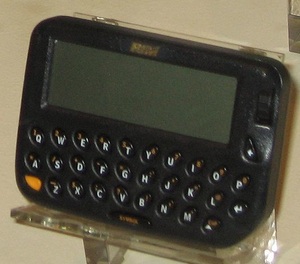
I don’t think BlackBerry stands a chance to be relevant in 2012. They lack innovation, they lack strategy and they lack vision. Their history proves that they had one great idea and kept selling the same idea until — well — now, when it isn’t selling anymore. ((Relatively speaking.))
Here is where BlackBerry started:
Here is BlackBerry today, with a just announced new phone:
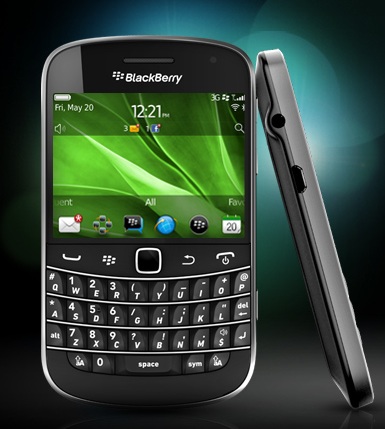
That’s called iteration, not innovation.
That’s the crux of BlackBerry’s problem — their devices aren’t compelling in the current landscape to both the general market and to the current BlackBerry users. If your customer base can’t be compelled to update their device then why should anyone want to buy your device? The users that you have, should be the most vocal proponents of your products, not silent “it’s ok” advocates.
[Updated: 5.5.11 at 7:33 PM]
Also see Marco here.
-
The B&B Podcast Episode 10
For this installment Shawn reports live from Hawaii on coffee and Pineapples. We also talk Mac OS X Lion, Mac App Store, writing bad reviews, and Shawn’s next computer purchase. Thanks very much to [Fontcase](http://bohemiancoding.com/fontcase) for sponsoring the episode.
For this installment Shawn reports live from Hawaii on coffee and Pineapples. We also talk Mac OS X Lion, Mac App Store, writing bad reviews, and Shawn’s next computer purchase.
Thanks very much to [Fontcase](http://bohemiancoding.com/fontcase) for sponsoring the episode.
-
Thinking About Macs as Cars and Trying to Figure Out What the Hell You Should Buy
Marco Arment [posted some great advice](http://www.marco.org/2011/05/04/imac-vs-mac-pro-vs-macbook-pro) about Mac buying decisions and he is right on his thoughts about the new iMacs being more disposable like laptops are seen. Since I am also a car nut, I find it much easier to break down the current slate of Macs by applying a car type to each…
Marco Arment [posted some great advice](http://www.marco.org/2011/05/04/imac-vs-mac-pro-vs-macbook-pro) about Mac buying decisions and he is right on his thoughts about the new iMacs being more disposable like laptops are seen. Since I am also a car nut, I find it much easier to break down the current slate of Macs by applying a car type to each model. This makes the decision process easier for most people.
**Mac Pro**: This is your workhorse truck. Its the big Chevy/Ford barreling down the road with all sorts of crap mounted to the bed. Maybe you have a fifth-wheel setup, maybe a toolbox with an oil pump on it. Perhaps you have a fancy rack carrying a ladder and some doug fir. Trucks are highly versatile machines that bear the brunt of the hard tax labor. Of course they can always be cleaned up and driven into the city — but that’s a bit over kill. Good luck finding parking too. Often your truck will be too big for parking garages and too big for parallel spots.
**iMac**: You know those large sedans that you see people driving around so comfortably in? That’s what we have here, lots of power for your average drive and plenty of room and creature comforts for those riding along. You can take it into the city with ease — though parking garages and valets are your domain. Old ladies drive these, so do car services and so do “normal” people. This isn’t the car for most people, often it is too much car, but for a great many this will be a perfect car.
**MacBook Pro 17″**: Stupid — I mean it’s a really big SUV. Think Hummer, or Ford Excursion — both that have seen end of life because of the limited market. This is a car without the full benefits of a truck, while still having all the downsides of the truck. Such as not being able to fit in parking garages, or in parallel stalls — all while not having the versatility of a truck. Basically you get all of the bad, without *much* of the good.
**MacBook Pro 15″**: This is the workhorse of the everyday man, best represented by your average SUV. It has all the benefits of a “normal” car and some of the power and versatility benefits of the truck. You can take it most everywhere and do most everything with it — certainly there are tasks best suited to trucks (like moving), but these are tasks most people don’t face that often. For the average person, this purchase represents a “safe” choice.
**MacBook Pro 13″**: It’s a Geo Tracker. Ok, well it’s really not *that* bad, but it is stuck in the same rut that the 17″ model is. You get all the bad things of the “Pro” line (size and weight) without the benefits of the “Air” line. It truly is the mini-SUV of the Mac line-up — far too small to be supremely useful, with limited power and a funky size class.
**MacBook Air 13″**: Mid-sized Sedan all the way. It’s the car that most of us *should* be driving instead of the SUV that we convinced ourselves that we *needed*. You get all the power you need for most everyday life driving around, enough room to comfortably fit four when needed and yet a perfect size for taking into the city and parking anywhere. You can haul groceries, golf clubs, or take and extended road trip — sure there will be some times of the year when this car isn’t right — it will be the *right* car 90% of the time for 90% of people.
**MacBook Air 11″**: This is your two-door car (not to be confused with a sports coupe, which is a different class) it isn’t as practical as an everyday driver for most, but makes a very nice secondary car. You get a smaller more efficient package, while sacrificing room for people and luggage.
**iPad**: I am including this because I have an analogy and because some are considering it as a secondary computer. The iPad is really the motorcycle of the Mac line-up. You can get a great many places with it and go where cars won’t fit, but you do so at a sacrifice to overall utility of the vehicle. Passenger support is limited and you can’t carry much with you. You can however park it on the sidewalk, or annoy the crap out of everyone else around you with how “small” it is as you dive in and out of traffic.
**iPhone**: Same reasons for including the iPad, except I don’t know where the iPhone exactly fits here. Initially I was billing it as a bicycle, but I don’t think that fits. I think the best fit for the iPhone is actually your shoes. You can go most anywhere with just your shoes, but you are going to get damned tired of using just your shoes after a few miles. Yet your shoes are always with you.
##### The Key #####
So how do we decode the above information? Here’s a limited key for you:
– Luggage = storage space (think hard drives).
– “Going into the City” and Parking = storing your computer and carrying it with you.
– Versatility and Utility = ports and expandability.
– Passengers = nothing really.
– “Creature Comforts” = things like backlight keyboards.
– Power = CPU, RAM, ports.So while it makes sense to buy a truck and also have a small two-door car as a secondary, it doesn’t make sense to buy a Truck and a large sedan. It also doesn’t make a ton of sense to buy and SUV if you never go off-road or drive in poor weather. Likewise it doesn’t make sense to buy a mid-sized sedan if you have a need to go off-road or drive in snow on a fairly regular basis.
*P.S. I am aware I left out Mac minis and the MacBook. There are many reasons, but suffice to say I don’t seem them as compelling options for anyone over what is currently listed here. Much more niche, like say smart cars (small, pointless and expensive) and oh Scions (the appeal of being cheap, but to get something decent it’s going to cost you the price of a ‘regular’ car).*
-
“Just Hold it Naked”
Devir Kahan: >If you have an iPhone and use a case, take it off for a second. Just hold it ‘naked’ for a second, and remember how it’s supposed to feel. I would also add: now throw away your case that you spent $30 on for no reason.
Devir Kahan:
>If you have an iPhone and use a case, take it off for a second. Just hold it ‘naked’ for a second, and remember how it’s supposed to feel.I would also add: now throw away your case that you spent $30 on for no reason.
-
“Less Software”
The other day, talking about my MacBook Air, I made [reference](https://brooksreview.net/2011/04/mba-qs/) to the fact that I am trying to use less software: >It is also important to note that while software wants to use every bit of juice it can get its hands on — I personally am using less and less software to get…
The other day, talking about my MacBook Air, I made [reference](https://brooksreview.net/2011/04/mba-qs/) to the fact that I am trying to use less software:
>It is also important to note that while software wants to use every bit of juice it can get its hands on — I personally am using less and less software to get tasks done. So while more resources are needed for each app, I am using less apps.
I didn’t think much about that statement when I wrote it, but I got a few questions about what I meant and how I was accomplishing this. Let me start by saying that, upon reflection, that statement is not entirely accurate. I am using less software, but I am also using different software to achieve better resource management — I am doing a little bit of each and reaping some nice benefits.
So for instance, I went from using Ulysses, TextMate, and MarsEdit on a regular basis — to instead just using TextMate. That is one app open instead of three and this makes a noticeable difference to overall performance. ((It is important to note here that I tend not to quit applications if I think I will be coming back to them in the next hour or so, meaning none of those apps would ever truly be quit.)) I have done things like switching from MS Office apps to iWork — they aren’t as robust, but they launch faster and use less resources. I use Acorn instead of Photoshop when I can. Instead of getting rid of apps, I added in a low resource apps that I use in place of the resource “hog” apps where and when possible.
I *could* delete Office and Photoshop and get by with the other apps, but my goal isn’t to decrease HD space (I have plenty of that), nor is my goal to reduce the usefulness of my computer — my goal is to use less resources while I am working.
I can get by just fine with out Photoshop or Word, but it is far less convenient to do so. My move towards this type of software has nothing to do with the power of my computer so much as it has to do with using better tools for the task at hand. There are times when you don’t need the power of a huge 4×4 truck — so why drive it around everyday?
The idea of my using “less software” is really about both physically reducing the number of applications that I use *and* using applications that use less resources — all without compromising the usability of my computer.
-
More on eBook Pricing
Fraser Speirs: >I don’t care and don’t want to have to care about the internal structure of your industry and the value chain and who pays for what when. If it doesn’t feel like a good deal, then no deal. Also see his graph for his perceived value of each type of book as I…
Fraser Speirs:
>I don’t care and don’t want to have to care about the internal structure of your industry and the value chain and who pays for what when. If it doesn’t feel like a good deal, then no deal.Also see his graph for his perceived value of each type of book as I think it gets at the heart of the problem.
-
Thunder Sync
MG Siegler: >Long story short, I’d bet on a big Thunderbolt strike before a full-on ascension by Apple into the cloud for syncing. Google, I suspect, may continue to go the other way. And the two sides will have a new talking point for their war: sync speed versus sync anywhere. That’s a pretty safe…
MG Siegler:
>Long story short, I’d bet on a big Thunderbolt strike before a full-on ascension by Apple into the cloud for syncing. Google, I suspect, may continue to go the other way. And the two sides will have a new talking point for their war: sync speed versus sync anywhere.That’s a pretty safe bet.
-
Arguing for ‘Business Class’ News
Oliver Reichenstein: >Reading news online feels like flying Economy. Loud distracting banners, cheap stock picture material, sloppy typography, a lot of useless comment noise, machine generated reading tips, no human service, and a claustrophobic information design make the reading experience a torture. If you are at all interested in shaping news on the web then…
Oliver Reichenstein:
>Reading news online feels like flying Economy. Loud distracting banners, cheap stock picture material, sloppy typography, a lot of useless comment noise, machine generated reading tips, no human service, and a claustrophobic information design make the reading experience a torture.If you are at all interested in shaping news on the web then this is a must read. To answer the question at the end, I’d pay $49 per year for the NYT laid out as described — actually it would be great with just his mock up.
-
MacBook Air SSD Upgrades
The pricing here is crazy considering the minimal speed gain you get. Sure the drives can be larger, but those prices need to, and should, come down.
The pricing here is crazy considering the minimal speed gain you get. Sure the drives can be larger, but those prices need to, and should, come down.
-
Checking Off My ‘Bugs Me’ List
Knocking off some chores on my ‘Bugs Me’ project in OmniFocus last night meant that I spent a lot of time playing in Keyboard Maestro. First up is Twitter.app and how I like it to stay near the upper left corner of my screen. Sometimes I move it, whether by accident or for some odd…
Knocking off some chores on my ‘Bugs Me’ project in OmniFocus last night meant that I spent a lot of time playing in Keyboard Maestro.
First up is Twitter.app and how I like it to stay near the upper left corner of my screen. Sometimes I move it, whether by accident or for some odd reason. I like the window to sit just below the menu bar and just off the left edge so that I can use the app without bugging the Dock and so that it doesn’t feel smashed against the side, like so:
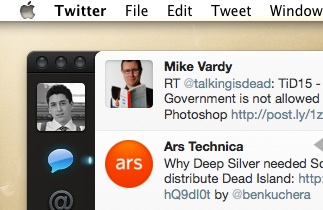
The thing is I want to be able to have Twitter snap back to that position at my command, but not automatically in case there is a reason I don’t have it in that corner. Here’s the Keyboard Maestro commands to do just that:
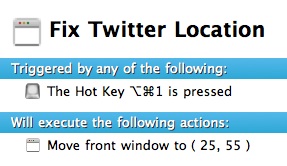
Please note that this macro is inside a group that only works on the Twitter app so that I don’t get weird things occurring in other apps that use this same shortcut.
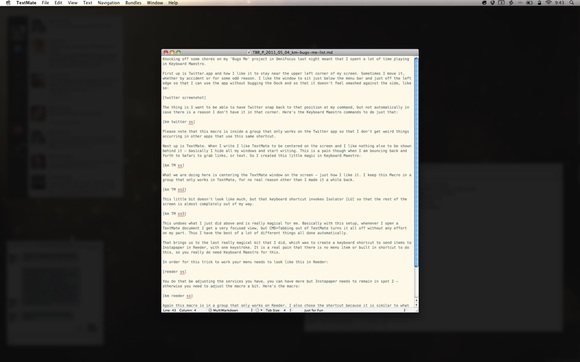
Next up is TextMate. When I write I like TextMate to be centered on the screen and I like nothing else to be shown behind it — basically I hide all my windows and start writing. This is a pain though when I am bouncing back and forth to Safari to grab links, or text. So I created this little magic in Keyboard Maestro:
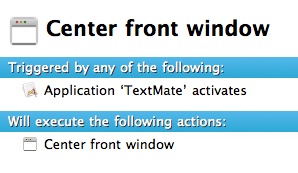
What we are doing here is centering the TextMate window on the screen — just how I like it. I keep this Macro in a group that only works in TextMate, for no real reason other than I made it a while back.
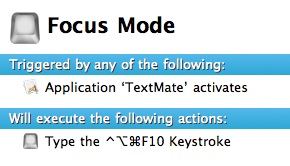
This little bit doesn’t look like much, but that keyboard shortcut invokes Isolator [LU] so that the rest of the screen is almost completely out of my way.
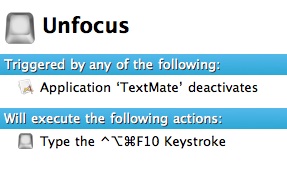
This undoes what I just did above and is really magical for me. Basically with this setup, whenever I open a TextMate document I get a very focused view, but CMD+Tabbing out of TextMate turns it all off without any effort on my part. Thus I have the best of a lot of different things all done automatically.
The end result looks like this:
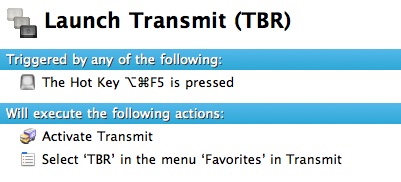
That brings us to the last really magical bit that I did, which was to create a keyboard shortcut to send items to Instapaper in Reeder, with one keystroke. It is a real pain that there is no menu item or built in shortcut to do this, so you really do need Keyboard Maestro for this.
In order for this trick to work your menu needs to look like this in Reeder:
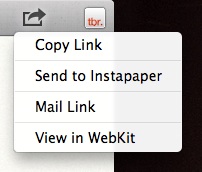
You do that be adjusting the services you have, you can have more but Instapaper needs to remain in spot 2 — otherwise you need to adjust the macro a bit. Here’s the macro:
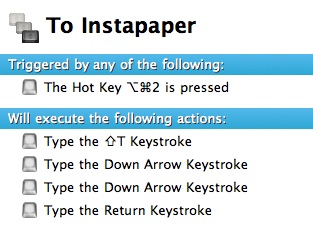
Again this macro is in a group that only works on Reeder. I also chose the shortcut because it is similar to what I use in Safari to send to Instapaper — making it easier to remember.
Just for Fun
A couple of others that I setup to help out with server stuff:
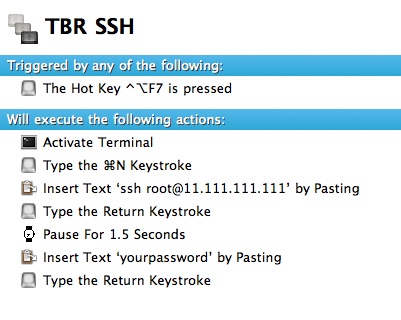
(Thanks to David Findlay for that.)
-
Streaming Videos to Your Tablet While You Fly
A nice touch by American Airlines allowing its customers to buy and stream movies to their devices over WiFi. Now, what’s the pricing on that?
A nice touch by American Airlines allowing its customers to buy and stream movies to their devices over WiFi. Now, what’s the pricing on that?
-
What would you buy first?
Here’s an interesting thought experiment: if you had to start over, buying all of your apps from scratch, in what order would you buy them (the assumption being you couldn’t afford to re-buy them all at once, but over time you could afford them all). I have been thinking about this for a while now…
Here’s an interesting thought experiment: if you had to start over, buying all of your apps from scratch, in what order would you buy them (the assumption being you couldn’t afford to re-buy them all at once, but over time you could afford them all). I have been thinking about this for a while now and I started with a list of all the apps I normally use that I would need to purchase. From there I started arranging them in order of what I would buy first.
Here’s where I stand:
– [Dropbox](http://db.tt/nQKF6kW) ((Yes this is technically free, but if you want it to be a success you need to start paying.))
– [1Password](http://agilewebsolutions.com/onepassword)
– [LaunchBar](http://www.obdev.at/products/launchbar/index.html)
– [Keyboard Maestro](http://www.keyboardmaestro.com/main/)
– [TextExpander](http://smilesoftware.com/TextExpander/)
– [Lightroom](http://www.adobe.com/products/photoshoplightroom/)
– [Transmit](http://www.panic.com/transmit/)
– [Acorn](http://flyingmeat.com/acorn/)
– [TextMate](http://macromates.com/)
– [OmniFocus](http://www.omnigroup.com/products/omnifocus/)
– [Parallels Desktop](http://www.parallels.com/products/desktop/) ((This is higher on the list than I want it to be, but my job necessitates it.))
– [Numbers](http://www.apple.com/iwork/numbers/)
– [Pages](http://www.apple.com/iwork/pages/)
– [Yojimbo](http://www.barebones.com/products/yojimbo/)
– [Reeder](http://madeatgloria.com/brewery/silvio/reeder) ((Assuming this will be priced above free.))
– [SuperDuper!](http://www.shirt-pocket.com/SuperDuper/SuperDuperDescription.html)
– [Tower](http://www.git-tower.com/)
– [xScope](http://iconfactory.com/software/xscope)
– [InDesign](http://www.adobe.com/products/indesign.html)
– [Photoshop](http://www.adobe.com/products/photoshop.html)That’s my order — I’m curious to see how you would order your own list, if you have a blog and create a post like this please share it with me.
I’ll try to add links below as I get them.
### Reader’s Lists: ###
– [Jordan Patterson](http://www.thecheapgeek.org/what-software-would-you-buy-first)
– [Recenseo](http://recenseo.tumblr.com/post/5189832441/what-would-you-buy-first)
– [Scott Jack](http://scojj.posterous.com/what-would-you-buy-first)
– [Brian O’lyaryz](http://www.allisinfinite.com/post/5190137968/a-reply-to-ben-brooks)
– [Kennon Bickhart](http://kennonb.tumblr.com/post/5190760480/what-would-you-buy-first)
– [Shadow Huard](http://smarterbits.tumblr.com/post/5189881667/re-what-would-you-buy-first)
– [Michael Kalina](http://3th.be/2011/05/04/in-dieser-reihenfolge/) (Written in German)
– [Craig Grannell](http://reverttosaved.com/2011/05/04/what-would-you-buy-first-or-my-favourite-mac-apps/)
– [David Silva](http://davidsilvaonline.com/notepad/what-app-would-you-buy-first/)
– [Josef Szotten](http://josef.co.vu/post/5192554542/what-would-you-buy-first)
– [Michael Rockwell](http://mickerlodeon.com/2011/05/what-would-you-buy-first/)
– [Michael Anderson](http://appleink.wordpress.com/2011/05/04/buy-first/)
– [Hugh Sissling](http://www.woooster.co.uk/?p=495)
– [Nik Fletcher](http://nikf.org/post/5194684867/what-would-you-buy-first)
– [Robert Falck](http://streakmachine.com/post/5194632024/what-would-i-buy-first)
– [Michael Doan](http://michaeldoan.com/2011/05/clean-start/)
– [Brandon Bohling](http://brandonbohling.com/2011/05/04/buy-first/)
– [Jon Snyder](http://ministrymac.tumblr.com/post/5196892338/what-would-you-buy-first)
– [Steven Teskey](http://therealsteventeskey.com/2011/05/04/What_Would_I_Buy_First.html)
– [Adrian Boioglu](http://www.boio.ro/experiment-ce-aplicatii-ai-cumpara-din-nou/) (In Romanian — awesome.)
– [Thomas Brand](http://www.eggfreckles.net/tech/buying-my-app-list/)
– [Giovanni Lanzani](http://blog.lanzani.nl/2011/what-would-you-buy-first/)
– [John Kmiecik](http://jkbc.co/post/5230564717/paid-applications-or-the-lack-thereof)
– [Gabriel Ponzanelli](http://gabrielponzanelli.net/2011/05/what-software-would-you-buy-first/)
– [Robert Lo Bue](http://robertlobue.com/2011/05/09/what-would-you-buy-first/)
– [Steve Lyb](http://astroaficionado.net/2011/05/09/clean-broke-apps/)
– [Jon Siddle](http://randombrainactivity.com/what-would-you-buy-first)
– [Nic Lake](http://niclake.com/2011/05/what-would-you-buy-first/)
– [Carlos Eduardo de Paula](http://carlosedp.com/posts/what-would-you-buy-first.html)Let me know if I missed you.
-
TomTom Oh Boy
Jim Travers: >In the video, TomTom CEO Harold Goodijn stresses that the tracking of its devices is voluntary and that customers can choose not to allow it. and: >TomTom says the company has provided this data to police departments and other authorities to help them identify congested areas for safety reasons and to help determine…
Jim Travers:
>In the video, TomTom CEO Harold Goodijn stresses that the tracking of its devices is voluntary and that customers can choose not to allow it.
and:
>TomTom says the company has provided this data to police departments and other authorities to help them identify congested areas for safety reasons and to help determine where road capacity needs to be increased. Mr. Goodijn says TomTom had been unaware Dutch police were using the data to choose locations for speed traps and that the company would prevent that type of usage in the future.Correct me if I am wrong, but here’s how the above basically reads: “I mean, look, these people asked for the location data and so we gave it to them. It’s not like we *knew* what they were going to do with that data. Look, if users really cared — then why’d they leave the tracking feature turned on? Here’s what I am going to do, I am going to go down and tell cops that they can’t use our data in that way. No, I will still sell them the data, but I will amend the ToS for the usage.”
Yeah — you get the picture.
-
Keeping it Straight
Patrick Rhone has a new book out called *Keeping it Straight*. I had the privilege of getting an advance copy of the book to read and read I did. I maybe read two books in the last year — this was one of them. I don’t know what you will get out of the book,…
Patrick Rhone has a new book out called *Keeping it Straight*. I had the privilege of getting an advance copy of the book to read and read I did. I maybe read two books in the last year — this was one of them. I don’t know what you will get out of the book, but for me I got a tangible benefit: a trunk full of items that went to Goodwill.
Again that’s not what the book is about, but it did cause me to start cleaning my desk (again). From there I started cleaning everything and eventually I was starring at bags of garbage and piles of items to donate. It felt great. I can’t wait to read the book again and see what happens.
Randy Murray says:
>Patrick offers the ‘Why’ to GTD’s ‘How.
I can see that.
-
Quote of the Day: Dave Caolo
“You needn’t sever an ear, retreat to a secluded cabin or stagger through French cafes to realize your creative potential. You must, however, work very hard, expect failure, employ a powerful filter and occasionally abandon your work entirely.” — Dave Caolo Dave’s issue of the Read & Trust newsletter (no. 5) is simply fantastically written…
“You needn’t sever an ear, retreat to a secluded cabin or stagger through French cafes to realize your creative potential. You must, however, work very hard, expect failure, employ a powerful filter and occasionally abandon your work entirely.”Dave’s issue of the Read & Trust newsletter (no. 5) is simply fantastically written — I found myself nodding along through the entire thing. Great work, you now *need* to subscribe to just check out this one from [Dave](http://52tiger.net/).
-
Fontcase 2.0
Bohemian Coding was kind enough to let me check out [Fontcase 2.0](http://www.bohemiancoding.com/fontcase) before it was released and all I can say about it is: “Wow”. Before Fontcase it was pretty common for me to open an InDesign document, paste in text and play with the fonts and sizes. Font Book has never been a very…
Bohemian Coding was kind enough to let me check out [Fontcase 2.0](http://www.bohemiancoding.com/fontcase) before it was released and all I can say about it is: “Wow”. Before Fontcase it was pretty common for me to open an InDesign document, paste in text and play with the fonts and sizes. Font Book has never been a very good app for selecting fonts, Fontcase though is fantastic for choosing fonts.
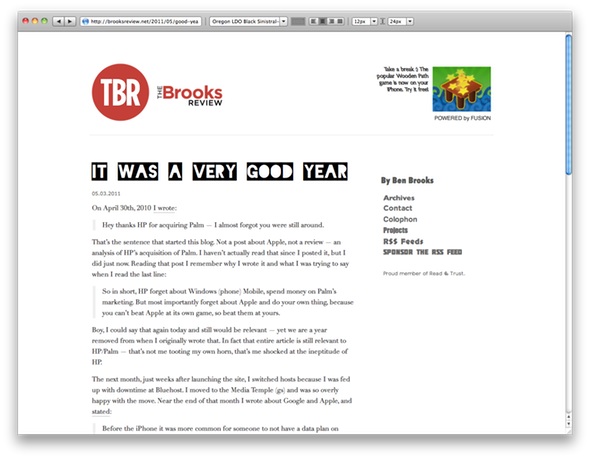
By far the best new feature is the Typesetter, once activated will display a webpage and allow you to click on a body of text and see what it would look like with another font. This will save me a ton of time when designing sites and more importantly: this will keep me at bay when wanting to tweak this sites font. Here’s Typesetter in action on TBR:
[
 ](https://f3a98a5aca88d28ed629-2f664c0697d743fb9a738111ab4002bd.ssl.cf1.rackcdn.com/tbr-typesetter.png)
The last feature that I want to mention is the glyphs feature — it is a real pain to grab html codes for glyphs, or even to view them — Fontcase makes that process dead simple. Are these things that you could do in other apps? Certainly, but not with the ease and beauty that Fontcase gives you.
At the very least it is worth checking out the free trial — I really love the app.
-
It Was a Very Good Year
On April 30th, 2010 [I wrote](https://brooksreview.net/2010/04/hps-very-smart-acquisition/): >Hey thanks HP for acquiring Palm — I almost forgot you were still around. That’s the sentence that started this blog. Not a post about Apple, not a review — an analysis of HP’s acquisition of Palm. I haven’t actually read that since I posted it, but I did…
On April 30th, 2010 [I wrote](https://brooksreview.net/2010/04/hps-very-smart-acquisition/):
>Hey thanks HP for acquiring Palm — I almost forgot you were still around.
That’s the sentence that started this blog. Not a post about Apple, not a review — an analysis of HP’s acquisition of Palm. I haven’t actually read that since I posted it, but I did just now. Reading that post I remember why I wrote it and what I was trying to say when I read the last line:
>So in short, HP forget about Windows (phone) Mobile, spend money on Palm’s marketing. But most importantly forget about Apple and do your own thing, because you can’t beat Apple at its own game, so beat them at yours.
Boy, I could say that again today and still would be relevant — yet we are a year removed from when I originally wrote that. In fact that entire article is still relevant to HP/Palm — that’s not me tooting my own horn, that’s me shocked at the ineptitude of HP.
The next month, just weeks after launching the site, I switched hosts because I was fed up with downtime at Bluehost. I moved to the Media Temple (gs) and was so overly happy with the move. Near the end of that month I wrote about Google and Apple, and [stated](https://brooksreview.net/2010/05/google-vs-apple-gaining-perspective/):
>Before the iPhone it was more common for someone to not have a data plan on their phone then it was for them to have one — let alone an unlimited data plan.
Funny now that a year later we are without the ability to buy unlimited data plans — because of the sheer overwhelming demand for mobile bandwidth and the greed of the carriers.
In May 2010 The Brooks Review had less than 150 total readers for the entire month. ((Which was far more people than I actually shared the blog URL with.)) I had no idea what I was doing, or where this was all going — but I was having a hell of a good time sharing my thoughts with a small audience.
July 2010 saw my first “big” post, it got a couple of points on Hacker News and occasionally people still come across it. I liked it at the time — though now I very much regret writing it in a list way, lame.
[Email Mistakes That Irritate Smart People](https://brooksreview.net/2010/07/email-mistakes-that-irratate-smart-people/):
>It is really awesome that you figured out how to embed your company logo in your email signature, but I know who you are and what your company logo looks like. I still hate it. Don’t waste bandwidth sending me email attachments of your logo.
Yeah, that *sounds* like me.
Thanks mainly to that single post I had what I thought was a huge month, at 766 unique views for the month — I was a very happy guy. ((Still am, though most would argue that.))
Unbeknownst to me this was the first turning point of everything, from here it would be nothing but up, up, up.
For October the only post that really generated discussion was [this one](https://brooksreview.net/2010/10/mba-fits/), where I refuted some of John Gruber’s claims about the new MacBook Air’s. To which, after seeing that I was buying one as my primary machine, he [responded](http://daringfireball.net/linked/2010/10/26/brooks-air): “And he’s putting his money where his mouth is.”
Luckily I didn’t have to eat those words. It also happened that buying my MacBook Air was one of the best purchases I have ever made.
The next month I wrote what still may be the longest post on The Brooks Review, my [MacBook Air review](https://brooksreview.net/2010/11/mba-review/). I remember slaving for days over this post to be as accurate and interesting as I could be. It was one of the toughest things I did all year and one of the most satisfying.
I am going to skip over the rest of the year — there is just too much to process at this point, suffice to say: thank you for reading and emailing and correcting my grammar.
—
Things I learned this past year:
– I don’t know how to use a comma.
– My readers know how to spell and use commas.
– Positive, interesting, email outweighs the bad 6 to 1.It… was a massive good year.