[Jonah Spangenthal-Lee’s guide to legal marijuana use in Seattle, posted on the Seattle Police Department’s website](http://spdblotter.seattle.gov/2012/11/09/marijwhatnow-a-guide-to-legal-marijuana-use-in-seattle/) is fantastic, including a `TL;DR` version:
>Please note that the initiative says it “is unlawful to open a package containing marijuana…in view of the general public,” so there’s that. Also, you probably shouldn’t bring pot with you to the federal courthouse (or any other federal property).
It’s been pretty interesting in Washington since the initiative legalizing marijuana was passed. King and Pierce county prosecutors applied the law retro-actively and dropped hundreds of pending marijuana cases. The local news has been reporting on such conundrums as:
– Should parents smoke weed in front of their kids?
– How do you teach kids drugs are bad, when drugs are legal?
– Legalizing marijuana will add $68 million to the anti-drug campaigns for children, will that help?
– What happens if you are caught with marijuana in another state, but were bringing it to Washington to smoke it?
I mean, it really has been bang your head against the wall stupid around here.
When you stop to think about it, legalizing marijuana really isn’t that big of a deal ((As in, people were already using it, this doesn’t change much.)) , but it does change the marijuana market here in Washington. No longer is it a black market, now it will be a gray market drug as people will soon realize it’s not that easy to purchase (there are no stores yet, but I have been contacted to put some in buildings I manage) legally.
The far more interesting question is for employers and employees — as most companies have anti-drug policies. So just as you can’t be drunk on the job, you also can’t be stoned on the job. Yet with alcohol, it’s a simple test to determine if you are drunk right now — weed stays in your system much longer. So now the question is, when you are hurt on the job and you get drug tested: does marijuana count?
Of course this is all moot if the Federal government decides to enforce federal laws banning it.
[David Heinemeier Hansson has penned an extraordinarily beautiful bit of prose about the path of Twitter](http://37signals.com/svn/posts/3328-twitters-descent-into-the-extractive). I love his concluding thought:
>Winter might be longer this time around, but inevitably Spring will return
That’s a fascinating sentiment, especially on the heels of the news that [Peter Chernin](http://en.wikipedia.org/wiki/Peter_Chernin) is now on the board of Twitter. Twitter is a company that has “sold out”, but the interesting thing is they didn’t recently sell out — no — Twitter sold out a very long time ago and it is only now that we are beginning to pull our heads out of the sand and realize that.
I used to say that it would be easy for Twitter to start making money, but that was back when Twitter was used as a communications tool. Now Twitter is nothing more than a shouting match, with Twitter corporate doubling the volume of the highest bidder.
[This post from Kontra about Siri and the future of semantic searching has made the rounds](http://counternotions.com/2012/11/12/siri-future/), with good reason too as it is a compelling and interesting post. I can’t help but think that it is interesting how much catching up Google is trying to do in this area right now, when it always has seemed that *interpretation* has always been the one thing that we all knew would take computers from being great, to amazing boosts to productivity and happiness. It’s then astonishing how far behind Google is in this respect — not that Siri is that far ahead.
While reading this post it occurred to me that one of the reasons that Android will never be as useful to me is because I just don’t trust Google. Because of that lack of trust I go out of my way to avoid their services — and because of that an Android device is exponentially less useful to me.
Kontra:
> That’s why you see Google, for example, buying the world’s largest airline search company ITA, restaurant rating service Zagat, and cloning Yelp/Foursquare with Google Places, Amazon with Google Shopping, iTunes and App Store with Google Play, Groupon with Google Offers, Hotels.com with Google Hotel Finder…and, ultimately, Siri with Google Now.
This is why my Nexus isn’t that great for me: I refuse to use these services from Google, whereas Apple products work better for me because I trust Apple services (not to work, just to be more private).
So as I think about the future, I have to wonder how bad this ultimately will be for users. If I buy 100% into the Apple culture and 0% into Google, everything will be fine until I want to switch from Apple to Google. At that point, how do I recreate all this backlog of data for Google to then be useful for me? As Google would be starting with me as I just came into existence.
Would it even be possible, or would I be stuck with a crappy service until I rebuild all that data one point at a time in Google?
This could really suck, as the lock-in potential is huge for whomever gets ahead and stays ahead.
[Now that I have gone over why you should carry a pocket knife everyday](https://brooksreview.net/2012/10/pocket-knife/), I think it prudent to look at some options of knives *to* carry everyday. As I said in my last post on the matter: what is best for me, what is best for Clint Eastwood, is *not* going to be what is best for you. So best not to think of this as telling you what to get, but giving you a starting point.
This is the kind of search that you could spend your entire life on and still not find *the* pocket knife. So it is a search that I embarked on while knowing this, being willing to settle, and with a set of general criteria to guide me.
Up and until a few months ago I was very happy with the knife I was carrying everyday. It was simple, sturdy, and reliable. What I began to notice though was that the thumb wedge used to deploy the blade was — I believe — wearing holes in my pockets. I have about four pairs of pants with holes in the pockets in identical spots and best I could tell this knife was causing it (not from the blade). So I needed something better, something that wasn’t so hard on my pants pockets.
## My Criteria
I started this search months ago, and here is the baseline criteria I laid out:
– Had to be under ~$100, so the [coveted Chris Reeve Small Sebenza](http://bladereviews.com/chris-reeve-knives-small-sebenza-21-review/) is out of the picture (for now).
– Could not have a thumb wedge that could potentially wear holes in my pockets.
– Had to be sturdy enough, that should the worst case scenario happen, I would feel confident in using the knife in the wild to survive.
– Had to look great. Whereby I mean it needed to have a discernible personality that I liked. (Dangerous, sleek, tactical, old-timey, etc.)
That was it. Since I was buying a lot of knives I spread this over many months — testing each knife as my daily carry for at least a week. Many of these knives are by [SOG](http://sogknives.com), which isn’t the best knife maker out there, but is a personal favorite of mine given the location of their company.
## The Knives
### SOG Fielder
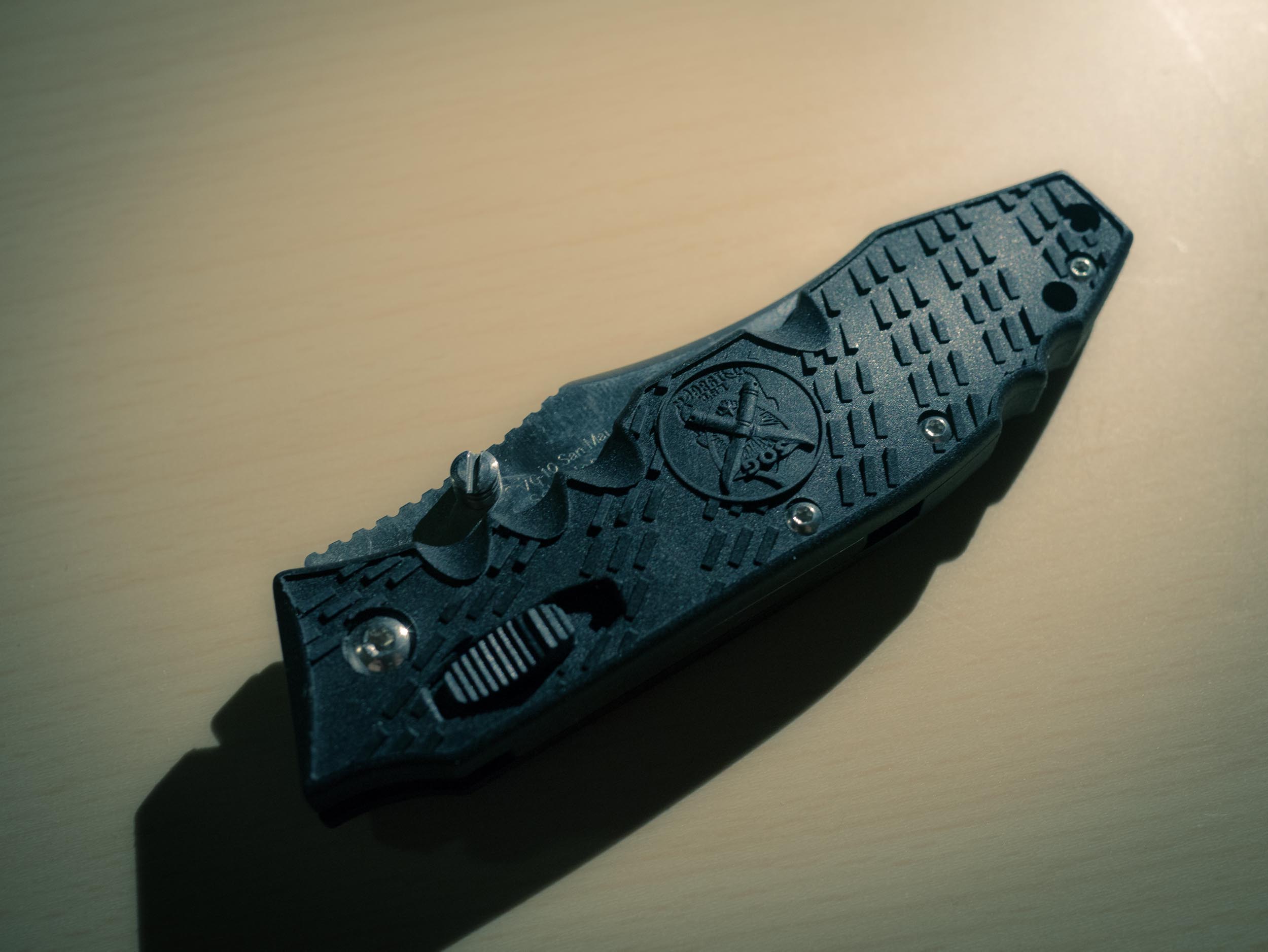
[I previously reviewed this knife](https://brooksreview.net/2011/11/fielder/), and my thoughts on it still stand. It is a nice looking knife with average blade steel. It isn’t my personal choice for an everyday knife, because of the weight and size. It’s also not a knife I would want to take out in the woods to rely on for survival. That said it is a solid around the house / sitting on your desk type of knife.
That’s where it has been used since I reviewed last.
([Buy it on Amazon](http://www.amazon.com/exec/obidos/ASIN/B004LF01GS/ref=nosim&tag=brooksreview-20).)
### SOG Toothlock
This is a very interesting knife. The locking mechanism is also used as the deployment mechanism — and this blade can be deployed very quickly with a slight flick of the wrist. The shape of the blade is a reversed curve — that is great for certain tasks but makes sharpening with the wet stones I use a bit more of a challenge.
Overall this is a nice knife but is very angular and large — too much so for it to sit comfortably in my pocket. It is not uncomfortable in my hand, but it is just another solid knife — not what I was looking for. I wouldn’t feel screwed if I was stuck in the woods with this knife, but again not my first choice among this group of folders.
([Buy it on Amazon](http://www.amazon.com/exec/obidos/ASIN/B0069E80L2/ref=nosim&tag=brooksreview-20).)
### SOG Flash I (partially serrated)
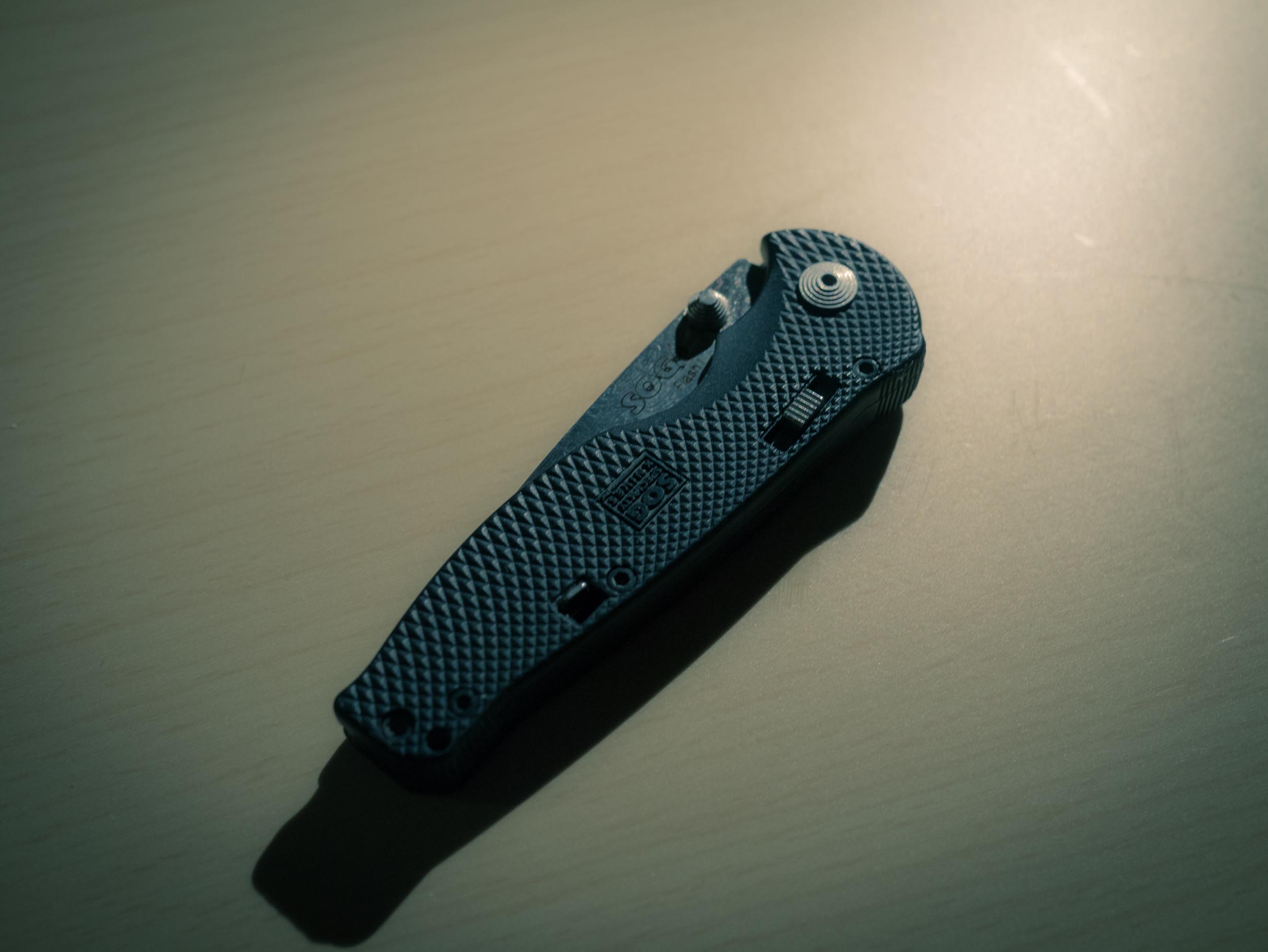
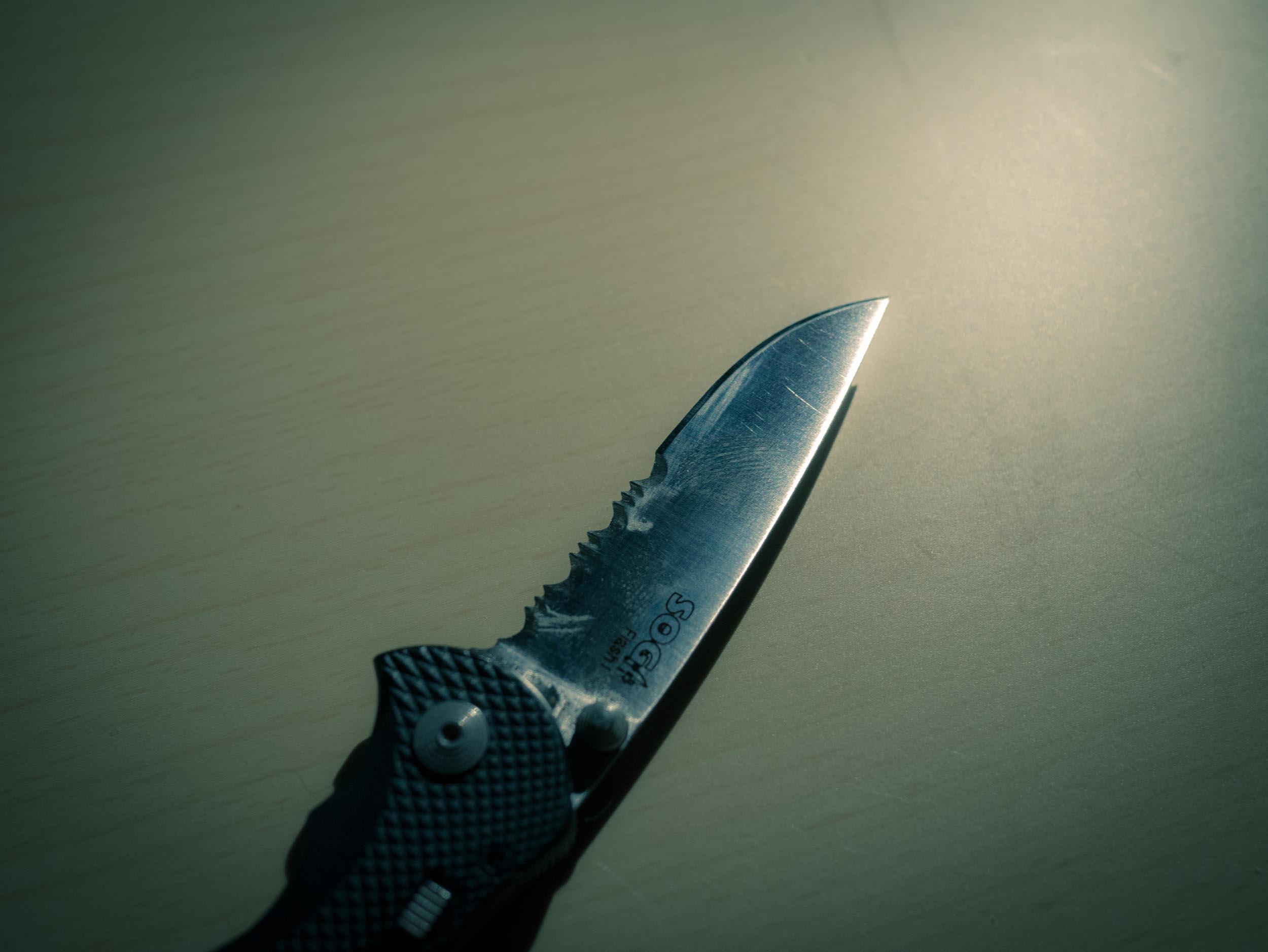
I used this as my everyday carry for quite a while, but switched away because I found the knife to be too small and the serrations too annoying for everyday use. It’s inexpensive, light, and discrete to carry — a good knife to have if you aren’t sure about carrying a knife everyday.
Do yourself a favor and get the non-serrated blade. This knife uses SOG’s assisted open technology, so it flicks open expeditiously when encourage by a nudge from your thumb — which means there is a safety you have to disengage. The safety isn’t as cumbersome as it sounds, you get used it in very quickly and can leave it off if you prefer. Personally I find this knife much too small for my preferences — certainly not something I would want to rely on in the woods and even too small for most things I did on a daily basis.
([Buy it on Amazon](http://www.amazon.com/exec/obidos/ASIN/B000AQABOY/ref=nosim&tag=brooksreview-20).)
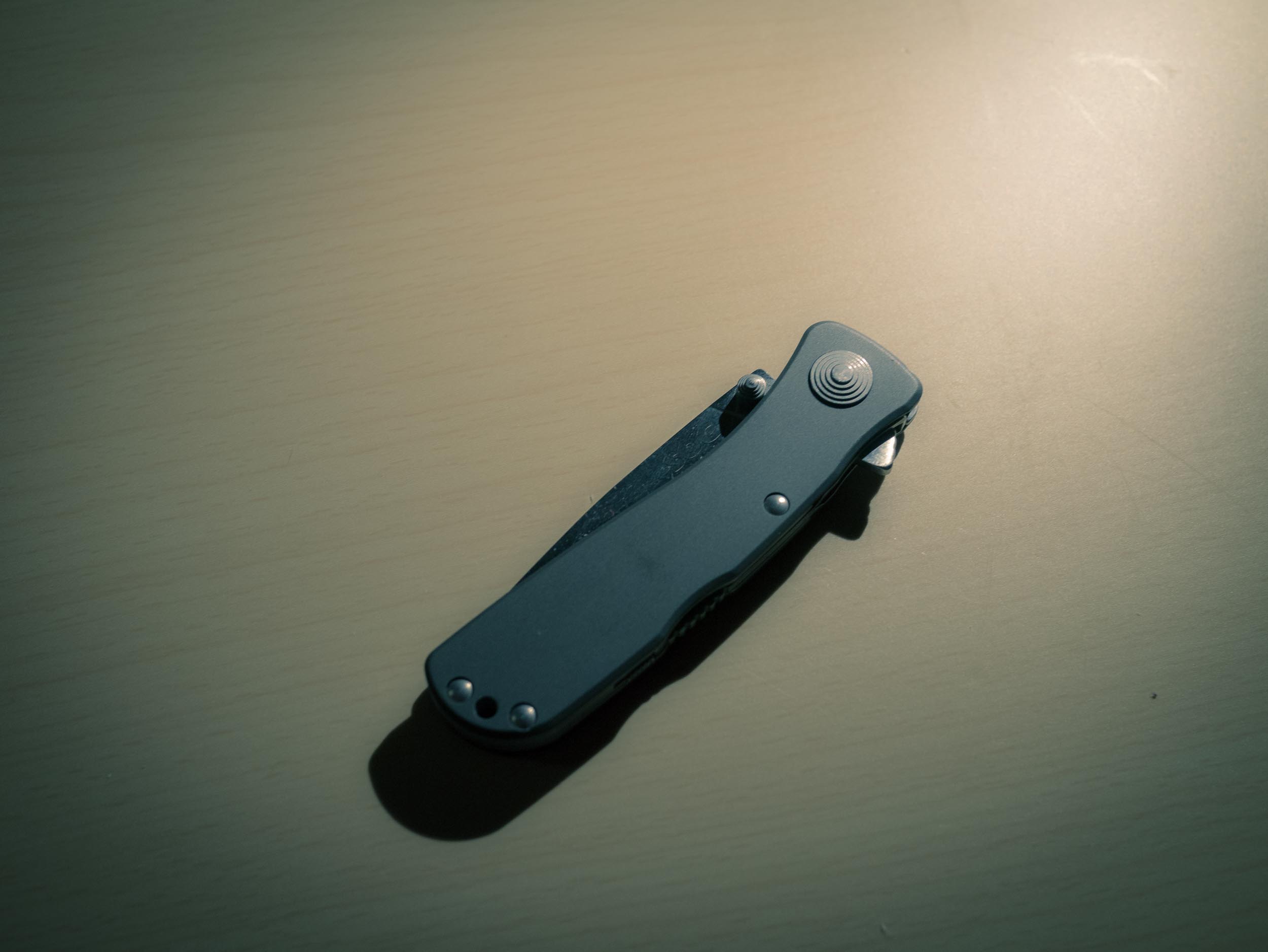
### SOG Twitch II
This is the knife that I think is wearing holes in my pockets. I really like this knife — it’s solid feeling, a good size, a nice blade.
I really like this knife — so much so that it’s now my go-to knife when I have to dress up in a suit, but can no longer be an everyday for me given my need to not stitch up my pockets weekly. The knife is smooth and sleek, and has a heft to it that makes it feel solid in your hand. It is, again, not a blade I would want to rely on in a life or death scenario, but it is certainly a better option than the Flash I. I’ve found it to be an ideal size for me for a daily carry, both in length and the thickness of the handle.
If only it didn’t have that thumb wedge for deployment — which is assisted and happens very quickly.
([Buy it on Amazon](http://www.amazon.com/exec/obidos/ASIN/B0001WC73K/ref=nosim&tag=brooksreview-20).)
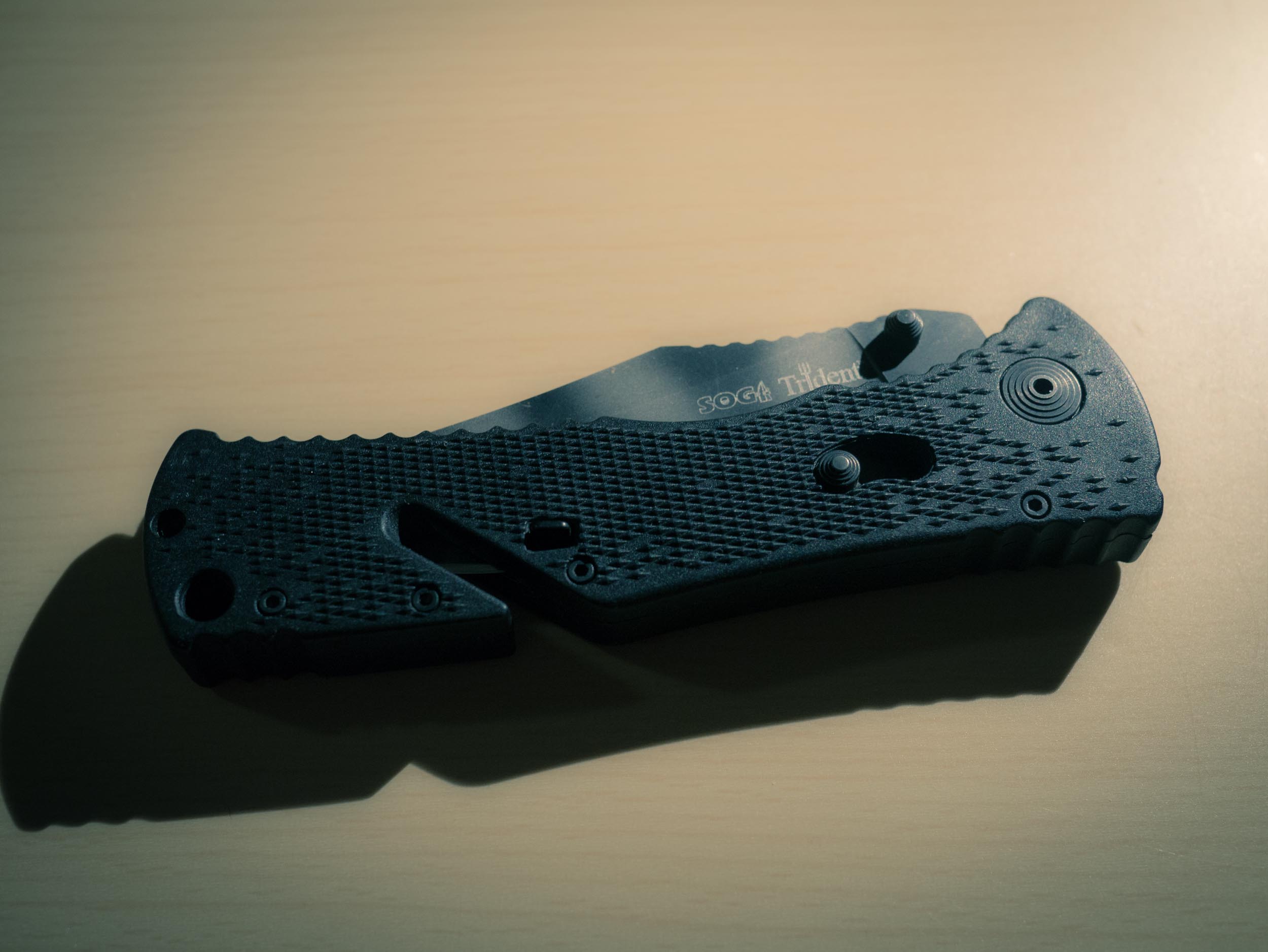
### SOG Trident (partially serrated)
Ah, the first SOG knife I ever purchased. This is a much larger knife and one that I typically carry when hiking. I like just about everything about this knife, but as an EDC it is far too large. I also worry about carrying an EDC that has a v-cutter, a notch that allows you to slide in thin material to cut without having to deploy the blade (seat belts in emergencies), as I worry that such a grove would suck in something that I wouldn’t want against the blade — like car keys.
This is a fantastic outdoors knife, but not so much when it comes to an EDC. It is just too large to carry in most of the pants that I wear without it being noticeable and uncomfortable. I’ve put this knife to the test many times and it has yet to fail me. The deployment is assisted, so again it is fast, and the overall balance of the knife is very nice.
([Buy it on Amazon](http://www.amazon.com/exec/obidos/ASIN/B00020BNW2/ref=nosim&tag=brooksreview-20).)
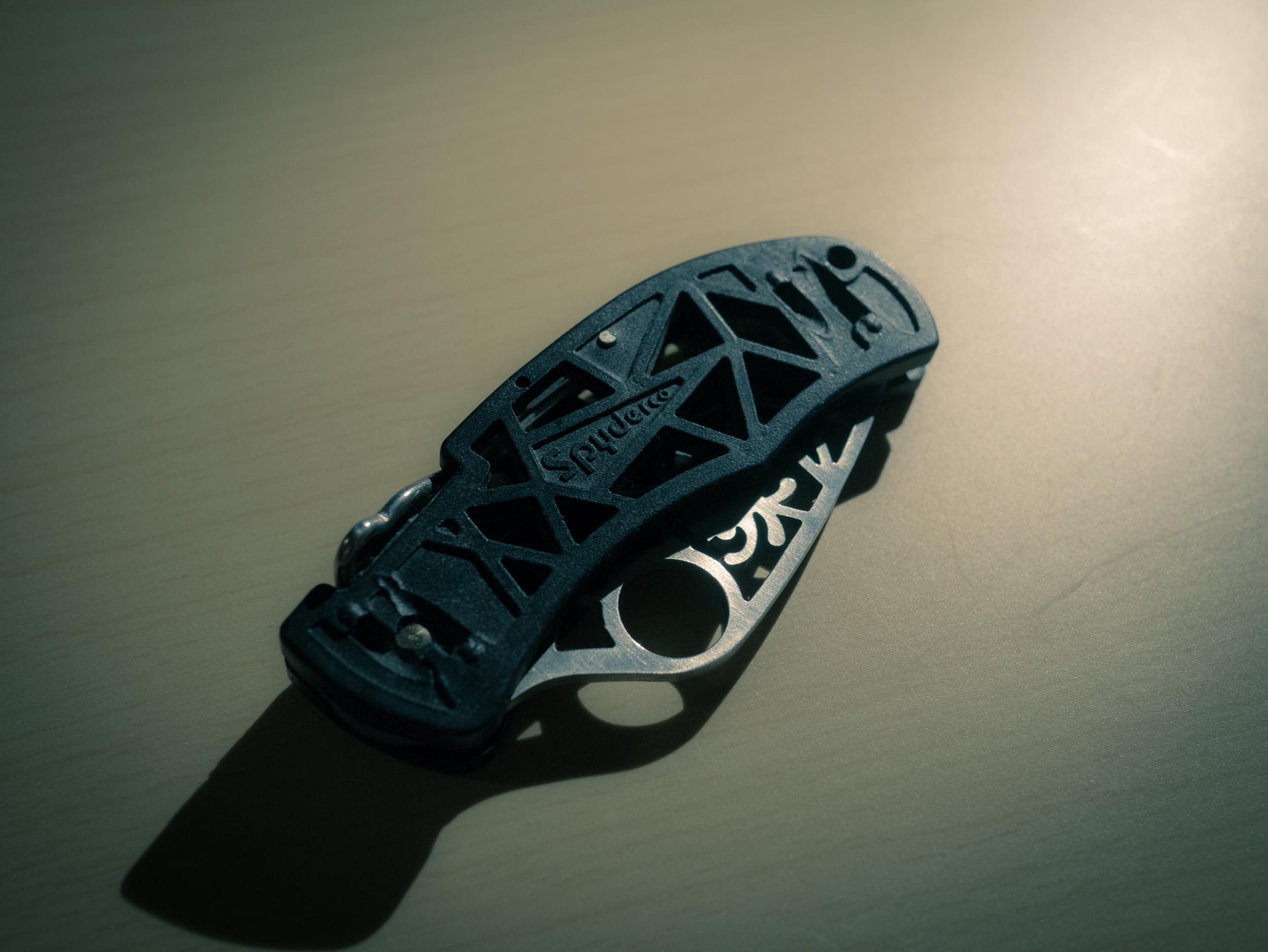
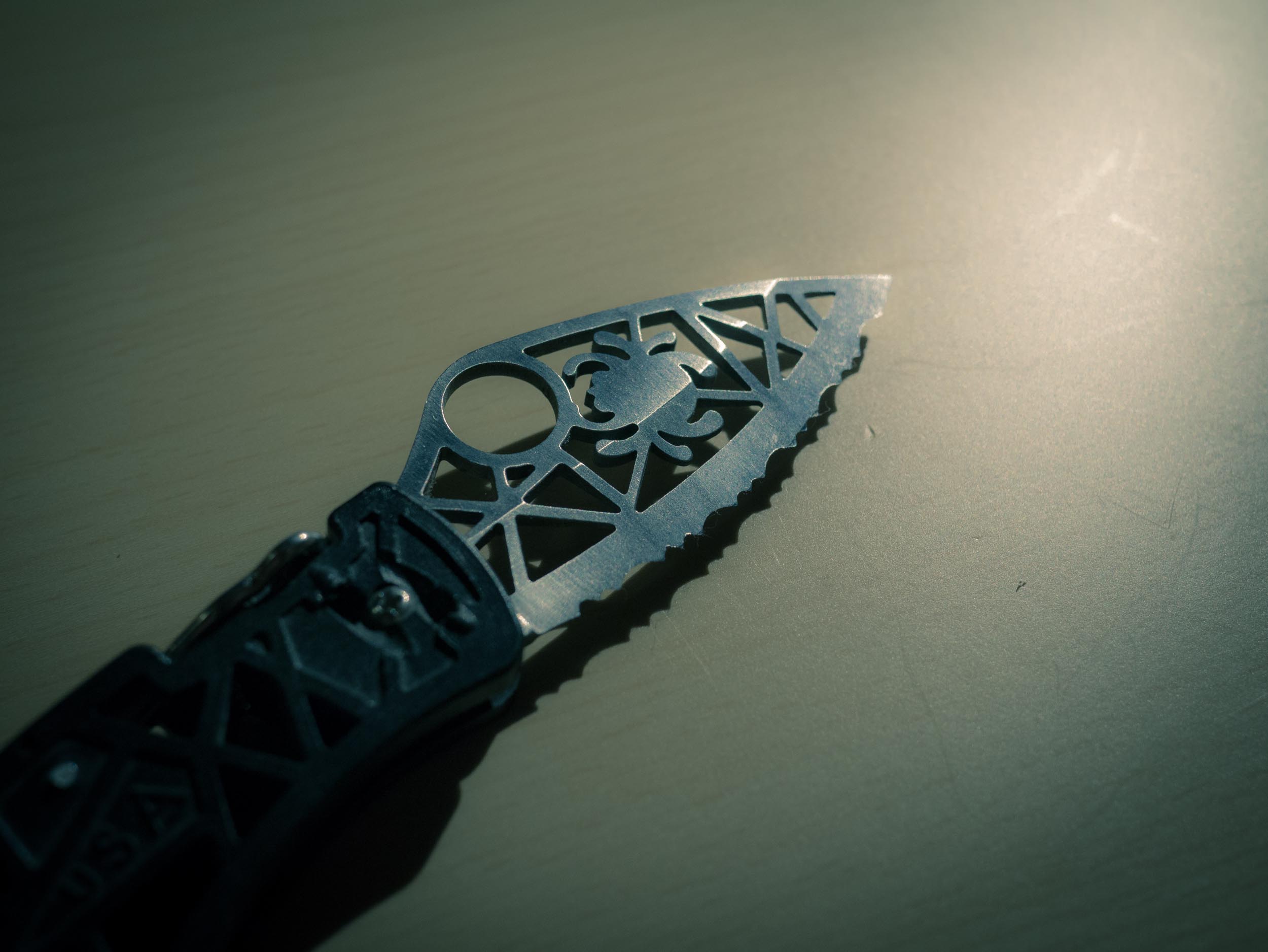
### Spyderco, I have no clue what
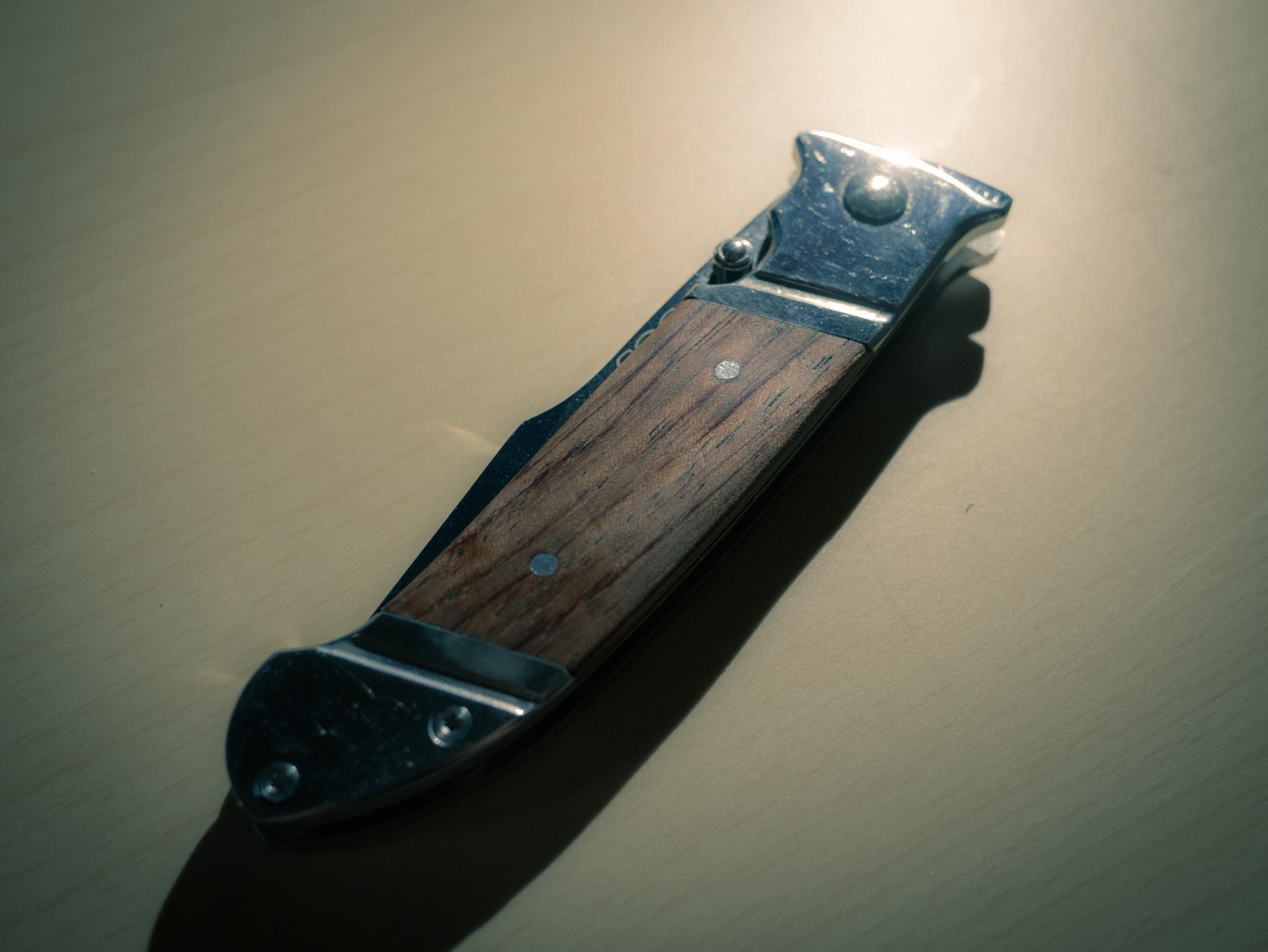
I was given this knife as a gift a very long time ago. It has a fully serrated blade and is more of a decorative knife than anything else.
It looks neat, but that’s about it.
I feel like this is a knife that a villain in a bad superhero movie would carry and threaten innocent women with, thus becoming the lynchpin of a pivotal scene in the film. Or something like that.
### Beretta, Who knows what.
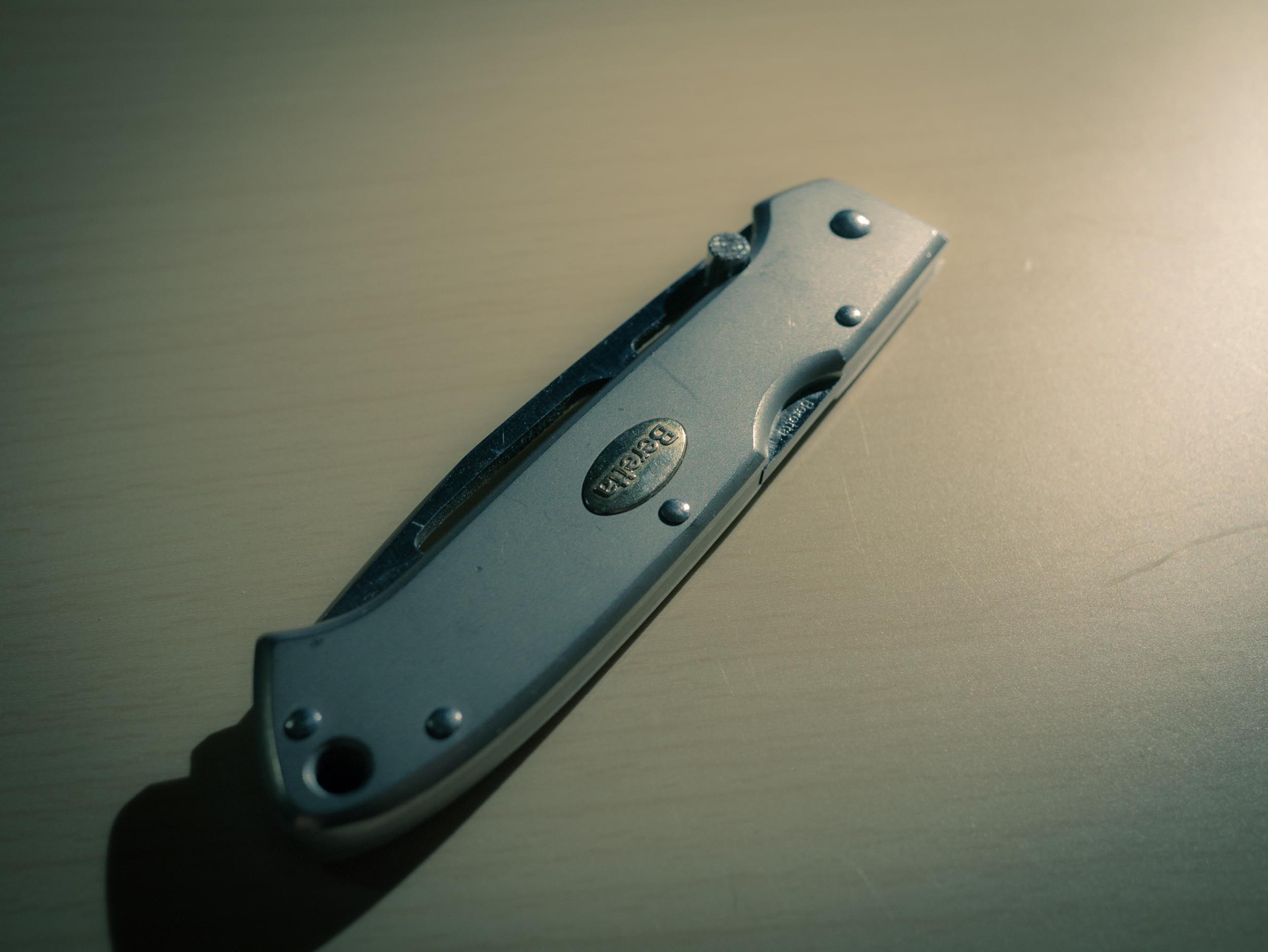
I remember buying this knife, I think I was in high school, I thought it was the coolest knife I had seen at the time. I still like the looks of it, but since the day I bought this knife it has been a bad knife for me.
Forget that it is partially serrated, or the fact that the blade is, again, hollowed out for a cool pattern. No the failure of this knife is that I have never once been able to actually open it with one hand. Drives me nuts. This blade is still razor sharp, because even though it is over a decade old, I haven’t used it.
### SOG Spec Elite I
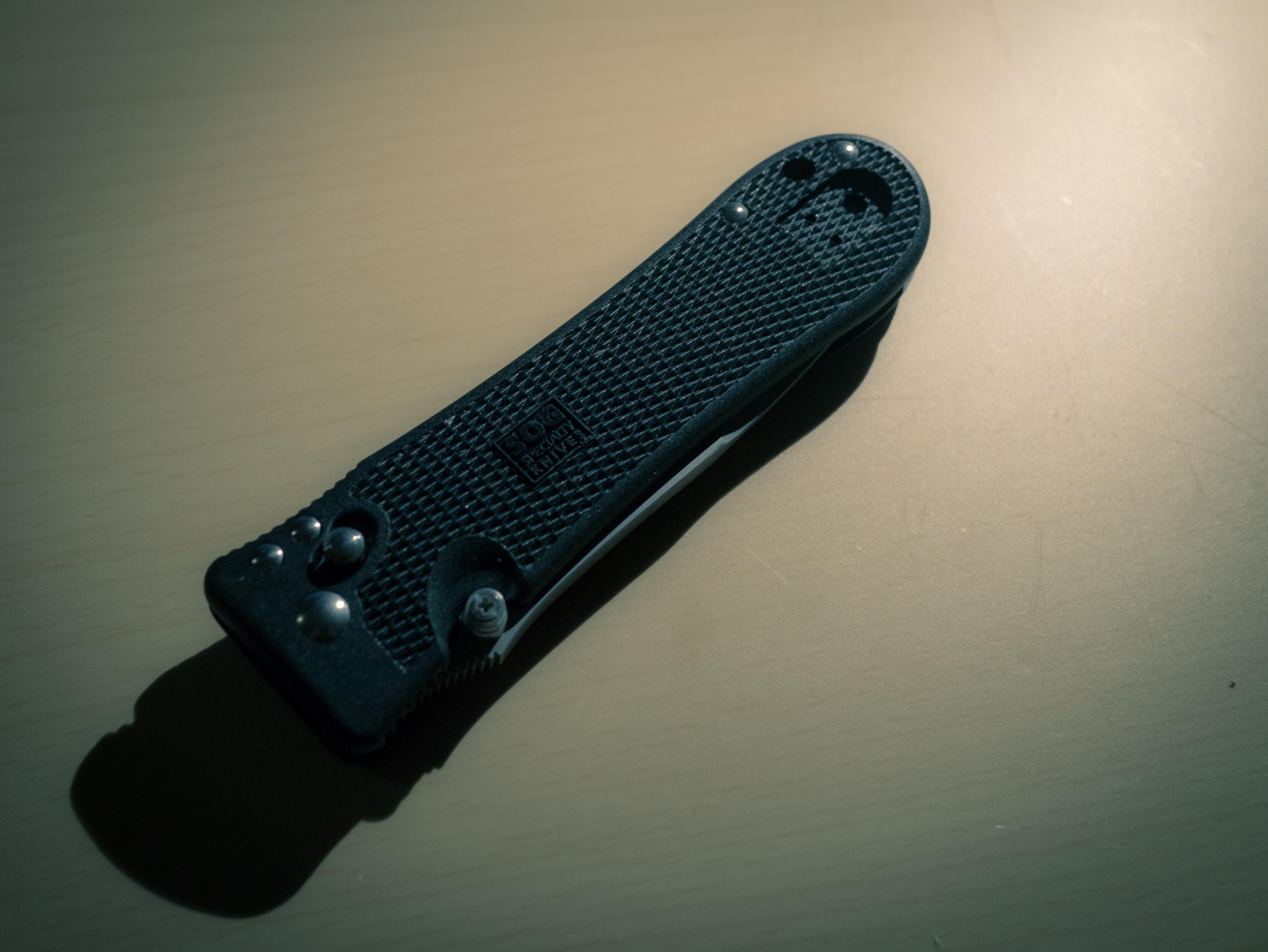
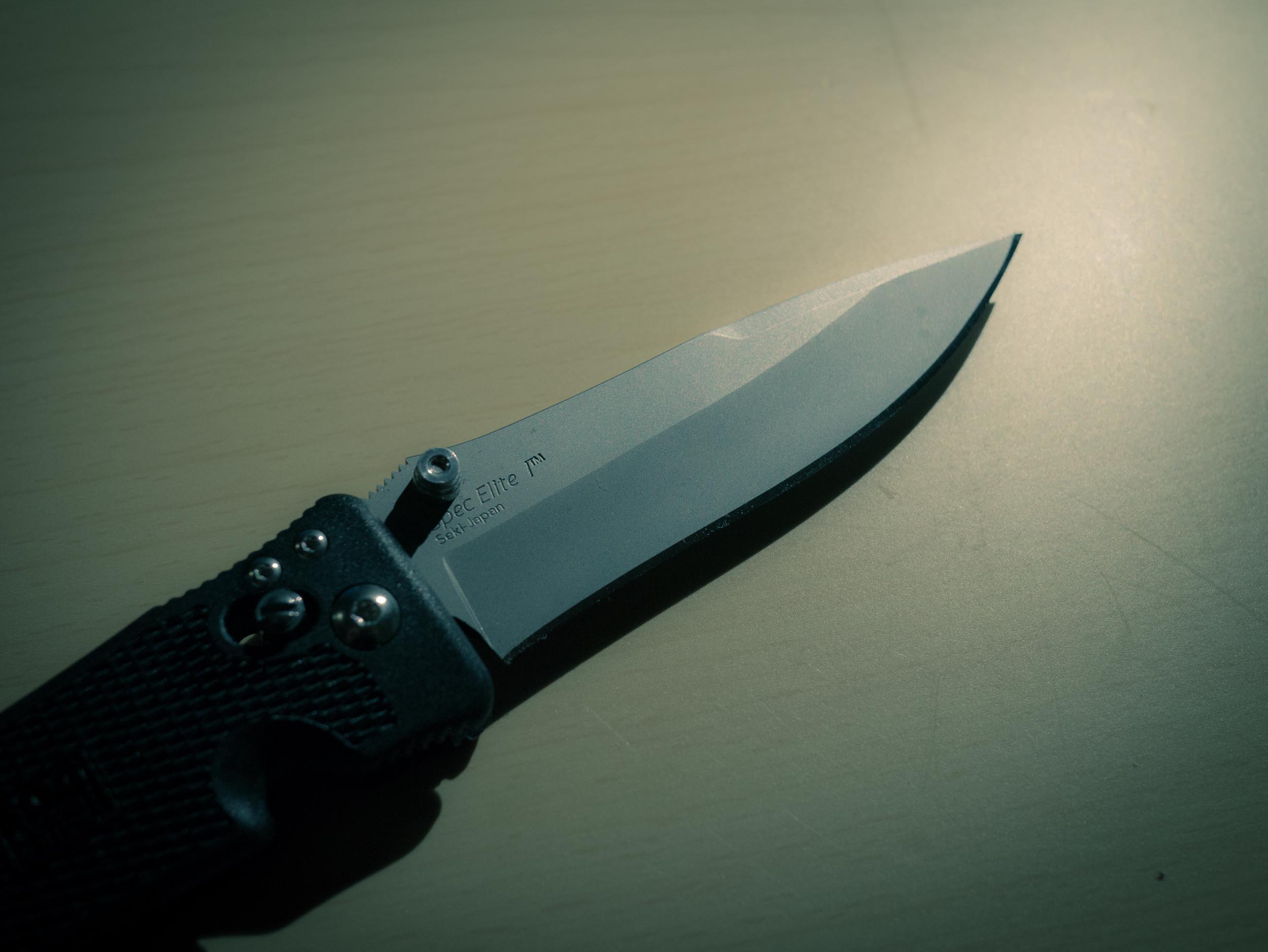
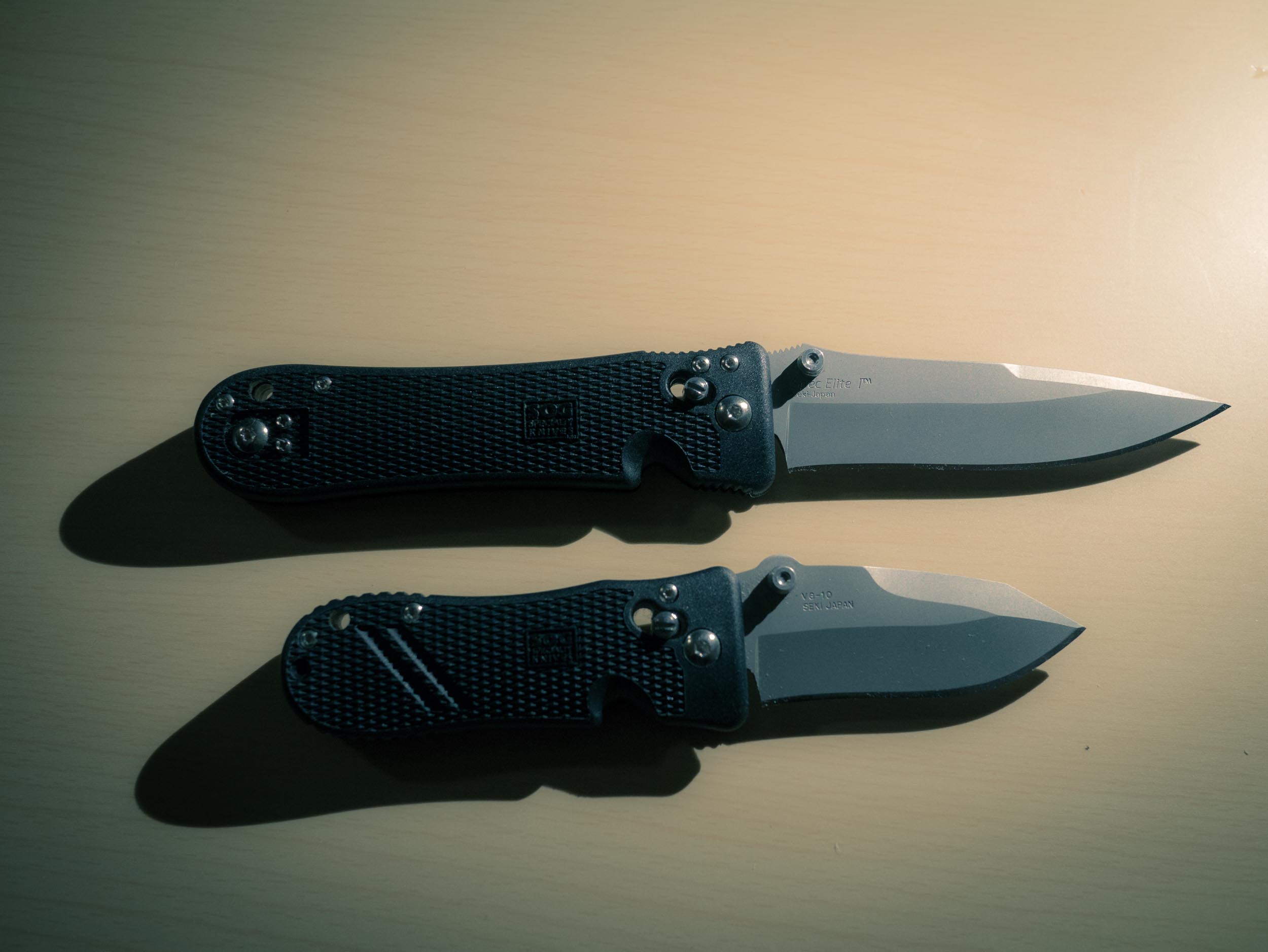
When I purchased this knife I was expecting not to like it, but I found it for a very good price. What surprised me is that I instantly liked the knife. The long sleek blade, the handle that fit in my hand perfectly, everything seemed great.
It has incredibly smooth and fluid opening, the double sided lock release is a nice touch for a lefty like me.
The only problem: it is really too big to carry, well, at all. I didn’t find a single pair of pants I owned that this knife comfortably fit in. Yet, I still really liked it. If you are the type to carry a knife in a tool bag, or stashed in your car — this is an awesome option. I really like the knife, just not as an EDC, as it is solid and handles well. I’d have no qualms being stuck in the woods with this knife.
([Buy it on Amazon](http://www.amazon.com/exec/obidos/ASIN/B000JJJ5SK/ref=nosim&tag=brooksreview-20).)
### SOG Spec Elite Mini
My love for the Spec Elite I, sent me looking to see if the knife is made in a smaller version — it is. This is the smaller version, and it is really great. Instead of shrinking the knife, it’s like SOG took one inch off the blade and handle length — keeping the thickness, tapering, and width all the same. The result is a chunky little knife that still feels great and moreover feels incredibly capable.
I’d not worry one bit if this were the knife I was stuck in the woods with, even though it isn’t a large knife. The unfortunate part is that I found it too bulky to carry in any pants lighter in weight than jeans — which for me is a non-starter.
Even so, I almost stopped looking at this point because I liked the knife so very much, but I felt compelled to check out more options — I still wanted perfection and this knife wasn’t there for me.
([Buy it on Amazon](http://www.amazon.com/exec/obidos/ASIN/B005Z2CPVK/ref=nosim&tag=brooksreview-20).)
## CRKT M16-02Z
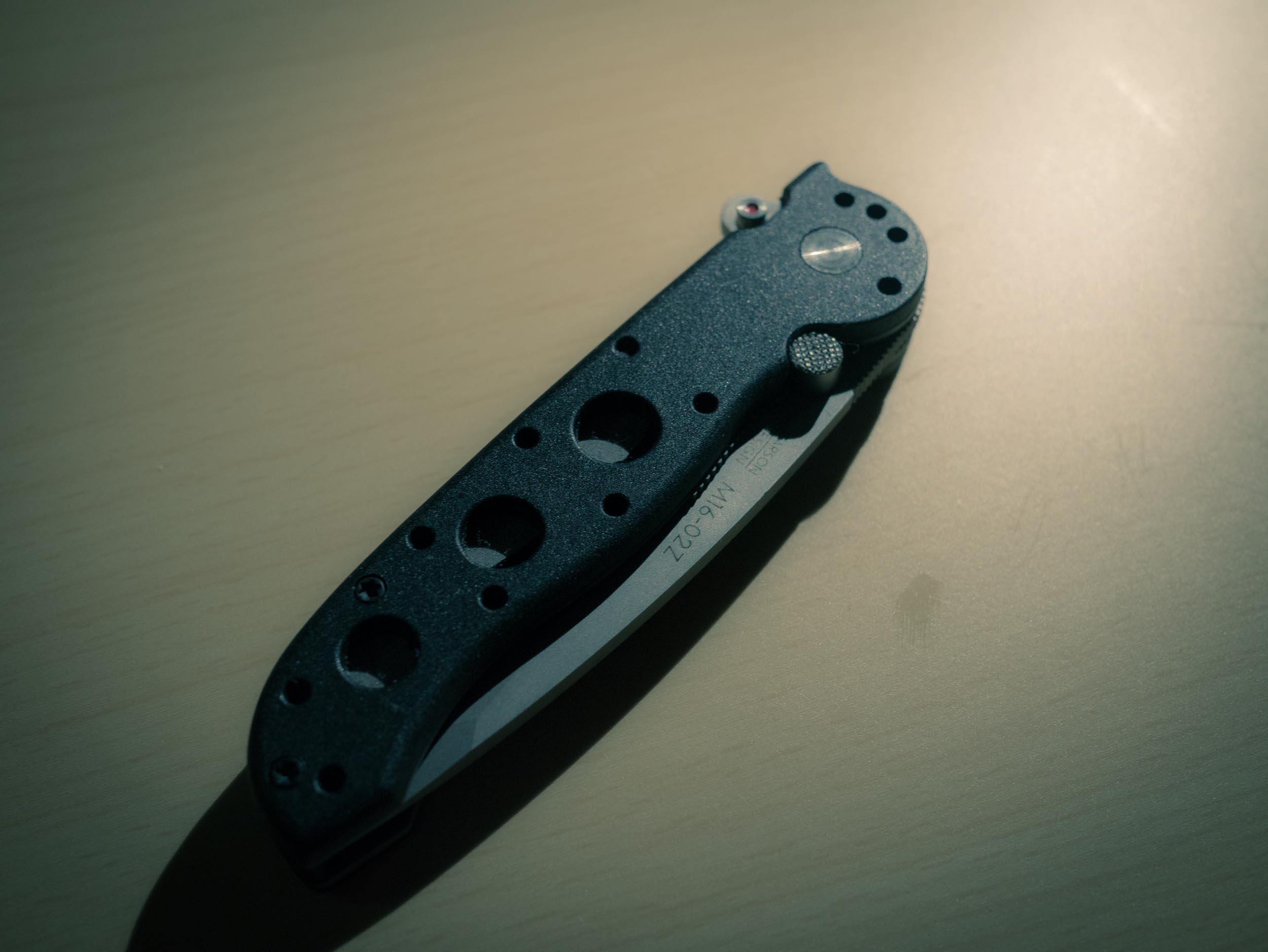
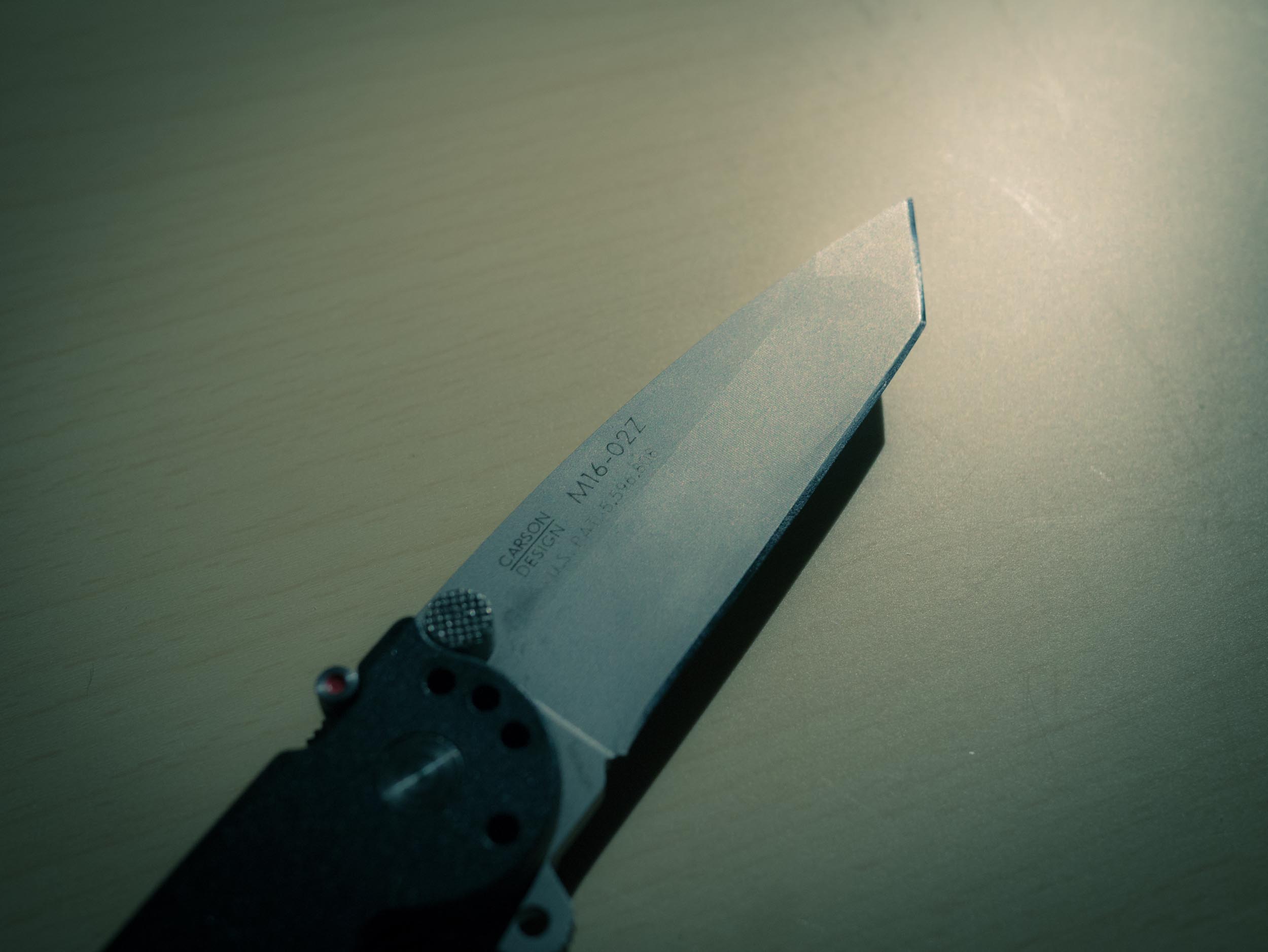
[Patrick Rhone praised this knife](http://patrickrhone.com/2012/09/06/columbia-river-knife-and-tools-m16-02z-knife-review/), [which made me order it instantly](https://brooksreview.net/2012/10/amazon-knife/). As I posted before this is a very solid knife, with two fatal flaws for me as an EDC.
1. It is too long and too thick.
2. The locking mechanism is much too finicky for me, as the mechanism has a safety to *close* the blade.
While many of the SOG knives I have listed have safety’s, they are solely on the opening action — seems odd to me that you would have a safety on the closing action. That said this is one tough little knife, feels absolutely rock solid.
It doesn’t have a thumb wedge like the Twitch, but it does have a nub for your thumb to press on, and that nub is very rough — I just can’t get into that type of opening action. This is another of the knives that I would feel fine with in the woods, and works well in an everyday situation. However I can’t get by the size and the closing action of the knife.
([Buy it on Amazon](http://www.amazon.com/exec/obidos/ASIN/B000WAC7RM/ref=nosim&tag=brooksreview-20).)
### Ontario RAT-1
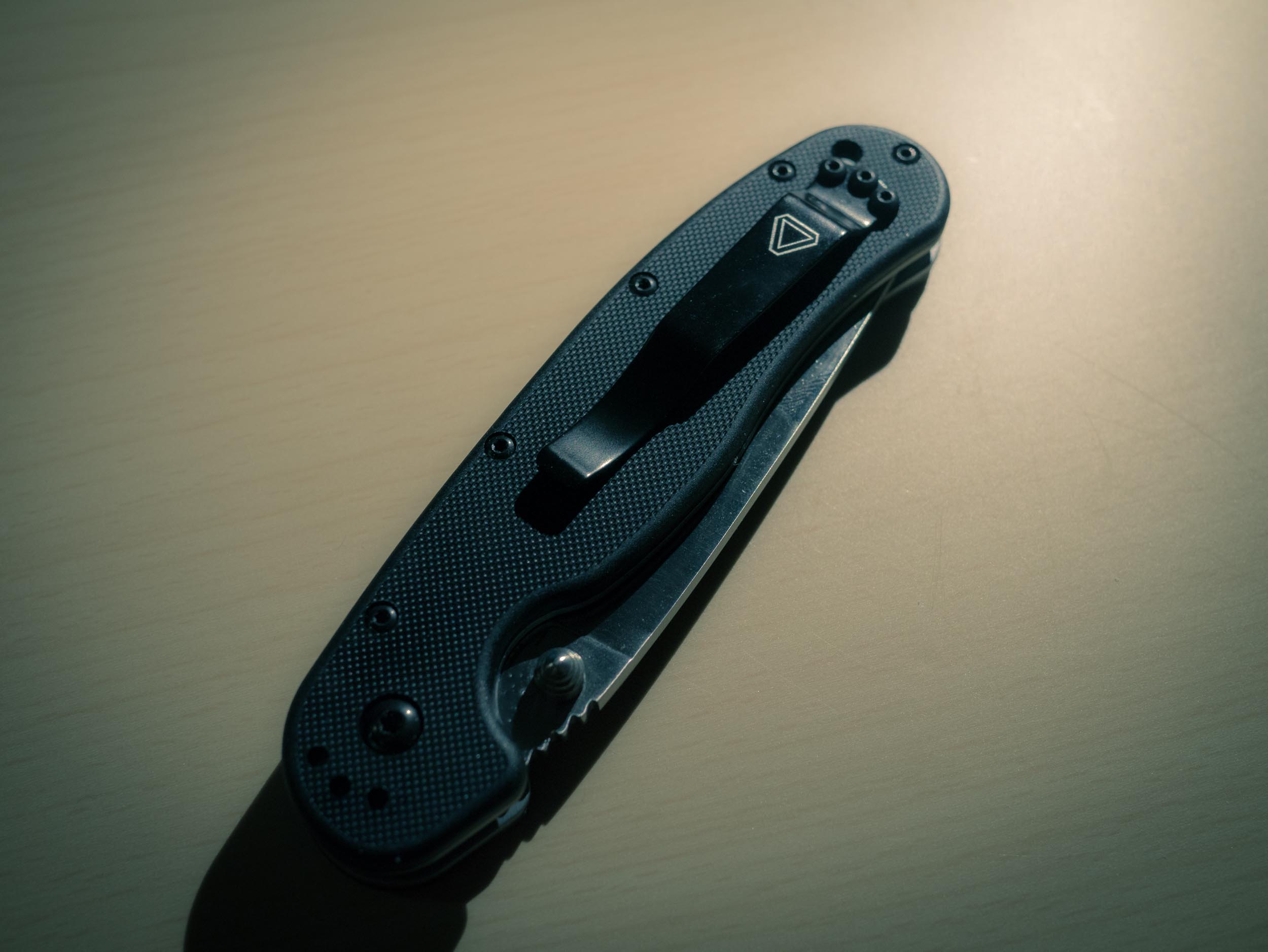
When I ordered this knife I knew it would be too large for an EDC, but I was [so excited to learn about it](http://bladereviews.com/ontario-rat-1-review/) and see the low price, that I couldn’t resist.
It’s everything I expected it to be: the most solid folder knife that I have ever held.
The ergonomics are great, the build is superb. This is a knife that would likely not make me miss one of my fixed blade survival knives if I had to survive with it — it’s that nice.
For an EDC though this is just much too large, but it will be my new hiking knife — without a doubt. There’s just one issue that I have with the knife: the liner lock is very cumbersome to use left handed — and I am left handed. I can close the knife fine right handed, but when held in my left hand it is a two handed job. Again, not a deal breaker, but not the greatest. I am hoping that with wear that liner lock eases a bit so that I can close the blade using my left hand easier.
I made a stink out of the closing action of the CRKT because an EDC needs to be deployed and put away with ease — that’s how you use an EDC. However when I am out in the woods I am typically not constantly pulling out a knife and stowing it back away. In the woods if I pull out my knife it is out until my task is completed — less back and forth. This is why the RAT 1 works great as a hiking knife, despite the liner lock issues.
([Buy it on Amazon](http://www.amazon.com/exec/obidos/ASIN/B0013ASG3E/ref=nosim&tag=brooksreview-20).)
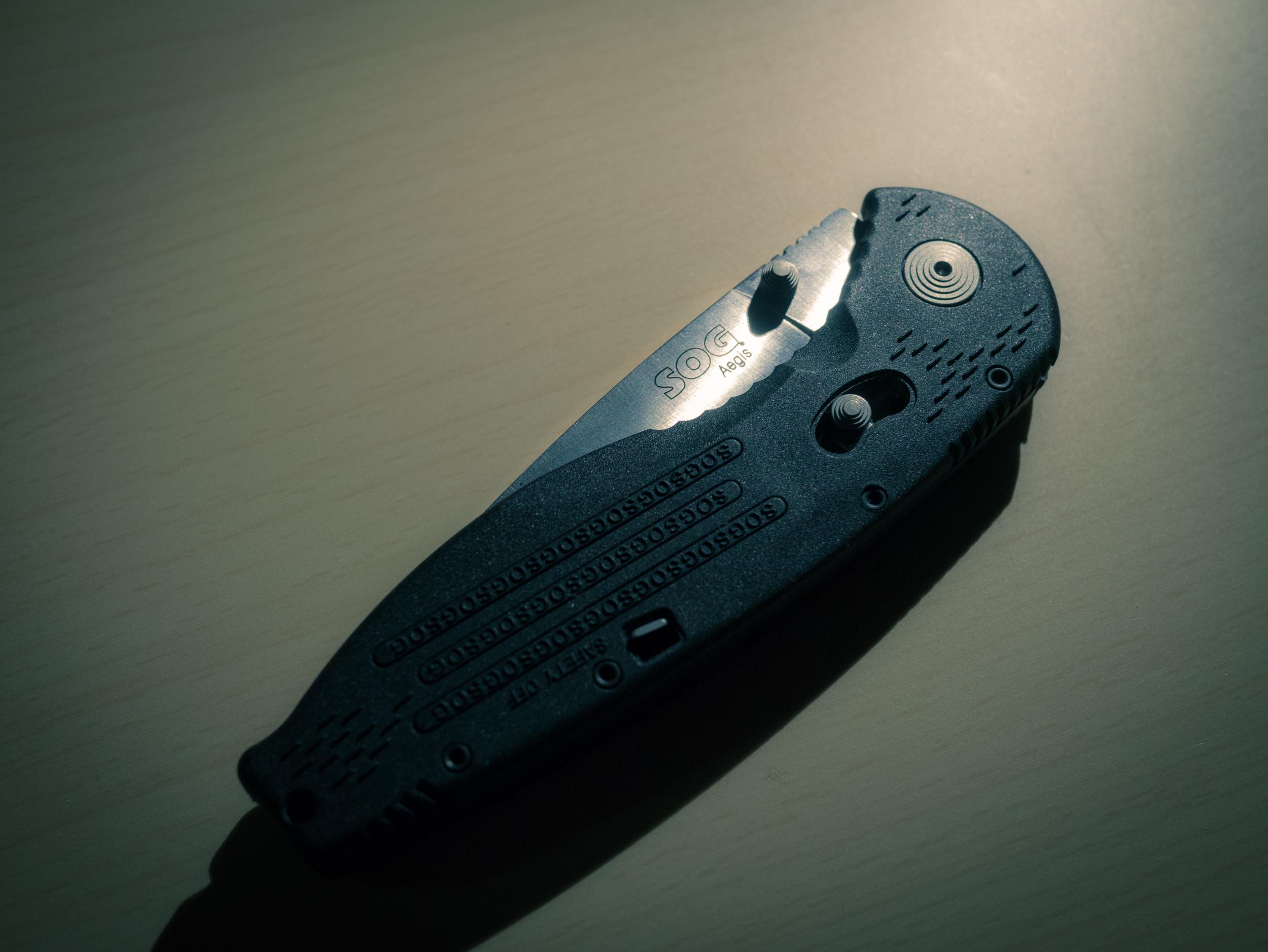
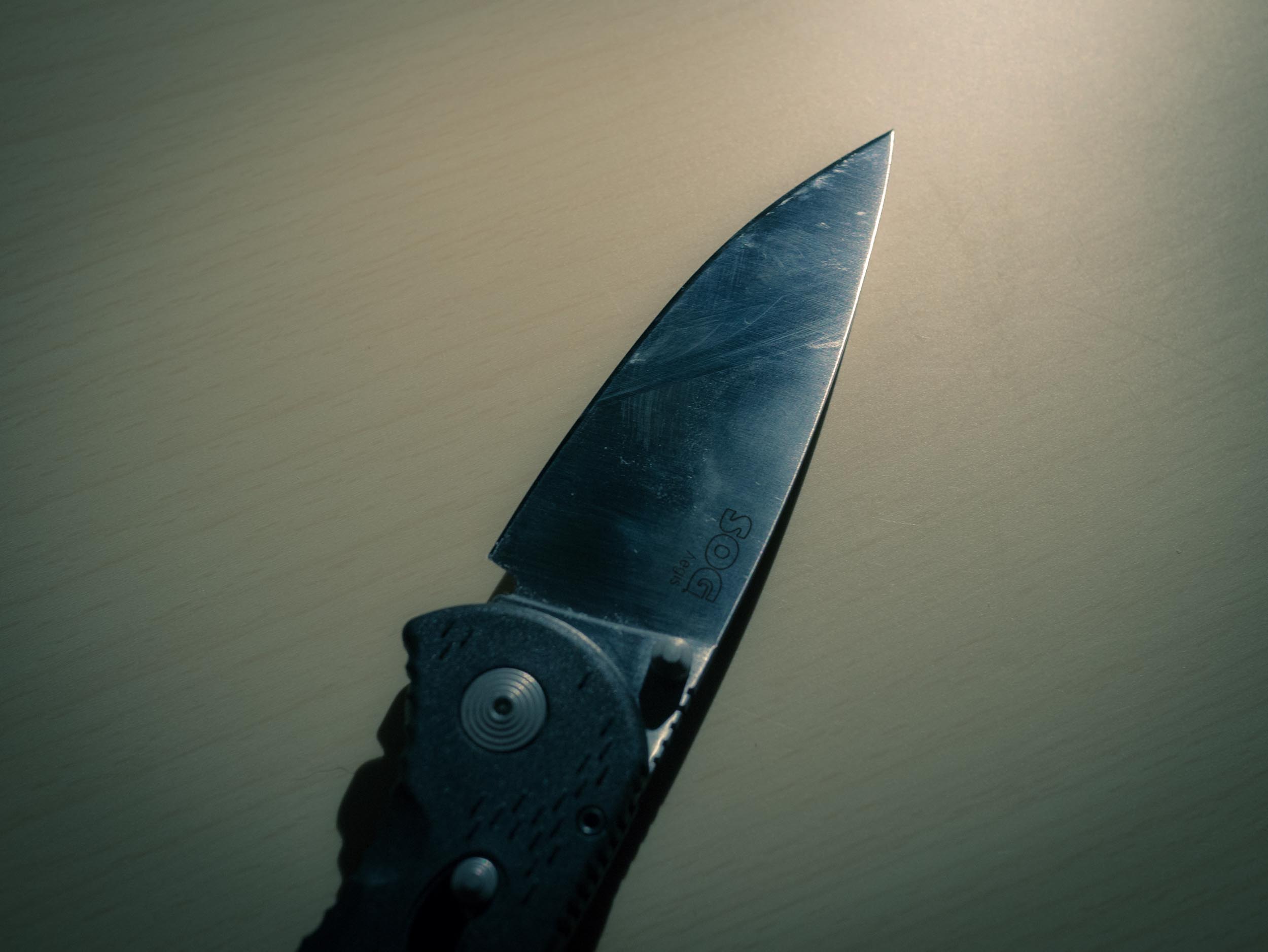
### SOG Aegis
I was very hesitant about buying this knife, but I was determined to find a great knife. I’m glad I bought this knife. It is very solid, not in the way that the Ontario is, but for a light knife it feels sturdy. The knife, is just (again) far too large for an EDC.
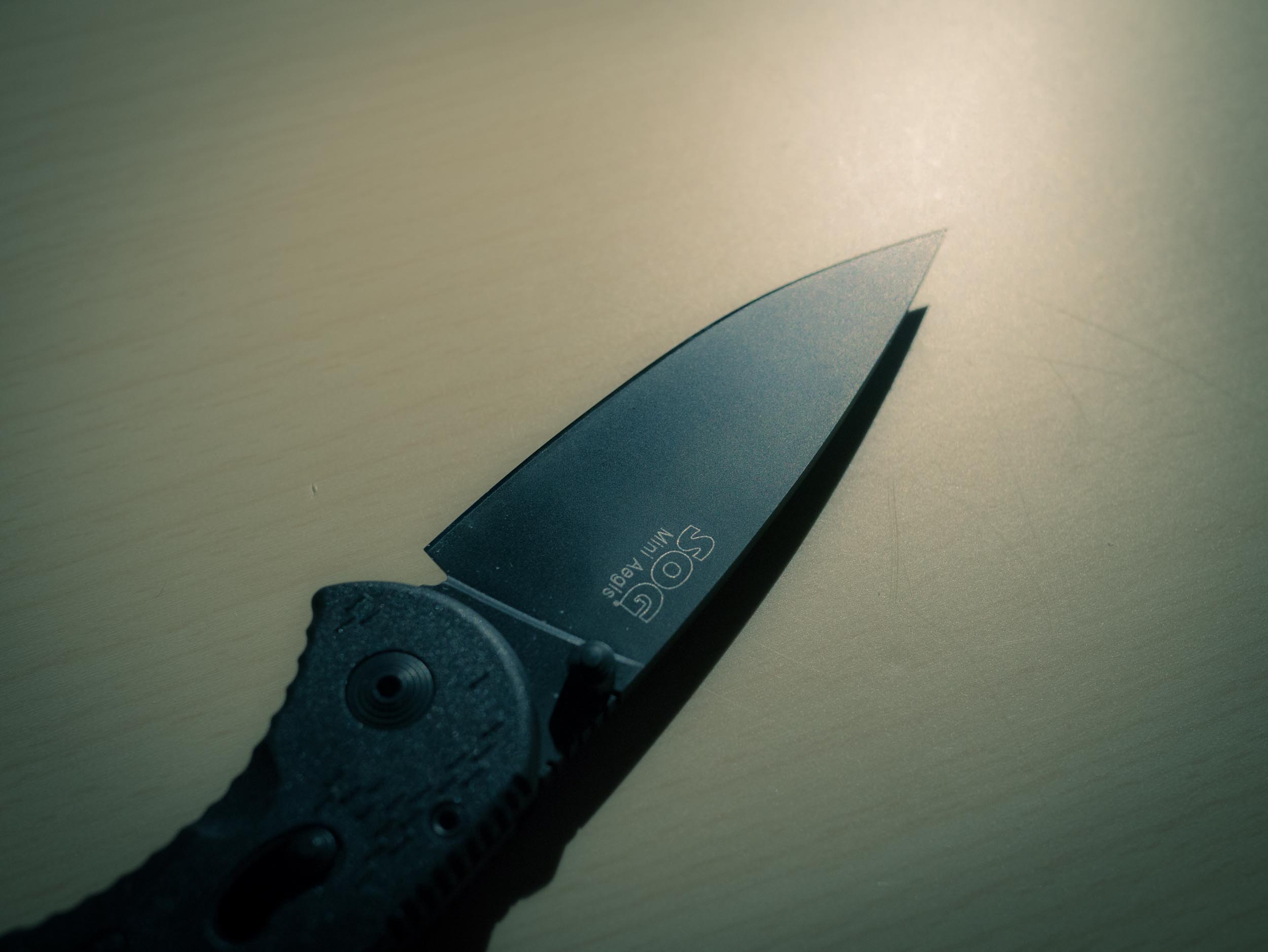
But the blade, oh do I love this blade shape. I don’t know what it is about the blade, but it looks both menacing and delicate at the same time. I really love it. So much so that I struggled to try and make this knife work as an EDC for me. Ultimately the knife is just too large to work.
The blade shape is great in use and deploys lightening fast with the assisted opening. The closing is a bit tough, but I think with age it will break-in nicely. Ultimately I would be concerned with this blade in the woods, given how thin it feels. This is likely completely unfounded, but I feel like this blade would snap under heavy use — again I am probably way off on this assessment.
([Buy it on Amazon](http://www.amazon.com/exec/obidos/ASIN/B00137ETQA/ref=nosim&tag=brooksreview-20).)
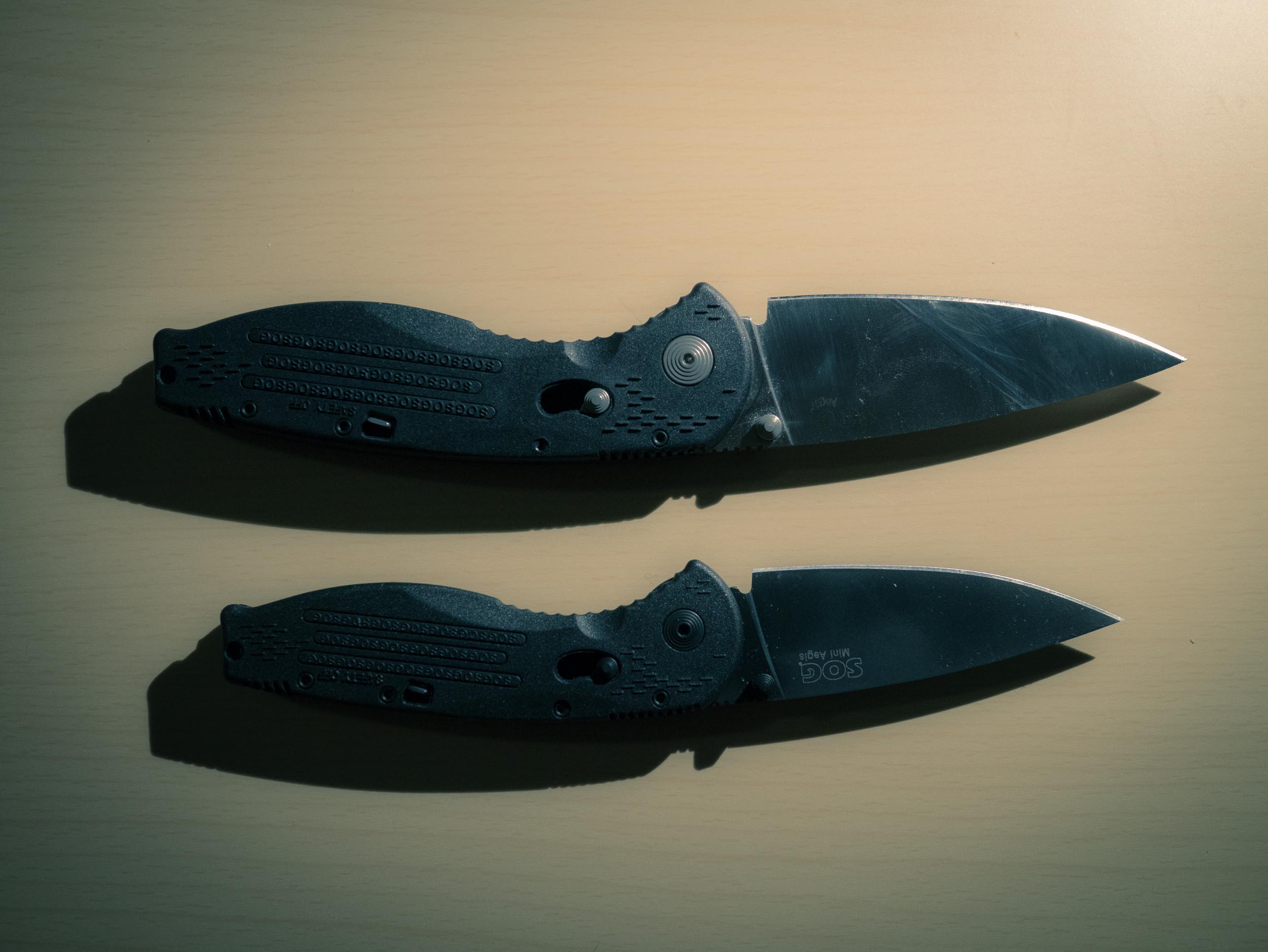
### SOG Aegis Mini
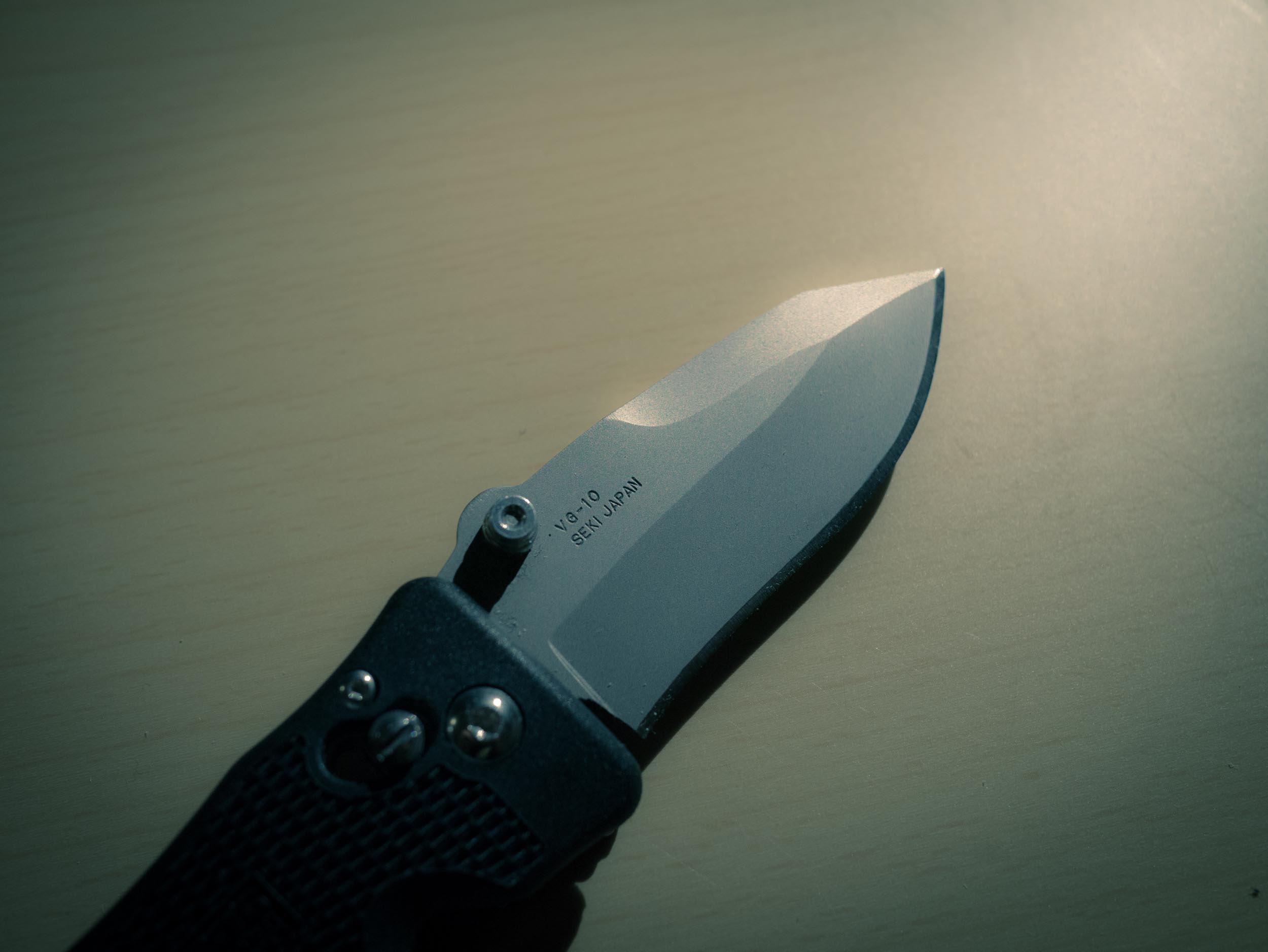
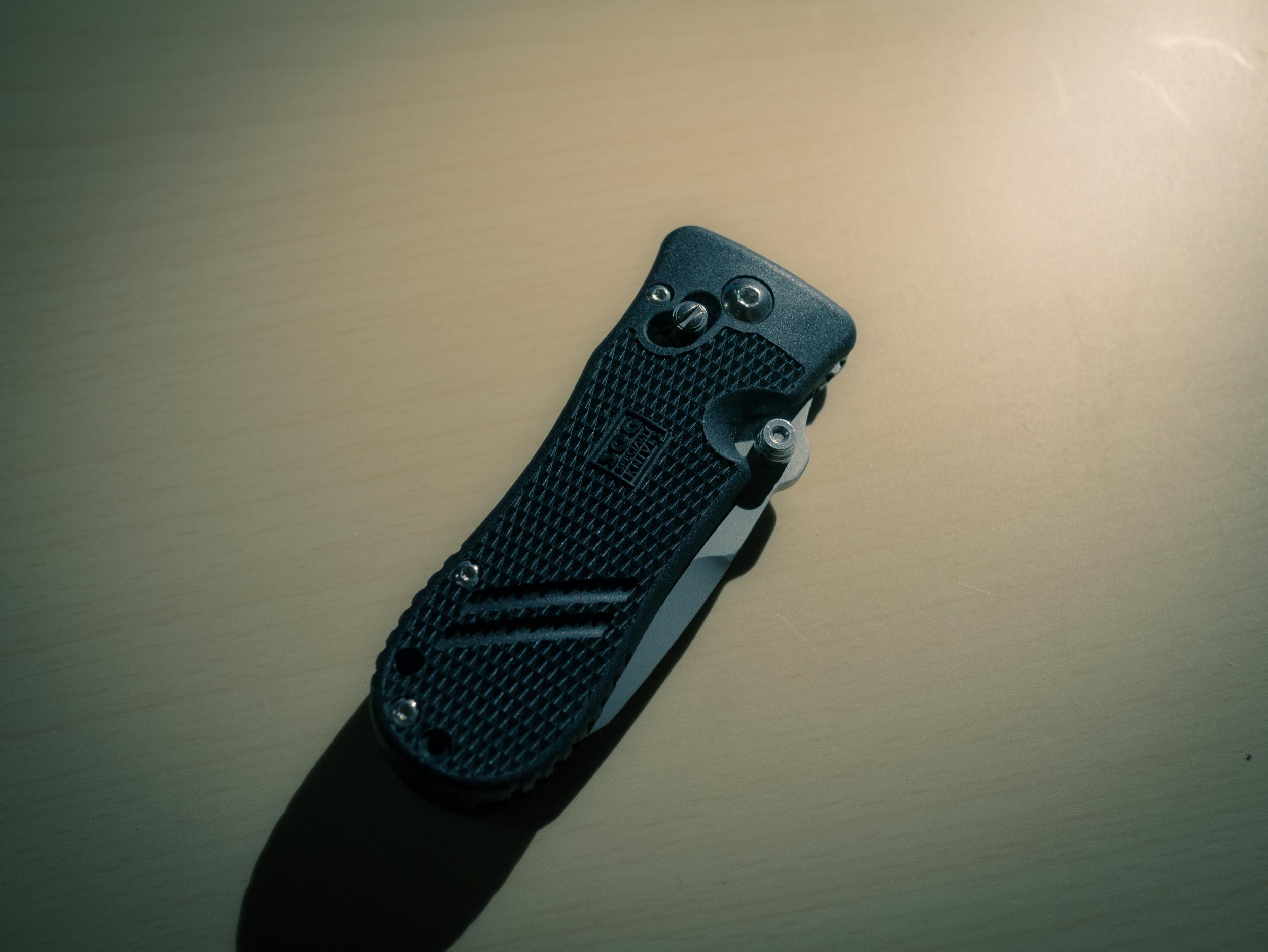
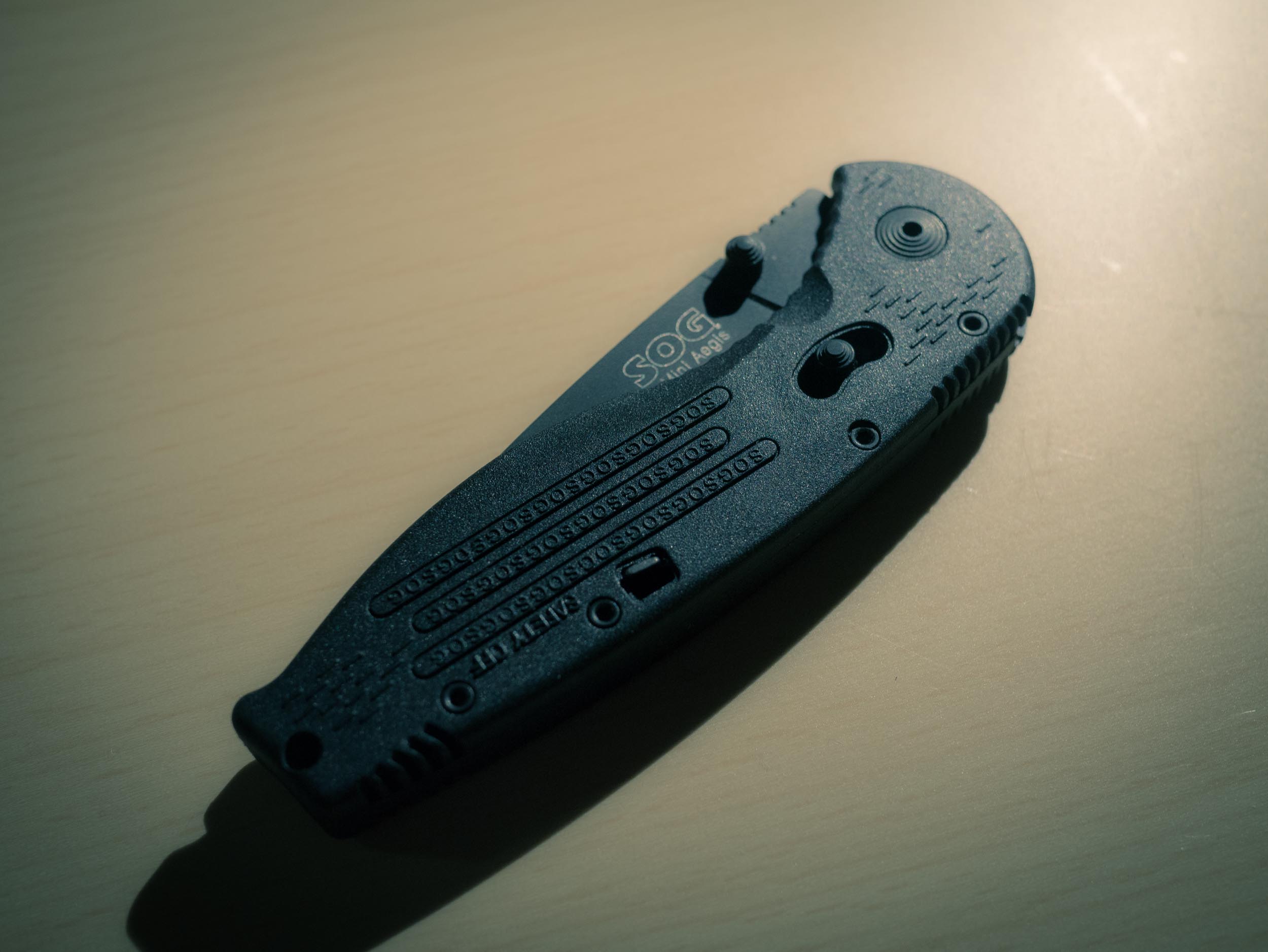
With the Aegis out, I purchased the mini Aegis in hopes it would be everything I wanted. The moment I first held this knife I was in love. It is surprisingly light, retains the same shape of the blade that I love from its older brother. Yet, this Aegis fits very comfortably in my pocket.
I think this is *the* EDC knife for me — at least of all that I have seen and tried so far. So let’s look at my criteria against it to see how it stacks up:
– Under $100, check. It is $40 on Amazon.
– No thumb wedge, check. Thumb studs only.
– Sturdy enough for outdoor survival? Half-check. The knife feels sturdy, but the frame has no metal which is worrisome to me. The blade is also delicate feeling — enough that I wonder just how it would hold up if really stressed. Therefore my main outdoor concern is in durability when pushing the knife to the limits. Otherwise I would have no qualms.
– Looks? Check. I went with the matte black metal finish, and it looks fantastic. Much meaner than the all silver Aegis that I own.
So the knife gets a 3.5 out of 4 — not too shabby. Most other knives were non-starters. This is the knife I am going with for now.
([Buy it on Amazon](http://www.amazon.com/SOG-Specialty-Knives-AE-22-Straight/dp/B004WN5844/ref=sr_1_1?ie=UTF8&qid=1353088583&sr=8-1&keywords=aegis+mini).)
## The Search
The SOG Aegis Mini suits me very well. It’s from a local company, and meets most all of my needs — certainly all of my normal everyday needs. Every knife I tested (exception to the Spyrderco and the Beretta) were very good knives — you can’t go wrong with any — but most are just too large or too small. So as the saying goes, the Aegis Mini was just right.
I have more knives on the way to test from a couple of other brands — I’ll report back on those comparing to the Aegis Mini, as it seems like it might be a tough one to beat.
### Note
[I am selling some of the knives that I don’t wish to hang on to, here](http://store.brooksreview.net/). They will all come sharpened and ready to go, but all are used.
[Ron Nixon, reporting for the New York Times, on the recent absurd USPS financial loss](http://www.nytimes.com/2012/11/16/us/politics/postal-service-reports-a-nearly-16-billion-loss.html?_r=0):
>The Postal Service on Thursday reported a record $15.9 billion net loss for the fiscal year that ended Sept. 30, bringing the financially troubled agency another step closer to insolvency.
Additionally he notes:
>Nearly $5 billion in other losses were because of a decline in revenue from mailing operations. The agency also reached its $15 billion borrowing limit from the Treasury.
The USPS, isn’t stupid enough to think that they don’t need to change, no Congress are the ones stupid enough to keep USPS from changing. The USPS wants to cut back to five days a week and grow into shipping beer and wine. Yet Congress hasn’t allowed it.
This is so beyond stupid. Here we are as taxpayers, paying for a company to exist that just lost almost $16 billion dollars in one year, when the solutions are so obvious:
– Cut costs.
– Raise rates.
I get that not everyone has a computer and therefore mail service for all is still seen as a vital infrastructure component for the U.S., but I have to wonder how many computers $16 billion would buy because perhaps the solution is dissolution of the USPS.
That is: if we shut down USPS, repurposed all the money they were blowing through on providing those without means an iPad and low-cost internet, how much of the money that we allocate to USPS would we (as a nation) use?
[Wikipedia notes](https://en.wikipedia.org/wiki/United_States_Postal_Service) that the USPS has an annual budget of $70.634 billion dollars: that’s 175 million iPads at $399 for an iPad 2. So not every U.S. citizen, but it’s not like we are talking unfeasible to think we could just give people a different communication means and shut down the money pit that is the USPS.
Hell, we could buy 351 million Nexus 7s. And [as best I can tell](http://www.internetworldstats.com/stats2.htm) we only need to buy 70 million devices to reach those that don’t currently have internet connectivity. So we would be half way there in one year’s budget for the USPS. And then save $70 billion a year every year afterwards — that’s almost a no-brainer.
Now, I’m not saying we do this, but this should put the absurdity of the USPS in perspective.
Again, over a five year period (it seems) that it would be cheaper to supply every non-internet-connected American with a tablet and subsidize internet access, then it would be to continue to operate the United States Postal Service. Think about that.
**Updated on November 16, 2012 to fix a decimal point error that makes this an even stronger case.**
Before I start sharing a bunch of Keyboard Maestro macros, we need to be on the same page when it comes to understanding the inner workings of Keyboard Maestro. So let’s get that out of the way.
Keyboard Maestro is a two part application. The first part is what you see when you launch the application: the macro editor where you can build your macros. The second part is the very lightweight Keyboard Maestro engine — this runs in the background to monitor user input so that Keyboard Maestro can make your macros actually work.
There isn’t much to know about the engine, but you can stop and start it from the `File` menu in the Keyboard Maestro macro editor. So unless you don’t have any macros, just leave the engine running — conversely if your macros don’t seem to work, check to make sure the engine *is* running.
The Keyboard Maestro engine isn’t something you can control, instead everything the user does is inside the editor interface so that’s what I will focus on.
## The Editor
Once you launch the editor you will see three main panes. From left to right these are:
– Groups: I will touch on these more later, but these serve as a way to group macros together and add additional functionality to the groups of macros by limiting them to certain applications.
– Macro list: A simple list of all your macros.
– The Macro: this is the detail view of a selected macro, showing the triggers and the actions (more on those in a bit).
The interface only get’s more complicated from here, so let’s break this apart a bit more.
## Grouping Macros
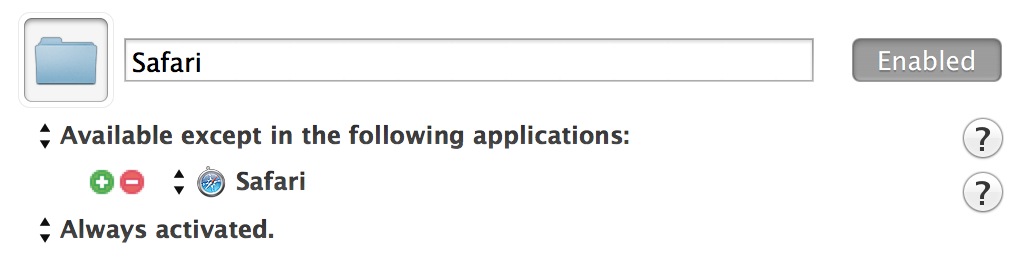
I mentioned that you can get additional power out of macros if you add them to a group. Groups are not a way to organize macros, they are a way to limit the power of macros and thus make your life a bit easier. For instance: there are bound to be macros that you want to work only in a certain application, or more often, never in a certain application. Groups are where you set up such controls.
So if you wanted to create a new group of macros that only works in Safari, you would simply create a group like this:
And if you wanted to create a group of macros that never work in Safari, you just change those settings to this:
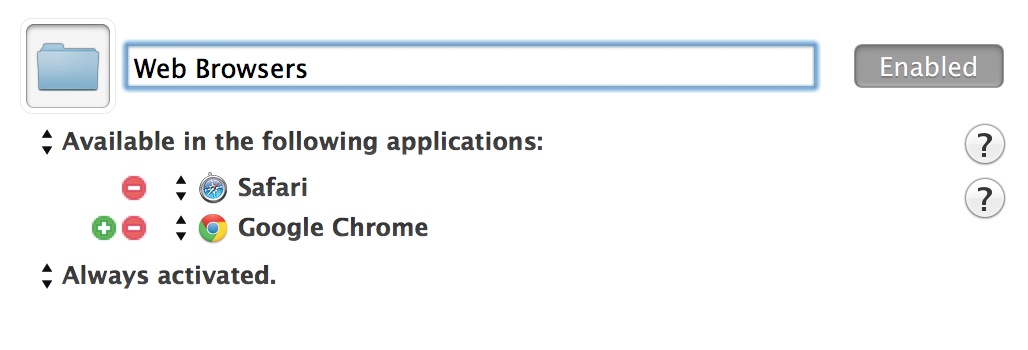
The power isn’t limited there, because perhaps you want to create a group of macros that only work in web browsers, which is easily done like so:
Of course, your results will vary depending on the web browsers you have installed.
Because of the way groups work it is best to think of them as ways of preventing bad things from happening in other apps — especially if you are sharing keyboard shortcuts. However, this is not the only thing we can do, you could use the group setting in conjunction with a quit-all macro. The macro could then easily quit every application running, except those excluded in the macro group.
Groups are an important tool in Keyboard Maestro to keep in mind as you are working through the construction of more complicated macros.
## Macro Editor
The macro editor can be broken down into two views, and two panes. The two views are: description and editor. These are the views you are presented with if you are **not** in macro editing mode.
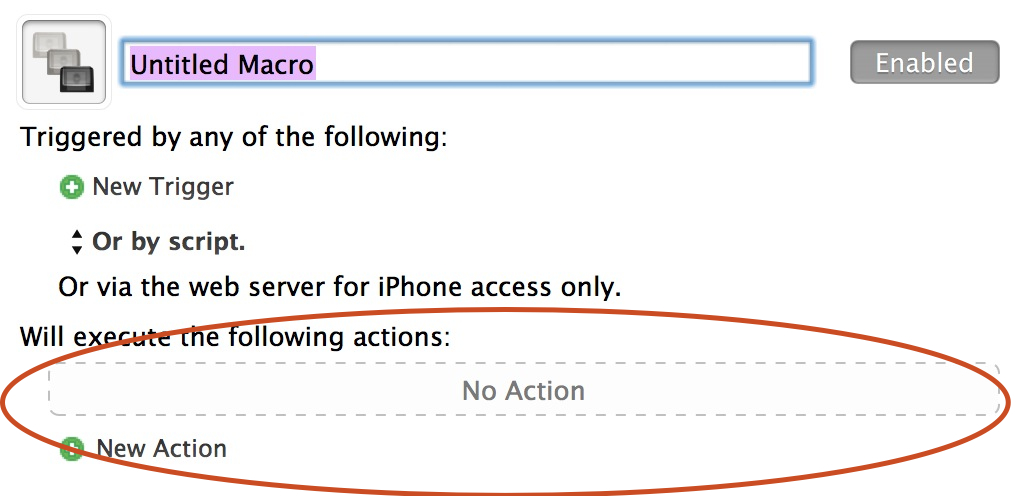
The two panes that appear in editing mode are: triggers and actions. When you click the edit button at the bottom of the macro editor you are able to manipulate both triggers and actions, and these panes are where you build your macro, so we need to take a deeper look.
### Triggers
Triggers are what’s going to set the macro into action. This is simply asking: what event has to happen for the below actions to run?
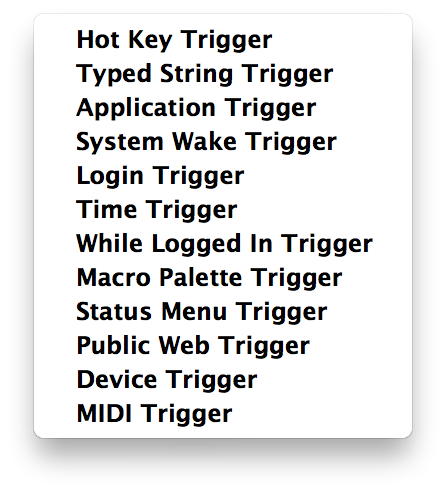
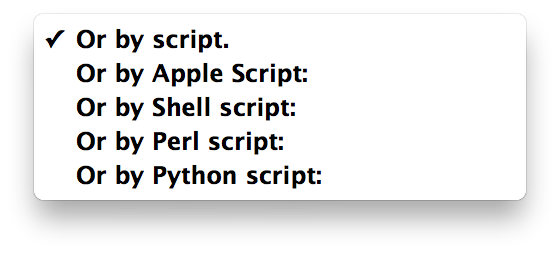
Right now there are 12 triggers, and four script triggers that you can choose from. (It’s important to note that you can have more than one trigger for each macro — as I will show in later examples.) For now, that could be a macro that runs everyday at a given time and that can also be invoked by a keyboard shortcut, or any combination of these twelve macros that you can dream up:
And the script triggers:
In this series I will primarily use time and hotkey triggers, but as you can see there are many different ways that you can trigger your macros.
To aid in the construction of macros you need to understand how each macro *could* be triggered.
– Hot Key: This is your basic keyboard shortcut trigger, and likely to be your most used trigger. It’s important to note that Keyboard Maestro will intercept any keyboard shortcut and run the macro while stopping the shortcut from working at the system level. Therefore if you were to assign `CMD+C` as a hotkey, the universal “copy” command would simply execute your macro, and not copy anything (unless that is your macro). So choose your triggers carefully.
– Typed String: Similar to the Hot Key trigger, except that this trigger watches for you to type a particular series of characters and then it will trigger (instead of forcing you to hold down a set combination of keys). I will show you some examples of Typed String triggers, but for now think of this as a great trigger to use to trigger macros while you are typing in a document — much like you would use TextExpander.
– Application: This will trigger a macro based on the state of one or more applications. Some examples would be if you launch a game, you can trigger system hogging applications to be quit. Or if you switch to a particular application, you could make it go fullscreen at that time. Perhaps when you quit an application you force the application to close all windows so that they do not reopen when you next launch the app.
– System Wake: Triggers macros when your Mac wakes from sleep. One of my favorite triggers here is to hide all applications on system wake — since I don’t sleep my computer much, there is a good chance that I am changing locations when I do sleep my computer and in these instances such a macro could save you some embarrassment if your screen didn’t have any of your previous “work” when you wake the computer — just saying.
– Login: Triggers a macro when you login into the account you used to create the macro. This can be used to replace login items, or applications that automatically start when you boot your Mac, but more pointedly you could use this to changes settings to specific defaults after you restart a Mac, among many other things.
– Time: This is a great trigger that I use often. You pick a time of day, and the days of the week, that you want the trigger to fire the macro for you. For example: Monday-Friday at 8:30am. I use this trigger to have my Mac remind me of daily things (Lunch Time!) and to keep my embarrassment level low(er) (Set volume to 0 when I get to work).
– While Logged in: Another fantastic trigger, this one will repeatedly trigger a macro within the parameters that you set. There’s three aspects to the trigger: how often you want the macro trigger, between what times of the day to do this, and which days of the week. (e.g. Trigger every 30 seconds between 8:30am and 4:00pm on Wednesdays and Fridays.) Another great trigger for automating a routine task, such as checking your OmniFocus inbox for unprocessed to-do items, or reminding you to look away from the screen.
– The Macro Palette entry is clicked.: A good trigger for macros that you build for one-off never to be used again circumstances. This trigger gives you a palette that overlays on your screen and you trigger the macro by clicking on an icon in the palette. I only use this if I build a macro for a specific document I am working on, knowing I will not need to use the macro later. This saves me from remembering a new keyboard shortcut. (Also handy for testing macros while you are making them.)
– The Status Menu item is selected.: Much like the last trigger, except instead of a palette that sits on your screen, there’s a menubar icon that allows you to execute a macro from it. (Hint: If you unchecked to show the menubar item in Keyboard Maestro preferences, but it still shows — make sure no macros are using this trigger and then restart.) This is the best way to trigger macros if you are keyboard-shortcut adverse.
– The Public Web entry is executed.: A bit more complicated, but you can set up a local area network webpage that is hosted by your Mac, and any macros with this trigger set, will appear on that page. You then can execute the macro by clicking on that page. Not a bad idea if you have a Mac running with no keyboard/mouse/monitor hooked up to it — just make sure your security settings are done correctly. I use this on a Mac that I use as a server to run a few commands without having to remote-login to the machine.
– This Device key: Ok, this trigger is a bit more complex; basically if an input is pressed on a particular device, then the macro triggers (with options for holding modifier keys). One potential use would be if you have a [Griffin PowerMate](http://www.amazon.com/exec/obidos/ASIN/B003VWU2WA/ref=nosim&tag=brooksreview-20) controller and want to execute macros by clicking the PowerMate. Other options would be if you wanted to have a dedicated Keyboard Maestro keyboard, you could do so without having to hold modifiers, just using the Device Key trigger. Some good possibilities, but not many which I use.
– This MIDI note: I have to be honest, before writing this book I had no idea what this did. Here’s what Keyboard Maestro’s documentation says: “The macro can execute when the MIDI note is pressed (note on), released (note off) or continuously while it is held down. This allows you to do things like have a macro execute when the key is pressed, and then a second macro execute when the key is released, for example to toggle a setting on and then off again.” Seems like it could be useful for musicians, but I honestly still can’t think of a use case.
– Or by Script: I’ll leave the scripts out, as those are more advanced triggers than we will be getting into with this series of posts, but the Keyboard Maestro documentation does show a couple of examples that might be of use.
### Actions
Now that we have the triggers all sorted out, we need to go through the action side of a macro. As the name implies actions are what the macro will actually do when it is activated. There is a wide range of actions available, and even more when you factor in that launching a script can be an action in a macro. While I won’t go through what each action does, the documentation does a decent job of that, I will say that it is worth your time to simply browse all the actions and get an idea of what’s available to you.
There *are* a few things that I want to go over about actions.
### Action Picker
The very right pane in Keyboard Maestro is the action area, and the bottom section is where the heart of your macro lies.
All you need to know here is that actions are executed in the order they are shown, from top to bottom. Clicking the green plus that says `New Action` will bring up the Action Picker that lays atop where your macros were previously listed. From this pane you can drag, or double-click, to add any new action to your macro.
## A Few Tips for Building Macros
#### Search
There’s a search box that sits in the top right corner of the action picker — this searches through all available actions. I recommend that you use this to find what you need if you already know the name of it since this will save you quite a bit of time.
#### Groups
All actions are grouped together by type, so that if you want to see all available clipboard actions, you can just select the clipboard group of actions — depicted as folders. I will reference where actions are by groups as I show examples of macros later on, this way you can find them more quickly.
## Action Items
The last, and most powerful part of actions, is that each action has additional options attached to it. A lot of the time it may not be readily apparent that there are additional options.
The best way to look for additional options is to look for arrows in the action itself after it has been added to the macro. Things like these:
There’s a lot to these options and I will dive into some of these as we go through example macros. Suffice to say that these options can double the power of Keyboard Maestro itself — they are important to look at.
## Basics
That’s the basics of Keyboard Maestro, while it takes a lot to explain, it is no more complicated than taking out the garbage for most tasks. All you need to know is the order of events:
– Pull garbage bag out of garbage can.
– Tie the top of garbage bag.
– Walk garbage bag to door.
– Open door.
– Walk garbage bag to garbage can.
– Open garbage can.
– Place garbage bag in garbage can.
– And so forth.
I like to think of Keyboard Maestro as a puzzle, where it can do anything I want it to do as long as I find the right puzzles pieces to fit together. Next up, a lot of examples.
*(This post is a part of a series on Keyboard Maestro, [see more here](https://brooksreview.net/tag/KM-SERIES/).)*
[Keyboard Maestro](http://www.keyboardmaestro.com/main/) is the best tool you can purchase for your Mac.
It is a bigger upgrade for most people than doubling up your RAM — yet Keyboard Maestro is also a daunting tool to learn at first glance. The reason I will be writing a series on Keyboard Maestro is that all too often I watch people waste time doing repetitive things that could quickly and easily be solved with Keyboard Maestro. And yet Keyboard Maestro is not installed on most Macs.
When you really get down to it, Keyboard Maestro is a simple tool to learn and use. All you have to know are two things:
1. Your goal (Or what you want to accomplish with any given Keyboard Maestro macro.)
2. The steps to go from start to the finish to make that goal happen.
For example, if I wanted to grab text that’s highlighted in one application and paste it into the last used application, all I would need to know is the order of actions to do that:
1. Copy text.
2. Switch to last used application.
3. Paste text.
There’s no code to learn to figure how to make that work, you just look through the massive list of Keyboard Maestro actions and select the ones that accomplish your goal. Put them in the right order and move on.
Of course this is just the very tip of the iceberg for Keyboard Maestro — it can do, oh, so much more.
In the next post I will walk you through the basics of Keyboard Maestro to give you the building blocks needed to work through automating your Mac with Keyboard Maestro.
Following that I will walk you through many of the macros that I have built, so that you can either replicate them, or build off of each macro to fit your computing needs. At each step I will try to explain why I am doing something a certain way, especially if there are other ways that may be more obvious to use.
As with any tool, you will need to use Keyboard Maestro in the manner that best suits you to get the maximum benefit.
### Note to Advanced Users
If I can make a macro work without having to write a script or take you into shell commands, I will do so for two reasons:
1. It’s easier to understand and thus replicate.
2. It’s easier to change and tweak the settings without having to teach scripting.
There are many advantages to diving into scripting and shell commands, but those are for another series of posts — not this series. In some cases I will use simple scripting commands if I feel the benefits of doing so outweighs the complexity of using scripts.
[Jeff Hunter has a “collection of valueless, invasive, and annoying push notifications” that he has received](http://blog.anylistapp.com/2012/11/push-notifications/) and it is clear from his post that there very much is a problem. What’s interesting is that it appears Apple already anticipated this, as this is section 5.6 of the App review guidelines, per Hunter’s post:
>5.6 Apps cannot use Push Notifications to send advertising, promotions, or direct marketing of any kind
So why isn’t this being enforced? I think it is because this is very hard to enforce given that Apple cannot know in advance what developers might notify users of.
That’s why this idea from Hunter is a very good one:
>Provide a feedback mechanism that allows users to report spammy notifications, and crack down on abusive apps.
My suggestion would be for the report feature to appear in the Notifications setting preference, inside the options for each app. So that directly underneath the toggle for push notifications is a toggle that says “Report abuse” burying it there would lead to less false-positives and still offer a way to combat ad-driven notifications.
Notifications in general have always been a problem for iOS, and while push notifications are nice, they can also be incredibly annoying when used incorrectly — or not as the user expects. I can’t be the only one that thinks half of the “Breaking News” push notifications aren’t really what I’d consider important breaking news. So this is a bit of a slippery argument, as Apple would have to define to users what is and is not OK — otherwise it would vary too much from user to user.
The big tech news last night was that Steven Sinofsky was fired from Microsoft (([Ballmer notes that it is Sinofsky “leaving”](http://news.cnet.com/8301-10805_3-57548758-75/ballmers-memo-announcing-steven-sinofskys-departure/) which is a [nice way of saying that he was told to resign or be fired](http://techcrunch.com/2012/11/13/windows-8-is-just-great/).)) — Sinofsky was the head of Windows and *the* man in charge of Windows 8. Naturally, tech blogs exploded drawing parallels to Cook’s quasi-firing of Scott Forstall, head of iOS at Apple. Other than both companies being competitors (kind of) and both being high-level executives leaving the companies, there aren’t any other similarities between the two — so let’s stop that silliness now.
What’s more interesting about this move for Microsoft is what it means long-term for the company.
I’ve been a [long-time proponent of the “shit-can Steve Ballmer” movement](https://brooksreview.net/2011/05/ballmer/) and what this move by Ballmer & Co. says to me is: Ballmer is Microsoft’s guy.
Ballmer, in other words, just showed the world that he has 100% backing from Gates and the entire board. This, you could argue, is the closest similarity between Cook and Ballmer that exists.
>How many heads are left to roll before we get to Ballmer’s? I’m thinking none.
I’m thinking Ballmer is going down with that ship — so to speak. It’s one thing if Ballmer was scapegoating Sinofsky, but he isn’t. Instead Ballmer simply removed another executive that he felt was:
1. Challenging him as CEO.
2. He didn’t like for whatever reason.
He did this with the backing of the board.
If the board is even somewhat skeptical about you as CEO of the company, no way they let you fire a CEO-in-waiting type that has been with the company since 1989. No way.
I highly doubt any of this had to do with Windows 8 success/failure, as it hasn’t even been out a month yet — so the results have yet to “come back”. This has likely been in the works for much longer, the timing only happening now because Ballmer wanted to make sure Windows 8 was launched without a hitch — now that it has launched, he didn’t need Sinofsky any longer.
I’ve not met a single rational and intelligent person that thinks Ballmer is on the right track or that he properly guides Microsoft — yet many of those same people say Sinofsky was on the right track.
If you are Ballmer, do you want Sinofsky around? I think not.
Yet the board and Ballmer clearly knew that Sinofsky could be an easy fit for CEO, so again: no way Ballmer could fire him without full support of the board.
Ballmer fired Sinofsky.
We can now infer two things from this:
1. Ballmer is fully supported by the Microsoft elites.
2. Ballmer is going no where — the Microsoft board won’t bring in an outside CEO and there isn’t a current Microsoft executive that would fit the role at this time.
This was a very bad move for Microsoft and [any hope that they were finally seeing the light](https://brooksreview.net/2012/06/ballmer-rebound/).
[The usually rational, Stephen Hackett is trading in his iPhone for a crappy Motorola flip phone.](http://512pixels.net/2012/11/hanging-up-on-iphone/) Stephen is tired of having his head down in his phone, which I think we can all understand, and here’s how he is going about this:
>In addition to my self-imposed 12-month timeframe, I’ve got an LTE iPad mini in the mail, set to be delivered Friday. It’s my first iPad with cellular data, and coupled with the Mini’s form factor, I think it will be a decent iPhone-replacement for the times I need data when I’m not in the office or at home.
Stephen freely admits that this could also be accomplished with self control:
>The problem is that five years of reaching in my front right pocket any time I’m free has created a strong habit, and I need to quit cold turkey.
Again, I get where he is coming from, but this just seems stupid to me. Not a publicity stunt stupid, or anything of that ilk, just a silly move to combat a *perceived* problem.
There is no doubt in my mind that we, as a society, need to get our heads out of our phones, however getting rid of portable computing isn’t the solution. The solution is finding what is addicting you and limiting that.
Addicted to Facebook? Delete the app. Addicted to Twitter? Delete the app. Email? Turn it off.
All of those actions can easily be reversed on the fly, with only a few minutes lost, yet they are annoying enough to reverse that we wouldn’t have the time to reverse the actions when we feel compelled to check.
I know this works, because I’ve done it. When I stopped using Twitter in favor of App.net, I noticed that I just stopped caring about checking either that often. My App.net feed is so slow that I can catch up every few hours, in a few minutes. Twitter is so irrelevant to me that I just check my mentions every few days.
This to me sounds like saying: “I’m quitting the Fourth of July because I don’t like lighting off fireworks.” Don’t buy the fireworks. ((Communist.))
I hate it when people say “guns don’t kill people…” and all that, but in this case it really isn’t the fault of the iPhone. It’s the fault of the user for being addicted. Now, luckily, that is easily solved by removing the addicting apps.
I’ve pushed a lot of addicting apps to my second home screen buried inside unnamed folders that I move regularly. This means I can still find stuff when I need/want to, but not fast enough for me to feel like I can just check on X “really quick”.
Maybe that doesn’t work for Stephen, but the benefits of having a phone like the iPhone with you 24/7 far out weigh the costs in my book. ((I say that now, hopefully the iPhone (et al) isn’t a leading cause of cancer later in life — but I suspect that it would be all cellphones not just smartphones.))
In the most recent issue of [The Magazine](http://the-magazine.org/3), [Harry Marks makes the case that self-publishing is not always a good thing for writers who want to be good writers](http://the-magazine.org/3/the-problem-with-self-publishing). It’s a fantastic read. Prior to reading this article I had been working (very slowly) on a book of my own, a guide to Keyboard Maestro.
It’s been on going for what seems like months, but probably is closer to weeks. My motivation to write this book has been in the toilet lately.
Why?
I had no clue until I read Marks’ piece, but now I know: writing an iBooks book on my own turned into less about writing and more about layout, software, and editing. I hate the process. I just want a way to take all the words, Markdown formatted, from [Ulysses](http://www.the-soulmen.com/ulysses/) to published. It turns out that this is a bigger pain in the ass than actually *learning* Keyboard Maestro.
So I’ve decided to stop writing the book.
I’m not interested in writing when it’s not about the writing. iBooks Author is neat, but I don’t want to learn it — instead I’ll just “publish” the book here as a series of posts, where I know what I am doing (somewhat) and where writing is about writing and not layout, marketing, legal issues, notices, copyrights, glossaries, etc.
I thought a book would be a fun way to cull all I know about Keyboard Maestro together, while making a few extra bucks, instead it turned into a chore that I loathed doing. There will only be a couple of chapters before I start detailing the how and why of each of the macros that I have come to rely on.
I initially chose the book format because I didn’t want to overwhelm those of you that don’t care about Keyboard Maestro. However, I think that the first two chapters are worth reading for everyone — so that you can then decide if you care about Keyboard Maestro or not.
My honest goal is to not only convince you to use Keyboard Maestro, but to show you how to use Keyboard Maestro to make your life a whole hell of a lot more fluid.
It’s that time again, where *we* [debate](http://www.marco.org/2012/11/07/linking-to-bullshit) [linking](http://www.hiltmon.com/blog/2012/11/08/linking-to-bullshit/) to [shit](http://daringfireball.net/linked/2012/11/08/bullshit) that is [written](http://www.loopinsight.com/2012/11/07/bullshit-3/) to pad the pockets of advertising-first sites that sometimes, also, have content on them. I couldn’t care less about the debate at this point — I figure idiots tend to do whatever they want — but I think a better debate surrounds the value of linked lists in general.
[Since day one on this site](https://brooksreview.net/2010/04/nerd-skill-number-one/), I have run the traditional, *Daring Fireball* style, [linked list](http://daringfireball.net/linked/). Such a linked list consists of:
– Short (rarely long) commentary on a post written on another site.
– Sometimes a block quote.
– The title of the post links to the article.
– The RSS feed links directly to the article.
The linked list approach is an invaluable tool for growing and expanding any one site that is linked to by a larger site. Had larger sites not linked to me in their linked lists way back when, hardly any of you would be reading this today.
Further, [John Gruber sees](http://shawnblanc.net/2008/02/interview-john-gruber/) the linked list as not only an integral part of his site, but a damned valuable part.
So the linked list provides a nontrivial value to sites just getting started around the web, and helps to keep traffic up between articles, thus keeping up ad revenue rates. I actually have no problem with either of these, my problem is that I am not sure that such a model makes sense any longer for *this* site.
[I vowed](https://brooksreview.net/2012/07/new-tbr/) to stop linking to things with trivial commentary such as, “cool”, when I erected the paywall. Therefore I believe that when I link to something, my commentary is almost as important as the item I am linking to — certainly an egotistical view, but in line with my goal to only put smart and lasting commentary on this site.
Given that, then, it seems like there is a direct conflict with the traditional linked list and The Brooks Review, as I *desire* to have all my readers read my commentary (and want to read it) but the linked list model pushes those readers away from my commentary. I’ve thought about, and talked about, killing the linked list on this site for over a year to friends — always encouraged not to do so and I have let it go for a few weeks, only to then be nagged by the idea of killing my linked list yet again.
I’ve always seen the linked list in black or white: you have it or you don’t. Either do it “right”, or not at all. Now I see room for the gray area of the linked list, what I shall call the [Kottkeian-list](http://kottke.org). ((My apologies specifically to Stephen Hackett, whom I spent many an IM conversation pushing him into the DF style linked list.))
That is, everything is an “article”, but some articles are specifically about a linked item. That which is being linked to is no longer done in the title, but instead in the first paragraph of the article — and linked to prominently. Everything else is the same, but I like this idea better.
Why?
Because this puts my commentary on a level playing field of that which I am linking to, which is ultimately how I view the two.
Attentive readers will have noticed that over the last few months I have been sneaking in Kottkeian-list posts here and there — not a single complaint thus far.
## Change It
So I am going change the way I do my linked list to be of the Kottkeian-list style and not the *Daring Fireball* style. My goal is that by doing this two things happen:
1. Traffic continues to flow to those sites that I link to. (Although I realize that it will most likely be *less* traffic.)
2. I further minimize my reliance on other sites to create, post, and write great content for this site.
As with anything web related, this is all an experiment — we shall see how it works. As always, I’d love to hear your thoughts. ((The Quote of the Day will remain as is, mostly because I love sharing great quotes and adore the way they look on the site.))
I’ve been using iOS 6 for a long time, and for a lot of that it was in “beta” so bugs and sluggishness are expected. But we are now well out of beta, and have received the first update. With that I feel comfortable talking about a few things that still really drive me nuts in iOS 6.
Allow me to vent:
## The App Store
The revamped App Store looks fantastic and has a lot of great touches. Not having to enter in your credentials for updates, and not leaving the store when you buy an app, are tops among those great new features.
What’s not so great is that the iOS App Store works as if it is being run off of a Blueberry iMac somewhere, wait that’s too generous. The entire interface is slow and sluggish — even on my 50mbps down internet connection — it feels like I am working on an 2G cell network.
I have even had times when — for no reason — I can no longer scroll around certain parts of the “Featured” section and have to force quit the App Store to get it working again. It’s bad, really bad.
At times I will even go to update an app and the updates screen just sits there blank… Good times.
There have been a few rare times where the App Store is running fast and smooth and it feels like a gem at those times, so what in the world is going on?
## Siri & Bluetooth
My car has a handsfree bluetooth system built in. So when my iPhone is in my car, it auto pairs with the car’s bluetooth. This is great for everything except Siri.
For whatever reason Siri doesn’t keep the connection open, so while I can start a Siri request via bluetooth, the connection soon cuts off and Siri gets pissy. The solution, is pretty easy, just tap the little bluetooth icon when you invoke Siri and switch to the iPhone for Siri input.
Well the solution would be easy if that toggle actually worked. Instead you will find yourself tapping the icon few times with no response, then the phone catching up and turning bluetooth on and off, and then finally getting the dialog where you can actually get bluetooth off.
That is, if you haven’t crashed into a tree yet.
## Incoming Calls
It’s great that my iPhone beeps when I get an incoming call, but why does it beep once more after I press ignore? Here’s what happens: I am on a call and another call comes in, I press ignore, I get back to the conversation and then the phone beeps as if another call is coming in, but there isn’t one.
This is massively annoying to me, and distracting as hell. Maybe the iPhone isn’t made to be a phone — at least that’s what it is feeling more and more like to me.
## —
These are nitpicks, yes, but they are very real and very annoying issues.
I don’t want to burden a Forstall-less-ish Apple with any more troubles, but it’d be swell to get these issues taken care of.
A brilliant idea that is *almost* perfect. [I first found the FLOTE](http://www.floteyourtablet.com) while lamenting about the difficulty of reading my iPad while holding a sleeping infant. The jackals in the chatroom pointed me to the FLOTE, a simple, beautiful, iPad stand that solves this very problem.
The base of the stand.
There were only two catches:
1. This was a Kickstarter project that had not shipped yet.
2. It is priced at $319.99.
The price, honestly, seemed a bit much, but in looking at it more I could truly see the quality of build that was going into the product. I paid up and waited.
I waited a really long time. Past the time when my daughter was sleeping on me all the time. I still wanted it.
I finally got it, and it is a mixed bag for me.
## The Design
The creator of the FLOTE kept me in the loop and I can tell you that the detail he focused on is amazing. There is a lot of care in this stand and it shows.
The magnetic ball of perfection.
The magnetic ball that allows articulation of the iPad is amazingly well designed. It’s quite honestly my favorite part of the stand, so well done that it seems as though Apple designed that bit.
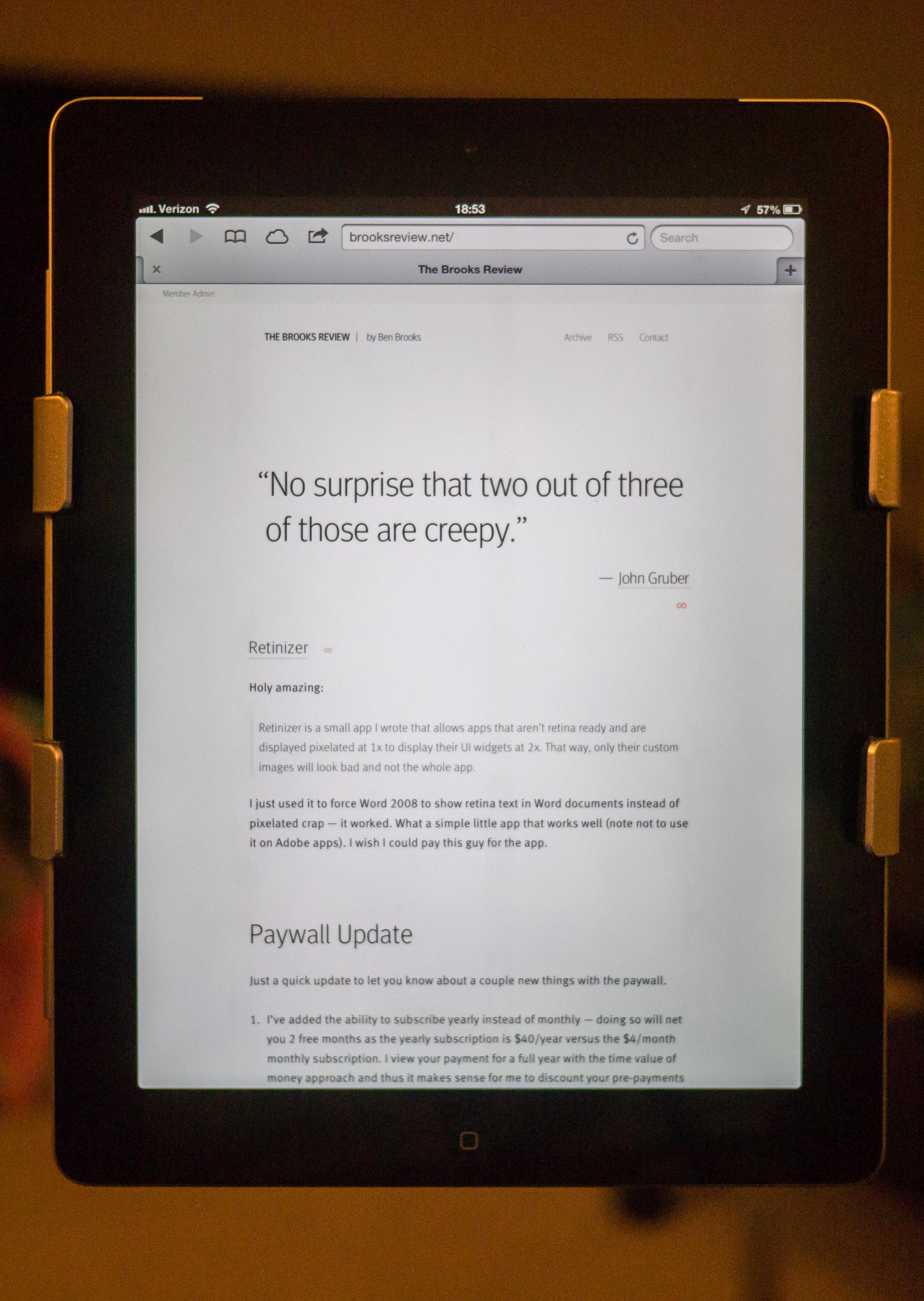
The looks are fantastic. The stand is sturdy and decidedly will not tip over — it weighs a lot. The clamp for the iPad is strong and allows for many different sized tablets. However the clamp seems like it could have been better. It’s not bad, but I’ve yet to be able to take my iPad in or out with just one hand. That probably wasn’t a design consideration, but when you are relaxing on the couch it is much harder to do something on the stand with two hands than just one.
The iPad clamp.
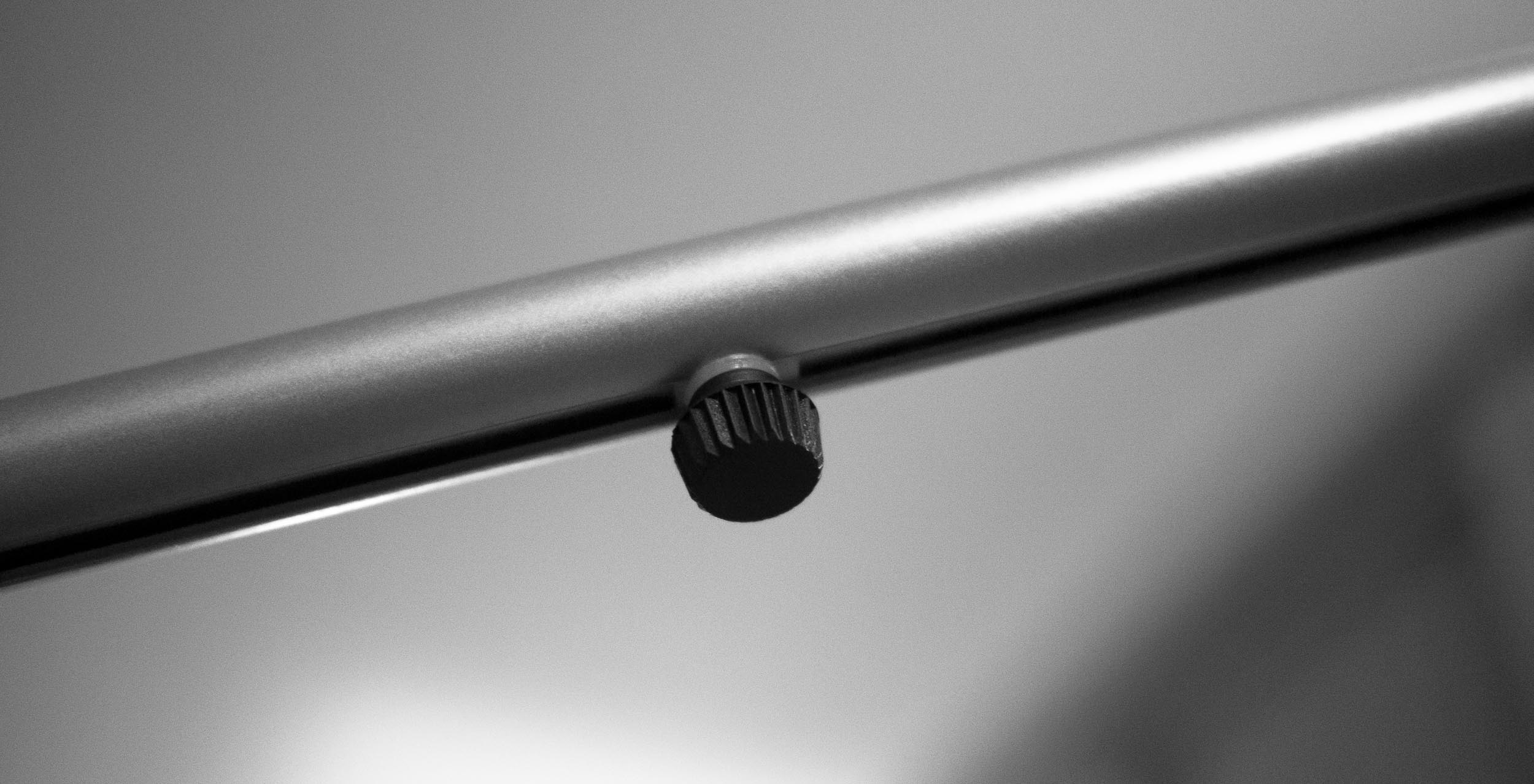
The stand itself swivels amazingly well. The telescoping arm was added after the funding was complete, and it works decently. The action is smooth, however the plastic finger nut is an unfortunate necessity. I have found, though, that you rarely need to telescope the arm — so it’s a set it and forget it thing for me. Thus, this doesn’t bug me too much.
The finger nut for the telescoping arm.
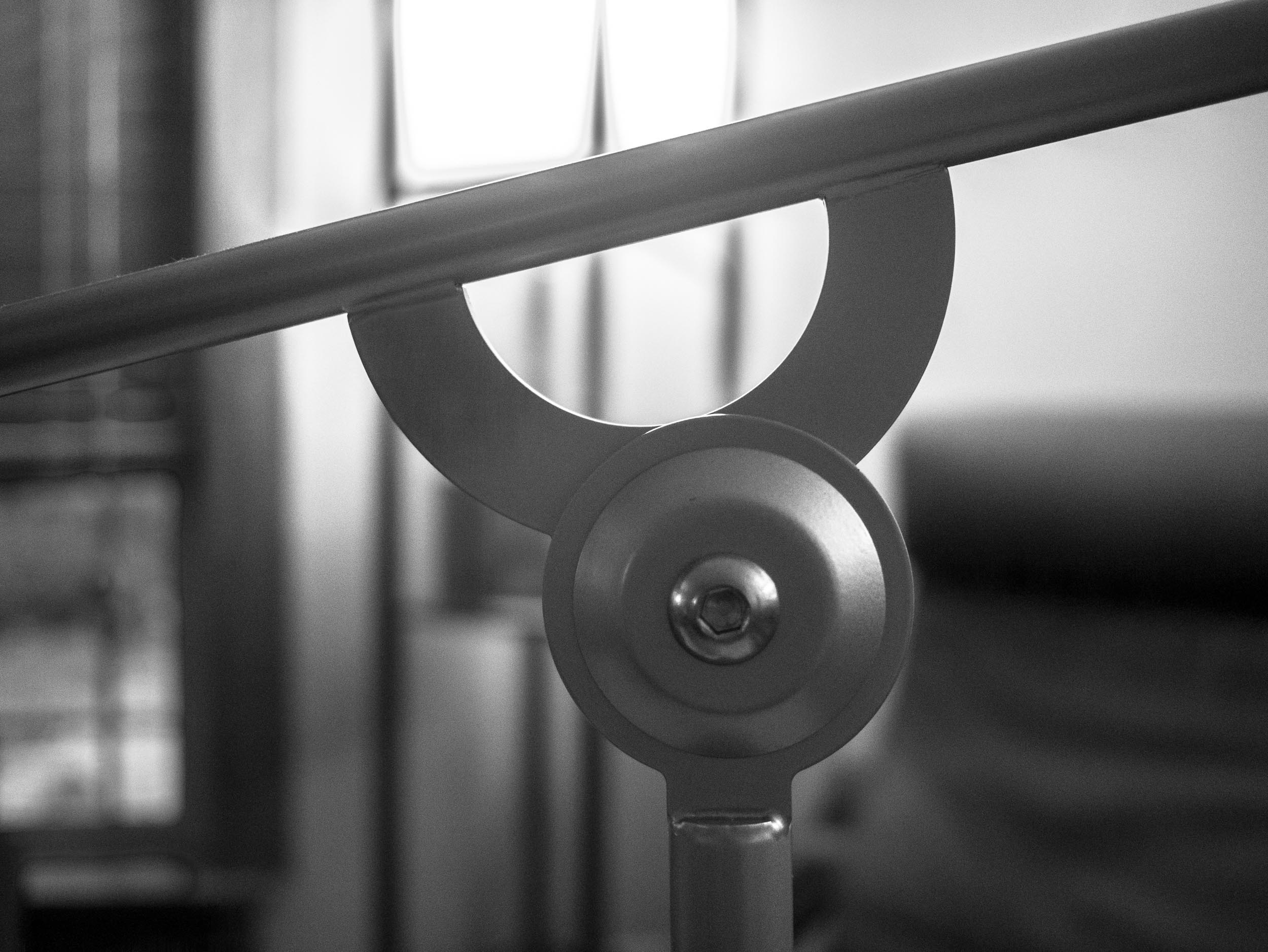
Which leads me to the one thing that drives me nuts about the stand: the up and down arm action. The arm that holds the iPad out from the vertical pole is secured with a large hex bolt. You pre-tighten it and then you are supposed to be able to use it with no issues. That, however, isn’t how it played out for me.
The hex bolt of doom.
I have yet to find the sweet spot that allows for smooth travel of the arm, with a firm hold when I want my iPad to stay where I want it. The creator is revising the design, to add a plastic wing nut instead of the hex bolt, but even that isn’t a great solution. This isn’t a deal breaker, I just tightened it down more so that it is a bit tougher to move — that works, but it’s not great.
## The Real Problem I Have
What I have come to realize is that no matter how good this stand was, it simply wouldn’t work for me. The iPad, it turns out, is a very intimate device. Whereby I mean that part of what makes the iPad great is touching it and holding it. So when you off-load the holding to a stand, the iPad just becomes a screen.
In use, iPad can be used at any angle or orientation.
That seems nice at first, but then you realize it’s not really great as just a screen.
Therein lies the problem: I don’t like using an iPad if I am not holding it.
## Back to the FLOTE
iPad clamped in with Smart Cover still on.
The FLOTE is not perfect, but you’d be hard pressed to look at it, use it and still say that it is over priced. It’s well made, it’s solid. A lot of thought has gone into it and the two problems I have with it are fairly minor in use.
No, my real problem with the FLOTE is that it solves a problem — that as it turns out — I really don’t have.
Here’s a crazy, yet pretty awesome, thought that I had today: what if Microsoft finally canned Steve Ballmer and hired Scott Forstall as their new CEO?
Let’s put aside the fact that Forstall is still working *with* Apple for another year, and the fact that he likely has a non-compete for 6-12 months after that. All of that aside, what if?
I don’t think it is that absurd of a fit, [Forstall is labeled as a “jerk” to work with](http://www.fastcodesign.com/1670760/will-apples-tacky-software-design-philosophy-cause-a-revolt), [yet Ballmer throws chairs](http://www.theregister.co.uk/2005/09/05/chair_chucking/). So Forstall is probably less of a jerk than Ballmer — that has to be a plus for Microsoft.
Add to that Microsoft’s board can tout they just hired the man that was key in making iOS what it is today. Another stock win there.
Microsoft could be infused with a little Apple blood to get things going. That can’t hurt anyone.
Most of all though, Microsoft would be a whole hell of a lot less boring.
The fact is, Forstall was only head of one division at Apple — albeit a very important and successful division, but only that division. I don’t know how he would do as a CEO of any company, but I can’t see him taking any less of a position. That’s why I think it would be in Microsoft’s best interest to try and hire him.
Oh one last thing: I bet such a move would put a dent in Apple’s stock for a bit. Apple’s “arch-rival” of days-past hires a recently ousted executive of Apple’s most popular product line, who now vows revenge.
That’s something that would make me break out the kettle-corn.
It’s sad and disturbing to think that when my kid(s) are of an age that I trust them with knives, they simply will not be allowed to carry them at school. Of course, this has always been a touchy subject, but I carried one everyday from third grade on. In fact, 9/11 was the only event that caused me to stop carrying a knife, as our population was too scared post-9/11 and I had no patience to deal with the odd looks.
Time passes, memories fade, and look — there’s a knife in my pocket everyday again, but why?
I’ve [talked](https://brooksreview.net/2012/05/survival-knife-2/) [a lot](https://brooksreview.net/2011/12/knife-follow-up/) [about](https://brooksreview.net/2011/11/fielder/) [knives](https://brooksreview.net/2012/04/wet-stone-amazon/) in the past and even offered a few reasons to carry a pocket knife everyday, but I don’t think I’ve convinced everyone just yet — so let’s try and do that now.
There are three keys to wrapping your head around carrying a pocket knife on a daily basis. You need to de-weaponize, utilize, and familiarize your knife.
*(Well, you have to buy one too, but that’s another issue all together that I will address in a later post.)*
## De-Weaponizing
The hardest part about deciding to carry a knife everyday is that, as an individual, you must make the distinction between weapon and tool. A pocket knife is rarely ever a weapon and almost always a tool. Think of your pocket knife less like a gun and more like a hammer. Yes, a hammer can be used as a weapon, but first and foremost it *is* a tool — so too is your pocket knife.
In the many years I have spent carrying a pocket knife there have been exactly zero times I have needed to use the knife as a weapon and countless thousands of times I have needed it as a tool. You simply won’t find yourself in a situation where stabbing with a 3 inch knife blade is more beneficial than throwing a rock.
Pocket knives are tools, in fact, most knives are — first and foremost — a tool.
Side note: You are not likely to ever convince non-pocket knife carriers that your knife is a tool.
## Utilize
If I can convince you of that first hurdle, the next question people always ask is: “What do *I* need a knife for?”
So, off the top of my head, here’s a list:
– Cutting things.
Perhaps that is too overly simplified, but it *is* the truth. I am not going to try and sell you on the idea that carrying a pocket knife is going to change your life, or even save it ((Just as your knife is not a weapon, it is highly unlikely it will save your life — just think of how many scenarios you have been in where a knife would have saved your life. That said, it can’t hurt if you are in a bad situation.)) , but I do believe that carrying a pocket knife results in an easier life.
Easier in the sense that I don’t struggle to rip open some packaging, try to snap a thread off my shirt only to cause a bigger problem, or any of the other various minutia that I encounter in my day-to-day life which requires cutting something. You honestly will be amazed at just how much you *could* use a knife everyday, but instead you struggle to get by without a knife and that largely works — not fun though.
## Familiarization
If you are sold on the the above two arguments, the last hold out is always your comfort level carrying and using a pocket knife.
There is only one way to get over this: you get really, *really*, comfortable with *your* knife.
This sounds trivial, and it is, but it will be the one step that takes you from carrying a pocket knife sometimes, to carrying and *using* your pocket knife everyday. Remember how awkward it was to type on your iPhone when you first got it? Then after some practice and usage you can tap out things quickly and easily. Same principle here, you need to get your knife in your hand and use it — a lot.
The more comfortable you are with your knife, the more you will find it being a natural extension of your hand. Again, like your iPhone probably is.
## Practical Advice
You’re convinced now, right?
Now being the good nerd you are you will Google: “best pocket knife to carry everyday”. From that search you will learn two things:
1. Knife geeks call these types of knives “EDC”, or “Everyday Carry” knives.
2. Every person has their own opinion as to what the best EDC is, and nobody seems to hold the same opinion.
Since you are now lost, I will offer you two places to start your search: [Blade Reviews](http://bladereviews.com) and [Amazon](http://www.amazon.com). As you are looking through all the options, you need to consider the following:
– **Blade length**. Ideally you should try to keep this under 3-inches, most US States and Cities have [regulations](http://thefiringline.com/library/blades/knifelaws.html) surrounding knives over 3.5 inches, so be sure to look that up for your area.
– **Overall length**. Most websites won’t tell you the closed length, so you will need to subtract the blade length from the overall length to get an idea of how big the knife will be in your pocket. I prefer a knife between 3-4 inches long when closed.
– **Blade type**. Look for a straight edge, nothing with serrations to start. Get a standard “drop point” (the blade shape that looks like your stereotypical knife blade).
– **Price**. Keep it under $50 to start.
– **Brand**. Stick with name brands, such as: Spyderco, SOG, CRKT, Gerber, Buck, Benchmade, etc.. If it sounds familiar it is probably OK to start, but a quick trip to Blade Reviews will put you at ease.
If this is your first knife, don’t get too hung up on the steel types used. There’s a huge variation in quality, but for a daily pocket knife you can get away with cheaper steel if you are willing to sharpen your blade more often and aren’t worried about using the knife for survival.
Which reminds me, be sure to [buy a sharpener](http://www.amazon.com/exec/obidos/ASIN/B000N35D2E/ref=nosim&tag=brooksreview-20).
## Parting Wisdom
Buy a knife that you are proud to show off, is comfortable in your pocket, and one that reflects your personality. If you buy a cheesy knife, you will never want to take it out when others are around and this defeats the purpose.
If you buy a knife that you truly love you will want to find things to use it on — and that’s when a pocket knife moves from crap in your pocket, to an essential tool.
We live on the cutting edge of health practices, well my wife does, I live in a world where Pepsi *is* water. So in our household I am the one pushing us to be on the edge of technology and my wife is pushing us to be on the edge of health and medicine — God bless her, because I’d probably be comatose on nacho cheese by now if it wasn’t for my wife.
So when our daughter had trouble nursing, my wife went digging.
I cannot tell you how many things we tried, how many sleepless nights we both had, the level of crankiness in our home, and on and on. These past six months have been brutal on my wife and I — and our daughter Sloane. None of us have been sleeping, or eating as we should.
A couple of weeks ago my wife came across some new-to-her research about tongue ties, and suggested that our daughter had one. A day later my wife found out about lip-ties and we were both pretty sure that our daughter had this based on images of lip-ties we found.
It was at this point that my wife found out about [Dr. Lawrence Kotlow](http://kiddsteeth.com). We found a dentist online that could revise both of these “ties” with a laser procedure (the cutting edge), so we packed up the car and headed to Canada to have something neither us knew about done to our daughter who wasn’t even half a year old yet.
We were stressed, tired, scared, and stuck in a car with a baby that was not happy about being in a car.
The surgeon/dentist that we found was kind. He didn’t tell us anything my wife hadn’t yet learned, we met him for all of ten minutes and then we left our daughter with him to have the procedure done.
We knew the wait wouldn’t be easy, and as we waited for the 10 minute surgery to be completed we were both beyond stressed, nervous, and hopeful. It seemed like an hour passed. We got the call to head back, and when we came back to our daughter, who was screaming, it wasn’t a pleasant sight.
She was in pain and not around anyone that she knew. She was scared. It was a terrible sight for any parent.
The one thing I didn’t fully understand going into this is that we must “stretch” her lip and tongue areas to prevent reattachment. This is basically keeping the wound from healing back together, and thus reopening the wound a few times a day — I think you can imagine how painful this must be. The first time we did this, in our hotel room, we both almost broke down into tears with our daughter.
Two weeks of three-times a day “stretches” went by. Our daughter was upset anytime she was on her back and our hands came near her mouth. It was truly sad.
We are now 3 weeks removed from her procedure and no longer have to do the stretches to her. She is healed, mentally and physically. Yet my wife and I still aren’t healed mentally from that stress.
We take solace in the fact that our daughter is now a happier person. She nurses very well. She sleeps much better. She cries less. She is less “fussy”. It’s hard to convey the difference in her, but it is night and day between how she was and how she *is*.
Causing her pain broke my heart, but, as it turns out, my wife was right (she usually is) and our daughter is better off for it.
Normally I wouldn’t post something like this here, but it turns out that this is a very common problem and almost no pediatricians know about it or how to treat it. When we looked there were but three doctors we found that did the revision with a laser, one in Vancouver BC, one in southern California and one in Albany, New York.
So I post this here in hopes that I am able to help at least one other person. The entire lip-tie/tongue-tie thing seemed silly to me at first, but the results speak for themselves and that’s all the proof I needed to be a believer.
[Learn much more here](http://kiddsteeth.com/dental_topics.html#evaluate_and_diagnose_a_posterior_tongue_tie).
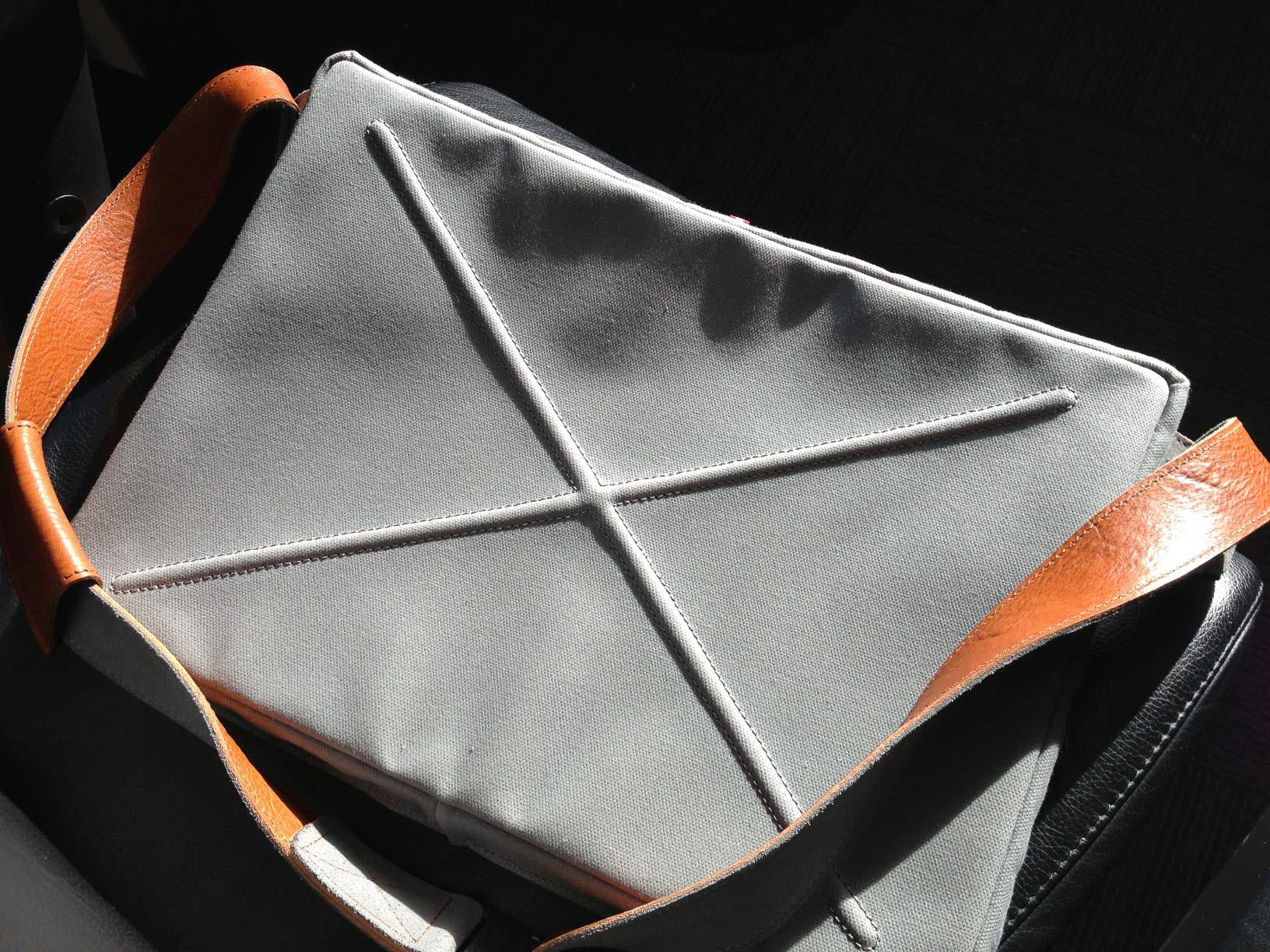
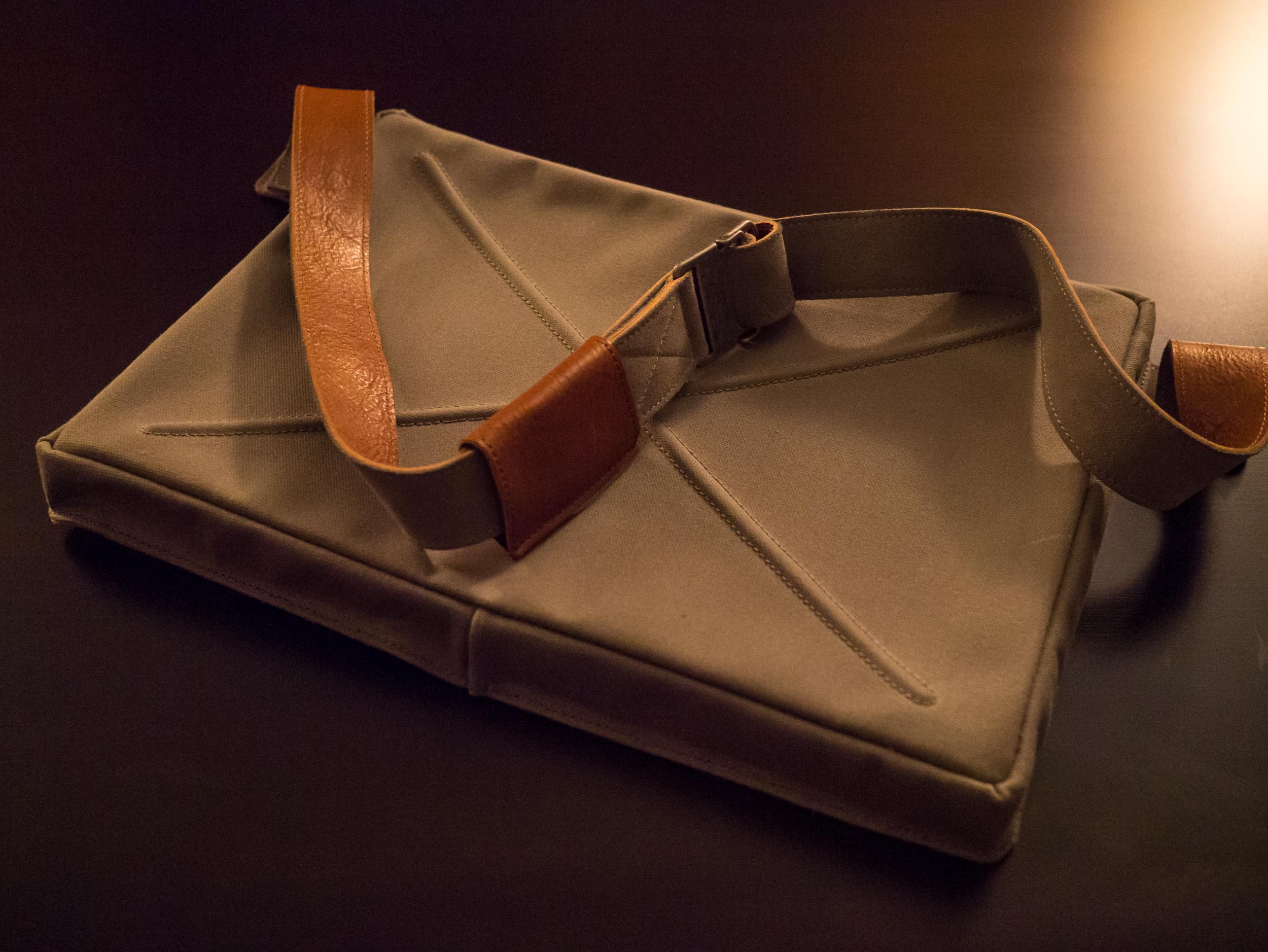
I love it when a new bag comes in a bag of its own.
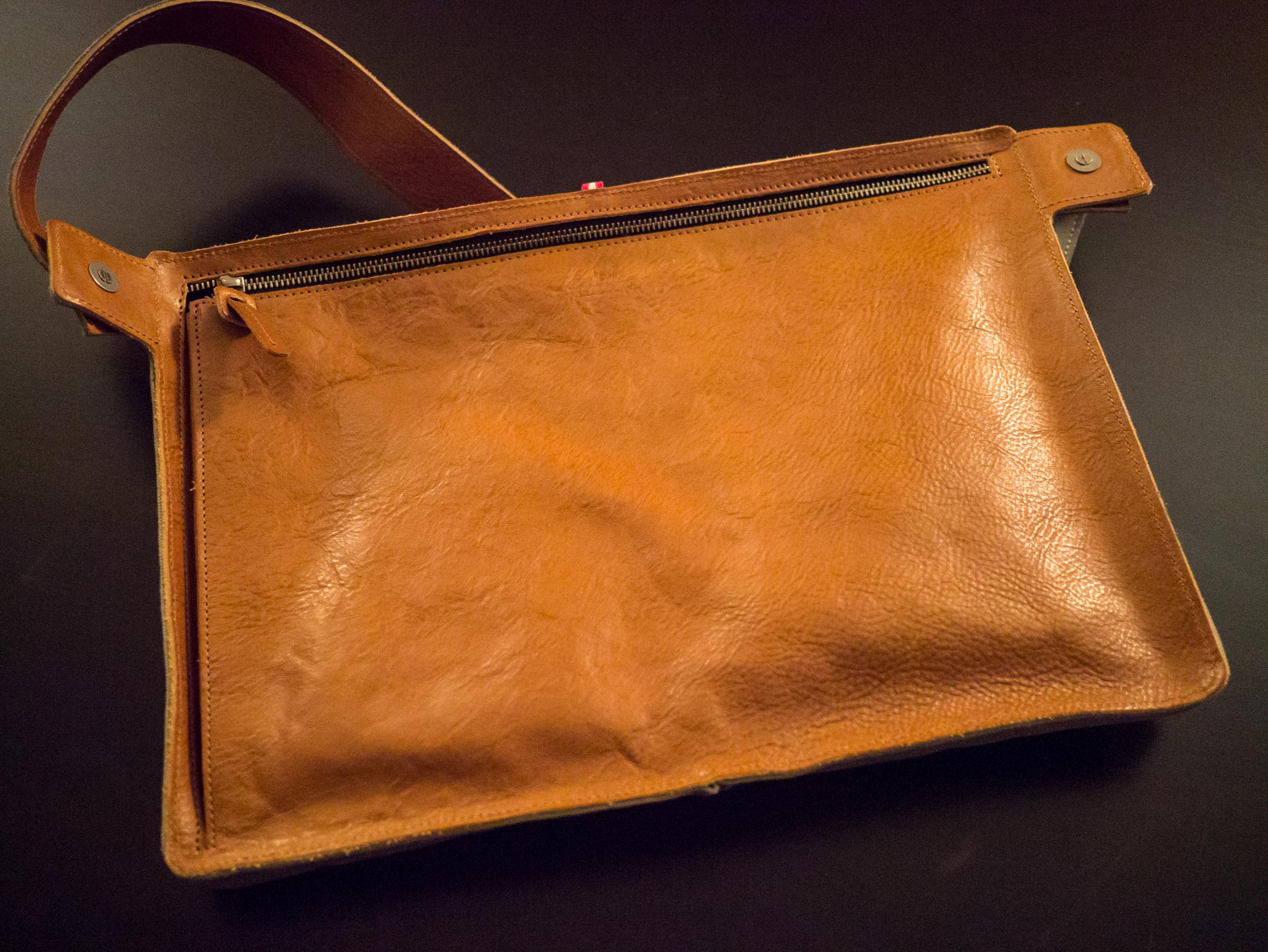
Just when I thought I had found a bag to last me a lifetime ((Granted, it did almost make it a year before I bought another bag. Thus besting the last record by 9 months.)), someone goes out and makes a bag I find irresistible. I’m talking about Hard Graft’s newest iteration to their Flat Pack which now accommodates the 15″ retina MacBook Pro. I wanted this bag when I first saw it, but never pulled the trigger on it.
This particular bag is very minimalist and comes in two colors/fabrics: Shore and Heritage. I personally chose the Shore edition.
In the world of bags there’s but three brands that seemingly always make fantastic products: Tom Bihn, Hard Graft, and Tumi. Tumi is the standard bag of your PC toting businessman, Tom Bihn is the new-age utilitarian bag manufacturer that I am in love with, and Hard Graft is all about sex appeal.
Where Tumi makes durable well designed, understated (mostly) bags, they fall short at hitting the market that Tom Bihn hits when Tom Bihn combines excellent durability and excellent utility. However, both brands fall flat when you look at style, which is exactly what Hard Graft is all about: style. Tumi makes bags that people swear by, so does Tom Bihn. All I knew about Hard Graft was that they make gorgeous bags.
At $328 the Flat Pack is not inexpensive, but it’s a fine good, this would be like balking at the price of art. It is what it is, you either understand that, or you don’t buy it. So from here on out, I am tossing price aside. Good bags are often more than $300, it just so happens that Tom Bihn bags are somehow much less.
I really wanted to try this bag for two reasons:
I’ve simply always wanted a Hard Graft bag, but the timing and offerings never seemed to work out for me.
I only have the Smart Alec, and so I often run into scenarios where I would very much like to have a smaller bag to carry, but must remain with the Smart Alec — which isn’t small.
Very basic reasons, overall.
The Smart Alec
Before I dive in, I haven’t changed my mind about the Smart Alec at all. Tom Bihn’s backpack is the best bag I have come across for carrying your gear. Plain and simple.
Instead I wanted to compliment the Smart Alec with a smaller bag that I could use as scenarios dictate. So while the Smart Alec is fantastic at carrying everything I might need, the Flat Pack is fantastic at carrying the bare essentials.
There’s two philosophies with bags: it should carry everything you want, or it should carry only what you really need. Bags fit on either side of the spectrum and everything in between, so you need to know your personal preference. For me, I tend to stay on the “everything you want” side of things, however I do respect the desire to have a small bag for the just what you need scenarios.
This is where the Flat Pack falls for me.
Why I Love the Flat Pack
Let’s face it, without equivocation, I love the Flat Pack. It is a fantastic looking, feeling, and smelling bag. I feel great about people seeing me carry this bag. I love the feel of the bag. I just love this bag.
More specifically:
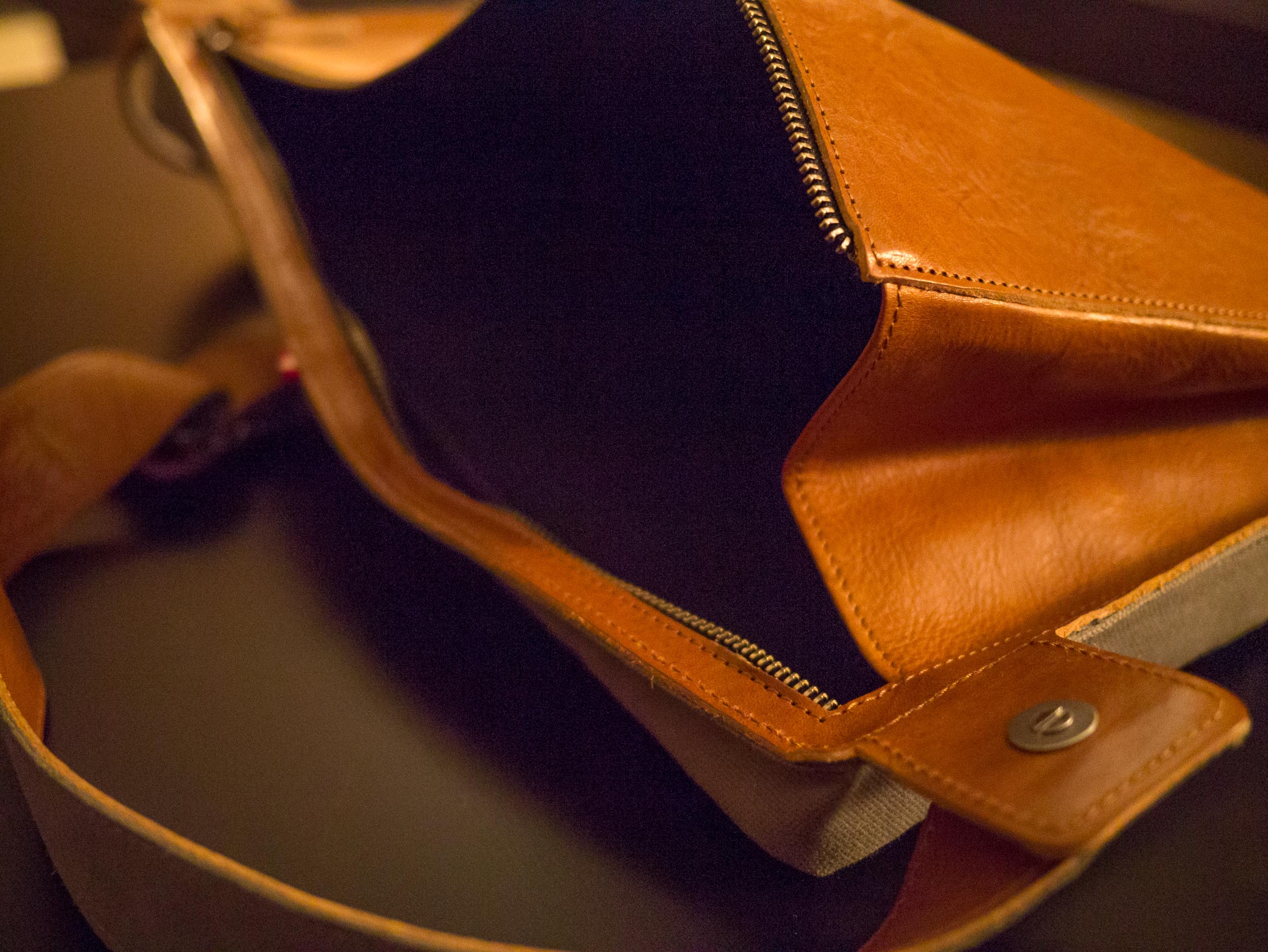
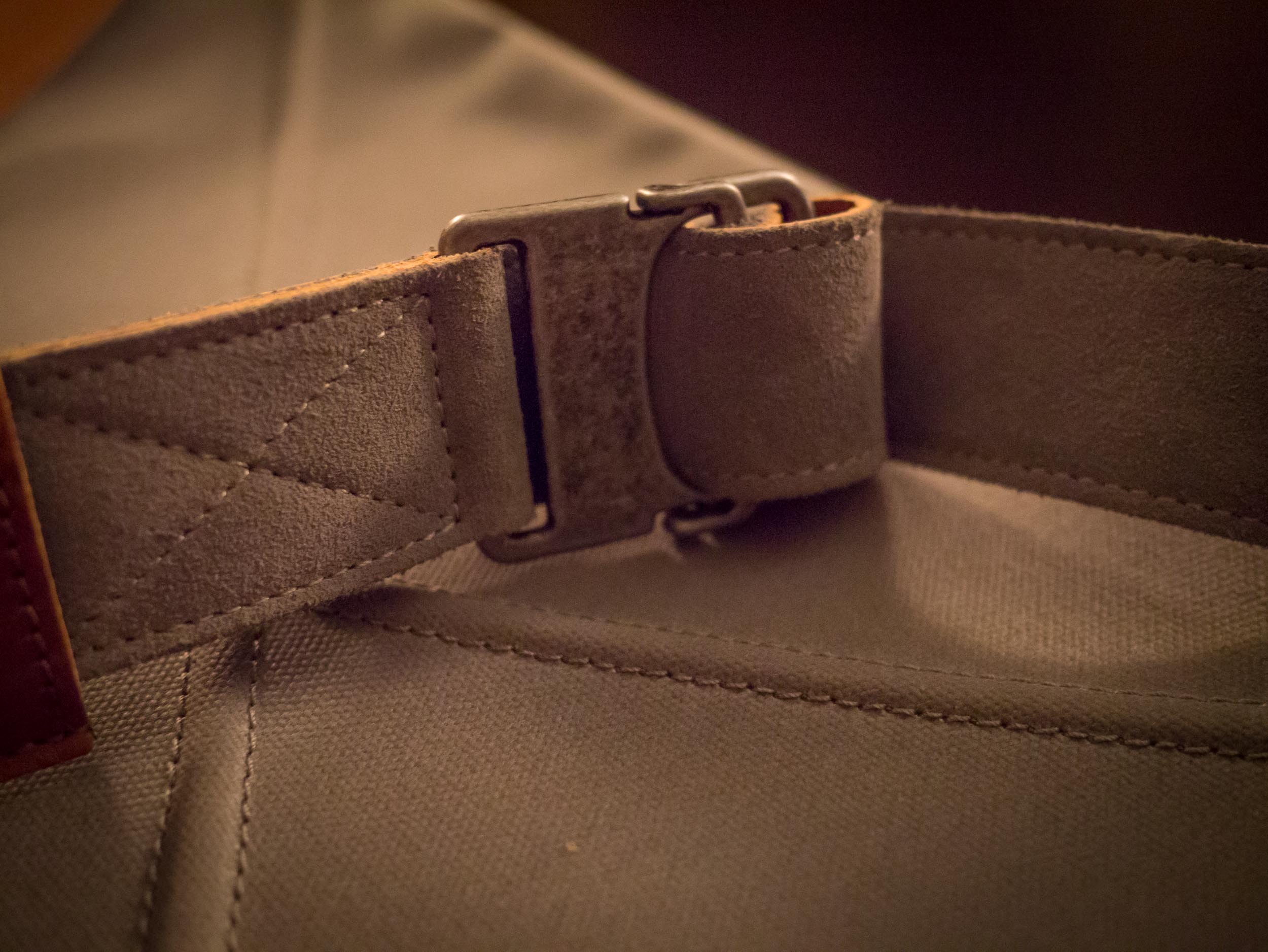
– The front of the bag is made from a high-quality canvas and the back from a high-quality leather. The strap, though, is very interesting. The leather bottom of the strap is tan and identical to the back of the bag. However the top of the strap, the Shore color, is not the same canvas you find on the front of the bag — it’s a suede-like leather dyed to perfectly match the Shore canvas color. It’s a small, but fantastic touch that gives a very soft feeling strap in your hand, something that could not have been achieved if canvas were used in the strap. This was the very first thing I noticed about the bag, and that attention to form and function carries throughout the bag.
– In my usage the bag was very small to carry, but surprisingly big on the interior. I was able to carry a retina MacBook Pro (15″), my iPad, notepad, pen, business cards, USB cables, and a couple other odds and ends without problem. The bag isn’t huge, it’s not a go everywhere carry everything, but it is deceptively bigger than it looks. I would note that given the leather bag you should be careful with how much you stuff the bag as leather can and will stretch over time.
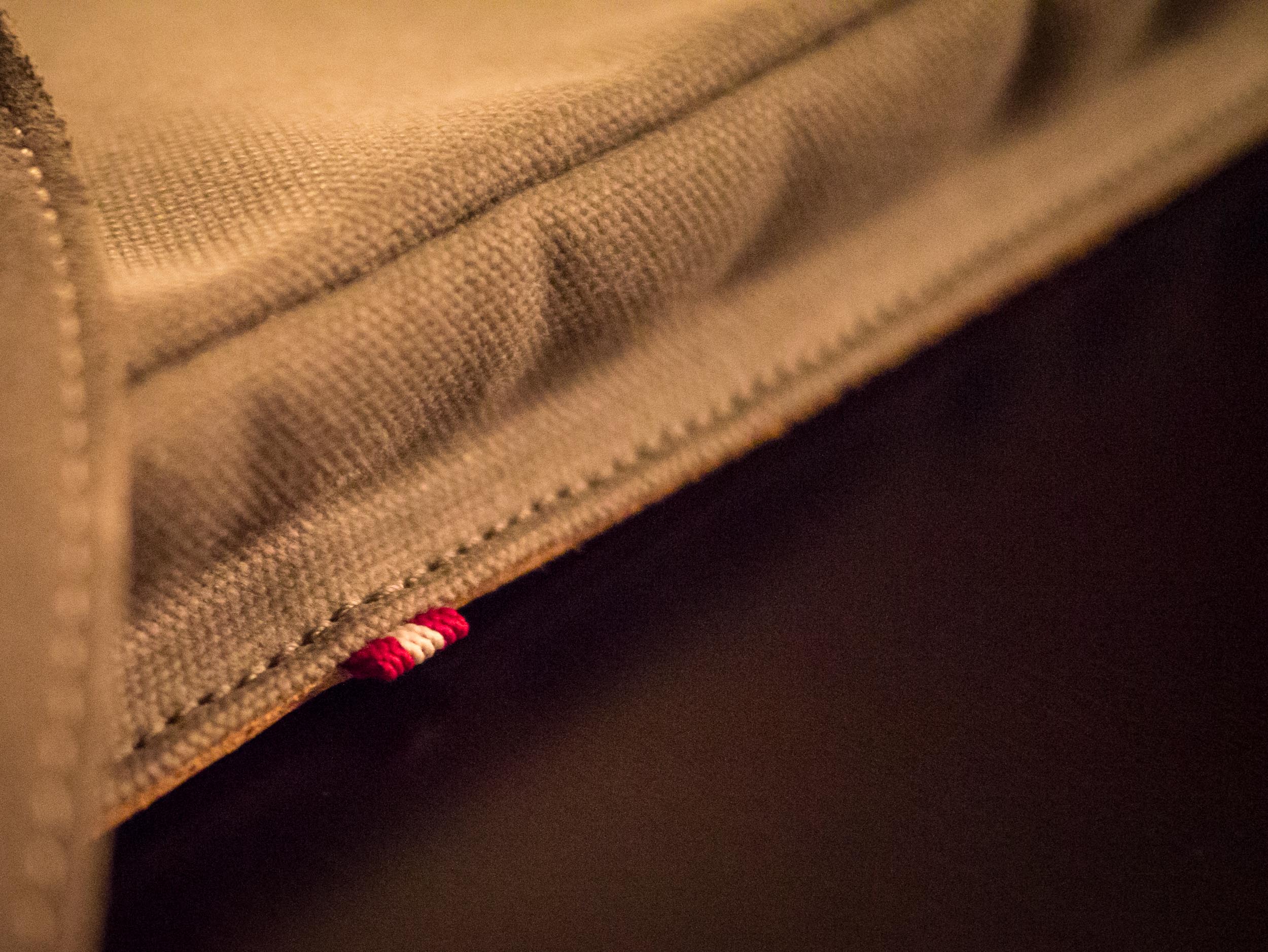
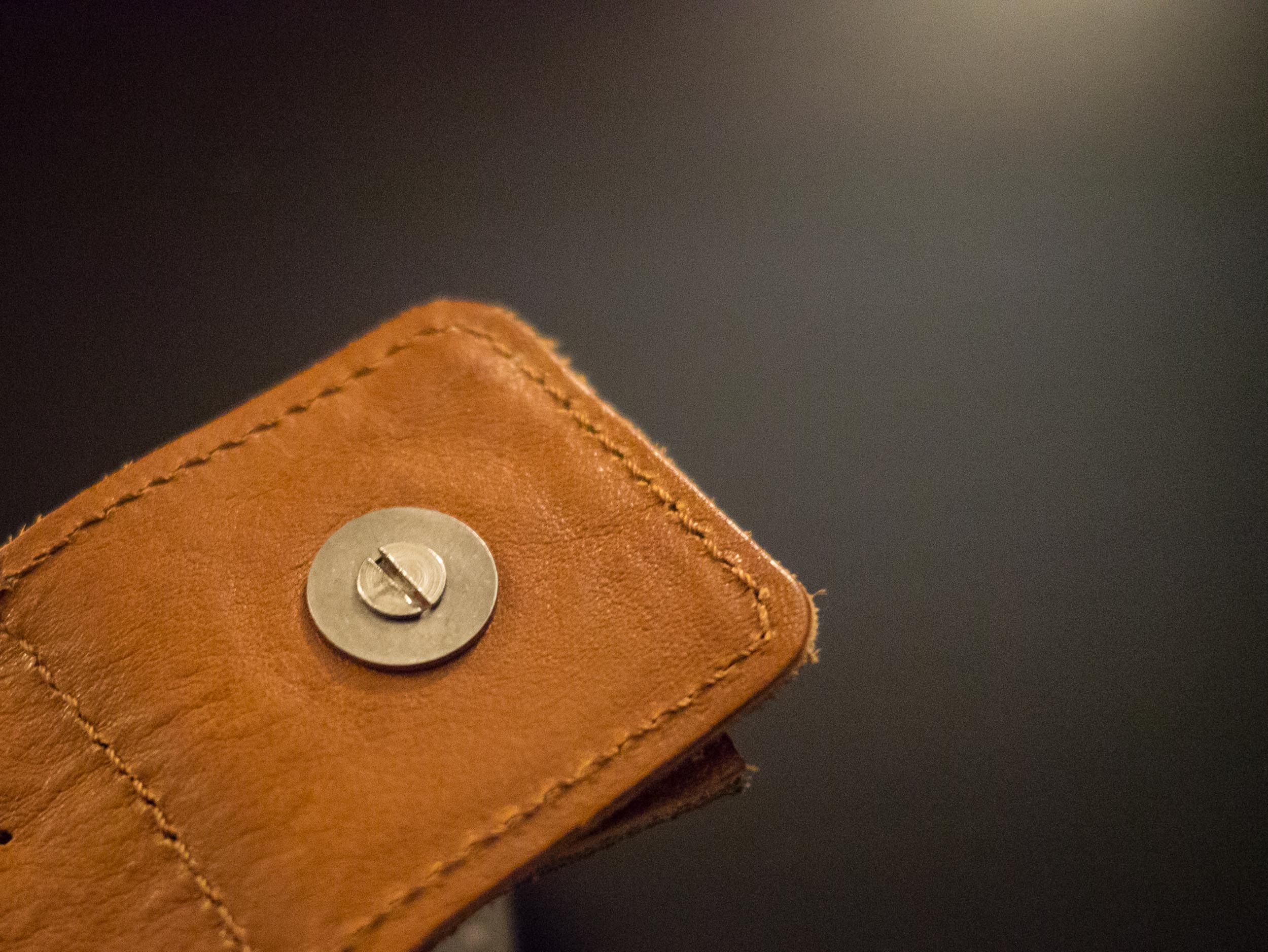
– The details on the bag are fantastic. Whether it be the small anchors on the strap, the fantastic feeling of the zipper ((Which is surprisingly smooth and easy to unzip/zip.)) , the perfection of the stitching, or the smell of the leather — this is a bag that was crafted by, and for, perfectionists.
Like I said, I love this bag, but it’s not exactly without its quirks.
What I Don’t Love About the Flat Pack
I’ve been using the bag a lot, and there are a few things that bug me about this otherwise fantastic bag:
The adjustment clasp on the shoulder strap is fantastic looking, and smooth to operate. However, I noticed that when I took the bag on and off the strap would slide looser each time, making for a tightening to be necessary after you don the bag. Not exactly a deal breaker, but I found it odd. Above the clasp there is a small piece of leather that wraps the shoulder strap and slides freely, I couldn’t for the life of me figure out what that was for — I assumed it was some sort of shoulder pad for the strap. I checked the products site for images to show what this was for, but at the time I missed the last image. Instead I contacted Shawn Blanc, who also owns this bag, and he sent me a picture of the end of the strap doubled back through this section to hold the strap from slipping sizings. This was great, but never seemed right, it didn’t fit the style or finish of the bag. I was missing something. I checked the website again and noticed that the last image showed the solution clearly.
Shawn was right that this piece holds the excess shoulder strap in place, just not right in the way that you feed the strap. Now it makes perfect sense and fits the style of the bag better, but it seems like a pretty odd solution as this doesn’t look as nice as if the end of the strap hangs freely. Hard Graft knows this too — that’s why all their product shots show the strap not using this holder. If the clasp could hold the strap’s position better this would not be necessary, so why not use a better clasp?
I talked about how nice the zipper is on the bag, but there is also a downside to that zipper: if you do not completely unzip the bag and slide your Mac in at an angle (and out at that angle) the Mac will slide against the zipper. It doesn’t happen every time, it hasn’t scratched my Mac, but it bugs the crap out of me each time.
There are two interior pockets, and both are open topped with no mechanism for securing the contents. This makes keeping the bag zipped shut important, even when not in use, otherwise you will find your pockets empty when you return. I’d love for one of those pockets to have a clasp of some kind, or at the very least for there to be a pen clip hidden inside one of the pockets as I frequently find my pen rolling around the bottom of the bag.
Lastly this bag has very little padding. No padding not they side against your body. So unlike the Brain Bag that I have stuff in my Smart Alec I have very little sense elf security in knowing that my MacBook is secure inside the bag. I expected this, but I still wish there was just a touch more padding. I think it could be added without making the bag any bigger.
Minor sticking points, but they still exist.
Overall
As I said, I love this bag, and don’t regret buying it in the slightest. However, will it supplant my Smart Alec?
No, but I do think it will compliment the Smart Alec. I love being able to carry all my goods in the Smart Alec, but there are times when I just want a small and light bag to sling over a shoulder for a day, and the Flat Pack serves that role very well.
The Smart Alec will still be my most-of-the-time bag, but the Flat Pack will/is the bag I take when I want a short vacation away from the larger Smart Alec. ((Though, the Flat Pack will not be the bag I take on actual vacations — the Smart Alec is just too good when traveling to leave behind.))
What you do on your Tumblr blog is probably closer to copyright infringement than it is to “curation”. Don’t get me wrong, [Rich Kids of Instagram](http://richkidsofinstagram.tumblr.com) is funny as hell, but that’s the minority not the majority.
What I’m more curious about is who is being fooled by the term “curation”, that is: are you lying to me in order to fool me, or to fool yourself?
Reposting photos and quotes from other people is simply not curation, it’s closer to scrapbooking — which is fine, but it’s not curation.
I only used Tumblr in the above example because it is the easiest example, but just about every social network or blogging platform has this problem.
What I can’t figure out is whether the use of the word “curation” now falls under acceptable infringement by copyright holders, or are we hiding behind the term “curation” in an effort to hide the infringement?
When BusyCal first came out I jumped right to it and used it for a couple of months. Slowly I moved back to, what was then, iCal on my Mac. Then Apple added the little torn jaggies of paper and after I stopped banging my head into my desk I basically made the move to Fantastical full time.
Since that time not much has changed. I still pop into “Calendar” from time to time, but mostly use Fantastical to enter new events. [Today BusyCal 2 came out](https://itunes.apple.com/us/app/busycal/id567245998?mt=12&ign-mpt=uo%3D4), and while I have only been using it for 20 minutes, I can already tell I am going to switch to it as my full-time tool.
Why? Lot’s of reasons, let’s go through some.
### Smart
I don’t know if Calendar does this, but it’s a nice feature:
Automatically notify attendees of meeting changes.
Here’s what really sold me though:
Change display settings, including the font.
Not only can you change the font, but you can also get rid of the bubble things used to show “all-day” event banners. Instead just showing a nice colored tile at the top. Thank you for this.
[This is almost perfect](https://brooksreview.net/2010/09/sucky-calendars/):
Show less days in the week view.
Who really wants to see seven days at a time? Not me.
This is just neat:
Start and end your day with the sun.
I’ve never been one to care where the calendar thinks the day starts and stops, so I like this little addition.
Of course, the best feature, is that the product is integrated with the menubar icon — allowing quick add and a nice overview.
### What I Don’t Like
I wish I could change the weather icons. I wish the menubar quick app worked like Fantastical. I wish the menubar icon was better looking. That’s about it.
### What’s Silly
This, this is silly:
Just silly.
### Solid
[For $29](https://itunes.apple.com/us/app/busycal/id567245998?mt=12&ign-mpt=uo%3D4), this is a solid app that I bet stays my default for quite a while.